7 Proven Reasons Enterprise AI Transformations Fail
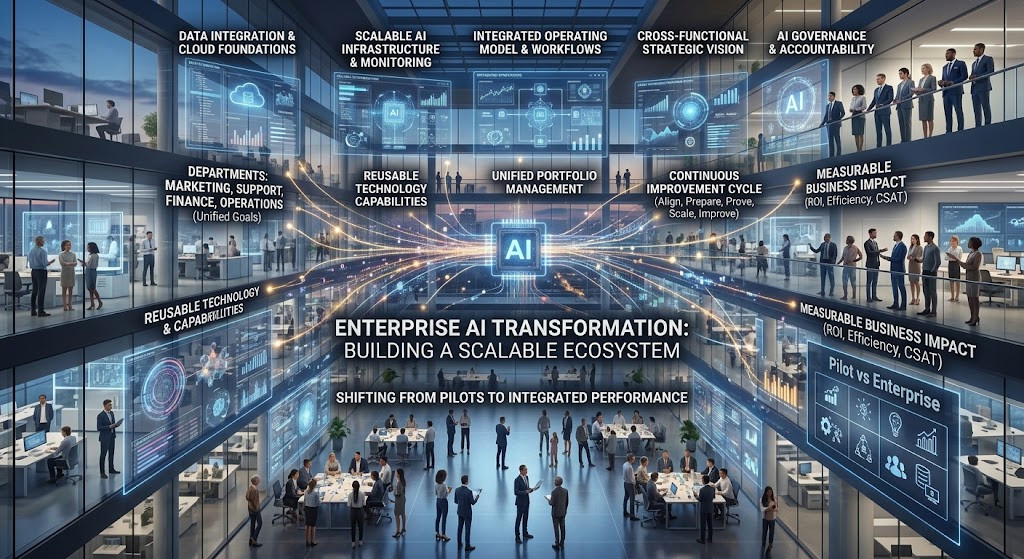
7 Proven Reasons Enterprise AI Transformations Fail
You have created your AI pilot and it works. The technology team is happy, early users are testing it, and there is a good business case for it.
You try to roll it out across the organization.
All of a sudden, the questions become much more difficult. Will your current systems be able to handle it? Is the data quality sufficient? Who will own the output? How will employees modify their work? What kind of controls are required? And last but not least, how do you know that your investment is generating business value?
It's now that enterprise AI transformation gets significantly harder compared to a pilot.
According to recent research by McKinsey, the same pattern applies: organizations transition from AI experiments to wider deployments, but often find it hard to create value at scale.
The problem is increasingly about workflow redesign, operating model, leadership, and organizational capability—not just technology.
If you lead an enterprise AI transformation, knowing where transformation can break can be very useful to solve some expensive problems in advance.
Seven reasons why enterprise AI transformation is hard—and what you should do about it.
Difference Between Enterprise AI Transformation and AI Pilot
While AI pilots and enterprise transformation can use similar technology, there is a huge difference between the problems that they solve.
The pilot resolves a rather specific issue: Does this AI application work in this particular environment?
It could be tested using a sample data set, a handful of employees, a single business process or a technical environment.
An enterprise transformation resolves a much broader issue: Can the organization successfully apply AI to enhance important business processes?
In turn, this poses additional requirements.
It needs to integrate into other applications, work with various data sources, be secure and governed, be scalable, and still be operational once the original team of developers goes away.
The work practices of the employees, as well as performance metrics and accountability of managers, might also have to change.
This difference is crucial as the technical success of a pilot cannot be assumed to guarantee the readiness of the organization to deploy AI company-wide.
It only becomes clear once AI moves from being an experiment to a part of the organizational model.
1. Starting With AI Technology Instead of a Business Problem
One of the simplest methods to sabotage an enterprise AI transformation is to begin with the technology itself.
From generative AI to AI agents, predictive models, intelligent automation, and other technologies, this can generate quite a lot of excitement. This may make the organization think about where they can apply it, rather than thinking about which problem they have to solve.
The difference seems to be minute but is actually a completely different transformation strategy.
Start With the Business Outcome
The alternative strategy would be to look at the business problem first and go back to the technology from there.
You need to define what improvement is required and then the outcome. Next, figure out if the outcome could be reached with AI and how it would be measured.
Instead of thinking of creating an AI chatbot, the leadership would start with a customer service problem such as delayed responses or repetitive queries.
It means that the application becomes one of the solutions to the problem and not the goal per se.
The ownership of the project becomes much more straightforward since there is someone responsible for solving the problem, not using a certain tool.
Ask the Right Questions Before Investing
Before moving forward with an important AI project, the organization must ask:
What business problem are we solving?
Whose problem is it?
What does the process currently look like?
What is the standard for success?
Why is AI the right choice?
Who will own the results?
How will we measure our success?
The above questions ensure the organization ties its tech spending to business results.
In addition, such an exercise makes it much easier to abandon projects that look good on paper but offer little or no path to tangible business results.
What Leaders Must Do
Focus on business results when investing in AI.
You are not trying to use the most AI you can; you are trying to find a business capability that can be strengthened by using AI and build the ecosystem needed to measure your improvement.
2. Confusing Successful Pilots With Successful Transformation
A pilot AI system may generate a strong feeling of progress.
The pilot generates useful output. The employees appreciate the system. The technical team proves that the idea is workable.
However, the organization may still be far from enterprise implementation.
The reason is clear - scaling brings challenges that were not faced in a pilot run.
The Scaling Challenge
When running a pilot, the team may have full control over the environment. The data can be prepped carefully. The users may get substantial assistance. Technical problems can be solved promptly since the team is small and compact.
When scaling, the situation will change.
The system will have to operate with different systems, bigger datasets, other users, security needs, operational procedures, and organizational units.
The organization has to answer some questions related to further ownership.
Who takes care of the system?
Who controls its performance?
Who deals with the failures?
Who analyzes the modifications?
Who funds the continued operation?
Who decides on expanding or stopping the system?
Create a Scale-Readiness Test
But before rolling out an effective pilot to wider adoption, look at more than just technical capability.
Ask questions like:
Is there evidence of business value?
Is the needed data accessible and governable?
Does it work in the current tech environment?
Do security and governance controls exist?
Can users adopt the solution into their workflow?
Is there operational ownership once deployed?
Are the economics of value relative to the operation of the solution compelling?
By doing so, you take the step of scaling from reflexive to intentional.
Steps to Take as Leaders
Establish criteria for whether an AI effort should be scaled, re-designed, slowed down, or even abandoned.
Just because something works well as a pilot doesn’t mean it is right to scale into a platform. Good transformational leadership involves knowing where to invest.
3. Underestimating Data and Technology Readiness

AI can seem simplistic from the end-user's standpoint.
You provide a query and get a response. You feed the AI system data and get an answer back. You ask the AI system to execute a task and get its output.
What happens behind the scenes, however, might be a fairly intricate array of data sources, applications, integrations, permissions, infrastructure, models, and processes.
This fact becomes more clear as AI is scaled out by organizations.
AI Needs Its Surroundings
For enterprise AI Transformation to work effectively, it needs to have access to the necessary information and be able to pass information through various systems securely and reliably.
Some of the key factors include:
data availability;
data quality;
data consistency;
integration;
infrastructure;
security;
identity and access controls;
monitoring.
As per the research done by McKinsey in June 2026, data readiness is one of the critical limiting factors in the process of scaling AI beyond pilot projects.
Legacy Systems Can Complicate Scaling
Many businesses have technology environments that have evolved over years and even decades.
Various departments may be using different applications. There could be different forms of data. Various systems may not communicate easily with one another. Various definitions of business information may exist in different departments.
The performance of the AI solution in isolation may not be the same in its interaction with the environment.
This is why there is the need to consider the systems that surround the model during enterprise AI Transformation planning.
Build Reusable Foundations
Leaders need to focus on creating capabilities that can be reused by different projects.
Examples of such capabilities include data governance and data access, integration standards, evaluation, monitoring, security controls, and infrastructure.
This is in line with IBM’s 2026 research, which advocates for foundations, capabilities, governance, and repeatability of AI use cases.
What Leaders Should Do
Leaders should assess the data and technology readiness before implementing the solution at scale.
Leaders who know that their company's data, infrastructure, or integration environment requires improvement should take care of that aspect in their transformation roadmaps.
4. Treating AI Governance as an Afterthought
Governance can be a problem for an organization that wants to operate at speed.
But as AI integration in processes grows, governance becomes a piece of infrastructure that has to be developed alongside.
Why Governance Becomes Complex At Scale
An individual AI project might not be too difficult to govern.
But a corporation with many AI projects is another story altogether.
Management needs to have an understanding of what:
AI tools are utilized;
data is accessed by them;
owns them;
they make decisions about;
the risks they create;
their performance is tracked;
happens in case of any trouble.
Governance Should Not Mean Endless Approval
Governance should not be only about committees and forms of approvals.
Governance should be about creating rules where innovation can take place in predefined limits.
Depending on the kind of data that would be used and the business process that would be influenced, AI applications might require different degrees of scrutiny if the error in the output would be harmful.
That would make the governance more practical.
Move to Governance by Design
Instead of:
Design → deploy → review,
the organizations can introduce controls at an earlier stage:
Design → assess → control → deploy → monitor.
Governance would thus become a part of the AI lifecycle rather than the stumbling block introduced just before its deployment.
Actions for Leaders
The leaders should create the rules of accountability, risk limits, monitoring, escalation and ownership of AI systems before the technology becomes fully integrated into the business processes.
The idea should not be only about governing AI but making the company capable of scaling it in an adequate manner.
5. Underestimating Employees and Workflow Change
Employees can be given access to an AI solution without necessarily driving any form of transformation.
Why?
AI implementation and adoption are not synonymous.
If the underlying workflow is the same, the employees may end up using the technology in a sporadic manner or continue working in a similar way.
AI Redesigns Workflow Processes
Take a case where employees used to collect information, analyze the same, make recommendations and submit it for approval by a manager.
Here, the AI might automate some of the processes for gathering information or analysis.
But then new questions emerge.
Who would be reviewing the results of the automation?
How would situations in which the automation was unsure be handled?
Which processes would still be done by employees?
Would the role of the manager change?
Would there be a need to change performance metrics?
What kind of skills would employees require?
Change in technology requires change in the workflow process for it to be of value to the business.
This is according to the McKinsey 2026 research on AI adoption.
Training Alone Isn't Enough
Training employees in the usage of an AI application is one thing, however, it might not be enough for the deeper organizational shift.
Employees also have to be aware of:
the reason why the organization starts using AI;
how their job will change;
where human decision making still is needed;
how results of the AI have to be reviewed;
what new skills they require;
how their feedback will affect the system.
This is because adopting becomes a question of workflow and management, and not only of software training.
Give People a Clear Reason to Adopt
Take a look at these two statements:
"This is one more AI tool for you."
and
"This is how this affects your process, frees your time, and keeps your judgment relevant."
The second statement relates the tool directly to the work of the person.
What Leaders Should Do
Engage employees as participants of transformation.
Give people a chance to try out new workflows, give feedback, find issues and contribute to the process of AI integration.
Understanding the effect of the tool on work will allow leaders to make better decisions regarding adoption, skills and roles.
6. Measuring AI Activity Instead of Business Results
A company could have many different AI projects in progress but find it challenging to prove value.
This problem exists because management measures the level of AI activity rather than its impact.
Activity Is Different from Impact
Companies can measure:
number of AI pilot programs;
number of AI applications;
number of employees trained;
number of users;
number of models applied.
Such metrics can help understand adoption and activity better.
However, such measures do not always show the key thing –
What became better as a result of the AI effort?
Link AI to Business Impact
A more helpful measuring process would be:
AI effort → change in the workflow → operational impact → business impact
In such a case, an organization may apply AI to the customer support workflow.
The technology metric will be the number of processed transactions.
The operational metric may include the time to respond.
The business metric may refer to customer service performance or cost reduction.
The main idea is to link technology and its impact.
Create a Benchmark
Improvement can only be measured based on the starting point that you know.
Before deploying any solution, determine relevant baseline measures.
Next, determine:
desired business outcome;
method of measurement;
measurement owner;
review period;
necessary evidence to make a case for continued investment.
This process results in more discipline around spending on AI.
Action Items for Leaders
Make sure any large-scale AI investments have an intended business outcome defined.
If a proposed effort cannot identify how it will contribute to business value through some measure, then leadership should consider whether it is mature enough to warrant further investment.
7. Fragmenting AI Leadership Across the Organization

AI transformation in an enterprise organization becomes tough when each department implements its AI solutions in silos.
Marketing can have one solution. Customer support can have another solution. Finance can have yet another solution. Operations can use AI agents as part of their transformation process, while IT continues with its own infrastructure.
A little bit of decentralization helps encourage innovation.
What becomes problematic is that there are no common standards, goals, or accountability between the implementations.
AI Transformation Requires Executive Leadership
Since AI in an enterprise touches many functions within an organization, leadership should not be just limited to the IT function.
The CEO can define the strategic direction and make sure that AI gets tied to the needs of the enterprise organization.
The CIO/CTO can provide leadership for architecture, integration, infrastructure, and technical capabilities.
The CFO can align the investments to measurable results.
The CHRO can take care of the skills required and the organizational change needed.
The business unit heads can lead specific business outcomes from AI and the adoption itself.
Centralize Standards, Distribute Execution
One such model would be to centralize those capabilities that are more consistent with being centralized and distribute ownership of business outcomes.
Centralize:
Governance principles
Security standards
Architecture guidelines
Reusable technology
Common evaluation methods
Distribute:
Use case identification for the business
Workflow redesign
Employee adoption
Functional priorities
Business results.
This will allow organizations to avoid having each individual department develop their own capabilities.
IBM’s research in 2026 also underscores the value of a common base as well as the importance of centralization in enterprises implementing multiple use cases with AI.
What Leaders Should Do
Develop an enterprise AI Transformation operating model, not just an AI department.
The goal is to have AI become an integrated organizational capability with ownership, reusable capabilities, control, and business results.
How Leaders Can Build an Enterprise AI Transformation That Scales
When you understand why transformations fail, your response as a leader becomes much more apparent.
Transformation should not happen only once all obstacles are eliminated before you start.
Transformation always contains some level of uncertainty.
The idea is to develop a structure capable of identifying opportunities, experimenting on them, learning fast, and expanding successful experiments.
1. Create a Strategic Business Vision
Start from the business perspective.
Understand what are the key strategic capabilities and which of them could benefit from AI application.
This will keep your AI investment relevant to your company’s needs instead of being driven by tools themselves.
2. Develop Required Capabilities
Analyze your data, infrastructure, integration, security, governance, and readiness of your workforce.
The McKinsey research mentions data readiness as one of the increasingly important foundations of scalable enterprise AI, and IBM highlights shared capabilities and governance as foundations when enterprises grow their AI portfolio.
There is no need to have everything ready before you experiment with your use cases.
However, there is a need for these capabilities to evolve together with use cases you want to scale.
3. Manage AI as a Portfolio
Rather than giving equal weight to all AI programs, build a rigorous portfolio approach.
The approach could follow a path of:
Identify → Prioritize → Test → Evaluate → Scale → Monitor
Some will succeed.
Others will require redesign.
Some won't require additional investment at all.
That's not a failure. That's rigorous capital allocation.
4. Redesign Workflows
It's not about adding AI to the existing process.
Is it even the right process?
McKinsey's latest research suggests that the real opportunity lies in redesigning the way work gets done and decisions get made, supported by the appropriate technology platform.
That means looking at the entire workflow and deciding where to use AI to automate, assist, recommend, or do nothing.
5. Measure Continuously
Transformation is not over when you put your AI into production.
Monitor whether it is delivering its expected result.
Monitor its adoption, performance, cost, risk, and business impact.
And then use what you've learned to refine the workflow, reconfigure the technology, or even the investment.
The 5-Part Enterprise AI Leadership Framework
This process could be boiled down to the following five stages that are interrelated.
1. Align
Ensure alignment between the AI initiatives and key business goals.
Each significant undertaking must be justified in its existence.
2. Prepare
Improve the data, technology, governance, talent, and operational readiness to support the desired use cases.
3. Prove
Evaluate selected use cases through measurable results.
The point is not just in showing that AI works but in demonstrating that the AI-enhanced process brings sufficient benefits to warrant scaling.
4. Scale
Deploy proven capabilities.
In this stage, integration, governance, ownership, adoption, and readiness assume great significance.
5. Improve
Keep track of performance after deployment.
Changes will happen with the AI systems, processes, business needs, and employees' expectations.
Thus, continuous improvement enables the organization to react rather than stick to the original deployment.
10 Questions Leaders Should Ask Before Scaling AI
Before rolling out an AI effort within an organization, consider:
-
What business problem are we solving?
-
What result can we measure?
-
Why does the use of AI make sense in solving the problem?
-
Is the necessary data available, accurate, and managed?
-
Does the solution integrate with our systems?
-
Who is responsible for the business result?
-
What impact will the effort have on employees’ processes?
-
What risks and controls must we address?
-
What evidence proves the justification for scaling?
-
How will we measure performance post-deployment?
These queries provide insight into any deficiencies while the effort is manageable.
It is important because enterprise AI Transformation is seldom the responsibility of one department alone.
Building Enterprise AI That Delivers
The real issue in enterprise AI transformation isn’t that the AI technology itself is complex.
It’s about transforming the enterprise around this technology.
You may have a compelling AI model and yet fail because you don’t know enough about your business problem. You may be successful with a pilot but lack the foundations to scale. You may have cutting-edge technology but meet resistance because you have not altered workflows or responsibilities.
The seven failure factors are thus tightly interrelated: technology focus, pilot dependency, limited readiness of data and technology, lack of timely governance, inadequate consideration of employees, bad measurement, and disjointed leadership.
Fixing them takes more than simply another AI technology.
You need an ambitious business goal, reusable foundations, rigorous investment decisions, workflow redesign, proper governance, motivated employees, and good measurement.
Recent studies also seem to be leading in the same direction. According to McKinsey, workflow design, operating models, leadership and culture are key elements in scaling AI, whereas IBM sees the need for shared foundations, governance and operational control as companies grow their AI offerings.
Organizations that develop such competencies put themselves on the path of building the right foundation for shifting from experimenting with AI to building enterprise AI.
The idea is not to deploy as much AI as possible.
The aim is to create an organization able to find true value in the use of AI and measure and improve its performance.