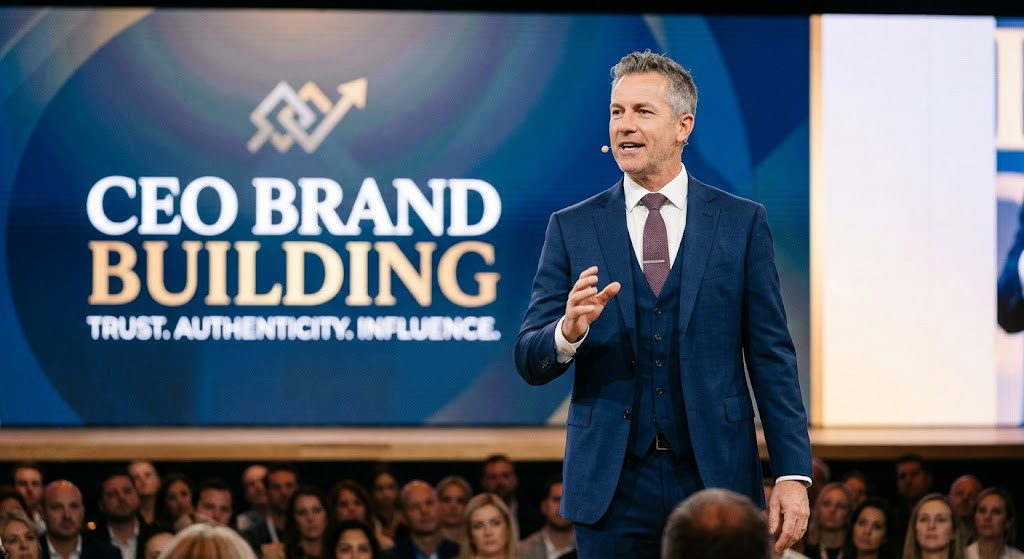
9 Proven Ways CEO Authority Without Creating Content

9 Proven Ways CEO Authority Without Creating Content
The CEO may have a wealth of experience, invaluable knowledge of their industry, and clear thoughts on where their market is going next, but still find it challenging to develop an established professional reputation. Because while expertise is not the issue, there is an assumption that the way to become known as an expert is to become a full-time content creator.
It does not work this way for most executives out there. Time is already split between strategies, employees, clients, operations, partnership decisions, financing, and growth. Writing, filming video content, managing social media, and organizing the process of creating new content every week can easily transform thought leadership into another full-time responsibility.
Yet building an established CEO authority and actually having to create all that content yourself are two different things.
Building CEO authority through content marketing means building a system of content creation based on the expertise you possess. Your contribution to that content will consist of providing experiences, perspectives, decision-making, lessons learned, and ideas that no one else but you can offer.
Why CEOs Don't Need to Become Full-Time Content Creators
Visibility as a CEO can lead to the need for publishing all the time. This could mean seeing CEOs publishing things on LinkedIn, podcasts, video recordings, articles, and even talking about industry news. The idea here is that the authority belongs to those who publish the most.
This is not always true.
CEO Time Is Better Spent on High-Value Decisions
The thing that will help you add most value as a CEO in creating content is not writing and editing posts on LinkedIn or videos. The thing that will make you more valuable as a CEO is decision-making, problem-solving, knowing customers, leading people, and deciding on what direction the company will take in the future.
It doesn't mean that you shouldn't pay attention to content creation. It only means that you should pay attention to those things in which you have more knowledge and experience.
You can give the idea without taking part in each production process.
Expertise Builds Authority, Not Volume of Content
Frequency of publishing can enhance your visibility, but just volume does not mean expertise.
Authority is formed when useful ideas, competent opinions, applicable frameworks, and observations are presented again and again by the same person. A CEO, who presents something interesting, becomes more recognizable than a CEO who creates just the number of posts.
The CEO Should Own the Thinking, Not Every Task
This is a principle that can be of great help: the CEO needs to own the know-how, but the content system takes care of the production.
You should stick around for the ideas, views, stories, and key takeaways. You don't have to go out there and get all statistics, write all paragraphs, make all graphics, edit all videos, or plan all posts.
This will enable you to keep it real without building authority becoming your second job.
What Actually Builds Authority for a CEO?

Before developing the content strategy for the CEO, it would help to understand what authority means.
Authority is not just getting a lot of mentions of your name in online sources. Authority means that people value your perspective as something relevant in a certain field.
Having a Defined Field
The first step is understanding the field you want to become an authority in.
A CEO cannot hope to become an expert in all aspects of business management. You should be sure that your authority will relate to your expertise, audience, industry and perspectives.
The area of authority may consist of such fields as enterprise AI, digital transformation, leadership, growth of organizations, technologies strategy, customer experience or others related to your expertise.
A Unique Perspective
Your expertise gains value when it is presented in the form of a unique perspective.
Do not say the same things which everyone knows already. How do you look at a certain issue? What did you learn from your experience? What assumption are you against? What mistakes do organizations keep making again and again? What should leaders consider before making an important decision?
Perspective gives identity to your content.
Consistent Visibility
Authority demands consistency as well.
This does not imply that you must write every day. It implies that your readers should meet your ideas consistently enough for them to grasp who you are and what you know.
The task will be easier once you get a system to collect and develop ideas rather than create something new each morning.
Evidence Behind the Perspective
Your personal experience can be useful in this case, but a good authority post must still separate personal experiences, proven facts, industry research and opinion.
Provide good examples, use customers’ questions, business experience, research, and reasoning to back up critical points.
Distribution to the Right Audience
The best thinking can go nowhere if the right audience never sees it.
Your authority strategy must take into account the channels your target audience already frequents. These can be LinkedIn, industry publications, podcasts, conferences, newsletters, search engines, webinars, or even the website of your firm.
You do not need to show up everywhere. You only need to show up where it matters.
9 Proven Ways CEOs Can Build Authority Without Becoming Content Creators
1. Pick a Concrete Authority Territory
One should think about what your brand identity would look like.
In case your topics include different things from leadership to artificial intelligence to personal productivity to finance to culture of work and there is no link between those topics, your audience will be confused with your specialty.
Select three to five themes which are closely related to each other and represent your competencies and needs of your audience.
For the enterprise technology CEO, the topics might be AI strategy, digital transformation, responsible adoption of AI, technology leadership, scaling innovations.
Your authority territory should be found in the intersection of three components: your knowledge, needs of your audience and topics which you can talk about uniquely.
With such topics, all decisions about content become much easier since you can simply ask yourself “What useful insights can I share in my authority territory?” instead of “What should I post today?” It is a much more strategic way to create the content.
Your name becomes associated with certain topics among the audience.
2. Capture the CEO's Thinking Instead of Asking the CEO to Write
One of the easiest ways to ease up on the burden of creating CEO content is by not forcing the CEO to begin from scratch.
Rather, it involves capturing the CEO’s thoughts via structured conversations.
Thirty minutes of conversations may cover:
What big change have you noticed in your industry?
What do companies keep doing wrong?
What has surprised you in your market?
What advice would you offer to another executive with this problem?
Which decision did you make to change the course of your business?
What do you know that the people in your industry don’t?
These discussions will produce content that can be used in the form of articles, LinkedIn posts, interviews, newsletters, videos, and so forth.
The CEO will do what only the CEO can do: Think, articulate, challenge, and share from personal experience.
The content creator/team can then package these thoughts into valuable content.
3. Turn One Executive Insight Into Multiple Content Assets
It doesn’t mean you have to come up with a totally new idea for each piece of content.
An effective CEO’s thought may be transformed into multiple assets if it is well-developed for the right format.
A CEO may talk about the problems with the transition of AI initiatives from experiment to regular operation.
This conversation may be transformed into a long article, multiple LinkedIn posts, podcast episode, video snippet, executive newsletter article, slide, and responses to customer inquiries.
What really matters here is that you should never use the same paragraph over and over again.
Each piece should be tailored to its format and target audience. A single thought may be highlighted in a LinkedIn post. The reasoning may be discussed in detail in the article. Personality may be shown in the video. Practical implications may be outlined in the newsletter.
This will create a whole ecosystem of content from one powerful thought.
You stop looking for new ideas and develop them instead.
4. Use a Ghostwriter or Content Team Without Outsourcing Your Voice
It needn't be that your writer takes away your influence.
The key here is the difference between outsourcing production and outsourcing expertise.
Your writer can do the research on the topic, interview people, structure the material, draft the article, edit the article, write a headline and reuse the content.
But the CEO needs to continue being the one who knows the important point of view.
Your writer needs to know your point of view on the issue, your experience, your conclusions.
You should also check the important content before publishing it in order to make sure that the wording reflects your thoughts properly.
The main danger of CEO ghostwriting is the creation of the polished material that any professional in the field could have written.
The answer is deeper access to the point of view of the CEO.
Provide him/her with your true stories, your opinions, your lessons learned, the hard decisions you had to make and your problem solving approach.
5. Publish Fewer High-Value Ideas Instead of Chasing Constant Visibility
It is not necessary for a CEO to make every day count as another publication.
The aim should be to build a body of thought that is identifiable instead of filling up the content calendar.
There is more to gain in terms of strategy from one thoughtful article than from a number of articles that offer conventional wisdom.
It is important to raise issues which matter to your readers. Help them understand difficult concepts. Pass on learnings from your experience. Question assumptions where you have solid reasons to do so. Develop frameworks to aid decision making.
There is no point trying to get in all the time on every emerging trend.
While a trend may draw attention, attention doesn’t necessarily translate into authority. Where the issue has nothing to do with your core competence or where there is nothing you can meaningfully add to the discussion, you don’t have to comment.
Sustainable content strategy allows you some breathing space before you post anything.
What matters is not to have the reader say, “This CEO always posts.”
What really counts is for them to say, “This CEO always has something worth saying.”
6. Create Signature Frameworks People Can Associate With the CEO
One of the most powerful ways to leverage experience into authority is through building frameworks.
A framework provides your audience with a concrete way of approaching a difficult topic.
Instead of consistently talking about the successful implementation of AI, for instance, you may want to come up with a framework regarding the five questions that must be answered by executives before implementing any AI initiatives on a large scale.
Your framework can be turned into an article, presentation, webinar, infographic, video, executive briefing, and even a series of posts on social media.
This is due to the fact that frameworks make expertise more accessible and memorable.
Frameworks allow you to differentiate yourself from industry clichés by providing insights into how you assess whether a company is ready to scale its AI efforts.
The framework does not necessarily have to be a complex thing.
It could be a simple three-step guide, decision model, checklist, principle or evaluation method.
7. Let Distribution Teams Extend the CEO's Reach
Generating valuable content is only one component of authority building. Individuals also require exposure to the content that you generate.
An effective distribution process would help get your ideas across without necessarily publishing on each platform yourself.
Based on your target audience, your ideas would then be distributed via LinkedIn, your company's site, newsletters, podcasts, webinars, conferences, magazines in your field, interviews, and other relevant means.
It is important to select the right channel based on the right audience.
An extensive executive article is great for your website. An insightful comment is better placed on LinkedIn. An intricate conversation on leadership can then make for an informative podcast or webinar.
The content team will take care of distributing your ideas even as you focus on generating them.
This approach helps you maintain consistency without developing different ideas for each channel.
The objective is not mass distribution at any cost but relevant distribution.
8. Turn Speaking, Interviews, and Real Conversations Into Authority Assets
CEOs are actually writing great content without realizing it.
A presentation at a conference can provide many excellent article ideas. A podcast interview can showcase a unique point of view. A customer's question can turn into an educational piece. A discussion with a leader can help you create a practical framework.
Do not consider such actions separately; build a system that will allow you to capture insights obtained through them.
After any speaking event, you can analyze your presentation and select the best ideas, arguments, questions, and audience reactions.
The interview can be transcribed and studied for ideas to develop further.
Questions from customers can be found and answered in detail.
Such a method has one big advantage: the content will originate from the actual experiences and actual questions, not artificially prompted.
Your usual work will become a source of authoritatively-written content.
It means that you are not going to take one more task to your busy schedule. You are building a system that will extract value out of tasks you are already doing.
9. Build an Evergreen Authority Library
Rather than producing all your content on a disposable basis, you can assemble an enduring library of CEO knowledge.
This might consist of seminal articles, executive FAQs, your trademark framework, leadership principles, original research, industry insights, and your insights into common business issues.
Your library of authority content then becomes the basis upon which future content can be built.
A thorough article explaining your strategy for AI adoption in the enterprise will eventually form the basis for a presentation, LinkedIn discussion, podcast interview, webinar, or updated article.
Evergreen content is not about reusing the exact same piece of content over and over again. It is about building out ideas based on ongoing problems while continually updating the content based on the evolution of your thought process and market conditions.
The value of an authority library is also that it makes future content creation much easier.
If something happens in the industry, your team can always tie it back to your pre-existing ideas.
Build a Lean CEO Authority System That Runs Without You

The nine strategies are much more effective when they are made into an executable system.
Step 1: Define the CEO's Authority Position
Identify first what the CEO should be known for.
Pick three to five themes that describe the executive's competence and the top concerns of his audience.
Step 2: Allocate Time For Insight Capture
Schedule a certain amount of time for structured discussions.
The task is not to create content in this discussion but to generate ideas.
It includes discussion of new business, customer concerns, industry news, leadership challenges, learnings, decisions, and opportunities.
Step 3: Develop a Content Brief Out Of The Conversation
Transform the best ideas into content briefs.
Every content brief must specify the main idea, CEO's stance on the idea, proof, experience, target audience, and content form.
Step 4: Create and Reuse Content
From here, the content team can research, create, edit, design, and reuse the content.
The CEO checks that the significant content pieces match their thoughts and views on the topic.
Step 5: Share and Track Results
In the end, you share the content across the appropriate channels.
Monitor what topics attract interest, business discussions, invitations, and other relevant results.
Such insights can help future content decisions.
It will be the CEO authority engine and not the CEO content treadmill.
How to Measure CEO Authority Without Obsessing Over Vanity Metrics
Authority cannot be expressed in numbers only.
While likes, impressions, and followers can tell how visible you are, they cannot prove that you are respected because of your expertise.
Track Quality of Engagement
Monitor who responds to your ideas and what they say.
Significant comments, business conversations, interview requests, invitations to speak, and connections with the right decision makers can offer some indicators.
Track Business Indicators Facilitated by Content
Check to see if the prospects reference your articles, frameworks, interviews, or any executive content in their conversations.
You can also check website traffic and branded search queries for other indicators where relevant.
None of these metrics alone proves that someone is an expert.
Track Recognition Over Time
The more important question would be whether the association you seek is growing in strength.
Is there an association made between your name and the topics you wish to associate yourself with?
Are the themes within your content cohesive?
Are you getting pulled into discussions about your areas of expertise?
5 Mistakes That Turn CEO Thought Leadership Into a Full-Time Job
1. Publishing without an Established Point of View
When each piece covers a new topic, it is possible that you might create action without creating a distinct zone of expertise.
2. Having the CEO Author All Posts
Forcing the CEO to do all the research, writing, editing, designing, publishing, and distributing of all posts creates needless conflict.
3. Outsourcing the Thoughts of the CEO
The content group may be able to help refine an idea, but they should never make up the expertise needed to back it.
4. Pursuing Each and Every Trend
Every trending topic may not require an executive response. Keep on top of your zone of expertise.
5. Judging Success Based on Views
It’s great to have visibility, but sometimes the quality of those who see your content is more important than the quantity.
Frequently Asked Questions About CEO Authority Building
Is it possible for a CEO to establish authority without posting daily?
Yes. It is possible for a CEO to establish authority through a systematic approach that focuses on valuable insights rather than regularity in terms of publishing. Articles, interviews, talks, newsletters, podcasts, frameworks, and other formats may be used in building an executive presence.
Is it possible for CEOs to utilize ghostwriters in order to establish their thought leadership?
Yes. In this way, the role of a ghostwriter would be to ensure that the insights of the CEO are properly organized and presented. It is important to maintain the perspective of the CEO in this case.
How often should a CEO publish?
There is no common answer for this question since there is no fixed publishing rate for all CEOs. The appropriate rate of publishing depends on numerous factors such as goals, audience, resources, content quality, and other aspects.
Which type of content helps create a CEO’s authority?
Effective types of content could be original viewpoints, frameworks, analyses, experiences, research-based information, interviews, articles, and answers to relevant questions in the industry. The best types of content are those which give the CEO an opportunity to show his/her expertise.
Is it necessary for the CEO to use social media?
The CEO may become visible using social media; this is not the only method. There are other means, like writing articles, giving talks, podcasts, interviews, publishing newsletters, researching and many others, which could attract the target audience.
Build the System, Not the Content Burden
CEOs don’t have to be full-time content creators in order to establish authority.
The biggest value in the equation does not lie in you writing all articles or making all posts. The biggest value lies in the thought process behind the content — your experience, judgment, perspective, decisions, lessons learned, understanding of the problem that your audience experiences.
The right process will harvest all that experience and develop it into content that is helpful and distributed to the right audience.
And most importantly, the process will let you stay visible while not letting content creation take over your calendar.
The aim is not for CEOs to create more content.
It is to let their already existing expertise be known and be used by people.