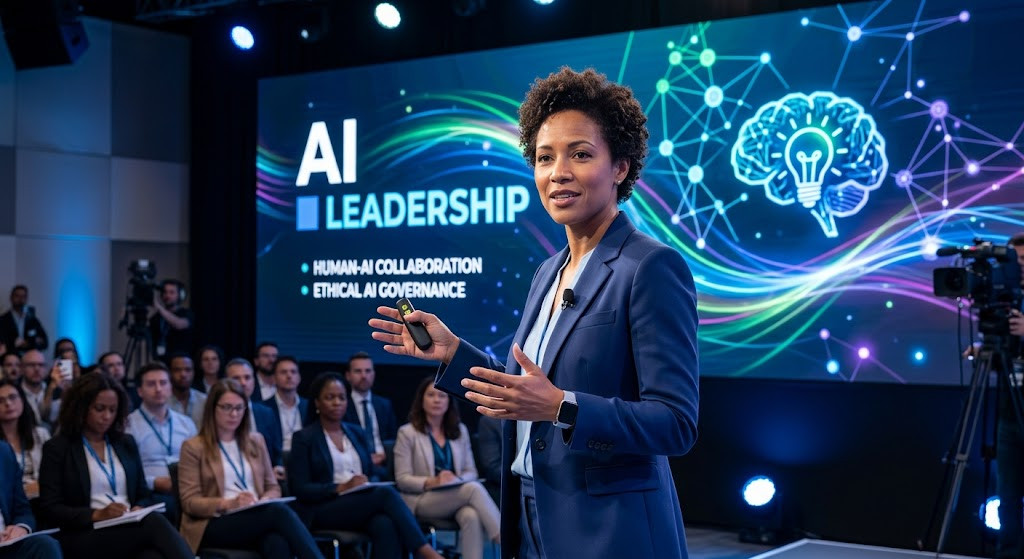
AI Leadership: 7 Proven Ways to Lead in the AI Era

AI Leadership: 7 Proven Ways to Lead in the AI Era
The world of business has been revolutionized by artificial intelligence. What may be even more important is what artificial intelligence requires from its leaders.
For decades, there have been questions regarding AI about whether machines will ultimately replace human AI leadership. Today, a much better question executives need to ask is this: what happens if some leaders become AI-enabled but others do not?
The trend is becoming apparent even at the C-level. In its annual 2026 AI Radar survey, Boston Consulting Group discovered that 72% of the respondents were now CEOs identifying themselves as decision-makers for their organization's artificial intelligence initiatives, twice as many as last year.
This is not to say that AI leadership is unnecessary. On the contrary, the nature of leadership is evolving.
AI has the ability to analyze data, identify patterns, generate content, conduct research, and automate certain stages of the workflow process. Leaders are responsible for choosing direction, tolerance to risks, collaboration between people and machines, and accountability in case of decision-making.
That is the essence of contemporary AI leadership – leveraging increasingly sophisticated technologies while retaining strategic vision, personal responsibility, and organizational mission.
Why AI Is Changing Leadership, Not Eliminating It
AI is able to conduct operations which before took much of humans’ time. Conducting research, summarizations, analyses, writings, forecasts, information searches and many other operations which require significant knowledge can be conducted by AI systems.
It means that leaders have new possibilities for using their time.
Rather than spend hours gathering all necessary information for the strategic discussion, the leader can use AI to sort all information and discover possible patterns. Rather than require team members to conduct comparative analysis of several possible scenarios, AI can provide help in organizing them for analysis.
More rapid access to information does not guarantee better decisions.
The leader will still need to check the reliability of the information, the correctness of assumptions and the context which is missed, as well as to estimate the consequences of following the recommendation.
That is the reason why the leadership bottleneck is shifting.
The worth of AI leadership now tends more and more to be not just about information but about understanding how to evaluate, question, prioritize, and take action based on information.
Current academic studies have picked up on this shift in value. According to IBM's CEO study for 2026, 64% of the CEOs polled said that they feel very comfortable making key decisions with the help of AI-generated information. In the same study, these CEOs estimated that only 25% of their employees use AI in the workplace.
What is required is not just getting AI tools into employees' hands.
1. Make AI Fluency a Leadership Skill
Understanding AI is the first step towards successful leadership.
This does not mean that all CEOs should become AI engineers. It does not require executives to construct large language models or code their own machine learning algorithms.
But they do need sufficient knowledge of AI to know how this technology can add value, where it can be unreliable, what kind of risks it poses, and what questions need to be asked before adopting the technology.
Leaders Don't Have to Become AI Engineers
A business leader should be able to ask questions like:
What are we trying to solve?
Why is AI the right tool for solving it?
What kind of data would the system use?
How do we verify its output?
What will happen in case of failure?
What should improve as a result of implementing the technology?
Who is still responsible for making a decision?
These kinds of questions are more helpful for executives rather than remembering technical jargon.
It is very important to know the ability and limitations of artificial intelligence enough to take a responsible decision.
Learn to Ask Better Questions
The benefit of the AI technology is that it gives a quick answer, but it largely depends upon the question that is raised.
Therefore, the art of questioning has become one of the crucial skills of modern leadership.
Apart from the question “What does the data say?” leaders can also pose questions such as:
What are the underlying assumptions here?
What data is not included?
What other alternatives should be considered?
What is our next move?
What risks are not included in this analysis?
Build AI Literacy Across the Leadership Team
AI must not be seen only as a matter for the IT department.
While the CEO could determine the strategy, the CFO could consider the financial considerations, CHRO could drive people changes, COO could transform operations. It could be the legal or risk departments which set the right controls.
According to IBM's CEO research of 2026, 76 percent of firms had a Chief AI Officer, compared to 26 percent in the previous year. At the same time, 59 percent of the CEOs predicted that the influence of the CHRO would increase in the future.
It shows a very important thing: AI transformation is now seen as an organizational leadership challenge, not only as a technology challenge.
2. Use AI to Improve Decision-Making, Not Replace Judgment
One of the most beneficial uses of AI by executives is decision making.
By using AI, leaders will be able to analyze data from various perspectives, find patterns, compare options, condense large volumes of data, and ask additional questions.
The difference between decision making with AI and delegation of the whole decision-making process to AI is essential.
Turn AI Into a Strategic Thinking Partner
Let's say that some executive group evaluates an option of entering a new market.
AI could help organize market research, find the necessary trends, compare competitors, condense customer feedback, and build potential scenarios.
This could improve the decision-making process.
But AI cannot decide whether entering the market is the right thing to do.
The executive group should evaluate many other factors such as strategy, organizational abilities, financial risks, customers, compliance with law, competition, and so on.
AI could broaden the analysis process. The executive group decides what the organization should do.
Challenge AI Outputs Before Acting
Information generated by AI is not inherently verified information.
The practical executive process is:
Question → Generate → Challenge → Verify → Decide
The first step is defining the question well.
Next, using AI to generate the analysis or alternatives.
Then challenge the generation. Is there missing information? Are there dubious assumptions? Inconsistencies? Do conclusions need support?
Verify claims that are crucial against reliable information.
Decide only after that.
The process becomes even more important where AI influences decisions around people, customers, money, regulation, security, or reputation.
Keep Accountability Human
Delegation of analysis to an AI algorithm doesn't absolve responsibility.
When an AI algorithm influences a critical decision, a person must understand and take responsibility for the decision and its consequences.
In KPMG's 2026 Global AI Pulse research, organizations that have accountability of the CEO in such decisions were more confident in their AI strategy and business value from it, compared to organizations that lacked CEO accountability in AI-influenced decisions.
These results are survey associations rather than evidence that CEO accountability was a cause of the differences in performance. But the takeaway is obvious: this kind of accountability is crucial.
And it should be the guiding principle of responsible AI leadership.
3. Redesign Work Around AI Instead of Simply Adding AI Tools
The purchase of AI technology is relatively simple.
Transformation of the way an organization functions is much more difficult.
Such a difference accounts for the ability of some companies to make massive investments in artificial intelligence while remaining stagnant in terms of their performance.
Don't Consider AI Just as Another Software License
If an organization just implements AI into its processes, it will decrease the amount of time needed for the completion of separate tasks but not necessarily the whole process itself.
The question to ask is:
How could this process be completely redesigned based on the capabilities of the new technology?
For example, the organization could have a reporting process that involves several workers gathering, organizing, summarizing the data and creating a managerial report.
Artificial intelligence can shorten many of the steps.
The process of reporting may be changed entirely by the organization, ensuring that executives have access to more pertinent data sooner, and employees can focus on analyzing the data rather than collecting it.
Identify High-Value AI Opportunities
Leaders can start by reviewing places where employees waste their time on:
repetitive administrative tasks
information acquisition
manually preparing reports
document processing
analysis
responding to customers
knowledge discovery
bottlenecks in the workflow process
Automation isn’t the answer here.
The aim is to understand where AI will actually contribute to time, cost, and quality efficiency.
Measure Outcomes, Not AI Usage
Organizations shouldn't cheer merely because thousands of employees have access to an AI platform.
Access is an input.
Value delivery is the output.
It is up to leaders to create measures, like:
time savings
revenue creation
cost savings
better customer experience
decision cycles
improved quality
error reduction
capacity release for higher-value activities
A BCG study from July 2026 discovered that almost nine in ten CEOs in a survey said that they had experienced either cost savings or revenue creation from AI within their businesses but struggled to scale those efforts. Execution and workflow redesign became part of the solution, according to the study.
4. Build an AI-Powered Workforce Without Losing the Human Core
Technology modifies the nature of tasks people do. It's AI leadership that decides the way people perceive this modification.
An organization can't achieve AI integration sustainability just by providing technology and letting people sort things out on their own.
Moving from "AI versus Humans" to "AI and Humans collaborating"
In which aspects can AI assist people to do their job and devote more time to those tasks that need people's involvement?
An employee could use AI in research, writing, analyzing, finding information, doing the paperwork while still being in charge of judgment, relations, negotiations, creativity, etc.
This way, there is created model of human-AI cooperation is created.
Invest in AI Skills and Reskilling
What people need is training in how to use the technology effectively.
Such competencies could involve:
Artificial Intelligence Literacy
Critical Thinking Skills
Data Literacy Skills
Prompt & Instruction Skills
Output Verification Skills
Subject Matter Expertise
Workflow Design Skills
Responsible AI Use
The IBM study on CEOs in 2026 revealed the considerable adoption problem: the CEOs surveyed estimate that only 25% of their workforce uses AI on a regular basis, despite 86% saying their employees have the skills needed to work with AI. Furthermore, 83% of the CEOs surveyed think that AI success is more dependent on people adopting the technology than on the technology itself.
It is a leadership problem.
Don't Confuse Automation With Leadership
Some of the most important AI leadership activities are difficult to reduce to automated tasks.
Building trust.
Resolving conflict.
Coaching employees.
Communicating uncertainty.
Understanding organizational culture.
Making difficult trade-offs.
Creating a shared purpose.
AI can support some of these activities, but organizations still depend on human relationships.
In the 2026 workplace research conducted by Gallup, it was discovered that, out of companies having the capability to use AI, 67% of leaders used it compared to 46% of workers.
This highlights the significance of leader behavior because workers are more inclined to comprehend the benefits of AI if leaders show its responsible use in practice.
5. Make AI Governance Part of AI Leadership

AI Leadership without governance creates undue risk.
With the use of AI becoming more entrenched in organizational processes, it is necessary for leaders to have clear guidelines on the capabilities of the system, its ability to collect data, and when human intervention is necessary.
Set Up Clear Guidelines for AI
It would be helpful to put together some practical policies on topics like:
Confidential information
Customer data
Employee data
Intellectual property
Approved use of AI technology
Security considerations
Human intervention
Sensitive decision-making
Such policies should not just lie around collecting dust.
Create Clear Ownership
A common governance problem is assuming that because several executives are involved with AI, accountability is automatically clear.
Someone needs authority to answer questions such as:
Who approves this AI application?
Who monitors its performance?
Who manages its risks?
Who decides whether it should scale?
According to the KPMG Global AI Pulse survey for Q2 2026, 24% of businesses believe the CEO or the executive board is the ultimate owner of the decisions about business operations using AI technologies, while 29% mention the names of particular C-suite executives. It is worth noting that executive ownership and executive accountability are two different things.
Balance Innovation With Risk
Good governance shouldn't mean stopping experimentation.
It will assist the organization in understanding what risks are tolerable for what applications.
An internal summary system for routine documentation might have other controls than an AI decision-making tool used for recruitment, loan approval, health care, legal, or financial purposes.
The appropriate question isn't simply:
“Is AI risky?”
It is:
“What risks does this particular application create, and what controls are appropriate?”
That is a much more useful AI leadership question.
6. Lead With Experimentation, Not AI Hype

The field of artificial intelligence is developing quickly. Therefore, while experimentation is key, disciplined experimentation becomes even more important.
Management should not be coerced into using any specific model, agent, or platform simply because it became fashionable.
Start Small, Learn Fast
One possible cycle of AI experimentation could look like this:
Identify → Test → Measure → Learn → Scale
The first step would be defining a specific business issue.
Run a controlled experiment.
Establish measurable criteria.
Study the results.
Then decide whether to improve, stop, or scale the initiative.
This creates evidence before large amounts of organizational resources are committed.
Know When to Stop an AI Initiative
Not all AI projects are worthy of being pursued.
Management needs to have the courage to call off efforts when:
the business case is poor
the data is poor
adoption has been slow
costs are too high
risks can't be managed properly
the performance is underwhelming
employees face undue complexity
Calling off a failed experiment is not necessarily an AI project failure.
It may actually point to good management discipline.
From Pilots to Scale
The real difficulty comes when an AI pilot is successful.
Can the company integrate it into its current systems?
Can the company leverage it consistently?
Can the company track performance?
Can economics work at scale?
Can governance keep up?
BCG's 2026 study on AI transformation highlights scaling as one of the biggest difficulties despite reported successes with AI pilots in specific focus areas.
And this is where executive leadership plays a critical role.
The AI pilot proves what is possible.
AI Leadership needs to decide whether it makes sense to scale.
7. Redefine What Great Leadership Looks Like in the AI Era
As AI advances, so too will the definition of what constitutes leadership effectiveness.
A leader in the age of AI is not just the individual with access to all the information.
A leader is one who uses information, technology, people, and strategy to take cohesive action.
From Information Access to Judgment
As information access becomes easier, judgment becomes even more critical.
Decision makers must figure out:
Which information is relevant.
Which assumptions require challenging.
Which trade-offs should be made?
Which opportunities fit with strategy.
Which risks need attention.
The use of AI can help provide greater amounts of information to decision-makers.
It won't make the act of determining what that information means any less necessary.
From Expertise of an Individual to Organizational Intelligence
AI can transform the way in which organizations leverage expertise.
This means that organizations will no longer need to rely on one individual having all of the expertise on an issue, but rather they will be able to leverage:
From Command-and-Control to Adaptive AI Leadership
AI can speed up experiments.
What that means is that organizations will be able to experiment, collect information, and tweak their approaches more quickly than through the usual planning processes.
Organizations must be set up in such a way that allows employees to experiment safely, share what they find out, and shift course based on evidence.
From AI Adoption to AI Advantage
Using AI does not equal advantage.
Two organizations may be using the same AI model and get very different outcomes.
This is due to the effectiveness of the organization in embedding AI into:
strategy
workflows
human capital
decision-making
customer experience
corporate culture
governance
It's not just about technology.
It's about leadership.
A Practical AI Leadership Framework for Executives
For leaders who don’t know how to proceed, AI transformation does not need to start out with a company-wide, big-bang approach.
1. Learn
Gain sufficient knowledge about AI for assessing capability, constraints, potential, and dangers.
2. Identify
Identify business problems that might be solved by AI and would create real value.
3. Experiment
Don’t make assumptions – conduct controlled experiments instead.
4. Validate
Validate quality, cost, adoption rate, risk, and business impact.
5. Redesign
If the application is found to be valuable, then redesign the overall workflow rather than just adding an application.
6. Govern
Set up rules, decisions, governance, security, and accountability.
7. Scale
Scale the applications once everything is ready economically, technologically, from a human standpoint, and governance-wise.
The idea is to avoid two extreme reactions – being too slow because AI seems like a big challenge, and being too fast because the technology is exciting.
That is not the point.
The Biggest AI Leadership Mistakes to Avoid
A poor approach to AI can create just as many problems as a good approach can solve.
One pitfall is approaching AI from the perspective of IT. AI encompasses aspects such as strategy, finance, operations, people, customer experience, risk management, and organizational culture.. As such, cross-functional leadership is needed.
The wrong approach to AI is jumping onto every new tool that comes out. The technology has to follow the priorities of the business, not vice versa.
It's also a mistake to automate without fully understanding the process itself. AI won't be able to improve a process that the organization hasn't taken the time to analyze.
Disregarding people is yet another pitfall of AI. Workers need training, clarity, experimentation, and an explanation of how the AI will impact their jobs.
Organizations have to resist the temptation to measure AI activities rather than results.
The number of workers using the AI solution is valuable data, but it's certainly not the same thing as measuring improvements in revenue, costs, quality, customer experience, efficiency, or decision-making.
AI Won't Replace Leaders — But AI Leadership Is Changing
While the most important change isn't that AI will be in the workplace,
The most important change is that AI will transform the capabilities of organizations.
A leader with AI will have the potential to analyze more data, consider more scenarios, automate more administration and assist teams in more ways.
Yet higher capabilities mean higher responsibilities.
The leader has to decide on the uses of AI, its limits, its risks and its measure of success.
That is why the future of AI leaders is unlikely to become either human or artificial intelligence only.
The Future Belongs to Leaders Who Know How to Lead With AI
AI does not make leadership unnecessary.
AI raises the bar for leadership.
While the leader of the AI age has to be technologically literate, he or she also has to have strategic thinking, AI knowledge, communication skills, understanding of organizations, and ability to make responsible decisions despite fast changing technologies.
The most effective strategy for AI leadership is not about using the highest number of AI instruments.
Instead, it is about understanding where AI creates real value, designing the work according to this, preparing people for changes, creating an adequate governance model, and assessing whether the money spent really creates added value.
The main question is not about replacement of leaders by AI.
The even more relevant question is:
Are the current leaders ready to lead organizations in the time when AI becomes part of their daily activities?
And the solution to this question will not depend just on AI.
Instead, it will depend on whether leaders can manage to integrate machine capacity with human judgment.
AI will be able to provide opportunities, conduct analysis, and perform tasks.
FAQs About AI Leadership
Does AI replace business leadership?
AI can automate and help in various tasks linked with leadership such as researching, analyzing, preparing, and processing information. AI leadership includes planning, responsibility, guiding organizations, communicating, and decision-making.
The way AI will transform specific roles within leadership depends on the company and the industry it operates in, as well as on the progress of the technology.
What is AI leadership?
AI leadership means leading the organization to apply the artificial intelligence technology strategically and properly. It encompasses knowledge of AI along with business strategy, decision making, talent development, governance, change management, and performance management.
Why is AI important for leadership?
AI provides leaders with a tool that can allow them to make better use of their abilities to process information, make decisions, and design workflows. Its significance lies in the effectiveness of the connection between these capabilities and the business needs.
What skills should leaders possess in the age of AI?
The list of necessary skills consists of such abilities as AI literacy, critical thinking, strategic decision making, data literacy, change management, communication, risk management, and AI responsible governance. Leaders need to know the effects of AI on employees and organization operations.
How can CEOs apply AI?
CEOs can use AI for research and analysis, information synthesis, strategic analysis, meeting preparation, workflow analysis, decision making, and knowledge management in organizations. The efficient application of AI involves proper verification and governance and proper business goals.
What is the greatest AI leadership challenge ?
The greatest challenge for AI leadership in the context of AI is going beyond the stage of AI experiments and obtaining the measurable value from AI usage.