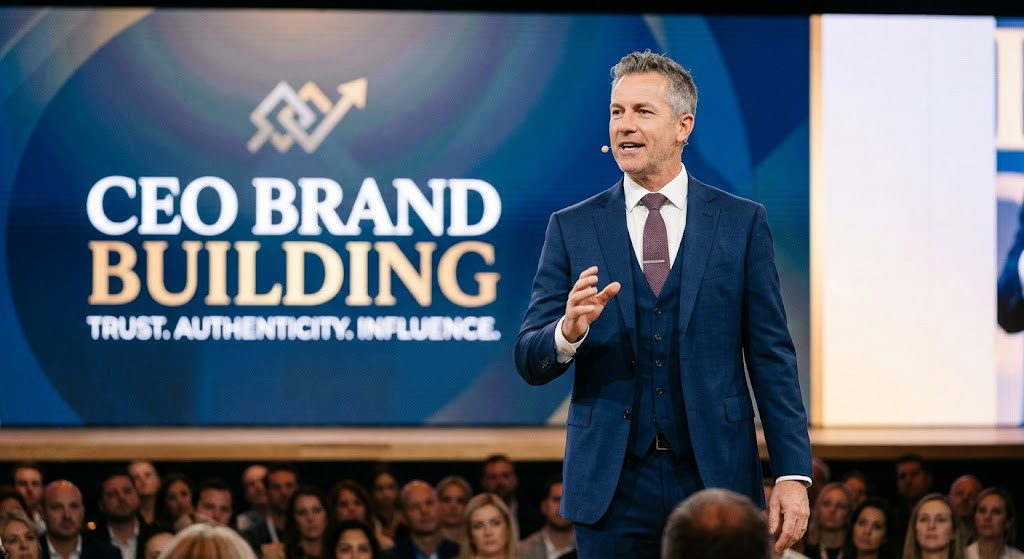
CEO Brand Building: 7 Proven Growth Advantages

CEO Brand Building: 7 Proven Growth Advantages
Even an effective organization can be well-equipped with great products, great team, and great strategy but still can have its leadership go completely unnoticed by those who should matter the most.
When competing for attention in such a market, this becomes one of the obstacles that prevent the customers, the partners, the employees, and other industry stakeholders from realizing what the organization represents.
This is when CEO branding becomes strategically essential. The experience, thoughts, communication skills, and presence of a CEO can bring life into the corporate brand.
With this kind of approach, CEO brand building helps with gaining credibility, influence, visibility, demand generation, hiring, stakeholder relationships, and brand building.
What Is CEO Brand Building?
The creation of a CEO brand building is the deliberate effort of crafting the image of the company’s chief executive among the desired target groups. This entails the effective communication of the executive’s knowledge, point of view, leadership principles, values, and experience in a way that adds value and relevance to the intended audience.
It goes beyond the efforts of creating social media profiles and frequent postings on LinkedIn. A CEO brand may arise out of articles, interviews, podcasts, conferences, speaking engagements, corporate content, professional networks, and various other forms of communication.
This is not about making all CEOs celebrities in social media. The objective here is to craft a connection between the expertise of the executive and the overall corporate positioning.
CEO Branding Is More Than Social Media
Social media may form part of the CEO branding, but it is just one channel.
A CEO may gain credibility by providing insights into an industry development, an example from his/her business decisions, a problem faced by customers, participation in an industry interview, and by offering a valuable framework in a conference setting.
Most successful communications offer something valuable to the audience rather than announce what is being sold.
CEO Brand vs. Corporate Brand
A corporate brand is one that reflects the organization that the firm is.
A CEO brand on the other hand brings out the human aspect of the company brand.
There is a need for these brands to work together. While the CEO may bring out the ideas and expertise of the organization, the corporate brand brings out the organizational aspect.
An executive brand thus needs to enhance the organization's positioning and not create another one.
Why CEO Brand Building Matters to Business Growth

A business is not always judged based on its goods and services alone. There may be interest in knowing the know-how, leadership, value, and thinking of the business.
This becomes especially important when customers are making big decisions, businesses are judging possible partners, or professionals are deciding their future workplace.
CEO brand building can help accomplish that goal.
People Want to Know the Leadership of the Business
While the website of the business can tell what it does, it is the executive communication that can tell why it exists, what are its beliefs, and how the business leadership copes with important tasks.
A leader who explains complicated things, shares his/her experience, and tells his/her viewpoint provides people with more information that helps them judge the business.
That does not mean trust. It is the deeds of the business that will determine whether or not people will trust what its leaders say.
Executive Visibility Can Extend Corporate Reach
The company can use the corporate web site, advertising, emails, social media, and other means of marketing to communicate. The CEO can be another source of communicating the thoughts of the company.
An executive who possesses a clearly established field of expertise may initiate the dialogues through various channels such as professional circles, events in the industry, interviews, podcast, etc.
This may help to increase the number of channels where the company's thoughts can be reached without turning each channel into selling.
Consistency Brings Visibility to Recognition
One-time posting cannot create a good executive brand.
The recognition is created through frequent exposure to consistent thoughts, expertise, and positioning.
When the CEO consistently discusses a certain set of topics from a unique point of view, the audiences can start identifying the executive with specific fields of expertise.
This consistency creates a strategic base for CEO branding.
7 Proven Growth Advantages of CEO Brand Building
CEO Branding is not something that can replace the product, customer experience, sales process, and overall marketing. Nonetheless, it can enhance different aspects of the business’s growth strategies where CEO branding is properly integrated into them.
Here are seven important advantages.
1. Build Greater Trust Around the Company
Having a recognizable CEO may provide an additional human link between the corporation and its brand.
It allows you to meet not just the logo, website or marketing message but also the one who is going to run the organization. The CEO is able to deliver his/her own vision, comment on current events in the industry and share his/her experiences.
It helps to better comprehend the company's experience.
A technology CEO may comment regularly on how companies should react to some technology revolution. Instead of constantly promoting the company's services, he/she may answer those questions that the decision-makers have.
In this way, the expertise of the CEO is demonstrated before becoming a client of the company.
Trust should never be perceived as something that can be created out of thin air with help of the content. The gap between what the CEO says and what the company does will only be highlighted by the increased visibility.
That is why the most powerful CEO brands combine communication and substance.
2. Strengthen Brand Authority Through Thought Leadership
Thought leadership is one of the most evident examples of how executive branding may lead to brand authority.
Thought leadership is not about stating opinions; this concept includes offering useful and relevant insights, perspectives, frameworks, analysis, lessons or any other form of ideas that help the audience see a certain problem differently or make a better decision.
There are a lot of ways for CEOs to build this kind of authority:
Industry insights
Educational articles
Executive commentary
Interviews
Conferences speeches
Interpretation of research results
Frameworks
Professional experience lessons
It is crucial to distinguish visibility and usefulness in this situation.
The first CEO may gain attention by publishing ten different motivational posts. The second CEO might publish only five posts but always tackle some problems which are important for his/her audience.
This second option will make the intellectual position of the CEO more clear.
Focus on Expertise and Not Promotion
Every post from the CEO is not obliged to be promotional.
On the contrary, too much advertising may make communication useless.
In this case, the CEO can answer questions, offer explanations, raise doubts, share experience, etc.
3. Create More Opportunities for Business Visibility
A strong brand can enable it to become simpler for audiences that matter to understand what a leader understands and about which issues he or she can talk about.
This kind of positioning may help in creating opportunities like:
Industry interviews
Podcasts
Conference participation
Professional events
Commentaries
Networking
Strategic talks
Partnership talks
These opportunities do not have to be automatically achieved through personal branding because they also depend on how well an executive is qualified, relevant, connected, timed, and interesting for certain organizations.
A CEO that has a clearly defined domain of expertise allows others to have some specifics that they can connect with.
To illustrate, a CEO who constantly speaks about the deployment of AI within enterprises becomes more associated with this topic than an executive who writes about something else each week.
So, clarity becomes just as important as visibility.
4. Support Sales and Demand Generation
Prospects investigate companies before contacting them.
They browse a company's website, read its content, examine its leadership, seek expertise, and compare different providers.
CEO content could help during this phase of investigation by answering the questions of prospects before they are ready to contact sales.
Consider a CEO who runs an enterprise technology consulting company. The CEO content wouldn't be limited to just services, but would include the explanation of the difficulties and mistakes that arise when organizations adopt new technologies.
This will give a prospect insight into what this company thinks.
The content doesn't need to sell something to have a commercial value.
Turn Executive Expertise Into Buyer-Focused Content
The most successful CEO content begins with relevant questions.
What challenges do buyers have?
What misconceptions keep arising in the industry?
What decisions are tough for buyers?
What changes are taking place in the industry?
What experiences does the CEO have in dealing with such problems?
Questions like that can turn into an article, video, interview, blog post, presentation, and many other types of content.
The outcome will be an executive brand that adds value to the education of buyers.
5. Strengthen Recruitment and Employer Reputation
Today's workers and candidates seek information regarding the leaders of organizations.
A CEO may share mission, leadership philosophy, focus areas, and vision of the organization using public materials.
An executive can clarify the way an organization treats innovation, lessons from its development, approach to customer service, or desirable qualities in a team.
In this way, candidates receive an additional point of view on the organization.
CEO branding can also increase visibility of communication efforts beyond internal gatherings.
Branding cannot mask a bad employee experience. When there is a contradiction between what an organization says in public regarding its culture and leadership and what it really does, the credibility is damaged.
The key takeaway here is obvious – share only the reality of the organization.
6. Build Stronger Relationships With Industry Stakeholders
It is not enough for a CEO to communicate with prospective customers alone.
The executive may need to deal with business associates, stakeholders, industry players, media representatives, professional associations, and many more.
A well-defined CEO brand enables these parties to know the executive's areas of expertise and the general direction of the company.
When an executive is continually providing his/her insight on some industry-related issue, then such insights form part of the industry's perception on what he/she knows.
Such interactions are not necessarily triggered by a normal marketing program.
Once again, the aim here is not just about gaining followers but about building relevant professional networks around key issues.
7. Create a Long-Term Brand Asset That Compounds
One of the most intriguing attributes of CEO brand building is that there is potential for valuable content to last beyond the initial publication date.
A good article has the potential of being found even months down the road. An interview could still be considered a part of a CEO's portfolio of achievements. A presentation could still be referred to in the future. Insights collected could prove a certain expertise area.
Over time, these separate content pieces create a body of work.
This is quite different from a quick campaign which focuses on one-time promotion of a particular product or service launch.
Over time, the CEO can build a library of:
Articles
Interviews
Videos
Podcasts
Presentations
Executive insights
Industry commentaries
Educational resources
And the strength of such a library is in the cumulative impact on the CEO's public position.
Not necessarily every content piece would bring in traffic, leads or sales over time. But having a growing number of them provides an audience with additional chances to see what the CEO knows about his/her expertise area and the company's point of view.
What Makes CEO Brand Building Effective?
A brand CEO becomes valuable if it is based on a strategically defined foundation.
Start With a Strategic Positioning of the CEO
Prior to producing any content, clarify what the CEO needs to be perceived as.
The CEO positioning framework would look as follows:
Who you are + what you know + who you help + what you bring to the table.
An executive could position himself or herself as someone who helps big companies grasp how to implement AI transformation in a practical way.
This positioning would give direction for future content creation.
In absence of clear positioning, CEO content may rapidly turn into a set of various ideas and pieces of information, including personal news, updates from the company, advice, etc.
Create 3-5 Key Content Themes
Pillars of content make executive communications manageable.
Key themes for the CEO's content could include:
Industry expertise
Leadership
Innovation
Challenges of customers
Business transformation
Vision of the company
Share Original Thinking
Generic advice does not often illustrate unique expertise.
CEOs need not regurgitate generic statements on leadership and success; rather, they can reveal what they have learned from their decision-making, problems, projects, changing market dynamics, and customers.
Personal experience makes executive content relevant.
Make Consistency Sustainable
The CEO brand-building process must be consistent with the executive's personal calendar.
If the process demands publication on a daily basis and yet lacks sustainability, then consistency will not be achieved.
It is better to determine a realistic publication frequency and create sustainable processes for converting executive insight into relevant content.
How to Build a CEO Brand Without Making It Feel Forced
Not all CEOs desire to become social media personalities, and they don't have to.
Branding for a CEO doesn't necessarily have to include elements of personal promotion, but be professional and informative instead.
Lead With Expertise
Often, the knowledge of a CEO is the biggest resource of content available.
It's better to ask "What does my audience need to know" rather than "What do I want to post today".
This simple change in attitude can turn content creation into a way of sharing knowledge.
Use the CEO's Real Voice
The content of an executive doesn't have to sound like it was created by an impersonal corporate communication department.
Content can still remain professional but at the same time be clear and direct.
Recognizable voices will make ideas easier to associate with their speaker.
Connect Personal Insight to Relevance for Business
Personal insight of a CEO can improve content, if it teaches something useful.
Leadership lessons, decisions to take, customers stories, changes in strategy, and mistakes made professionally can all become valuable content, if the CEO shares his or her experiences.
Common CEO Brand Building Mistakes to Avoid

CEO Branding as Self-Promotion
Speaking constantly about accomplishments will make the content appear promotional.
The useful insight should stay at the core.
Posting Without a Specific Position
When all posts revolve around different topics, audiences will find it difficult to get a sense of who the CEO is as a professional.
A consistent set of topics in content contributes to a consistent position.
Following Every Trend Instead of Providing Expertise
Trends can bring engagement, yet following every trend does not necessarily establish the CEO as an authority.
Take advantage of trends when they align with the CEO's expertise and target audience.
Using AI-Generated Content Without CEO’s Input
Artificial intelligence can facilitate research, writing, editing, and content processes.
Generic content may result in making executive communication look the same.
CEO's insights, experience, examples, and opinions should stay core.
Making Unsupported Claims
Credibility is the key to establishing an authority.
Do not use unsupported statistics, exaggerations, absolute statements, and claims that cannot be proved.
Good executive communication should be assertive, yet not irresponsible.
How to Measure the Business Impact of CEO Brand Building
Measuring CEO branding requires more than counting followers.
Different metrics can indicate different stages of progress.
Visibility Metrics
These can include:
Content impressions
Reach
Profile visits
Search visibility
Content views
They indicate whether the executive's ideas are being discovered.
Engagement and Authority Signals
More meaningful signals can include:
Relevant comments
Shares
Mentions
Interview invitations
Speaking opportunities
Professional introductions
These can provide context about how audiences are responding to the CEO's ideas.
Business Metrics
Where appropriate, businesses can also track:
Qualified inquiries
Referral conversations
Partnership opportunities
Recruitment interest
Sales conversations
The key is to connect these metrics to actual business processes rather than automatically attributing every outcome to CEO content.
Track Patterns Over Time
A single high-performing post should not determine the entire strategy.
Look for patterns.
Which subjects consistently attract relevant audiences? Which content generates meaningful conversations? Which ideas lead to invitations or business discussions?
Long-term measurement can provide a more useful picture than chasing individual spikes in attention.
How CEO Brand Building Fits Into a Broader Growth Strategy
CEO branding is most effective if it is aligned with the company's overall marketing and growth strategy.
It may work together with:
Corporate content creation
Search engine optimization (SEO)
Demand generation
Public relations
Sales enablement
Employer branding
Communication with customers
The CEO shouldn't be the only marketing tool for the company.
Rather, executive communication may become an additional layer in the company's strategic thinking, which adds a human touch to the company's expertise.
If CEO positioning, corporate messaging, customer demands, and content strategy are well-aligned, then CEO brand development will become easier.
Frequently Asked Questions About CEO Brand Building
What is CEO brand building?
CEO brand building that involves creating the perception of the executive through his/her expertise, communication, thought leadership, point of view, and presence.
Why is CEO personal branding important?
CEO personal branding may allow for sharing an executive’s expertise, defining one’s point of view, and increasing visibility in the target audience. CEO branding can be used as a component of corporate branding.
How does CEO branding benefit the company?
The CEO brand building may bring benefits in terms of visibility, thought leadership, stakeholder relationships, communication related to recruiting, demand creation, and brand building if it is consistent with the corporate strategy and expertise.
What should a CEO write on LinkedIn?
A CEO may write about industry trends, insights from experience, reactions to key events, leadership viewpoints, lessons learned from customers, educational information, and useful analyses.
How often should a CEO produce content?
It is impossible to suggest one frequency of production that would be appropriate for all CEOs. It is more sensible to maintain a sustainable schedule of producing valuable insights rather than publishing often with no particular goal.
How is CEO branding different from personal branding?
While personal branding can be applied to any professional person, CEO branding deals exclusively with the executive whose reputation and image may also overlap with that of their company.
Is CEO brand building helpful for small businesses?
Yes. The CEO of a small business can leverage his expertise and communication skills in order to promote the value of their company, build professional relationships and educate potential customers.
Turn Executive Expertise Into a Strategic Brand Asset
CEO Brand building goes beyond the visibility of the person. If done well, it can provide substance to the expertise of the firm and generate new communication opportunities with customers, employees, partners, and industry audiences.
The most compelling CEO brands are the ones that are rooted in substance – expertise, positioning, valuable ideas, communications, and alignment with the strategic initiatives of the firm.
The seven benefits are interrelated. Communication by the executive can serve as a platform for trust, authority, visibility, demand generation, recruitment, stakeholder management, and creation of the body of brand knowledge over time.
The opportunity here is not in making every CEO an influencer but rather utilizing the expertise that leaders already have to generate value through communication.