Freelancer Onboarding Expectations: The Ultimate Guide

Freelancer Onboarding Expectations: The Ultimate Guide
Imagine that you have hired an extremely highly-recommended freelance designer for a very important product launch. You received the perfect portfolio, your kick-off was great and you can’t wait to see what is coming up next. After two weeks it is time to give back the assignment and you receive another type of product!
No, not only that, but you find out the freelancer is billing you for revisions you assumed were part of the flat fee, and only responds to your emails at 2:00 AM in his/her time zone?
But who was at fault? While it's often easy to shift the responsibility for the problem back to the freelancer, the fact is that most of the issues in the gig economy come down to one thing which could have been avoided by the client: no clarity regarding freelancer onboarding expectations.
The gig economy continues to expand and has resulted in an unprecedented flexibility and access to talent by businesses. Hiring an external individual to be on your staff is quite different from hiring a full-time employee. Freelancers are independent and are not aware of your unspoken policies, the preferred communication styles, and how you define "done."
Working with freelance talent requires you to have a freelancer onboarding process which will keep you sane if you are to continue growing your business. In this comprehensive guide, we will break down everything that you should know about onboarding your freelancers. At the end of this article, you will understand everything there is to know about communicating, the legal aspects, work production, and payment for all your freelancer engagements.
It is critical that you set your freelancer onboarding expectations early to be a successful freelancer and client.
When getting a project out the door is in a rush, onboarding can appear like a luxury that you can't afford. It's easy to say, "Have at it!" and then send a quick email, grant access to a Google Drive folder.
This is a very serious error. If you invest the time for the right freelancer onboarding expectations, you'll have a tremendous ROI throughout the project. That's why it's critical to establish the expectations with gig workers.
What is Scope Creep?
In freelance, scope creep is the “budget killer that eats away at your budget.” It occurs when the scope of a project gradually creeps outside the agreed upon project. A ‘quick logo tweak' becomes a brand new style of brand; a blog with 1,000 words becomes a thoroughly researched whitepaper.
If you don't have clear freelancer onboarding expectations about the Scope of Work with freelancers (SOW), both you and the freelancer end up losing out. Freelancer becomes overworked and underpaid and resents the situation, resulting in rushed work. In the interim, your project budget blows out and deadlines are not met. When you clearly define what is included in your project, and what it is not, your project has a "wall of scope" that protects it.
Accelerating Time-to-Value (TTV)
Time to Value (TTV) is the duration it takes for a new hire to begin creating valuable work that can be utilized. Freelancers typically are hired for brief and/or very specific jobs, so their TTV must be extremely rapid.
Your first few billable hours (or days) with a freelancer who is lost in a fog of brand guidelines, target audience and software stack will be spent wandering in the dark. Setting clear freelancer onboarding expectations acts as a catalyst in this induction process. It provides them with a blueprint to begin performing at a high level on their first day.
Protecting Brand Integrity
Your brand is your most valuable asset. Week after week, full-time employees are steeped in your company culture, picking up your brand's tone of voice, visuals, and company values. That's not the case for freelancers.
Unless you clearly establish brand guidelines and quality control, you will have the potential of losing content, code, or designs that can also break your brand's consistency. Aligning your freelancer onboarding expectations will ensure that the work that the freelancer produces is consistent with that of your in-house team so that it all flows together.
This is the Pre-Onboarding Phase: Setting the Stage Before Day One.
Your biggest mistake when onboarding a freelancer is taking action after you've signed the contract. When you make the decision to hire someone, you're already setting your baseline freelancer onboarding expectations.
Developing a crystal clear job description
Your initial outreach or job posting are the first place where you are establishing boundaries. The general curve is what draws off misaligned talent. Instead, incorporate your freelancer onboarding expectations into a job description.
Be sure to include:
The desired outcome: Here's not "Need a writer" but rather, "Need a writer! If it's B2B SaaS you need, for example, say "Need a B2B SaaS writer to write 4 1500-word SEO articles each month."
Availability: At the initial interview, tell them that they need to be available to meet with them for a weekly Zoom sync at 10 AM EST.
The workflow: Tell briefly how you work on a project (e.g.: "All tasks are tracked in Jira, all communication is done in Slack").
The Freelance Contract & Statement of Work (SOW)
The contract is the final document for solidifying your freelancer onboarding expectations. Don't start a project without a formal agreement that is signed that clarifies the legal and functional aspects of the partnership.
A good freelance contract and SOW will be clear and specific in terms of:
Specific Deliverables: Identify each and every asset that the freelancer must produce.
Specific Deliverables by specific times: Link specific deliverables to specific times.
IP Rights: Once the work is completed, who is responsible for the IP Rights. Usually, it is “work for hire” and as soon as it is paid in full, you will become its owner.
Non-Disclosure Agreements (NDAs): When it comes to proprietary information, customer lists and unreleased product information, the highest standard of confidentiality will be provided by a Non-Disclosure Agreement.
A Freelancer Welcome Packet is something that should be developed.
Send a digital "Welcome Packet" to fill the time until the work is under way and the contract. This doesn't have to be an interactive module that you would use for an employee. A simple Notion page, a well-formulated PDF or a structured Google Document are all fine!
The following items should be included in your Welcome Packet:
Company Overview/Background: The purpose of the company, its target market and its main competitors. (Context is crucial for good work).
Point of Contact (POC): Full name and email and standard working hours of their point of contact.
Tech Stack: Tools they will be using and links to any logons they will need.
Admin Essentials: Link to upload their W-9 (or other tax forms) and instructions for sending their invoices.
The 5-Step Freelancer Onboarding Framework
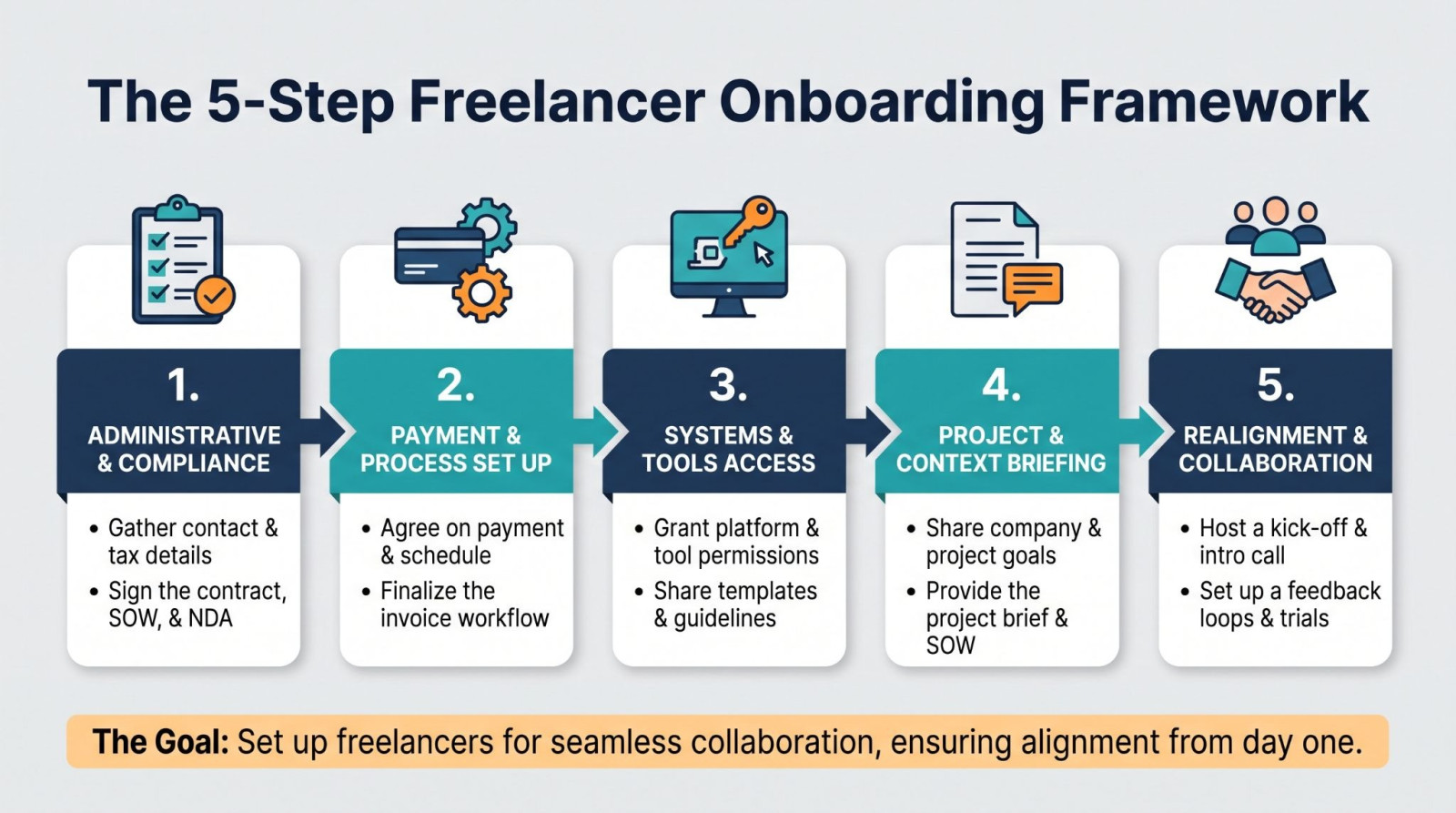
After the signature of the paperwork and the welcome packet is received, it's time to implement the "Doing" phase of onboarding. Use this 5-step approach to avoiding misunderstandings.
This is the Startup Call (also known as Async Video).
If your company is not the synchronous type, a face-to-face kick-off call using Zoom, Google Meet, etc. is strongly suggested for complex projects. A face-to-face interaction helps to establish trust and rapport from a first meeting, which is essential for communicating your freelancer onboarding expectations effectively.
When live calls aren't possible, record an asynchronous walkthrough of the project with a tool such as Loom.
The Kick-Off Agenda:
Introducing and establishing rapport.
A summary of the project's purpose (the "Why").
A walk through of what (tasks).
Reviewing deadlines and communications.
Time for the freelancer to ask clarifying questions.
Step 2: Formulating the scope and milestones of the project in S.M.A.R.T. goals.
During the onboarding process, it's important to break down the overall plan for the project into smaller, more manageable tasks. Unspecific goals result in unspecified outcomes. Use the SMART approach for freelance work items:
Specific: "Create three effective landing pages for the new marketing campaign in Q3."
Measurable: "Every page needs to be fast enough to pass the Google's Core Web Vitals speed test."
Achievable: Make sure the freelancer agrees that the amount of work is realistic for their time frame.
Relevant: Relate to your business objectives (e.g., lead generation).
Time-Bound: "Draft 1 due Tuesday 5 PM EST; final drafts due Friday noon."
You can establish milestones (such as an outline, first draft, final polish) which are checkpoints. This way, the freelancer will not be able to take the wrong route for two weeks without you knowing about it.
Ensure that access to the data and processes is controlled, and that they are integrated with the tools that are used.
There's nothing more frustrating to a freelancer than being able to work but unable to access your files or software. On the other hand, no business owner wants to get a first-time contractor to sign up their admin account to a whole CRM platform.
Establish data-protection policies.
Principle of Least Privilege: Only share with the freelancer access to the folders, channels and tools that are required to complete the task.
Centralized Communication: Add them to your company Slack and let them know which channels to keep an eye on. To not overload them with company wide noise, you may want to have an exclusive project channel.
Offboarding Protocol: Establish early in the project that access will be revoked at the end of the project.
Step 4: Sharing Brand Guidelines and Style Guides
A logo file is not a brand guideline. If you wish for the freelancer's work to mirror your company's, you'll need to supply a thorough style guide.
For Designers, this relates to hex codes, typography rules, padding guidelines and mood boards. For Writers, this encompasses tone of voice (e.g. "authoritative but approachable, never academic"), formatting preferences (e.g. "use H2s and H3s, bold key terms") and a list of industry jargon to use or avoid (e.g. "prefer not to use 'The Monument'"). This applies to Developers with regards to coding standards, deployment procedures, and GitHub branch naming conventions.
Step 5 is the "Paid Trial" Task.
If possible, begin a new freelance job using a paid trial task. This is the ultimate test of your freelancer onboarding expectations.
Rather than making a large project with multiple months worth of commitment, break up the $5,000 action plan into a smaller $300 target. This will enable you to assess not only the quality of their work, but also how well they're following your new expectations. Was the relationship between the teacher and learner effective? Were they on time? Have they adhered to the style guide?
Along the way, if things are proceeding smoothly, you've established a good example for the other projects. If it doesn't work, you can split amicably without having to spend much money.
The Government of India's words don't change anytime soon.
The first and foremost reason for failed freelance relationships is communication breakdown. On day one you need to agree with your freelancer on the communication protocols, as there should be none.
Synchronous vs. Asynchronous Communication
Freelancers appreciate complete control – this may be what attracted them to freelancing in the first place. Their deep work time must be respected and a distinction must be made between what needs to be done during a live meeting (synchronous) and what can be done by an email or a text message (asynchronous).
When outlining your freelancer onboarding expectations: We try to keep meetings to a minimum, we will have a 15 minute sync every Monday at 10 AM, all other communication such as small questions and sharing of files will be done asynchronously in our shared Slack channel.
Time Zone, and Availability Boundary.
When you're in New York and your freelancer is in London, you have to be able to have overlapping hours.
If it's one am in their time, don't think that they'll respond to your email sent at 8 PM your time.
Make it very clear what your core hours are: "From 9AM to 5PM PST we are online 24/7, but we don't expect you to be online all the time, we just want to hear back on any questions you might have within 24 business hours."
Everyone's status update and check-in.
Don't leave a freelancer in doubt about whether to log in or not. Be clear with them about how often you would like updates. If a long-term project is involved, ask for a short weekly update (e.g., "Every Friday before EOD, provide a short list of what has been accomplished this week, what is scheduled for next week, and anything that you are stuck on"). This way, you won't get on everyone's nerves, but you'll be informed.
Controlling revisions, feedback and quality control
How you respond to the freelancer's feedback makes the relationship go with them. If it is unclear here, it screws up the whole project, and causes scope creep and frustration.
Capping Revisions
Endless revision cycles are a nightmare for both clients and freelancers. You need to specify how many rounds of revisions are covered in your base rate contract and onboarding process with freelance talent.
Typically, there will be two revisions in the Standard Expectation.
The Clause: "This project supports up to two rounds of reasonable revisions. A 'round' means a combined list of revisions from the client. Revisions that extend beyond the two rounds or revisit previous revisions will cost at $X per hour."
How to Give Constructive Feedback
Do not use a performance review as feedback for a freelancer. It should be about the deliverable and not the person, and should be directly linked back to the initial freelancer onboarding expectations you established.
Bad Feedback: "I don't like this, make it pop more." (Subjective, useless).
Good Feedback: "This is not an exact match to the brand guidelines we discussed in the onboarding phase. The color palette is a little too subdued compared to our brand guidelines and typography should be updated to Inter. Is it possible to tweak those two for the second draft?"
When freelancer onboarding expectations are not met... What Happens?
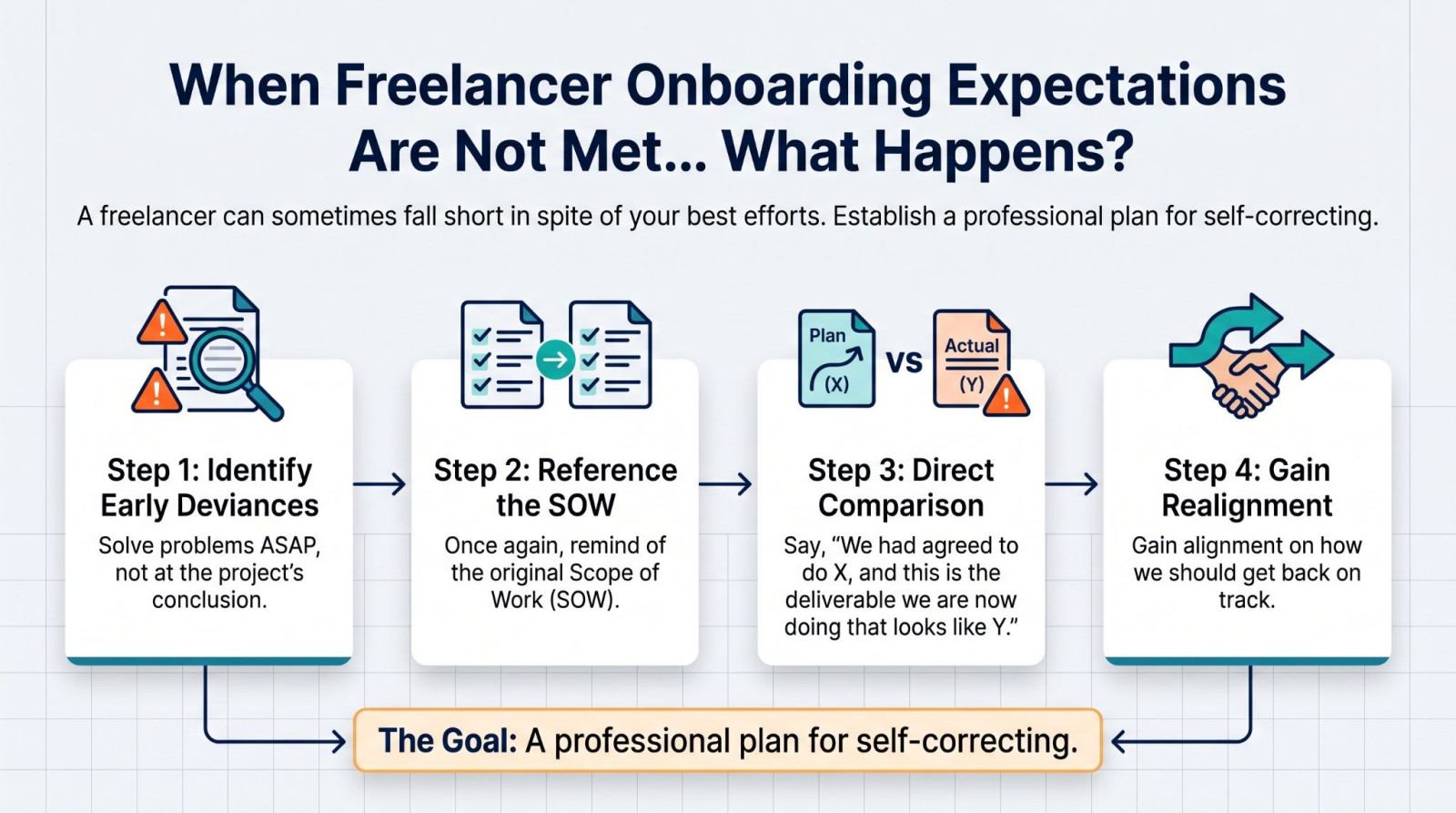
A freelancer can sometimes fall short in spite of your best efforts. Establish a professional plan for self-correcting. Solve problems ASAP, not at the project's conclusion. Once again remind students of the original SOW and say, “We had agreed to do X, and this is the deliverable we are now doing that looks like Y.” Gaining alignment on how we should get this realigned.
If it's obvious it's not working out, follow the termination clause of your contract (established in the pre-onboarding stage) and you're done with this relationship in a professional way – you pay them for what they've already done; that's it.
Payment, Invoicing, and Administrative Expectations
The subject of money is the most delicate one in any business dealings. If there is any confusion about payments, trust will be thwarted. Get a sense of what they're expecting in terms of payment before they start typing.
Invoicing Procedures
Don't just let the freelancer guess how they should be billing. During onboarding, specify:
What do you want the invoice to be formatted as? PDF invoice or a particular vendor portal?
The Details: What needs to be included on the invoice? (PO number, project name, their tax ID etc.).
The Schedule: At the beginning, at certain checkpoints, or at the end of the month?
Payment Terms (Net-15, Net-30, etc.)
Freelancers take care of their own finances, which means they have to be aware of when their cash will arrive in their bank account. If your accounting department only works Net-30 (invoice payable 30 days after receipt) you need to make sure to communicate this during the onboarding process. If a freelancer assumes he will get paid the very same day as he sends the invoice and you wait 30 days, you will just lose a guy for the next project.
Expense Reimbursements
If software, stock photos or travel is going to be required for the project, get the rules out in front of the freelancer. Are any purchases over $50 required to be pre-approved? How do they provide receipts? Straightforward rules avoid all the confusion later on.
How does Gigmint.AI automate the Freelancer Onboarding process?
AI makes the Freelancer Onboarding process easier. It can be exhausting handling multiple spreadsheets to manage contracts, create welcome kits, set up secure access, and handle invoices.
Here's Gigmint.AI revolutionising the game.
Gigmint.AI offers a single source of truth that has been created with a specific focus on simplifying the process of managing the gig economy. With AI, businesses can automate the most aggravating aspects of managing freelancer onboarding expectations.
It manages secure contract creation, aggregates your SOWs, serves as a centralized communication and milestone management hub, and enables safe, timely payments.
Gigmint. is one solution that replaces five tools to onboard a freelancer. With AI, you can save time from manually aligning expectations and concentrate on doing the work.
Frequently asked questions (FAQs)
What is the ideal length of time for onboarding a freelancer? Freelancer onboarding should be quick unlike employee onboarding that can go on for weeks. Admin (contracts/access) should take 1-2 days and active (kick-off call, brief review) should take no more than 1-2 hours of direct interaction. The objective is To-Value in a fast time.
Should I hire a contractor? You should not have to teach a freelancer how to do their job, e.g. you shouldn't teach a freelance developer how to write Python. But there are some things you will need to teach them about your brand rules, your inner workings and how your company works.
In what ways are onboarding an employee different from onboarding a freelancer? All aspects of employee onboarding are culturally oriented, with a significant emphasis on long-term retention, benefits, history of the company, and career development. Freelancer onboarding is only output based and what is required of him. Scope of work, deadlines, output and brand alignment are the only components of the onboarding process.
The key takeaway: Promote long-term freelance relationships.
Expectations onboarding of freelancers is not micromanagement, it's empowerment. A great professional, when he/she understands what a successful life is and how far they can go and what they will get in return, can work at their best.
Structured agreements, communication processes, and an onboarding process address the conflicts that make many gig economy projects hanging in between.
End scope creep and misunderstandings and save time and money. Sign up for Gigmint. From finding, onboarding and managing the best freelance talent to starting to build strong, long-term business partnerships, AI today is helping to make it all possible.