How Businesses Can Turn an AI Prototype Into a Production Application
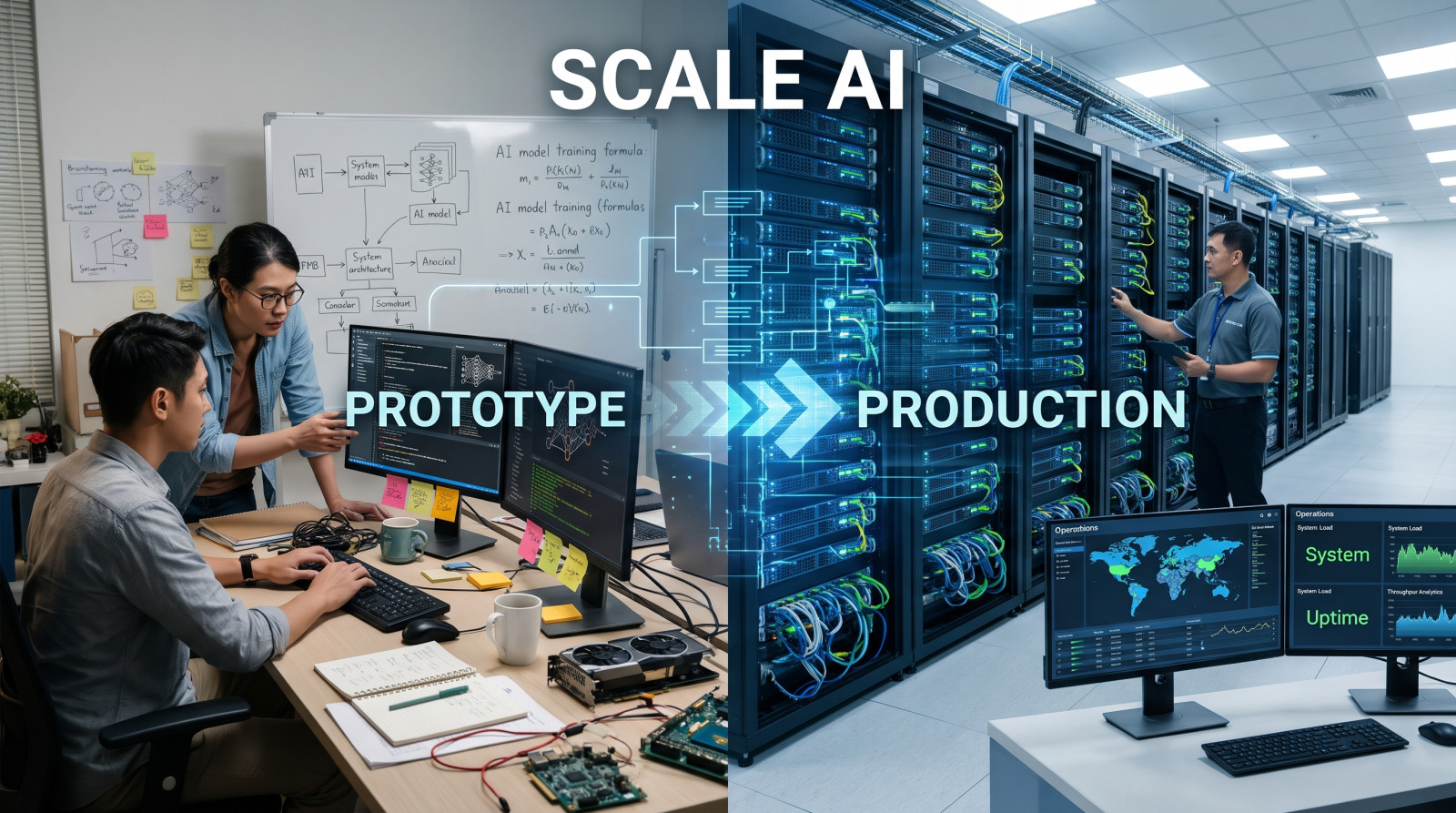
How Businesses Can Turn an AI Prototype Into a Production Application
Having trouble scaling up your AI project from your AI prototype? Well, you’re not alone in that regard. According to the industry statistics provided by Gartner, 80% of AI projects are unsuccessful at the PoC level as an AI prototype. This happens due to them getting stuck in a phase called "AI Pilot Purgatory".
It might be really exhilarating for you to experiment with a PoC AI prototype using a local Jupyter notebook. It gives you a chance to realize what could be possible from the mathematical point of view. Building a highly secured and highly available application that runs on a 24/7 basis is altogether a different story.
The process of taking an AI prototype to the production stage involves a paradigm shift from being an experimental scientist to an engineer. It's a journey from data science experiments to serious software engineering. To facilitate such a transition, it is necessary to have Machine Learning operations, appropriate infrastructure, and the right team.
Understanding the Gap: Prototype vs. Production AI
But before moving onto the next discussion on the "how" there is one important matter that needs to be sorted out and that is the "why". Why is the development of AI apps from an AI prototype hard?
Proof-of-concept for AI
The answer to the question that is addressed by AI proof-of-concept is: "Is it viable?" Within a highly controlled environment where static and cleansed data sets exist, data scientists create your first AI prototype. This would help you prove that the use case is really a viable business with a proper solution to a well-defined problem.
AI in Production
Regarding the issue of the production system, the AI system that was developed through the development of the AI prototype should have enough resilience for it to be able to run in the real-world environment.
This is not about having perfect performance now. This is about scalability, high availability, low latency, and security. This system should be able to work with dirty data streams, respond to several thousand API requests simultaneously, and adapt its behavior based on the change in data streams without any human interaction.
Understanding the “Hidden Technical Debt” in Machine Learning
The research conducted by Google's team and named “Hidden Technical Debt in Machine Learning Systems” dates back to 2015. The concept that has been stated above in the introduction statement is valid for the current day. Only a small portion of the entire production system comprises the machine learning itself – the algorithm of the AI prototype.
|
Feature |
AI Prototype |
Production AI Application |
|
Environment |
Local machine, Jupyter Notebooks |
Cloud infrastructure, Kubernetes, Docker |
|
Data Source |
Static CSV files, historical databases |
Real-time streams, dynamic APIs, messy user inputs |
|
Success Metric |
Model Accuracy (F1 score, RMSE) |
Latency, Throughput, ROI, System Uptime |
|
Update Cycle |
Manual, ad-hoc |
Automated CI/CD pipelines, MLOps |
|
Primary Team |
Data Scientists, Researchers |
ML Engineers, DevOps, Software Engineers, Data Engineers |
Phase 1: Validating Business Value and Readiness
But before you deploy you need to make sure that your organisation is prepared from a strategic and tech perspective to use AI solutions.
Non-accuracy KPIs
When building a prototype such as an AI prototype, data scientists are fond of high accuracy rates. When it comes time to put the model of the AI prototype into production, one of the KPIs is accuracy. KPIs must be clearly established to reflect the needs of the business involved in the project.
Latency: What is the lowest latency that will give users the experience? For instance, more than 100 milliseconds.
Load: When the load is high, what is the maximum number of requests the system can process simultaneously?
Computing Power: Estimate computing power (GPU or CPU) required for the system that the API requests. Does this cost make sense for the business model?
ROI: Will the model make money for the business?
Data Readiness & Pipelines Assessment
The rules that AI algorithms use to function cannot function properly in reality if they are based on a set of rules. Once you've gone from testing the AI prototype to using the data, you need to shift from working with batches of data to real data engineering.
You'll have to create a method that will be able to get data, convert it to the format and insert it into a system that will basically operate in split-seconds. In this way, the data used in real life will be the same as the data used for training the model.
Review of the compliance, security and governance checks are made. Is your AI system built from an AI prototype for real use from a legal point of view? Any AI model that is used in production needs to work with user data. This puts you at risk of legal problems. Adhere to the regulations such as:
HIPAA (for the industry)
The AI Act (in the EU)
Phase 2: Architecting for Scale and Resilience
After having discussed the topic of business alignment, it is high time to consider how software architecture could be designed in order to address challenges posed by AI.
The AI model from your AI prototype must be completely separated from the primary application
What's the most crucial part of an AI model? Typically, companies integrate their AI models tested in the AI prototype into their monoliths and/or front-end or back-end applications. And this is a huge mistake! The microservices architecture should be used. The AI model of the AI prototype should be able to work independently of the code in your monolith via API (FastAPI/Flask, etc.).
The good part about such a practice is that you can implement a new version of the main application without impacting the AI model, and you can update the AI model without closing down the entire website. Furthermore, you'll be able to scale AI service far beyond the AI prototype separately from the lightweight web server.
Choosing the Right Infrastructure
Machine Learning is a costly process, especially when inference is performed, in which the machine makes a prediction. The right choice of the environment is essential:
Private Cloud (AWS EC2 or similar): Ideal for scaling up and implementing Managed Machine Learning services such as Amazon SageMaker or Google Vertex AI. Ideal for many organizations.
On-Premise: Required in heavily regulated sectors like defense and certain healthcare segments where data cannot be moved from physical servers; however, it is extremely costly to start with owing to the large expenditure on the hardware.
Serverless and Edge Computing
Deployment using small models on the edge (smartphones and Internet of Things) will lower latency and cloud computing fees.
Inference Optimization Techniques
Models, especially large language models and neural networks, cost a lot of money to run in production. For minimizing computation costs, there must be some optimization for inference.
Batch vs. Real-Time
Predictions are not always real-time. If you want to recommend products every week, batch predictions will be more economical than real-time predictions.
Quantization & Pruning
Will help you to minimize the number of parameters and simplify computations.
Phase 3: Implementing MLOps and CI/CD Pipelines
DevOps was the revolution that came into software development. With respect to the revolution in AI, it was MLOps. MLOps is the combination of Machine Learning, DevOps, and Data Engineering.
What is MLOps and why is it important?
Deployment of a model does not happen once. This is a prolonged process which happens during the whole lifecycle of the application. MLOps provides access to all necessary tools which will be used when dealing with the model – from its development, testing, deployment to maintenance. Without MLOPS, the deployment process will be carried out manually and will be associated with risks of mistakes and delays.
Version Control for Models and Data
For software, there is always a version control of the code, using the tool of Git even for an AI prototype. The case of AI is not the same as the code, there are lots of things other than the code. Besides the version control of the code, you need to have version control of the model and data. Thanks to DVC and MLflow, it becomes possible to know which version of the dataset resulted in which model version.
Automated Testing for AI Systems
While it is possible to perform unit tests for software, this is no longer the case for machine learning algorithms. This is because of the nature of machine learning algorithms. In your production environment you need to concentrate on kinds of tests.
Data Expectation Tests: These ensure consistency of the input data. For example, the 'revenue' parameter should not have any negative values. That’s a strict rule. If a negative value appears, the data pipeline should flag it as invalid.
Directional Expectation Tests: The tests ensure that the algorithm acts in a certain manner. "For example, a real estate pricing model should generally predict higher prices for larger houses. If a model predicts the opposite, a directional expectation test will flag the anomaly before it hits production
Next is the deployment phase. You don't want to take any chances. Therefore, you employ approaches to deployment:
Shadow Mode: In this mode, the new algorithm will be executed in parallel with the algorithm. Both processes deal with live traffic at the time. The results of the new algorithm are simply stored. They don't impact the production system. This will enable you to compare the results without any risk whatsoever.
Canary Releases (aka A/B Testing): Here you direct some of your real traffic to the new algorithm, e.g., 5%. You monitor the results. If that doesn't change, or improves, you slowly increase the traffic. Continue until all traffic is directed to the algorithm.
This will help you identify problems at an early stage. Minimize the risk of a large, expensive mess. These steps help you to take your machine learning models forward in a controlled manner.
Phase 4: Monitoring, Maintenance, and Managing Drift
An AI/ML model will never be finished because as soon as the AI/ML model is released the AI/ML model begins to decline. The world evolves; users evolve; the macroeconomic dynamics change.
Making Observability Right
The observability of production machine learning needs to be 100%. In addition to watching software metrics such as server health, memory usage and API latency you must watch machine learning specific metrics. When something goes wrong at the endpoint an alert should fire, using dashboards powered by Prometheus and Grafana.
Tackling Data Drift and Concept Drift
Data Drift occurs when statistics of the training data change over time. As an example, the computer vision model that was trained with daytime photographs is provided with low quality night time photographs from phones.
Concept Drift happens when the link between inputs and outputs shifts, over time. For instance, a model used for predicting inflation built in 2018 will be inaccurate in 2024 due to the evolution of economic relationships.
Install monitoring tools that can detect both Data Drift and Concept Drift and alert on low confidence scores.
Setting up Continuous Feedback Loops
As time goes on, the performing AI model becomes more efficient. Act by ensuring there is feedback to users: hidden and visible. In some cases, if the chatbot's answer is not appealing to the user, for instance. If the user cancels a suggested purchase, it should be stored in the data warehouse to be used for retraining the AI model.
Team Structure: The Talent Needed to Scale AI
Some of the most difficult hurdles moving from prototype to production is human capital – that is, the team members building your prototype may not be the team members who are able to take your prototype to the next level.
Changing the Data Scientist job
Data scientists love maths, statistics and algorithms. They are not always knowledgeable of system architecture for buildings, Kubernetes, and cloud security. You'll be required to add to your team with:
Machine Learning Engineers: Data science + software engineering, to fine-tune your models for deployment.
Data Engineers: People who design your data pipelines.
DevOps/MLOps Professionals: The professionals that develop your CI/CD deployment pipelines and monitoring.
AI Product Managers: The people who will make sure the AI technical output is aligned with business ROI.
For those who dare to rise to the challenge: bridging the Talent Gap with Gigmint.AI
It is very costly and time-consuming to form this kind of specialized team internally because of the severe lack of AI expertise all across the globe. That's what makes companies lose to their competitors.
Gigmint.AI is the ultimate platform that aids organizations in meeting these complex resourcing needs. Instead of one by one hunting down the AI experts and the others, Gigmint.AI allows you to access world class AI experts, AI ML Engineers and Infrastructure Advisors.
Gigmint.AI can also be helpful in ensuring seamless integration of projects, right from hiring the MLOps engineer to design a pipeline of the project to creating a complete team that works on refactoring monolith applications to microservices.
Real-World Case Studies
Remove repetitions and provide smooth integration of context: "Take for instance, the recent case study of a mid-sized retail organization that was enhancing its e-commerce portal."
There was a midsize retailer with a local, weekly batch based collaborative filtering system that was successful. As traffic started to increase, they had to have recommendations in real time in order to tweak their cart size.
The retailer's solution included the following:
An API microservices-based architecture to separate the model from the legacy back-end
A real-time event streaming solution (Apache Kafka)
They could have automated the retraining of the model on the clickstream data they were given daily with the help of MLOps. Outcome: With just a 45 millisecond latency, it was able to boost their average order value by 22%.
Enterprise RAG (Retrieval-Augmented Generation) Application Case Study #2
The challenge for a financial services company was to create a first-of-its-kind Generative AI solution to query their own documentation. The system was very accurate, but was slower than 30 seconds to get a response to new data added to it, and tended to "hallucinate" when new data was added.
An improved LangChain architecture and the development of a new system with a tuned vector database solution like Pinecone are the solution. They also developed a data pipeline to update the data hourly, so that the data is re-indexed every night and the LLM always has the latest data.
Results: The response time was reduced from > 3 seconds to < 3 seconds. The data updater pipeline enabled this system to be a reliable production tool that is used by over 5,000 people in the firm, and this pipeline virtually eliminated hallucinations.
What are the chances of an escape from Pilot Purgatory?
While the way from prototype to production with AI is not an easy one, it is the only way to ROI in the era of artificial intelligence. But what is important is to not think of AI as an experiment, but rather as a software engineering discipline with a methodology and tools of its own to address the MLOps, scaling and monitoring challenges in this field.
Say goodbye to the era of keeping your best AI prototypes in Jupyter Notebooks, and hello to a new era of AI that's ready – and your business is too. Interested in scaling your team? Contact Gigmint.AI to recruit top-tier machine learning engineers and MLOps experts.
Frequently Asked Questions (FAQ)
How much time would it take to put the model into production?
It largely depends on the level of preparedness of the infrastructure and the complexity of the model itself. The deployment of the simplest microservice will take 2 – 4 weeks. Additional data pipelines, compliance checking, and integration of MLOps practices will take 3-6 months to become stable and ready to go to production at enterprise size.
What is the hardest aspect of the implementation of AI?
The biggest challenge in this process is the transition from data science to software engineering. That is, when real world data changes, causing the model to underperform (known as data drift), when infrastructure costs vary and can lead to higher expenses, and when you need Machine Learning Engineers with the right skills.
How much does it cost to operate an AI app in production?
The costs involved with maintenance are not just limited to the development of the solution. One should consider the costs of cloud computing (particularly expense of GPU computing), data storage, software monitoring solutions, and staff expenses for frequent re-training and management of the MLOps pipelines.