Hiring Freelance Team Onboarding Freelancers
How to Improve Your Freelancer Onboarding Process: The Complete Guide

How to Improve Your Freelancer Onboarding Process: The Complete Guide.
The predictions of the workforce state that the importance of independent work is increasing day by day, since there are millions of people who choose such ways as independent contracting and freelancing.
This trend proves the necessity of the existence of the process of hiring and managing such an independent workforce.
Independent contractors are used by both startups and big firms like Fortune 500 ones in order to cover the skill gap, move faster than competitors and get rid of the need to hire full-time employees.
Despite this huge transition towards the mixed workforce, the way in which companies deal with this pool of flexible workers is rather inconsistent. Even though firms enjoy the flexibility, cost-effectiveness, and specific skills of the freelancers, too often they fail to include them in the business process.
The consequences of such lack of attention can be quite serious: delayed project starts, wrong expectations, excessive scope creep, poor data security practices, and, last but not least, frustration both on the part of the independent contractor and the company's management team.
If your organization is onboarding independent contractors just like regular full-time employees by putting them through week after week of cultural orientation, or, alternatively, just dropping them off at sea without any form of instruction whatsoever, then you are simply burning cash. The key is to develop an efficient and highly effective process flow.
In this detailed guide, you will find out how to optimize your independent contractor Freelancer Onboarding experience. By the end of the article, you will know how to mitigate legal risk, optimize ROI, shorten time to value and transform your best freelancers into your organization’s best-kept secret.
What is Freelancer Onboarding?
Freelancer onboarding is a deliberate process by which an independent contractor is brought onboard for a specific task or process within the business. This differs greatly from the general HR onboarding process that is aimed at W-2 employees since freelancer onboarding is much more focused and rapid.
This refers to the process of taking up all those steps that will be required to ensure that the freelancer gets all the necessary information about the system for the purpose of producing good quality work.
Freelancer vs. Employee Onboarding: Understanding the Critical Differences
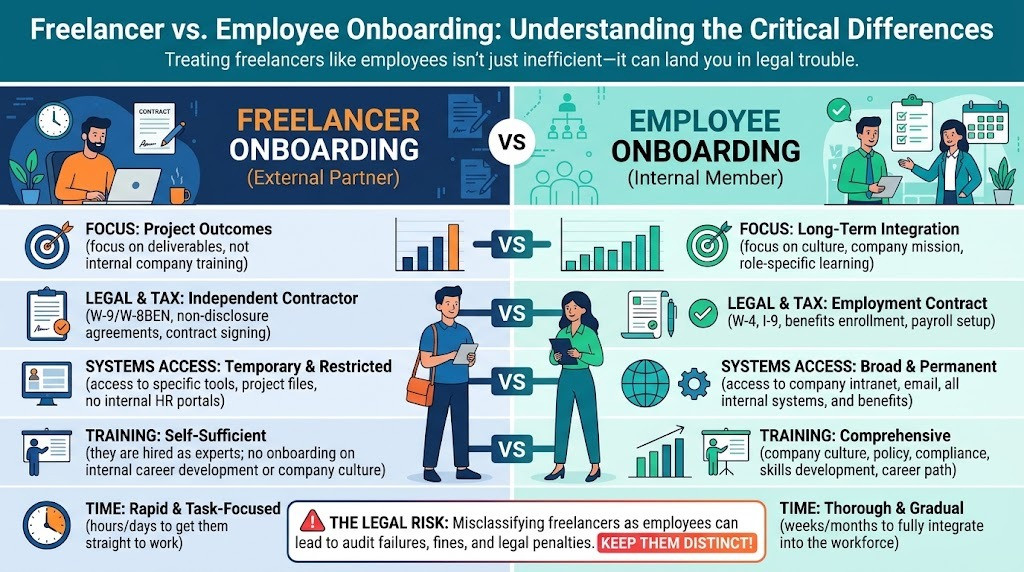
One of the most serious errors that can be committed by project managers and HR personnel in dealing with freelancers is to adopt the same method that has been applied to onboarding normal employees. This not only makes no sense, but it might even land you in legal trouble. Here is a comparison between the two types of onboarding:
1. Pacing and Duration
Employee onboarding is a marathon. It can take from 30 days, to 60 days and even 90 days, focusing mainly on cultural integration, enrolling into benefits programs and team building. Freelancer onboarding is a sprint. It has to be done within 24-48 hours. Only thing that is required – immediate execution of the project.
2. Deliverables vs. Corporate Culture
When working with full-time employees you have to focus on company hierarchy, values, history of founders, vision and mission of the corporation. With freelancers, you don't have to.
You just have to teach them your company's brand guidelines, what is expected from them, who is their point of contact and what deliverables are required. Forcing a freelance graphic designer to attend a two-hour seminar about company culture would be a mistake.
3. Legal Differences and the Probability of Misclassification
It is probably one of the most crucial distinctions between the two kinds of onboarding. In order to prevent possible fines and legal problems due to worker misclassification, you need to make sure that the Freelancer onboarding reflects the true independent contractor status.
The U.S. Internal Revenue Service bases its decisions on worker classification on three major factors: behavioral control, financial control, and relationship of the parties. Other jurisdictions might use other criteria for worker classification.
You need to make sure that your onboarding does not create unnecessary employer-like conditions for your independent contractors. Asking them to follow strict employee working hours, participate in non-related internal meetings, and work under close supervision are some of the things that can cause problems with worker classification.
Remember that signing an independent contractor agreement is not enough to make someone your independent contractor. The real working relationship should correspond to that classification.
Why a Structured Freelancer Onboarding Process is Critical
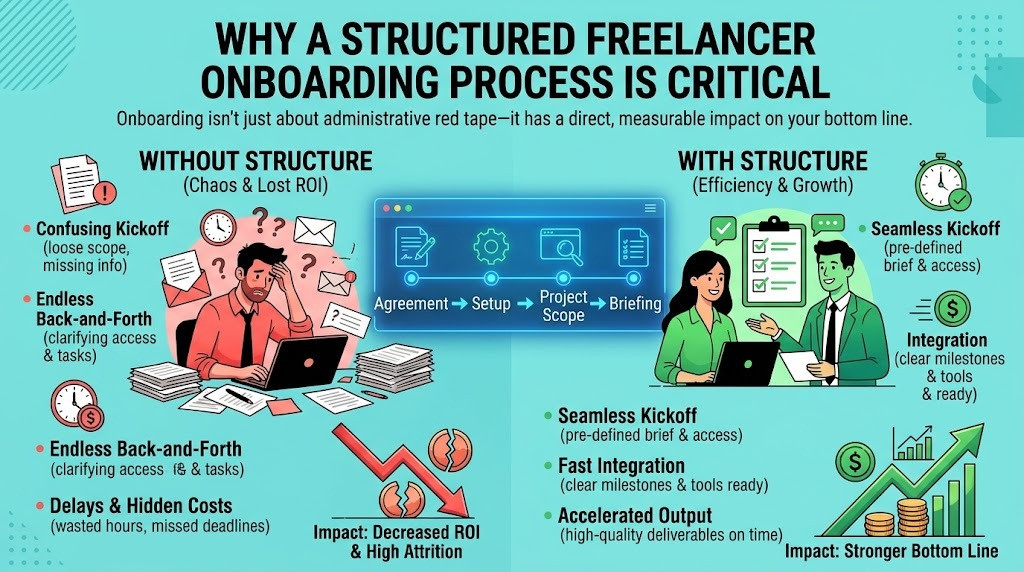
Onboarding isn't just about administrative red tape designed to appease your accounting department; it's an essential part of your operations that has a direct, measurable impact on your bottom line.
1. Dramatically Lowers Time-to-Value (TTV)
Time-to-Value (TTV) is a vital metric in business. In this case, TTV can be defined as the amount of time it takes between agreeing to hire a freelancer until they are producing value-added work for your organization.
When the Freelancer onboarding process is a chaotic mess – with a freelancer spending their first week at your company awaiting login information, a creative brief, or an invoice submission process – you are dramatically increasing TTV.
An effective Freelancer onboarding process makes sure they get started right away. If you are paying a consultant $150 an hour, wasting an hour of their time means wasted dollars.
2. Minimizes Severe Legal and Compliance Risks
Dealing with external talent has its own set of weaknesses within your business. The formal process of onboarding can be considered as the protection you need.
-
Protection of Data: It makes sure that every contractor has signed the NDA before he or she sees how your business works internally from the data perspective.
-
Intellectual Property (IP): It requires the signing of an IP agreement, which is the assurance that you will have ownership of the final product of their work.
-
Taxes: Gathering all the necessary information on tax issues (W-9 in the United States or W-8BEN for international vendors) before starting the work will save you lots of troubles during the tax period.
3. Increases Freelancer Retention and Builds Loyalty
Top freelancers - 10x developers, great copywriters, visionaries in UI/UX design - are hard to find. They interview you just as much as you interview them. And if the first interaction with your company is a scattered email thread, confusing brief and delayed first payment, they fire you as a client.
The professional Freelancer onboarding process shows them respect. It creates trust and builds loyalty, making sure that when you need some urgent project done, they put your project above all the other ones.
4. Improves Project Quality and Brand Consistency
It would be absurd to believe that the freelance writer, video editor, or designer would be aware of the brand tone and image when he or she has never even been given a chance to look at the company’s style guide before working for the company.
Onboarding allows external employees to have easy access to the company’s style guide, tone guide, hex codes, and previous successful campaigns.
Common Pitfalls in Freelancer Management (And How to Avoid Them)
Despite best intentions and superb organizational skills, even the best internal teams fall victim to some typical mistakes in the process of working with external people.
1. The Silent Killer: Unclear Expectations and Scope Creep
"Scope creep" is truly the worst nightmare of freelance projects. This takes place when there are no clearly defined expectations regarding the deliverables, time frame, and number of revisions allowed from the very beginning.
As a result, the initially agreed-upon task, like "designing a landing page," morphs into "designing a landing page, writing the copy and creating three social media graphics." It results in pressure for more money from angry freelance professionals and frustrations from the internal team about overspending and not meeting deadlines.
2. Crippling Administrative Bottlenecks
The most significant challenge is the exchange of agreements through emails, the gathering of banking details and manual approval of the invoices. Whenever it is up to the project manager to remember to forward a PDF contract to the accounting team, mistakes will happen. Contracts will go into spam folders, autoreplies will postpone any approvals, and kick-off of projects won’t take place.
3. The “Information Silo” Syndrome
There’s no shortage of freelancers who can solve one particular problem in your company. What most companies fail to do is give a freelancer access to tools that help them solve the problem.
An "information silo" is when the freelancer cannot access all the necessary tools for their work — it could be something like Jira, Figma, HubSpot, CMS, as well as the people and materials that they need to talk to and use.
Step-by-Step Guide: How to Improve Your Freelancer Onboarding Process
Step 1: The Pre-Onboarding Stage (Preparation)
The Freelancer onboarding starts way before the signing of the contract. Preparation is very important.
Internal Teams' Preparation:
Make sure to inform your teams about a new freelancer who is going to join a certain project. Inform your IT team if there are some licenses of software or some other requirements (for example, access to the company's VPN). Inform your accounting team about the new vendor so that they wouldn't be surprised by the first invoice from the freelancer.
Preparation of Documentation:
Do not start preparing contracts right when you have picked up a new freelancer. Make sure that you have prepared all necessary documentation (Master Service Agreement (MSA), NDA and DPA templates) which only require filling in the data of the freelancer and his/her rates.
Step 2: Streamline Legal and Financial Paperwork
It’s absolutely essential that you get all the administrative documents sorted out without any pain and delay.
Digitalize Everything:
Don’t ever ask freelancers to print, sign, scan and send you documents via e-mail. It’s very unprofessional and time-consuming. You should use the software for digital signatures (or the platform with its built-in functionality) to make all the agreements legal and quick.
Financial Transparency:
At this stage, you should determine how you’re going to pay the freelancers. Is it going to be Net 30, Net 15 or you’ll be making the payments per milestones? Obtain their tax forms and financial details (routing number, Swift code, etc.). The critical step here is to obtain their W-9 form before the first invoice comes in..
Step 3: Provide a Crystal-Clear Project Brief and SOW
Statement of Work (SOW) is probably the most important piece of paper you will use during Freelancer onboarding. This is the one piece of paper that will hold the whole engagement together. A good, conflict-proof SOW should contain:
-
Exact, Measurable Deliverables: What is exactly going to be delivered? Be really specific. (Example: "Three 1,000-word blog posts that will be SEO optimized for [Keyword], delivered in Google Docs" vs. "Some SEO content marketing").
-
Deadlines & Milestones: Set exact dates when first drafts should be delivered, when revisions are to be made, and final deliveries made.
-
Maximum Number of Revisions: Specify the number of revisions that will be included at your rate ($$). Specify the amount that each hour will cost in case there are 1 or 2 revisions.
By including such a clause in your statement of work, you can greatly minimize the chances of any potential scope creep in advance.
-
Definition of "Done": What defines project completion?
-
Work Not Included in Project Scope: Just list it briefly.
Step 4: Set Up the Tech Stack and Access Management
A careful balance between security and efficiency needs to be struck when giving access to external individuals who have access to your internal systems within the corporation.
Apply the Principle of Least Privilege:
Never provide a freelancer with unfettered access to all parts of your company’s Google Drive, internal Wiki, and global Slack workspace. Establish a limited-access environment.
Establish Workspaces:
Establish a separate Slack channel (using Slack Connect), establish a separate Notion page that is accessible only by them, or set up a restricted GitHub account. It will give them everything that they need in order to succeed while safeguarding your internal data from any outside exposure.
Step 5: Establish Firm Communication Protocols
Ineffective communication is one of the main causes behind all kinds of issues that happen with freelance work. Get everything clarified at the very start.
Select one Point of Contact (POC):
It makes no sense that freelancers try guessing who exactly they should talk to for approval and advice, getting three managers' conflicting reviews.
Appoint a single internal representative who would handle the communication with the freelancer, gather all internal feedback, and pass it on to the freelancer.
Establish Communication Channels & Frequency:
Define explicitly how you are going to communicate ("Let’s use our shared Slack channel for quick everyday queries but send emails for deliverables & invoices submission.") and when you will be meeting up ("Let’s have an asynchronous catch-up of 15 minutes each Tuesday, no meetings needed.").
Step 6: The Kickoff Meeting
In spite of how asynchronous and remote many freelancers are, a quick video kickoff call is perfect for getting everyone on the same page.
Be Brevity Personified:
Never go beyond 15 to 30 minutes maximum. Freelancers' time costs money.
The Best Call Agenda:
This will give you the chance to introduce the internal point of contact, run through a quick review of the SOW, show brand guidelines/mood boards, and most important of all, address any immediate questions that the freelancer has with regard to the brief.
Leveraging Tech and AI (The Gigmint.AI Advantage)
Handling the six phases described above using manual spreadsheets, reminders on your calendar, disconnected Google Docs, and endless email threads just isn’t scalable. Once you have more than a few freelancers at your disposal, you will find that the manual process described above will overwhelm the productivity of your team. You need to use technology to help do the heavy lifting.
The Power of Centralized Gig Management Platforms
The problem with disjointed tools is that they result in disjointed and messy workflows. Using DocuSign for the contract stage, Slack for the communication stage, Asana for the project management stage, Google Drive for the asset storage stage, and PayPal for the invoice stage generates tremendous friction.
This is exactly where centralized gig management platforms like Gigmint.AI come into play.
Using an online portal such as Gigmint.AI, one can achieve the following results:
-
Centralize Documentation: NDAs, MSAs, and tax documents all stored in one safe and regulatory compliant space.
-
Milestone Tracking: Monitor the progress of the project graphically through the SOW without having to be hands-on at every turn.
-
Conduct Contextual Communication: Conduct project-based communications in relation to the deliverable.
-
Automation of Global Payroll: Processing of invoices as well as payments to freelancers in their respective local currencies without hassles. Centralization eliminates all administrative bureaucracy and provides insight to executives about ROI of the external labor force.
Embracing AI-Driven Workflows
Artificial Intelligence is revolutionizing the process of onboarding temporary employees for organizations. Today’s systems employ AI to automatically create extremely detailed project descriptions and SOWs through simple conversational input by project managers.
AI technology can also review independent contractor contracts for potential problems with compliance in the locale where they work, trigger the next stage of the onboarding process immediately upon signing of the contract, and produce automated performance reports based on time of milestone achievement.
The Ultimate Freelancer Onboarding Checklist
Refer to this extremely practical checklist in order to make sure that nothing is overlooked whenever you have an independent contractor join your ecosystem. With such a procedure incorporated into your firm's SOPs, you can be assured that everything will be handled professionally and securely every time.
MSA/Contract Signed: Legal document defining all terms for the business relationship between the two companies including the rates and termination conditions.
NDA Signed: Complete confidentiality of all company proprietary information and client lists.
Intellectual Property (IP) Agreement: Ensuring that the company owns the deliverables after the project completion.
Tax Information Obtained & Verified: Safely obtained and verified W-9 tax info for US citizens and W-8BEN tax info for foreign nationals.
Payment Information Collected: Information required to issue the invoice or wire transfer obtained through invoicing or payment portal.
SOW/Project Brief Approved: Terms of the work that will be performed, what is included/not included, deadlines, and the amount of revisions.
Brand Guideline Supplied: Style guide, tone of voice guide, personas, logos, colors (in hex code), fonts.
Tools & System Access Provided: Limited access to the required systems (Slack Connect, CMS, Figma, Jira).
Internal Teams Notified: The stakeholders and IT are informed about the freelance contractor's access and role.
Kickoff Call Done: A 15-to-30-minute kickoff call done with internal Point of Contact (POC).
Measuring the Success of Your Onboarding Process
You cannot optimize a process which you don’t measure. To be able to confirm that your Freelancer onboarding process works and you receive ROI for its implementation, you have to monitor the following KPIs:
1. Time to First Deliverable (TTV)
How long it takes for the company to receive the first deliverable after the last signature of the contract? The lower it is, the higher efficiency of the onboarding process you have.
2. Freelancer Satisfaction Score (NPS)
Set up an automatic two question survey for the end of each project where the freelancer has to evaluate his/her onboarding experience on a scale of 1 to 10. High score – means that you create a pool of talent.
3. First-Task Error Rate
Examine carefully the first deliverable submitted. In case it needs huge and fundamental revisions because it doesn’t fit the brand tone at all, it means that the onboarding process regarding the project brief and brand guideline is not done correctly.
4. Administrative Onboarding Time
Monitor how much time it takes for the HR or project management team within the company to onboard one freelancer. In case it takes 4 hours of manual efforts, then you need to automate it via a platform such as Gigint.AI
Frequently Asked Questions (FAQs)
1. What should be the time for Freelancer onboarding?
In an ideal situation, Freelancer onboarding should happen within 48 hours. Freelancers have been hired to accomplish certain tasks quickly. Therefore, the process should be quick, all digital, and concentrated on the specifics of the current project only.
2. Should freelancers be provided with an official company email id?
In general, no. The freelancer can typically be allowed to use his/her own business email IDs for the communication purposes while dealing with your company. An email ID of a company may be provided in order to establish a similar working relationship to that of employees in some situations, though the mere provision of email ID will not classify workers as such.
Unless the provision of the email ID is required by any particular security or operational reasons, the freelancer should be allowed to use his/her own business email IDs.
3. How should you onboard international freelancers differently?
In terms of operations, everything stays the same, but finance and legal compliance vary. You have to provide a W-8BEN form rather than a W-9 (in case you hire from abroad for a U.S.-based company).
You need to set up a good payment channel that won't cost too much, and be extra attentive about huge time zone disparities during initial communication protocol setting and kick-off sessions.
4. What is the worst mistake companies commit while hiring freelancers?
It's working with freelancers in two extremes – either treating them as full-time employees (making them come to your company-wide gatherings and work certain hours), or making them psychics (giving them a task and forgetting all about branding, system accessibility, and communications).
Call To Action
The gig economy provides amazing possibilities for scaling up rapidly, accessing global niche expertise and remaining competitive in the rapidly changing marketplace.
But without proper organization of the Freelancer onboarding, all these possibilities would be wasted as a result of missed deadlines, massive exposure to legal risks, budget overrun and dissatisfaction among the freelancers themselves.
Having an organized step-by-step approach to the problem, such as digitalizing legal documents, drafting bulletproof SOWs, setting communication rules – you will enable your freelance team to operate at their best right from the start.
Say goodbye to cumbersome spreadsheets, disorganized emails, legal compliance nightmares, and postponed start dates of projects.
It’s time to give your freelance team the same organizational attention as any other team.
If you are searching for an effective method to streamline the process of Freelancer onboarding, freelancer documentation management, workflow automation, and global payments to freelancers, then look no further.
Gigmint.AI can be used to manage your freelancing team, making freelancer management easier and reducing administrative lags in order for your independent workers to perform at their best.