10 Best Practices for Onboarding Freelancers: The Ultimate 2026 Guide
10 Best Practices for Onboarding Freelancers: The Ultimate 2026 Guide
There has been a complete transformation in the manner in which workforces have been organized by 2026. The 9 to 5 structure that companies had been using as a standard method to hire top-level professionals for certain specialized professions including AI, software engineering, and data analytics is not as effective as before.
Companies have begun to use liquid workforce, which includes independent contractors with top expertise. It becomes easy to hire such talents via platforms like Gigmint.AI, but companies have found integration of these hires a huge barrier.
Imagine this situation. Your company has just hired a great machine learning engineer to be working for the next three months. You are very enthusiastic to witness the outcomes immediately.
You end up spending the first two weeks of their arrival without work due to a poor onboarding process with no access to the API keys, confusion about project requirements, and waiting for some legal documents. It is not only time-consuming but also costly for your company.
The main issue here is that many founders, HR specialists, and hiring managers continue to neglect freelancer onboarding. Some of them even mix it with employee onboarding, forcing contractors to go through weeks of cultural immersion and HR video training instead of giving them necessary context, clear deliverables, and easy access to all needed tools.
A proper onboarding procedure specifically tailored to the specifics of freelance projects is crucial for achieving productivity and avoiding legal issues as well as establishing long-lasting connections with your extended team.
This guide will walk you through 10 must-have onboarding procedures for freelancers in 2026. These are not just tips. These are the actions taken by high-performing startups and enterprise companies to maximize the potential of independent contractors and integrate them into their teams.
By the end of this article, you will be able to create a comprehensive freelancer onboarding checklist and make sure that your investments pay off. And once you need to hire the best talents, Gigmint.AI is there to help you with the sourcing, vetting, and hiring.
Why Freelancer Onboarding Is Different and Why It Matters
But before we get into the actual checklist, there needs to be some understanding of why you need an individual onboarding process for your freelancers. Applying your tried-and-tested employee onboarding process to a contractor will only lead to inefficiencies and even possibly legal troubles.
Employees vs. Freelancers: The Main Difference
The main difference between the two can be found in the nature of their involvement in your business processes.
When hiring an employee, you are getting someone who will stay with your company for a long time, whose onboarding will have cultural aspects, will be aimed at long-term career development, will involve understanding all the subtleties of the political climate inside your company, and whose job description might change over time.
When working with a freelancer, you hire someone who will do something specific for you in a set amount of time.
This person is basically a business owner offering their services and they do not need to know all the history of your company picnics or intricacies of your 401(k) matching program. They need context right now, a clear scope of work, and quick access to necessary tools.
The Cost of Getting Freelancer Onboarding Wrong
Onboarding a freelancer like an employee can create several risks for your business.
Misclassification and Compliance Issues
This is one of the biggest risks. When you require the freelancer to attend meetings that are not essential, use company equipment when it is not required, and control the way the task is performed instead of focusing on the outcome, government organizations such as the IRS may consider the person to be an employee.
This can result in additional taxes, penalties, and compliance issues. You should onboard the person according to their independent contractor status.
Wasted Budget and Lost Productivity
If a freelancer starts to work on Monday but only receives access to your GitHub or Jira account by Thursday, you waste several days of the project budget on unproductive time.
Data Security Risks
If there is no system for granting and revoking system access for a freelancer, you might leave your data unprotected for too long after the end of the contract.
Project Failure and Freelancer Turnover
Confused expectations during onboarding can result in misaligned goals and poor project outcomes. This can ultimately lead to frustration and frequent freelancer changes.
The ROI of Getting Freelancer Onboarding Right
Proper freelancer onboarding can produce significant benefits for businesses.
Faster Time to Value
When your freelancer is properly onboarded, they are ready to create a billable impact from the beginning of the project.
Better Quality Output
Clearly defined expectations from the start help reduce revisions and ensure that the final results meet your requirements.
Building a Reliable Freelancer Bench
Freelancers talk. If you treat them professionally and respectfully, you can become a client of choice. This makes it easier to build a reliable network of highly skilled specialists who want to work with you again in the future.
Pre-Onboarding: Setting the Stage for Success
The most successful onboarding occurs before the freelancer's first day. This stage should prepare the ground for administrative and strategic readiness.
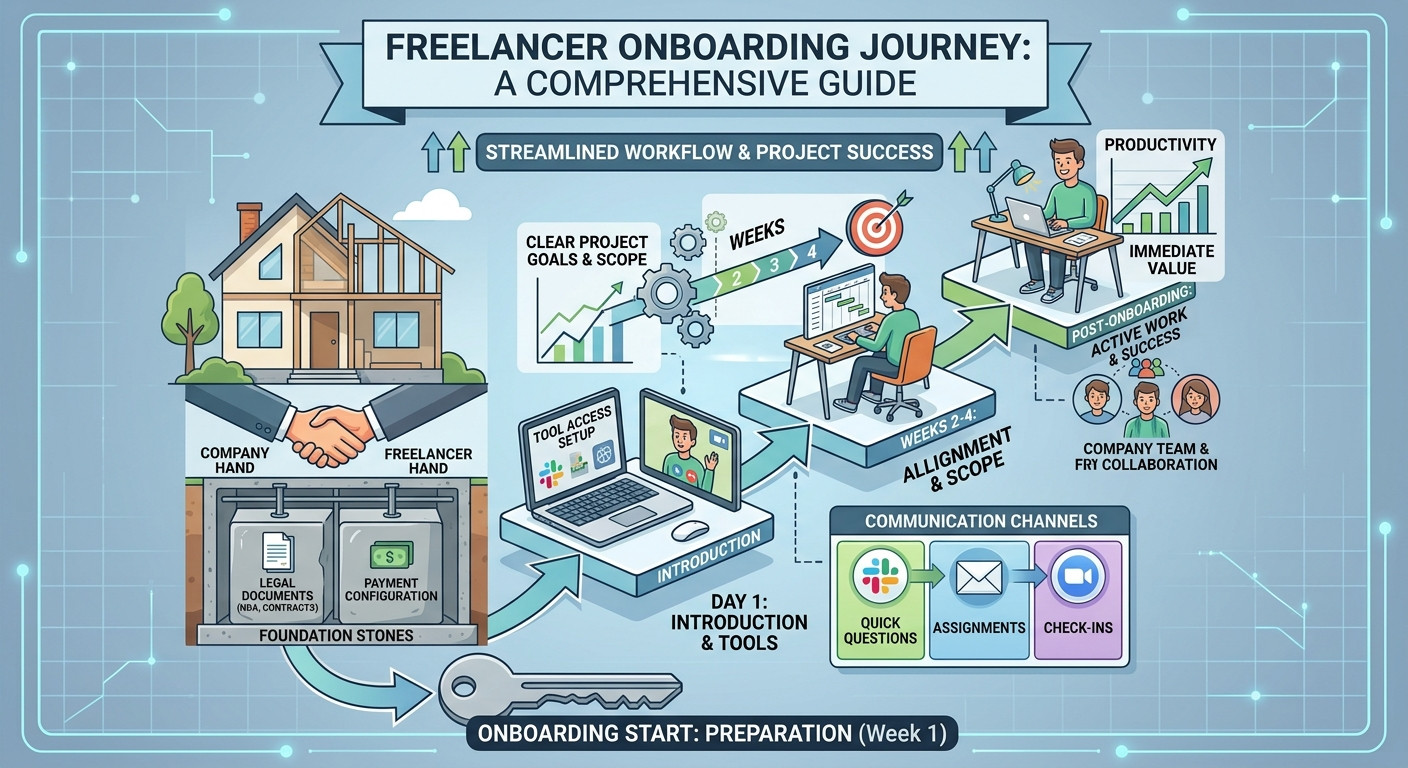
Consider pre-onboarding like building a house. When the foundation is shaky or there are delays in its construction, the whole process becomes compromised. An unnecessary delay in signing an NDA or a vague vision of the project's goals can immediately create problems and make the project appear disorganized.
The purpose of pre-onboarding is to deal with potential friction points such as legal documents, payment configuration, and tool preparation before the project begins. When the freelancer's first day arrives, the focus should be on the work itself.
10 Best Practices for Onboarding Freelancers
1: Define the Scope of Work Clearly
A clearly defined Scope of Work is critical for productive collaboration with freelancers. General requirements often result in general and unsatisfactory outcomes.
Simply hiring a specialist and telling them, "Help us create an AI strategy," does not provide a clear deliverable. It is an aspiration rather than a defined outcome.
Your SOW should include everything that needs to be completed. This means defining the deliverables, their format, quantity, and deadlines.
If you require someone to improve your data, your SOW could specify that they need to label a dataset of 10,000 images according to provided instructions in JSON format by a specific date.
You need to establish clear acceptance criteria. This defines how you will determine whether the task has been completed successfully. Doing this helps eliminate ambiguity and reduces the risk of scope creep.
2: Handle Legal and Compliance Verification Upfront
Do not give a freelancer access to your code or internal information until the necessary legal documentation has been completed. It is important to ensure that intellectual property rights and other legal requirements are addressed.
First, classify your workers correctly. You need proper documentation to establish that the person is an independent contractor. For US citizens, the required form is generally a W9, while international contractors may use the W8BEN depending on their circumstances.
The necessary agreements may include a Master Services Agreement that covers general terms and conditions, a Non-Disclosure Agreement that protects confidential information, and an IP assignment agreement that establishes ownership of work delivered by the contractor. Because freelance hiring can involve different jurisdictions, contracts should be appropriately localized.
3: Define Payment Terms Before Starting Work
Freelancers operate as independent businesses, so clear payment terms are essential for maintaining a strong working relationship. Any ambiguity around payment can lead to disputes and negatively affect the relationship.
Before work begins, establish whether you will pay a fixed project price, hourly rate, or daily rate. Define the milestones, explain the invoicing process, and specify when payments are due.
Tools such as Gigmint.AI can make payment management easier by providing payment integration tools such as Stripe for international transactions and escrow.
4: Prepare a Curated Digital Welcome Package
You should not overwhelm your freelancer with a lengthy employee handbook, but they still need enough background information to succeed. Prepare a concise digital welcome package that includes information relevant to their specific assignment.
Include Relevant Brand Guidelines
Brand guidelines are particularly important for designers, writers, and front-end developers working on customer-facing materials.
Provide Your Tone of Voice Guidelines
A tone of voice document helps freelancers understand how your company communicates with its audience and is especially useful for anyone producing content on behalf of your brand.
Create a Key Contacts Directory
Provide a simple list explaining who the freelancer should contact for specific needs. For example, they may contact one person for API access and another person for invoice approval.
Create a Project FAQ
Include answers to common questions about the project's workflow, technology, tools, and processes so the freelancer can find important information without unnecessary delays.
The welcome package should remain concise. Avoid filling it with unnecessary company history or internal policies that are unrelated to the freelancer's assignment.
5: Provide the Right System Access
In today's digital environment, cybersecurity is an important part of freelancer onboarding. Access should be prepared before the freelancer's first day, but it should follow the principle of least privilege.
Identify precisely which systems the freelancer needs to complete the Scope of Work. This could include specific Slack channels, a Jira board, a dedicated GitHub repository, or design tools such as Figma.
Whenever possible, use guest access options rather than providing unnecessary access to your entire organization. The most important step is to have a reliable process for revoking access when the contract ends.
6: Run a Focused Kickoff Meeting
The kickoff meeting is the point where the project moves from the organizational stage into implementation. It does not need to be an extended introductory seminar. A focused meeting of around 30 to 45 minutes can be sufficient.
Review the Scope of Work
Confirm the deliverables, acceptance criteria, responsibilities, and expectations so everyone has the same understanding of the project.
Confirm Deadlines
Agree on the project milestones and final delivery deadlines before the freelancer begins work.
Explain the Bigger Picture
Explain how the freelancer's work contributes to the wider objectives of the company. Providing context allows experienced freelancers to make better decisions.
Explain the Feedback Process
Make it clear how the work will be reviewed, who will provide feedback, and when the freelancer can expect responses.
Following the meeting, create a brief record of what was discussed and decided so everyone has a clear reference point.
7: Establish Clear Communication Channels
Questions such as "Where should I send this?" and "When will you review it?" should be answered from the first day. Poor communication can result in lost files, misunderstandings, delays, and frustration.
Determine which communication tool should be used for each purpose. For example, Slack can be used for quick questions and blockers, email can be used for assignments and invoices, while Zoom can be used for a short weekly check-in.
You should also establish response-time expectations. If freelancers can expect a response within 24 hours, communicate that clearly. At the same time, the company needs to meet those expectations because unnecessary waiting can reduce productivity and increase project costs.
8: Give Context, Not Just Tasks
One of the most common mistakes businesses make is treating freelancers as order-takers who receive tasks without context.
Freelancers do not need to know every detail about your company, but they will generally perform better when they understand the purpose behind their work.
Explain why the task is important. Who are the target users for the new product feature? Why was a particular AI model selected to achieve the business objective?
Providing this context allows experienced freelancers to use their expertise, make better decisions, and produce more effective results.
9: Create Checklists and SOPs for Recurring Work
When you plan to work with a freelancer on an ongoing basis, consider creating basic Standard Operating Procedures for recurring tasks.
This can be useful for activities such as AI data labeling, technical content writing, regular reporting, or code maintenance.
SOPs do not need to be lengthy manuals. A simple explanation of the steps involved may be enough.
You can also use short asynchronous videos to demonstrate recurring processes. For example, a five-minute Loom video showing how to use an internal application or prepare a specific report can save numerous emails and training sessions in the future.
10: Create a Constructive Feedback Loop
Do not wait until the end of the project to assess the quality of a freelancer's work. Waiting until the final stage can result in major and expensive changes.
Instead, conduct milestone reviews early in the project. For example, review the work when approximately 10% or 20% of the project has been completed. This allows you to confirm that the freelancer has understood the brief and that the project is moving in the right direction.
Feedback should also work both ways. While reviewing progress, ask the freelancer whether they are receiving answers on time and whether they have all the tools and resources they need.
How to Automate Freelancer Onboarding
As your business grows and you increasingly depend on a flexible and remote talent pool, manual onboarding can become a serious challenge. Managing multiple contracts, access permissions, and tax forms through email can be difficult to scale and can increase the risk of human error.
Automation can help streamline the process.
Businesses can use specialized tools and integration platforms to automate contract creation and signatures, payment releases after milestones are completed, and IT provisioning for assigning and removing software permissions.
Platforms such as Gigmint.AI can help centralize parts of the freelancer management process, including vetting, payments, and project brief management. This allows hiring managers to spend less time on administration and more time executing projects.
How to Measure Freelancer Onboarding Success
Implementing these 10 best practices is the first step toward creating an efficient freelancer onboarding strategy. Businesses also need to measure whether the process is actually working.
Time to Productivity
Measure how quickly a newly onboarded freelancer can produce their first high-quality deliverable. A shorter time to productivity generally indicates that the onboarding process is effective.
Freelancer Retention and Re-Engagement
Track whether skilled freelancers want to work with your company again. Strong re-engagement rates can indicate that freelancers had a positive experience working with your business.
Freelancer Feedback Scores
Ask freelancers directly about their onboarding experience. A short survey conducted during or after the project can reveal areas where the onboarding process can be improved.
Frequently Asked Questions About Freelancer Onboarding
How Does Freelancer Onboarding Differ From Employee Onboarding?
Employee onboarding is generally focused on integrating employees into company culture, history, processes, and long-term career development.
Freelancer onboarding is more functional, focusing on immediate project context, clearly defined deliverables, and quick access to the resources required to complete the work.
How Long Should Freelancer Onboarding Take?
Compared with employee onboarding, freelancer onboarding should generally be much faster. Administrative tasks such as legal documentation and system access should ideally be completed during pre-onboarding.
The initial kickoff meeting can then focus on project alignment and should generally take around 30 to 45 minutes.
Should You Give a Freelancer a Company Email Address?
Providing a freelancer with a company email address may not always be necessary. Depending on the circumstances and jurisdiction, the nature of the working relationship can affect contractor classification.
When possible, businesses can consider guest-access functionality on platforms such as Slack or Microsoft Teams.
How Should You Onboard Freelancers Working Across Different Time Zones?
Asynchronous communication can make onboarding easier for freelancers working across different time zones.
Businesses can use recorded videos, detailed SOPs, and comprehensive Scopes of Work to reduce the need for repeated meetings. When a kickoff meeting is necessary, choose a time that overlaps reasonably with the freelancer's working hours.
What Is the Most Efficient Way to Pay International Freelancers?
Managing international wire transfers and different tax requirements manually can be complicated. Using a global talent platform with integrated payment capabilities can simplify the process and reduce administrative work.
Build a Better Freelancer Onboarding Process
The period of spontaneous and disorganized contracting management is over. Having a systematic and rigorous onboarding procedure is not merely an advantage. It is essential for getting the most value from a flexible workforce.
With a clearly defined Scope of Work, appropriate legal documentation, streamlined system access, and an effective feedback process, businesses can turn individual freelance engagements into an efficient workforce strategy.
A well-structured onboarding process can reduce unnecessary delays, improve project performance, minimize risks, and help businesses build relationships with talented independent professionals.
The general rule is simple: treat your freelancers with the same level of professionalism you expect from the work they deliver.
It is time to build your flexible and remote dream team.
Do not let administrative processes slow you down. Publish your project on Gigmint.AI and connect with skilled independent professionals. Use the platform to simplify the hiring process while applying the freelancer onboarding best practices outlined in this guide.