10 Content Ideas for Tech CEOs That Drive Enterprise Growth
10 Content Ideas for Tech CEOs That Drive Enterprise Growth
Why Technology CEOs Cannot Delegate Their Voice
As a technology leader today, you know that enterprise B2B sales processes have been transformed. As per the research of the Edelman-LinkedIn B2B Thought Leadership Impact Report, more than 80% of enterprise decision-makers indicate that the thought leadership of the executives plays a direct role in vendor selection.
Over 70% of these enterprise decision-makers state that most of the CEO's content they receive is just generic corporate content that provides no insights whatsoever.
You did not set up a software business to be yet another source of repurposed motivational quotes on LinkedIn or to approve generic corporate press releases. The modern enterprise buyers and tech leaders have to go through what is known as digital fatigue.
With the advent of generative AI solutions, creating low-level blog posts and marketing content has become easy and cheap; thus, there is a digital clutter all around us.
An enterprise buyer and tech procurement team does not review the marketing brochures while making a six-figure or seven-figure software deal. They want to hear what the CEO has to say about industry challenges.
This is why coming up with high-leverage content ideas for tech CEOs has now become a board level imperative rather than a minor marketing activity. Corporate logos cannot create trust in an uncertain market environment; people who have technical conviction and clarity can.
High-leverage content ideas for tech CEOs help shorten enterprise sales cycles, neutralize the most skeptical security evaluators, and recruit the best engineering talent that would like to build alongside an executive that has a grasp of his craft.
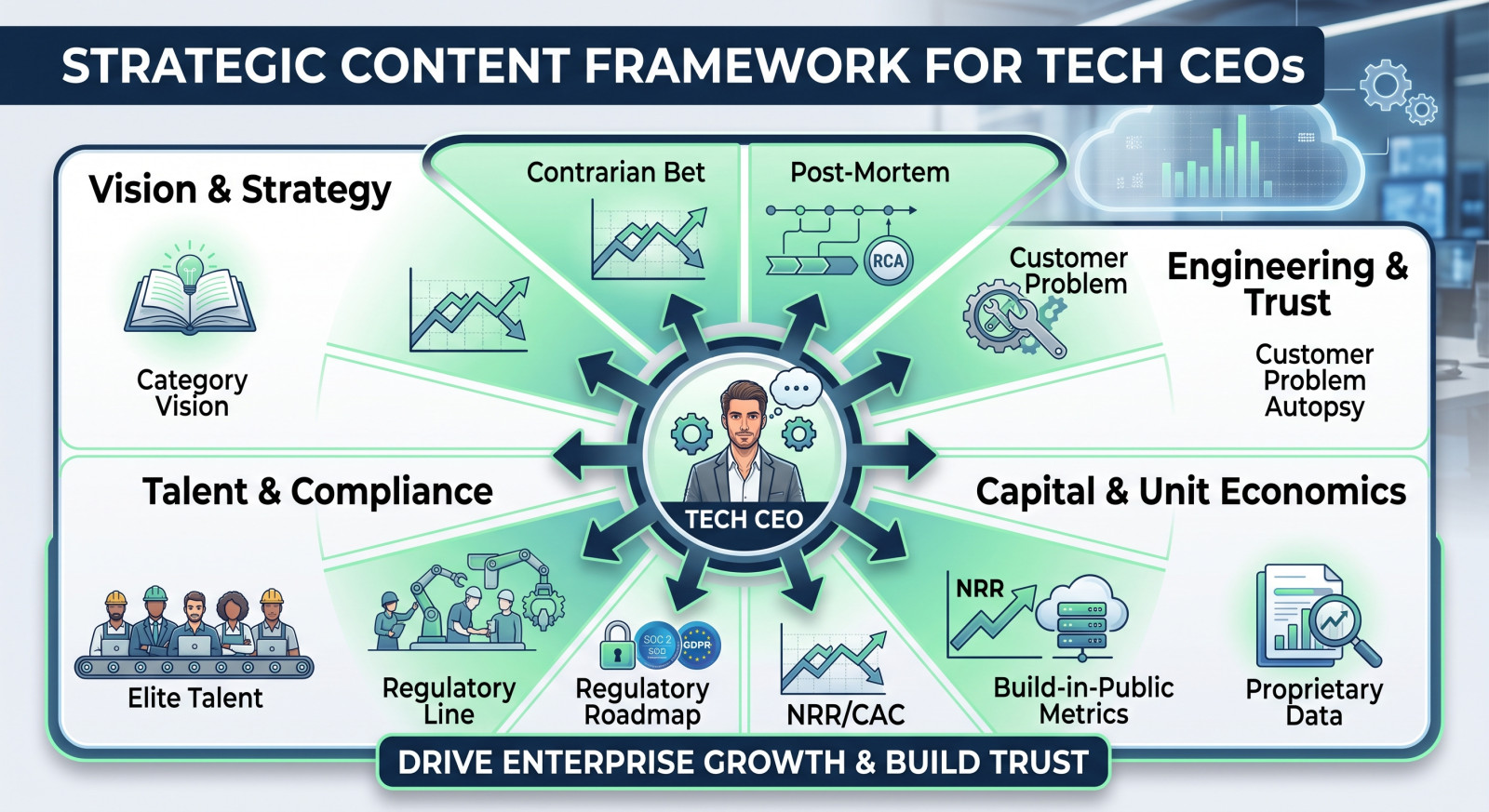
The key thesis of this guide is simple – when you execute deliberate and high conviction content ideas for tech CEOs, you create an uncopyable competitive advantage around your point of view as opposed to spending money on ads in a hope that others would see and emulate you. Below are ten examples of how you can create such content ideas and which formats are required.
1. Defining the Problem Space
The reason why most software vendors find themselves in tough spots isn’t because of any deficiencies in the core code of the system. It’s because they allow competing companies and legacy players to establish the definition of the market space they operate in.
A category vision manifesto is not a product announcement or even a preview of what is coming next in terms of roadmaps. It’s a statement of the new paradigm of how computing, data, or operational infrastructure works.
In the context of identifying successful content ideas for tech CEOs, the manifesto ranks first in terms of strategic importance. Think of how Marc Benioff presented "The End of Software" during the early days of Salesforce.
Instead of trying to match features with the existing on-premise titans, he was able to position on-premise software as a legacy product imposing unnecessary costs on businesses.
According to the Gartner research, successful category creation by companies is worth up to 76% of total market capitalization of that specific market niche.
The Three Elements of an Effective Category Vision Manifesto
Identify the Legacy Enemy: Describe the out-of-date way of doing things that currently exists in the marketplace. This could be bloated, monolithic software architecture, long annual cycles for release, or a legacy recruiting model.
Describe the Tectonic Shift: Describe the technological or economic turning point which renders the old paradigm irrelevant. This could be cheap cloud inference, innovations in distributed computing, or a fast-growing flexible engineering talent pool.
Describe the Future Inevitability: Explain what the world will look like in five years from now. Describe how the firms that continue to operate using the old paradigm will be left behind, whereas those who embrace change will experience exponential increases in efficiency.
2. Earning Trust Through Vulnerability
In case of a massive outage of the cloud infrastructure and failure of a production release, the typical company reaction is silence, followed by some legal disclaimer.
The traditional playbook on marketing considers technical malfunction as an existence-threatening embarrassment that should be kept under the carpet. But in modern enterprise technology, this strategy is absolutely wrong.
Experienced enterprise customers understand that complex distributed systems will fail. They only wish to learn how your engineering management team handles this.
An uncensored engineering post-mortem becomes one of the most powerful and counter-intuitive ideas of the content for CEOs of tech companies wishing to build impenetrable credibility.
Once a tech CEO goes public with an RCA (root-cause analysis), enterprise risk aversion disappears. Companies like Cloudflare and Stripe have made a tradition out of using operational problems as a lesson in engineering systems for everyone.
With minute details about exact timings of the problem, race condition, memory leak, and dependency chain, they reinforce the image of world-class engineering organizations..
The Structure of a Credible Post-Mortem
The Granular Timeline: Create a detailed map of the chronological series of events from first realization of the problem to ultimate resolution, without glossing over any uncomfortable blunders.
The Root Cause: Identify the fundamental flaw in the architecture or in the work of humans, while avoiding any finger-pointing on an individual level.
The Systemic Mitigation: Outline the specific changes in code, regression tests or infrastructure that have been made to guarantee that this exact issue will never reoccur.
In addition to establishing credibility for enterprise customers, this type of content is a fantastic recruiting tool. Engineers and architects detest any PR spin.
If they read a CEO speak intelligently about database indexing performance issues or concurrency deadlock, they know that there is a true engineering culture there.
3. Beyond the Superficial Case Study
Classic B2B case studies no longer carry the same level of persuasive weight. Enterprise buyers have grown incredibly skeptical about predictable promotional storytelling which insists a client used your product, and magically created a 400% return on investment within two weeks.
Enterprise deployments are messy, complex, and highly political. If you release case studies that leave out all of these complexities, buyers will rightly interpret that you are being disingenuous.
Using a problem autopsy to replace tired promotional tales is one of the highest impact pieces of content a tech CEO can produce to speed up enterprise sales velocity. A problem autopsy works by investigating what really went into the deployment of your technology. You walk the buyer through the messy, complicated world of enterprise transformations and the issues encountered along the way.
In order to apply this archetype, conduct a direct 20-minute debrief session with the technical champion or sponsor from your customer's team. The focus of the debrief should be on his/her personal experience:
Which organizational hesitations did their team have prior to signing the contract?
What technical obstacles did their team discover during the third week of implementation?
How did your teams work together to overcome those edge cases?
How have the operational metrics been affected since then?
According to the Demand Gen Report data, 71% of B2B buyers examine multiple technical assets before deciding on a vendor list and consider technical content to be the most important one.
By demonstrating how you handle complex enterprise situations, you disarm any procurement teams and show them that you are not just another software vendor but an operational partner.
4. The "Future of Work & AI Augmentation" Operating Playbook
The old-fashioned way of creating a software company has become outdated. The traditional business strategy called for a tech startup to secure a huge venture funding round, lease an office, and hire several dozen developers who would need half a year to be up and running before they could produce any code.
Thanks to recent advances in self-learning AI code generators and freelance talent pools, capital productivity standards have been turned upside down.
Discussing your approach to assembling your team is one of the most topical topics to write about if you are a CEO of a tech company.
Enterprise executives and founders alike look for models on how to incorporate artificial intelligence tools into the software development process without risking the quality or security of your product. By articulating your company's approach, you demonstrate leadership in organizational innovation.
In your playbook, break down the inner workings of the modern hybrid engineering team. How does a forward-thinking tech company stay lean and laser-focused with its own systems architecture staff while expanding its specialist development capacity via elastic staffing models?
The likes of Gigmint.AI give engineering leaders the ability to bring on board certified AI specialists and freelance developers to work on specific sprints like optimization, API integration, and model tweaking without putting a strain on its balance sheet with payroll costs.
Engineering Metrics to Show
What percentage of your code is created or accelerated using AI-driven processes?
How much has your sprint speed increased over the past year?
What’s your process for evaluating and hiring specialist freelance developers so that you don’t create development bottlenecks?
Through demonstrating the modern way of doing software development, you establish your enterprise as an agile and capital-efficient organization that can out-iterate incumbents stuck in traditional ways.
5. The Build-in-Public Unit Economics & Metrics Memo

Growth at all costs days are over when it comes to financing of software products. Procurement committees, corporate boards, and investors start evaluating the discipline, efficiency, and solvability. Software providers should ensure that their enterprise buyers will be safe to know that the software provider will be alive and well in 5–10 years ahead.
Publishing a metrics memo is one of the most comforting content ideas for CEOs of technology companies who want to reduce risks of enterprise vendors.
In no way does such a form of communication involve sharing any sensitive data on salaries and financial reports. This shows that you have a good understanding of software economics of today: NRR, CAC, payback period, cloud economics, and revenue per employee.
Discuss Efficiencies That Matter, Rather Than Vanity Metrics
Calculate Cost Per Active User: Explain how your engineering team fine-tunes database queries and serverless compute instances to cut down marginal cost per unit served as volume on your platform increases.
Ticket Deflection: Describe how workflow automation and better documentation practices have cut back on customer support costs.
Efficiency Ratios that Are Organic: Show how executive content and developer relations efforts help avoid reliance on expensive paid customer acquisition tactics.
Frame this memorandum as if it were a letter to the shareholders. The mere fact of addressing your dedication to unit economic efficiencies shows that your business is designed to last.
Your enterprise customers know that they can count on working with your company because partnering with you is a safe and defensible choice regardless of macroeconomic events.
6. Taking an Unpopular Stand
Content that tries to satisfy everybody ends up satisfying nobody. When all the people within your industry are nodding along with you on the headline of your piece even before reading it, then that idea is not worth writing about.
The basis of sustainable technology firms is founded upon the idea of contrarian truths: Contrarian viewpoints in the areas of technological architecture, market forces, and organizational philosophy.
Being contrarian about the viewpoint of the technology industry is among the most daring content ideas for tech CEOs wishing to make noise in the market.
One only needs to consider the impact that 37signals made in the industry with their announcement of moving away from the public cloud to bare-metal servers due to the cost savings and performance benefits they experienced.
Important Considerations for Articulating Your Contrarian Stance
Do not Create Controversy for Its Own Sake: It is imperative that the contrarian viewpoint that you put forth in your white paper is an honest and operational stance which you yourself practice in your organization.
Start With the Common Viewpoint: Start with discussing the prevailing common industry viewpoint on the topic and why this viewpoint gained prominence in the first place.
Support Your Contrarian Argument With Data: Support your contrarian viewpoint with system benchmark data, performance latency metrics, cost numbers, or operational post-mortem studies, all of which illustrate where the common model falls flat.
State Your Alternative: Conclude with the alternative model that your organization practices and the specific operational advantages your team has gained from this contrarian standpoint.
By adopting this informed contrarian approach, you are making yourself stand out from other organizations which simply parrot conventional wisdom. You are proving to future enterprise customers and tech talent that your management team has strategic depth and vision.
7. The Regulatory, Security, and Ethical Governance Roadmap
For a sale in B2B enterprise sales, the main problem isn’t software features and UX/UI – it’s compliance and security review. The chief information security officer (CISO), general counsel, and enterprise risk management committee get paid to keep companies safe from liability risks, exposure to regulations, and data breaches. In today’s world of intricate international data legislation and growing artificial intelligence laws, this is an especially important point.
One of the most useful ideas of content creation is the publishing of a compliance and security roadmap for tech CEOs who want to remove the sales objection before it stops them from selling.
Rather than keeping the compliance information in a password-protected portal that clients will see at the end of the sales process, an executive statement on transparency should do the job of addressing the problems.
Essential Enterprise Aspects to Address
Data ownership and sovereignty: Explain in what way customer data is kept separate, encrypted, and stored. Specify if enterprise client data is ever made available or used to train third-party machine learning models.
Architectural security standards: Provide information about internal access controls, zero-trust network architecture, penetration testing timeline, and compliance certification including SOC 2 Type II, ISO 27001, GDPR, HIPAA.
Proactive regulatory posture: Explain how engineering architecture is prepared for compliance with future legislation, such as EU AI Act, to ensure that enterprise clients will not have any problems with compliance as laws change.
According to research by PwC, almost 90% of enterprise buyers take data transparency and security posture into account as critical factors in the evaluation of vendors.
If a technology CEO talks about compliance with relevant regulations in a very technical way, security evaluators do not need to question the control aspects and can focus on the deployment of the product.
8. How We Vet, Retain, and Scale Builders
The worldwide race to attract the best software engineers, artificial intelligence experts, and system architects continues. Career pages full of buzzwords that no talented technologist would take seriously do not impress people with real building skills.
The true builders assess a company by how much autonomy they have, how well they work as a well-oiled machine, and how sophisticated their architecture is.
Describing the engineering culture is one of the most powerful content ideas for tech CEOs who want to establish a long-term talent pipeline. When you lay out your expectations and philosophies, you filter out people who come looking for a traditional corporate setting and, at the same time, attract real builders.
How You Can Break Down Your Talent Operations
Removing the Performance Interview: Describe what makes your organization reject algorithmic puzzles on a whiteboard for more practical coding assessments or take-home assignments similar to real-world projects.
Defending Deep Work: Discuss your practices related to asynchronous working and meeting-less periods dedicated to deep work. Show how you make sure engineers are protected against calendar disruptions.
Flexible Talent Orchestration: Discuss how your organization pairs full-time systems architects with specific freelancers using resources like Gigmint.AI. This approach frees your core employees from repetitive tasks and allows them to concentrate on proprietary systems and features.
The fact that the CEO defends the engineering-first culture lets prospects understand that the technical aspect is considered at the executive level.
9. The Tactical Tech Ecosystem & Consolidation Teardown
The technology stack of enterprises faces consolidation phases approximately every decade. During prosperous times, enterprises buy several point solutions to address specific issues. This ends up in serious software bloat, duplicated software spending, and weak integration architecture which becomes burdensome for the IT departments.
The concept of an unbiased teardown of an ecosystem is one of the most authoritative content ideas for tech CEOs who want to showcase their expertise in the industry. By understanding how different tools, APIs, and frameworks work together in your industry, you become a strategic advisor, not another biased software salesman.
Ensure the Structure of Your Ecosystem Analysis Brings Practical Value
Draw the Picture of the Fragmented Ecosystem: Describe the usual modern technology stack in your vertical in terms of the variety of separate pieces of software used simultaneously by the enterprise teams.
Illustrate the Integration Overhead: Point out how difficult and costly it is to deal with fragile point-to-point APIs, different vendors, and the fragmented data storage.
Describe an Architectural Solution: Show how the platform helps in orchestrating these processes and how the software you propose should be seen not as yet another piece of software, but as the key part of the streamlined ecosystem.
Close your article with a useful evaluation framework that will help your readers to assess the situation in their companies and conduct an internal audit of the redundant software and the costs related to its integration maintenance.
10. Original Industry Data Reports
Empirical research continues to set the bar for organic search effectiveness, digital authority, and CEO credibility. When you create and share benchmark data for your company, industry analysts, journalists, and business practitioners reference your research as one of the top sources. This creates authority-building inbound links that permanently boost your domain authority.
Benchmarking original data is perhaps the most justifiable content topic for tech CEOs. Early stage tech companies have unique data sources – for example, anonymous usage metrics for their platforms, query processing speeds, changes in API latency, or how the infrastructure has been deployed amongst their clientele. Creating an annual or bi-annual report makes your company a definitive source of industry information.
Three Parts of an Effective Data Report
Aggregated Dataset: Show anonymous insights drawn from millions of platform engagements or transactions while explaining the parameters of your research and sample sizes.
Strategic Analysis: Directly relate the data to the business results of your enterprises. For instance, you can tell how certain latency increments of the system lead to lower retention rates, or how flexible allocation of engineering talent helps shorten product deliveries time frames.
Forward-looking Action Plan: Propose actionable recommendations in order to show how the enterprise technology leadership needs to change their strategy over the next year.
Then you can break down this all-encompassing benchmark report into several assets, namely a downloadable summary on Gigmint.AI, a LinkedIn analysis series, and commentary for industry publications.
By backing up your executive content with proprietary data, you will set your company apart from purely speculative articles and create a moat of authority that will not be easy for your competitors to overcome.
How Tech CEOs Execute Without Losing Time

Step 1: The Asynchronous Brain Dump (15 minutes)
Don’t create a document with an empty page. Maintain an asynchronous audio/video recording application (for example, Loom, Otter, or whatever voice memos app you use) on standby while conducting your work week.
After finishing a review of the architecture, handling a tricky enterprise objection, or after the incident debrief, make a five-to ten-minute unedited voice memo of what happened, including operational difficulties, technical trade-offs and the solution.
Step 2: The Editorial Translation Layer
Hand the unfiltered audio and meeting notes to a professional technical content strategist, internal communications manager, or a specialist writer. It’s not their job to develop the ideas themselves, but to help you express your operational knowledge using the following content strategies for tech CEOs.
They’ll make sure your main keywords are used organically, headers are logically arranged and the technical information is presented correctly.
Step 3: Executive Review and Tone Calibration (10 Minutes)
Take ten minutes before publishing to review the asset you have drafted. The goal is not to simply duplicate its elementary punctuation but to make sure it is technically accurate and expresses your true voice. Put in a spontaneous story, a contrarian statement, or explain an architectural nuance. Approve the article after verifying it.
Strategic Guardrails: Things a Tech CEO Should Not Publish
To protect your executive credibility, set up guardrails against publishing certain things in your name:
Generic Inspirational Articles: Stay away from generic productivity hacks or life advice which add no concrete value to your enterprise customers.
Bespoke Feature Promotions: Do not promote your minor feature updates through executive content. They should go in the platform's release notes, not executive essays.
Hollow Predictions: Do not make predictions without being able to back them up using real operational experience, architecture explanations, or benchmarking data.
Using this structure, you'll be able to reliably churn out top-notch executive thought leadership every week in under an hour, transforming your operational experience into a growth engine for enterprises.
Frequently Asked Questions (FAQs)
How much time should a technology CEO spend creating content weekly?
It takes about 60-90 minutes weekly for a high-leverage executive content strategy. By incorporating an asynchronous extraction process of recording short voice debriefings after customer interactions, incident post-mortems, and architecture reviews, the CEO brings authentic subject matter expertise, whereas the technical writer or content strategist does the research, structuring, and SEO.
Should a tech CEO create content alone or work with an executive ghostwriter?
The best strategy is to collaborate. The key insights, technical facts, and contrarian opinions have to come from the CEO himself. A ghostwriter who operates independently and does not get executive access would definitely produce generic and shallow content that experienced buyers will never take seriously. The task of the writer is to organize and polish the executive’s authentic insights.
How can executive thought leadership expedite the software selling process at enterprises?
Executive thought leadership resolves any technical, regulatory, or architectural objections prior to any RFP being issued, by means of sharing open engineering post-mortems, customer problem autopsies, and security governance roadmap. This helps create high-level credibility with the economic buyers, and hence minimizes the friction in the selling process.
What are the preferred distribution channels for the tech CEOs' content?
A technology leader should adopt an “owned first, syndicated second” strategy. The original, comprehensive long-form essay should be published directly to your primary company domain (like Gigmint.AI). Then, you should distill core ideas from the original essays and share it via LinkedIn analysis posts, technical developer thread on X and related industry communities.
Your Content Is Your Company's Competitive Moat
With enterprise software, there may come a day when the proprietary code can be cloned, the features in the products can be equaled by other players with plenty of money to spend, and advertising dollars may be outbid. What cannot be duplicated so easily, is the technical savvy, vision, and honesty that comes from the person who is leading the business.
By employing these proven content strategies for tech CEOs consistently, you make sure that you create a self-reinforcing engine for your business based on the knowledge that only you have. You reduce the complexity of the sales cycle, establish trust with prospective champions of your technology, and draw talented engineers to you and your vision.
If you are looking to build engineering velocity and execute your product strategy fast, you need the right talent architecture. Platforms like Gigmint.AI enable visionary technology entrepreneurs to find and hire vetted, specialized talent in AI and engineering on demand without any recruitment hassles or payroll burden.
Pick one of the ten content archetypes outlined above and record a quick ten-minute voice debrief on the most difficult experience your team had this quarter in terms of operations.