How to Build CEO Authority Across LinkedIn, Search, and Industry Media

How to Build CEO Authority Across LinkedIn, Search, and Industry Media
Even before the prospective customer signs a contract, the senior engineer takes up a job, and the journalist chooses whether to write about the business or not, someone is likely to be looking for the person leading the business.
The person might be Googling the CEO, browsing the CEO’s LinkedIn profile, reading an article that the CEO has written, or finding some interview or industry insight of the CEO. Such instances create the picture of the individual behind the company and consequently of the company as well.
This is why CEO authority proves essential in such a situation. A good product can certainly get noticed but what would eventually convince people to trust and interact with the company will be the authority of the person promoting that product.
Promoting CEO authority has nothing to do with making executives social media influencers or getting viral posts on social media. Instead, it is all about promoting the CEO’s knowledge in a credible manner across LinkedIn, search, and industry media channels.
In combination, these three channels make it easier for the CEO's knowledge base to be identified, to be proven out and verified, and for the connection between the two to become increasingly tied to the reputation of the organization itself.
This guide describes how to create that influence deliberately and systematically, from understanding CEO positioning to establishing presence and then managing the whole process without tying up executive time in the process.
What "CEO Authority" Actually Means (And What It Doesn't)
Authority, visibility, and popularity – how they differ
Visibility is when people see you. Popularity is when many people see you. Authority is when people believe you and act accordingly. These are three separate notions, but only the latter drives your business.
You can earn many impressions through motivational quotes and observations on trends. That’s visibility. A sophisticated customer who scrolls past yet another generic post about leadership and vulnerability learns nothing about whether you can help him. Authority emerges from the consistency of your views in a certain domain, which are proven right so many times that people start believing them.
That is why I always keep in mind the purpose of everything written here. You are not trying to grow the following. You are trying to build credibility that a busy executive will value in tough times.
The three-channel model: LinkedIn, search, and industry media
Why these three specifically? Because they map to how people actually form an opinion about a leader.
LinkedIn is where your professional network operates and where your thoughts live in the present moment.
Search is where people look you up the very second they make a decision about you. Your reputation is what ranks in your name – even if you didn't manage to create it.
Industry media – industry press, podcasts, speaking on conferences – delivers one thing you cannot create for yourself: third-party endorsement.
Each channel is unique in what it can do for you and feeds into the other channels. This is the key.
Why building authority is compounded
Once you stop investing in a paid ad, its work is done. This is exactly the opposite when it comes to an established CEO reputation. Once published, your article will be found next year. Your podcast episode will stay visible in search forever. Once you speak at a conference, your presentation turns into quotes and citations.
Content pieces by themselves are not the asset; your overall portfolio is. Treat building authority as an ongoing process that builds up once and pays off many times.
Before You Post — Define Your Authority Positioning
This is how most CEO brand strategies fail. They begin with the tactics, “we need to post more on LinkedIn,” rather than figuring out how the CEO wants to be seen. And as a result, they get a bunch of random posts and no particular reputation.
The positioning formula
Get your CEO’s positioning boiled down to one sentence:
Who you are + what you know + who you help + what problem you solve.
Example: A founder who helps mid-market manufacturers automate operations in order to reduce operating costs while avoiding layoffs. This is specific enough to guide your decisions on what to post going forward.
If you can’t come up with that sentence, you’re not ready to create content. Generic positioning (“thought leader in business”) doesn’t provide anything your audience can latch on to.
Choose 3–5 content pillars
With a position secured, turn it into 3-5 core themes. This is what the CEO will speak about over and over again until your market will associate this person's name with these topics.
Choose pillars where these two things meet: what the CEO really knows and what do your customers, employees and partners care about? For a B2B software company founder, these could be:
Real-life implementation of the latest technologies by enterprises
Technical debt and its costs
Engineering teams that actually ship
Industry trends in the next couple of years
The narrower, the better. A CEO with 4 topics in-depth is more authoritative than one commenting on everything.
Define your audience and their questions
Map now who your target audience is and what questions they have. Buyers want to see if you understand their problem. Future employees want to know what it is like to work with you. Journalists want an expert opinion on some complex matter.
Put down actual questions from these audiences. These questions will become your content. You will demonstrate expertise when answering questions not broadcasting messages.
Channel 1 – Gaining CEO Authority via LinkedIn
LinkedIn is the channel to be moved first because that's where the CEO's audience is hanging around anyway and one post will get it done right away. But simply posting is not enough. Here's how to become an authority on LinkedIn.
Optimize profile as landing page
Prior to publishing anything, start fixing the CEO's profile. After reading an interesting post, the visitor will want to learn more about the CEO by clicking on his profile, which has to serve as a landing page rather than a résumé.
In the CEO's profile headline, state his profession and audience rather than his title. In the About section, provide a straightforward description of his vision and knowledge from the first person perspective.
In the Featured section, pin the best piece of evidence – article, interview, presentation. It shouldn't take more than ten seconds to figure out the worth of this person.
The content mix that builds credibility
Depth differentiates authority from noise. Strive for the following content types:
Perspective posts: an opinion about something significant in your field.
Lessons from actual decisions: what you did, what happened, and what you learned. This content type is the most credible there is, since it is yours and not replicable by anyone else.
Industry commentary: a well-reasoned reaction to a development, a new regulation, or a research paper.
Answers to buyers' questions: covering the concerns that potential clients raise before reaching out to sales.
Avoid the motivational drivel and the humblebrags. Smart audiences will see right through this, and they'll actively undermine your credibility efforts.
Engagement, not merely publishing
An authority relationship is reciprocal, not a broadcast channel. The CEO who only publishes content but doesn't engage looks as if he or she were talking about the industry, not being part of it.
Well-informed comments on the posts of peers, engagement in the discussions that matter in your sphere of activity, timely responses to those engaging with your content create relationships. And those are where many business opportunities are formed.
A sustainable cadence
Consistency always wins over intensity. The CEO who posts a good thought weekly over a whole year will become more authoritative than a CEO who posts something daily for a month and disappears thereafter.
Choose an interval that aligns well with the executive's actual schedule. An approach that works only because nothing else is going on is a wrong approach altogether. Better be safe than sorry.
What to avoid
A few patterns quietly undermine everything:
Persistent self-promotion. There is only so much one can take from your blog if you make everything about selling.
Following every trend. Trying to be relevant by writing about each and every topic will undermine your established positioning.
Generalized AI content without involvement from the CEO. While AI tools might assist in creating and editing your content, if it doesn’t sound like your CEO, then it sounds like everyone else’s content.
Channel 2 — Making the CEO Discoverable in Search

Most executive branding advice stops at social media. That's a mistake. The moment someone decides whether to trust your company, they Google the person leading it — and whatever comes back is the reputation you actually have.
Own your name in Google
Start by taking control of the first page of results for the CEO's name. Ideally, that page includes a clear professional bio, authored articles, interviews or podcast appearances, a speaking or events page, and consistent professional profiles.
If searching the CEO's name returns almost nothing — or worse, returns something unrelated or unflattering — that's your first priority. You want a searcher to find a coherent, credible picture, not a blank.
Publish authored content that ranks
Search rewards useful content, so publish articles that answer the real questions your audience types into Google. These can live on your company site or on reputable third-party outlets.
Use your keyword research to guide the topics — what are people really looking for when it comes to your pillars? — but write for the human being who is going to read it, not the search engine itself. When you really provide someone with information to help them make an informed decision, that’s when your article will rank.
Build an author entity
Search engines increasingly try to understand people as entities, not just pages. You can help that along.
Make sure that the CEO has one consistent bio, photo, and name on all the channels where they publish. Create an author page on your website, then mark it up with structured data (Person schema).
Connect all profiles of the CEO and their articles on other sites in order to create a signal chain proving that there is one expert in certain areas with one name who owns the domain.
Earn links and mentions
When credible sites reference the CEO or link to their work, it strengthens both search visibility and human credibility at once. This is where search and media overlap — a feature in a respected publication is both a reputation win and a search asset.
We'll get to how to earn those in the next section, but keep in mind that the two channels reinforce each other.
Repurpose for search longevity
LinkedIn posts disappear into the feed within days. Search assets last. So take the insights that resonate on LinkedIn and rework them into fuller, evergreen articles that live on an indexable page. One good idea can serve as a quick social post today and a search-ranking article for years. Don't let your best thinking expire in a feed.
Channel 3 — Earning Authority Through Industry Media
You can say you're an expert all day on your own channels. It lands differently when a respected publication, podcast, or conference says it for you.
Why third-party validation matters
There's a reason a trade-press quote carries more weight than a company blog post: someone with editorial standards decided you were worth including. That endorsement is something owned media can't replicate, no matter how polished. Industry media borrows the outlet's credibility and lends it to your CEO.
Become a quotable source
Journalists are constantly looking for credible people who can explain things clearly and quickly. To be one of them, the CEO needs sharp, defensible points of view on the topics in their pillars — and a willingness to respond fast when a reporter needs a comment.
Offer genuine insight, not a sales pitch. A source who explains an industry shift in plain language gets quoted again. A source who redirects every question to their product does not.
Pitch contributed articles and interviews
There is a host of trade magazines and podcast shows that will eagerly take expert contributors. Approach them with something substantive: an angle that is relevant and useful to their readers/listeners rather than just marketing material for your company.
This will be all the easier if you have strong positioning and have already produced a lot of material on the subject.
Speaking engagements as authority engines
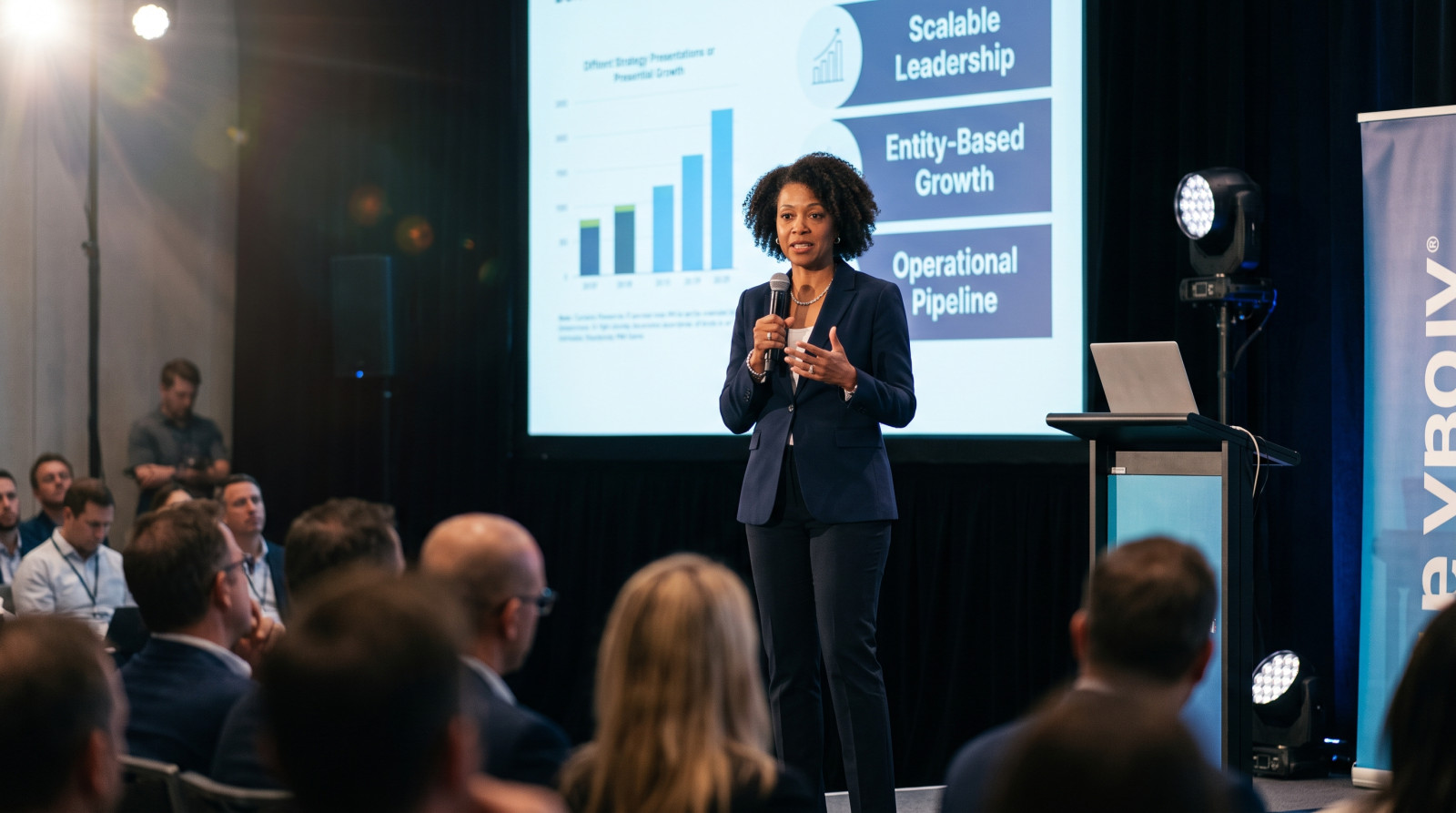
Conference talks and panels do triple duty. They put the CEO in front of a qualified live audience, they generate content — clips, quotes, slides, recap articles — and they create durable search assets that keep working long after the event. One good talk can feed all three channels for months.
Feed media wins back into LinkedIn and search
This is the flywheel that ties everything together. A media feature becomes a LinkedIn post that shows proof of credibility. That proof grows the CEO's profile authority, which makes the next media opportunity easier to land, which produces more shareable proof.
LinkedIn builds the network, search makes the CEO findable, and media validates them — and each turn of the wheel makes the next one easier.
The Operating System — How to Sustain This Without Draining the CEO
Here's the objection every executive raises, and it's a fair one: I don't have hours a week to write content. Good news — they shouldn't have to. The leaders who sustain authority don't sit down to write essays. They run a system.
The weekly insight capture
Instead of asking the CEO to produce content, extract it. Schedule a short recurring session — 30 minutes is plenty — where someone interviews the CEO about what's on their mind: a hard decision they made, a shift they're seeing in the market, a question a customer keeps asking.
The CEO just talks. The expertise is already in their head; the job is to capture it.
One insight, many formats
One 30-minute chat provides sufficient content to produce plenty of output. One conversation is enough to form the basis of a LinkedIn post, an extended article, media interview questions, and a future speech. You are not inventing something new for each medium but simply recycling one well-sourced conversation into three different mediums.
Assign ownership
A system without an owner stalls. Someone — an internal communications lead or an external partner — needs to run the cadence: schedule the sessions, turn insights into drafts, get them approved, and publish on schedule. Without clear ownership, "we should post more" stays a good intention forever.
Keep the CEO's real voice
The most important one is the following: the content that is published must fit the CEO who can defend it in a face-to-face discussion.
If a potential customer comes across some intelligent content on the Internet, but cannot get a corresponding explanation from the CEO in a discussion, the result will be lost credibility.
All content that is published must be the truth of the CEO.
How to Measure CEO Authority (Beyond Follower Counts)

The number of followers would suggest that you are making some progress, but it rarely indicates that you are gaining more power. Focus on these ones instead.
Visibility signals
The starting layer: are your ideas being discovered?
Look at content impressions and views, profile visits, and whether the CEO's name and topics are showing up in search. These tell you reach, not impact — but reach is the precondition for everything else.
Authority signals
More telling than reach is how people respond. Substantive comments from credible peers, shares by people you respect, mentions of the CEO in others' content, and — most tellingly — inbound invitations to speak, be interviewed, or contribute all signal that the market is starting to treat the CEO as an authority.
Business signals
Where it's appropriate to track, watch qualified inbound inquiries, referral conversations that mention the CEO's content, recruiting interest, and deal with the content clearly influenced.
One caution: connect these to real business processes, and resist the urge to attribute every good outcome to CEO content. Authority is part of the cause; it rarely causes results on its own.
Track patterns, not spikes
One successful post won’t make your plan work, and a bad post won’t make it fail.
Keep looking for trends.
Which topics consistently draw the right audience?
Which pieces spark real conversations?
Which ideas lead to invitations and business discussions?
Those patterns tell you where the CEO's authority is genuinely taking hold — far more than any individual spike.
Common Mistakes That Undermine CEO Authority
Marketing over substance. Frequent mentioning of successes and products turns content into marketing material and alienates thoughtful audience members.
Positioning mismatch. Lack of focus on related issues prevents the audience from forming a proper picture of CEO's knowledge.
Following every trend blindly. Trends generate engagement, yet following all of them undermines the effort to establish CEO's expertise in the subject matter. Use trends when they actually have something to do with the CEO's area.
AI-generated content without executive approval. Content generated by an algorithm that has no involvement of the CEO's ideas will turn out generic and will fall flat when facing the knowledgeable audience.
Frequently Asked Questions
What is CEO authority?
CEO authority is the trust and credibility a chief executive earns by consistently sharing genuine expertise where their audience looks — primarily LinkedIn, search results, and industry media.
How long does it take for a CEO to gain credibility?
There is no standard time frame here, but it comes through slowly as the body of credible work grows. Be sure to look out for early indicators such as engagement and profile visits within the first few months and deep signals such as media inquiries and inbound interest.
Should the CEO begin building credibility on LinkedIn or industry media?
The majority of CEOs build credibility initially on LinkedIn because they control that channel and can quickly build momentum. It is normally easier to earn media credibility once the CEO's positions and work are established.
How often should a CEO publish content?
Often enough to stay consistent and no more. A sustainable weekly or biweekly rhythm the CEO can actually maintain beats a burst of daily posting that fizzles out. Set the cadence around the executive's real schedule.
Can a startup or small-company CEO build authority?
Yes. A smaller company's CEO can use their expertise and clear point of view to build credibility, attract talent and partners, and educate potential customers — often more nimbly than executives at large, slower organizations.
Are CEOs required to personally author their own material?
Not necessarily. In most cases, the good programs distill the input of the CEO in an interview and write it as material rather than having the CEO write it. What cannot be outsourced is the thought process itself.
Turn Expertise Into a Lasting Authority Asset
Becoming a CEO Authority is not about being omnipresent nor writing content all the time. It is about making the expertise residing within the organization visible, credible, and discoverable by the relevant parties.
LinkedIn provides a platform for the CEO to voice opinions and engage with relevant people. Search is a discovery mechanism for this expertise when relevant parties come looking for information. Industry media coverage provides additional visibility that can help reinforce the CEO and business reputation.
The true power of CEO authority stems from integrating the above channels as opposed to treating them as stand-alone efforts. An opinion from the CEO can easily become a LinkedIn post, an article that will stay discoverable via search, and an insight published in industry media.
Given the right positioning and operating model, the CEO authority can become a long-term asset for the business as opposed to just one more thing for the CEO to do.
The objective of CEO authority is not to make the CEO famous. It is to make the expertise of the CEO discoverable, credible, and relevant to the business reputation.