7 Steps for Building Production-Ready AI Applications

7 Steps for Building Production-Ready AI Applications
Everyone knows about AI. But deploying an AI model in a real-world scenario is a whole other story. You might have seen some spectacular demos of AI in action.
Maybe you even tried to create your own experimental model using a Jupyter notebook and managed to get some great results. Moving that experimental model from the controlled environment to a live application that works for real users is where things get complicated.
Many AI initiatives never move from the experimental phase simply because the step from the sandbox to the production environment is huge and comes with its own set of complications.
The mastery of the fundamentals of engineering and operations described in this guide allows you to safely work through the complexities of developing production-ready AI solutions.
Taking these actions allows you to convert your brittle and experimental models to robust and scalable systems. This is how your models start earning real money, gaining the trust of users, and saving you tons of money.
What Separates a Sandbox Model from a Live AI System?

This all changes when you leave the safety of the laboratory environment. A sandboxed model only needs to function one time against a pristine, static dataset.
A live model must function flawlessly all the time against a messy and unpredictable real-world dataset which will be changing all the time.
This necessitates a completely different way of thinking. You are not merely a data scientist anymore but a software engineer or MLOps professional.
Your priority will have to shift from maximizing accuracy to reliability, uptime and latency. An AI model which is 99% accurate yet crashes the server every ten minutes is practically worthless to any company.
When you are developing AI solutions for the production environment, you will not just be making predictions. It will be necessary for you to maintain the ecosystem which can survive in the wild world of the Internet by having constant nourishment and surveillance.
Step 1: Define Clear Business Objectives and ROI Metrics
Before a single line of code is written or a model is trained, your team must clearly define its exact objectives
All too often, businesses find themselves in the pitfall of implementing "AI for AI's sake." Complex models get built in search of problems to solve rather than from the desire to address the company's needs. This way is doomed to fail.
One needs to identify the precise problem his or her model is supposed to solve. It can range from decreasing the number of dissatisfied customers, automation of support operations or providing personalization in product recommendations to increase the average order value and much more, but whatever it is, it should be very clear and quantifiable.
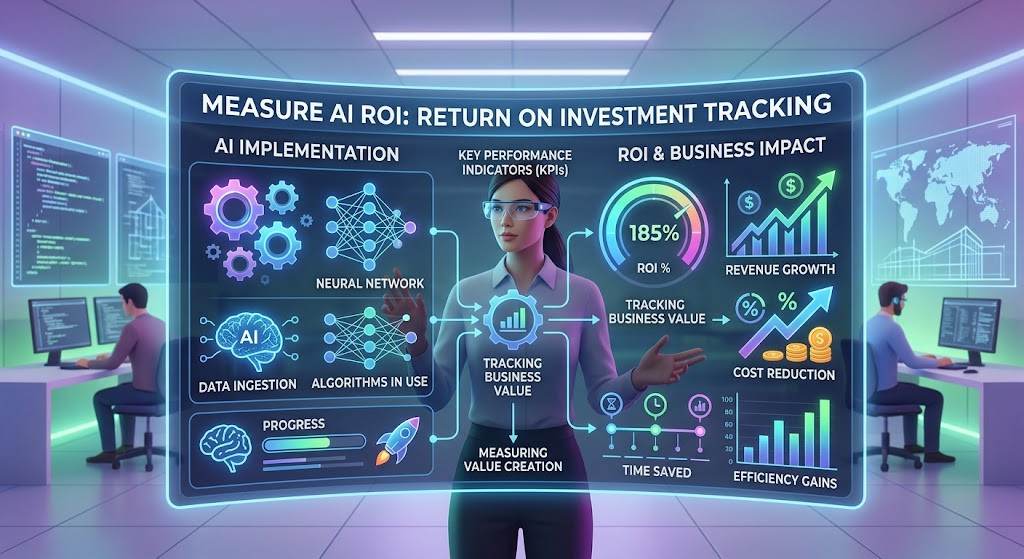
The next step is to define the Key Performance Indicators (KPIs), which your stakeholders care about. Engineers will be interested in F1 scores and cross entropy losses, whereas business executives will want to know how much revenue was generated, how much time was saved and what was the customer satisfaction score.
The first true milestone towards making an actual AI application for production is proving that the application can really help you make money. If there is no direct line that you can draw from the result of the model that you created towards ROI, then you should start thinking of something else.
Step 2: Establish Robust, Automated Data Pipelines
Data is the very essence of an AI. “Garbage in, garbage out” is a cliche by now, but it takes on real meaning when using machine learning algorithms. When a live model gets garbage data, it will make garbage decisions. So, a robust and automated pipeline for processing the data is essential.
The pipeline must do that for you automatically. You can clean the data manually in a sandbox once. In a production environment, there will be constant data coming from various sources with mistakes, NULLs, and errors included. Those mistakes must be cleaned up before feeding the data into your model.
Prioritizing Data Quality Over Quantity
It is also an erroneous belief that having more data is always preferable. Instead, large, unstructured datasets are actually major sources of harm.
They increase the costs of storing data, reduce your learning time, and confuse your algorithms. Quality of data is far more important than quantity of data.
In case your pipelines fail, your model fails as well. This is precisely why data engineering is the true backbone of AI implementation. Without constant data feeding, even the best-designed neural networks will soon become useless.
Step 3: Choose the Right Model Architecture for Scale
As far as transition to production goes, the most sophisticated and advanced neural network would not be the optimal option either.
While in a research environment you may go for a small improvement in accuracy, not minding the amount of computations needed, in the practical case you should weigh your gains in accuracy against the time required to perform the computation and costs involved.
It is crucially important to properly weigh the latency and accuracy trade-offs. For example, when developing the system of credit card fraud detection that will need to provide its verdict within milliseconds, a super large and slow model that would give a verdict within three seconds won't do the trick, no matter how precise it is.
Keep in mind the price associated with computing for your particular model. Deep learning algorithms are known to need powerful GPUs in order to make inferences.
If for any reason, you end up getting tens of millions of customers from your product, the cost of computations could eat away any profit that comes from using the algorithm. In reality, in many instances, a simple alternative such as a random forest, or even good old logistic regression, would work perfectly fine.
It is vital for you to determine if the model chosen by you will survive the pressure of excess user load at one time.
Step 4: Implement Rigorous Testing and Validation
Such splits of the typical train/test type would be adequate for use in the laboratory but are absolutely inadequate in practical application. Real data is messy, and your tests have to take this into account. It is not enough to check whether your model is accurate overall.
You have to test your model for edge cases, abnormal input from users, and for any kind of bias your model might exhibit.
Adversarial testing—where you intentionally confuse the model by feeding it incorrect or misleading data—is a crucial step to undergo. Before going live, you have to do shadow deployment.
In other words, you have to deploy your model simultaneously with the existing one, where it will process live data and make predictions without the actual effects on the end-user.
Combating Model Drift
Model drift is among the biggest challenges in keeping AI working well. That's when there is a difference in statistics between the production data and what it was like back then during the training process. The model that worked just fine in January will be completely wrong by June as something changes about users or markets.
The ability to foresee drift and test for it is one of the things that make developing AI-based applications very different from the usual software development process. The need is to devise a mechanism that detects when the input data begins to deviate from the training data.
Step 5: Design for Scalable Infrastructure
Good for your application, it will never perform well beyond its infrastructure capabilities. When your awesome machine learning algorithm is running on a poor server, even when there is a slight increase in the number of users of your application, it will go down.
Scale involves using cloud computing systems and deployment architecture that enables high availability.
The first thing is to containerize your models using software such as Docker in order for you to be assured that they run consistently regardless of the environment they are being used in. The next step is the use of container orchestration platforms such as Kubernetes in order to scale your containers in real time by adding and removing compute power based on traffic.
If your application is a suitable fit, then you should consider going for serverless architectures since you will only pay for the exact amount of computing resources used by your application.
Having proper infrastructure will prevent you from spending all of your budget on server costs since you would have already developed production-ready AI applications.
Step 6: Prioritize Security, Privacy, and Compliance
The aspect of security must not be taken for granted and should always be considered one of the last few things to be done prior to product launch. When it comes to AI, you are constantly handling massive amounts of sensitive user data, which makes you the prime target for hackers.
The data encryption must be done properly both during transport and storage. Access control is essential, as you have to make sure that only the right people have access to the model itself, data pipelines, and all other elements of your infrastructure.
Depending on your business and geographic location, you need to comply with certain data privacy laws such as GDPR in Europe or HIPPA in healthcare.
While working with the Large Language Models (LLM), you get exposed to a completely different set of threats that you should stay protected from, like prompt injection. In this case, an attacker tries to trick your AI into revealing some personal data or performing any other action that shouldn't be performed.
Security should not be left for the end. It must be embedded in the process of building AI solutions. Neglecting it can have disastrous consequences in terms of data leaks, penalties, and reputation.
Step 7: Set Up Continuous Monitoring and CI/CD

Your day of deploying the AI app does not mark the end of the development process; rather, it’s just day one of your journey.
Unlike any other software, AI systems get stale as time goes by because of the changes taking place around them. The only way to ensure your system remains healthy even after the deployment phase is through monitoring.
Monitoring here involves developing monitoring dashboards that will enable you to keep tabs on latency, errors, server load, and most importantly, the metrics that you had set at step one. It is important to know when there are problems in the efficiency of the models.
It is equally important to develop CI/CD pipelines for machine learning systems.
Embracing the MLOps Lifecycle
The real true art of keeping AI alive is the art of MLOps cycle itself. This is a constant feedback loop when you keep monitoring your live model, detect drifts, collect new data, train your model again, validate it and redeploy in an automated manner.
Being able to master this constant life cycle is what makes the secret of building truly productional AI applications which will survive the test of time. AI becomes alive and evolves together with the business.
Accelerating Your Path to Production with Gigmint.AI
Executing these seven steps, ranging from data engineering and CI/CD pipeline implementation to MLOps and compliance with security standards, requires a very specific set of skills. In many cases, attempts to develop such infrastructure internally lead to launch delays and increased costs, diverting attention from the core objectives of the business.
It doesn't have to be that way. Gigmint.AI provides you with an engineering partner to facilitate the move from sandbox environments to production-scale infrastructure.
But this is exactly what Gigmint.AI is good at. We can be your reliable partner in handling the technical side of things - infrastructural management, continuous deployment, and strict MLOps. Our specialists make sure that your models move seamlessly from development to a secure and scalable environment.
If you need to speed up your process of building production-level AI solutions, the help of experts from Gigmint.AI will make sure that you are doing everything correctly from the very start.
Frequently Asked Questions (FAQ)
How long does the process of transferring from sandbox to live system take?
This period varies depending on the level of complexity of your model and your infrastructure. In case of a fairly simple classification model and clear internal data, the period may take several weeks.
If you are working on some complex generative AI features and/or need to comply with some specific regulations, the time period usually varies from three to six months. Most of the time in this process isn't spent on coding the algorithm but on creating automated data pipelines, setting the security protocols and infrastructure in the cloud.
What are the most common reasons for AI projects failing at the launch stage?
One of the reasons why many projects don't succeed is an underestimation of the huge amount of data engineering that is needed when developing an application.
Developers think that they can use the same clean and static data which was used while developing in Jupyter Notebook to develop a live project and that everything will be fine. But the moment they connect the project with a live API/database all those errors with missing fields, different formats of data and corruption appear.
Do I have to have a large engineering team inside to release an AI tool?
No, you don't have to build up a team of machine learning engineers and MLOps professionals. Cloud services nowadays can help a lot in terms of simplifying the deployment process.
The lack of necessary talents can be solved through the use of third-party APIs and collaboration with AI agencies. Here the emphasis should be made on good product management and data governance.
What can I do about AI hallucinations in live environments?
When using Large Language Models (LLMs), hallucination (that means the generation of wrong facts with high confidence) can happen. And you won't be able to get rid of them completely.
You must mitigate them by implementing strict guardrails, using RAG and output validation when developing generative AI tools based on proprietary data.
Does it really make sense for small companies to use custom AI?
Of course, it does. It does not mean that you should have a huge budget and dedicated research department to create production-quality AI solutions if you concentrate on very concrete, highly efficient problems.
Often, the most impressive results are achieved by small companies that use narrow AI solutions to automatize the work with back office processes, analyze customer tickets, and deal with local inventory. The main rule here is to begin with small steps and do not rush with generative AI solutions.
Making Production-Ready AI a Reality
The path from a viable experimental model to a proven live model might be difficult, yet totally achievable with the right approach.
By designing your AI models with business metrics in mind, having a clean data pipeline, selecting scalable architectures and adhering to the MLOps cycle, you are setting yourself up for success in the future.
Now that you know the way towards building production-ready AI applications, what comes next is implementation.
Be it the case that you are just starting out on your AI journey or facing difficulties in scaling a particular model, the principles of building production-ready AI applications will always serve you well in a challenging environment.
Are you ready to build production-ready AI applications? Talk to us at Gigmint.AI about your next project today!