How CEOs Can Measure AI ROI and the Business Value of AI Investments
How CEOs Can Measure AI ROI and the Business Value of AI Investments
Currently, every executive boardroom across the planet is buzzing with the same two letters. You know the overwhelming pressure to implement and scale artificial intelligence throughout your organization.
This is because you have been allocating a substantial budget for the implementation of different tools of generative AI, machine learning, and data.With the increasing need to determine AI ROI, a concerning pattern appears to be arising.
When you ask your technical experts to measure AI ROI, suddenly everything falls silent. Instead of receiving a simple spreadsheet with clear profit data, you get some mumbo jumbo about "efficiency gains," "workflow optimization," or "innovation potential."
As a business person, you cannot go to your board of directors with the words "potential." As a business person, you cannot compensate your shareholders with "efficiency."
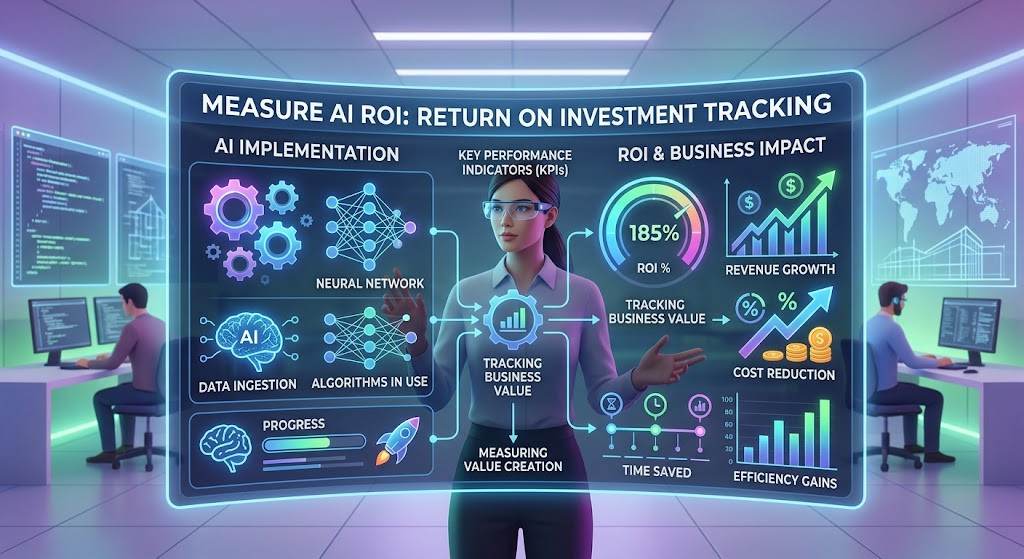
This is the truth: With the integration of projects related to artificial intelligence with financial measures and evaluation of tangible as well as intangible benefits, it will be possible to measure the economic benefit from investments made in this area.
Learning to measure AI ROI accurately is no longer an option. This is the critical point that distinguishes real market winners from those who are just wasting money on trendy technologies. In order for you to stop thinking and start calculating, there must be a complete change in your perception of the effectiveness of technology.
Why Trying to Measure AI ROI Feels Like Chasing Ghosts (And How to Stop)
If you ever felt frustrated trying to measure AI ROI and grasp the business value of your AI efforts as a ghost chaser, you're definitely not alone. The problem comes from the attempt to apply the usual evaluation criteria to artificial intelligence as a business solution which is far away from being usual itself.
In the case of implementing the conventional software product – say, some CRM or ERP – the implementation is a predictable process where you set up the software, teach your employees how to work with it and you get the particular predetermined functionality from it. The input produces a certain result.
AI is a probabilistic phenomenon; it’s not deterministic. AI does not just work; it learns and grows. It doesn't execute tasks but rather changes the way those tasks are done each time.
The leaders often become victims of the so-called "deployment gap" – the period of frustration before seeing how the model starts to affect the company's bottom line when you already spend plenty of money while there are no tangible results at all.
AI frequently plays the role of a hidden platform that supports other services. If a salesperson wins a huge order, does it mean that he did it through his skills or that it was the result of an accurate timing by an AI algorithm, which created a very customized pitch? Finding out this specific variable may turn out to be impossible.
While the technologies have significantly changed, the underlying rules of doing business have remained exactly the same. The money invested has to pay off in excess of one dollar.
It is not necessary for you to change the way of doing your business, but only the way of using the established concepts. You need to stop treating AI as some kind of magic wand and start considering it as an advanced form of capital investment where you need to measure AI ROI.
The 3-Pillar Framework for Measuring the Business Value of AI

Before we look at the individual metrics and dashboards, you have to have an organized approach to how you are evaluating your AI portfolio and implementing the framework to evaluate AI ROI. If not, you will find yourself inundated with a sea of random numbers.
For any analysis of your AI activities to take place, it must be done against the backdrop of a rigorous three-pillar methodology.
Pillar 1: Strategic Alignment and Problem Mapping
Perhaps the single most important point that can be made from all the above is that the worth of AI is determined long before any coding begins. If you do not have your artificial intelligence solution working on a precise, clearly defined problem within your organization, it has zero value to your business.
All too often, companies find themselves trapped within the world of “artificial intelligence for the sake of artificial intelligence.” The idea sounds great to them, perhaps after reading a headline and experiencing FOMO (Fear Of Missing Out), and they invest in a costly enterprise license to show off their innovation.
For this reason, every single project related to AI must align with the Objectives and Key Results (OKRs) of your organization.
Before making any decision on the technology budget for the year, you have to pose yourself an important question – "Is it purchased for solving a particular bottleneck that exists in our revenue stream or have we purchased it just so that we can publish a press release about having AI?"
The pillar requires that you map out the problem first. Here, you will need to identify the pain point, determine the effect of the problem on your organization by setting up a baseline for measuring the problem, and then applying AI into the equation.
Without this pillar, it will not be possible to measure AI ROI and you will end up with good tools for nothing.
Pillar 2: Direct Financial Impact (The Bottom Line)
Once you are strategically aligned, the next thing you should obsess about is the bottom line. This is where you generate money and save money.
These are the figures that will be communicated in your quarterly earnings call. The first step to measure AI ROI would be to measure the net-new revenue generated by your AI offerings.
If you have introduced an AI-based recommendation engine into your e-commerce website, then you need to find out the share of your revenues that is generated through recommendations.
In case you have launched an AI-powered version of your SaaS product, you can calculate your recurring revenue from this new product.
Determine the financial benefits of your automated processes. Probably the most popular metric is a deflection rate of customers’ requests in your customer service department.
If you use a chatbot which deflects up to thirty percent of all the support requests without any involvement of your employees, you will be able to precisely estimate the financial benefit of these deflections in terms of per-hour salary of your customer support representatives.
The financial performance of your business is not only defined by the money that you earn or save. It is also determined by the money that you spend.
That is why it is necessary to assess the total cost of ownership of your artificial intelligence. It is the place where many business leaders face problems.
Cost of ownership will not only include licensing fees for the software or development costs but also all the costs incurred related to using computing resources, cloud storage, and making API calls.
Pillar 3: Operational and Cultural Transformation
The last key metric to assess the ROI of AI technology is the measurement of the impact AI has on the daily processes of your employees. Introduction of AI technology requires changes in the culture of your company – makes it your business partner.
In this respect, one of the crucial metrics is the time to market decrease. Conduct an analysis of the process of the product development before and after the implementation of the technology.
When engineers employed the assistance of the coding assistant of AI and released the new feature within three weeks instead of three months, it resulted in significant economic benefits for you. Now you will be able to beat your competitors in the market and make money earlier.
It is necessary to measure the employee velocity and capacity. The latter means analyzing the productivity of each employee in your business.
Whereas the marketing team used to launch only five campaigns in a month until it used copywriting and designing AI technology; it can now launch fifteen campaigns in a month, which is thrice more than before.
Essential KPIs Every CEO Must Track for AI Initiatives
The knowledge about the three pillars enables you to have the right theoretical background. It is time now for theory to transition into practice, into numbers that can be tracked. In order to understand your AI investments in real terms and properly measure AI ROI, you must insist on reports from your technical team using the KPIs of business.
Efficiency and Productivity Metrics
For technical teams, efficiency is frequently measured in terms of vanity metrics such as "amount of lines of code generated" or "number of words written." As a CEO, you have to make them calculate what it is in terms of "Hours Given Back to the Business."
If an AI solution provides the process of automatic summarization of internal meeting notes and follow-up emails, you should find out the number of saved hours on an average manager per week.
But the knowledge of the number of saved hours is only half of the equation; you should calculate the monetary value of the saved hours.
This involves calculating the opportunity costs. For example, when the AI solution is giving back ten hours of time to the senior financial analyst every week by automating the data entry, what will be his use for those ten hours? If he utilizes those hours in finding some new tax incentives or optimizing prices, the real way to calculate the ROI of the AI solution will not be the salary of the analyst; it will be massive gains through his strategies.
Quality and Accuracy Metrics
A well-trained AI system will not only perform better than the older technology but will also make far less mistakes. The quality and accuracy are important factors to take into account because, in many industries, errors may cost a fortune.
It is important to monitor the error reduction rate in critical processes. For instance, if your organization uses an AI to perform automated data entry, document review, and manufacturing defect detection, then it is important to compare the error rate of the AI to the historical error rate made by humans.
It is critical to calculate how much can be saved by lowering the risks and compliance. For organizations operating in very regulated sectors like finance or healthcare, just one error can cost the company a lot of money.
If you have implemented an AI system that is able to analyze communications and transactions so as to find compliance problems before they occur, then the main metric for calculating AI ROI will be the disaster avoided.
Customer Experience (CX) Metrics
Anyway, the most sophisticated AI ever created would be completely useless to you if it leads to alienation on the side of your end-user. It is essential to carefully assess the influence of your AI projects on the general customer experience.
Pay attention to how your NPS and CSAT scores are changing and in what way the contacts which are performed by the use of AI affect them.
Do your customers feel more satisfied in their communication with the personalized onboarding experience? Is your support rated better when the problem is instantly solved with the help of a smart bot rather than two-day delay with human e-mail?
Do not forget about the decrease in customer churn which can be predicted with the help of AI algorithms. In case your company uses an algorithm which predicts account cancellation based on user's behavior and your success team saves the accounts, you can be sure that the saved recurring revenue is a direct result of work of the AI algorithm.
Quantifying the Intangible: The Hidden Value of AI
While hard numbers are a must, you have to understand that not all of the value provided by artificial intelligence can be quantified right away. There are many highly valuable aspects of this innovation which are not quantifiable but will definitely pay off financially down the line.
Think about the effect it will have on employee retention. Today's generation hates performing tedious, mechanical tasks. Using the technology to eliminate such monotonous activities from their everyday routines will give employees more room to think critically and solve problems.
It will significantly increase their job satisfaction level. Even if it is difficult to attach a price tag to something as abstract as "happiness," you can certainly calculate the costs associated with turnover rate among your employees.
Examine your brand perception. In modern business reality, having a reputation of a company that does not innovate technologically can spell doom.
Individuals prefer working alongside people who are innovators in the business space. Success in using artificial intelligence would enhance your brand value, making it easy for you to close deals and even recruit engineers.
You need to appreciate fast decision-making ability. With real-time insights provided by artificial intelligence right in the C-suite, you will make decisions faster than your competition.
Think about how a global manufacturer’s executive team utilizes AI-powered analytics dashboard for monitoring global weather patterns, port congestion and raw materials shortages.
AI detects a huge coming supply chain disruption, which is going to make headlines in another three weeks. In response to this information, the executives promptly re-route their cargo deliveries and find alternate sources of raw materials. The company escapes from a total inventory stock-out situation, which could cost them millions in sales.
Such a situation cannot be predicted on the spreadsheet in advance, but seeing around the corner is likely one of the most important ways to evaluate the business value of AI.
The Lifecycle of AI Value Realization
One of the most common blunders that business managers do is that they try to measure the pilot program in the same fashion that they would measure an enterprise-scale program which is already in place. It is important to note that different stages require different ROIs.
Phase 1, – PoC – no big revenues should be expected from your efforts. The performance criteria at this stage involve only technical viability and user acceptance. Do your employees like the solution provided by the vendor? Are they happy to see a new interface or are they actively resisting the change?
Phase 2, the tool will be released to a broader user base. It is here that you move into measurement of early efficiencies and workflow adoption. You want those "hours given back to the business" and keep a careful eye on the system, making sure it does not buckle under real-life conditions. You are aiming for a break-even on your initial investment.
Phase 3, you are deploying AI throughout the entire company. This is where you will require financial accountability. At this phase, you will be required to formally measure AI ROI, evaluate net new revenues, and calculate total cost of ownership.
It is also important to talk about the possibility of failure. What if your pilot project fails completely? If you invested fifty thousand dollars in a pilot project which has proven that AI is not ready yet to solve your particular problem, you might see that as a loss.
A failed but controlled pilot, one that stops you from investing five million dollars into scaling up your enterprise, is a huge success. In the realm of emergent technology, loss prevention is a definite business value.
Common Pitfalls in Tracking AI ROI (And How to Avoid Them)

Although it is true that with the latest technologies and intentions, managers often end up succumbing to various traps while evaluating their AI. The first thing that you should always remember about is that there are certain pitfalls which will prevent your data from being reliable.
The first and the most obvious one is neglecting the cost of data preparation. It does not matter how advanced AI software is because its success highly depends on how accurate the database used by it is.
The moment when executives buy some software and discover that their company's data is scattered across different places will cost them a lot of money and effort as they will have to pay a lot to hire data engineers.
The other critical mistake companies make is failing to set up an AI baseline. You simply cannot measure AI ROI if you don’t have a very clear picture of where you start from. Before implementing any AI solution, it’s essential to document in detail the amount of time it takes to complete a task, the current error rate, and your operating costs.
You should never use only vendor-reported metrics and fail to have your own internal audits. Any software vendor will show you their dashboards with billions of generated tokens or thousands of tasks done automatically.
It’s important to have your internal finance and data teams verify all these figures in order to understand if the success metrics for vendors mean anything for your business profitability.
Demanding Accountability from Your AI Investments
The age of using AI to hype things up and please stockholders is dead. With advancements being made, people want real sustainable results. It’s time to stop looking at AI as some sort of wizardry and look at it as any other large investment that needs a solid financial argument.
No one expects you to know how to use Python or the advanced math required to run a neural network, but as a CEO, you will need to dictate what outcomes you expect. You need to force your teams to focus their tech builds on delivering strategic value and track the dollar impact along with the total cost of ownership.
For that level of measurement and execution, it is not enough to have great software; you’ll need great people. You’ll need experts who know the complicated code and can navigate a corporation’s balance sheet.
If you are ready to review your strategy and hire the right people to make sure your tech delivers a real financial impact, visit Gigmint.AI. We offer the best talent you will need.