Enterprise AI Strategy & The AI-First CEO: How Modern Executives Build Scalable Organizations
Enterprise AI Strategy & The AI-First CEO: How Modern Executives Build Scalable Organizations
With advancements in technology, it is no longer enough for executives to select specific technologies for use in their organizations; they must develop a strategy about how artificial intelligence should be used within the firm's strategy, operations, people, technology, and decision making.
This is when the idea of the AI-first CEO comes into play.
The AI-first CEO sees artificial intelligence as a corporate capability, not just a technology project. It is not the technology itself that is used, but the areas in which it can be applied in order to help achieve organizational goals, enhance processes and decisions, and generate sustainable value.
The development of an enterprise AI strategy goes beyond choosing applications of AI. There needs to be clear prioritization, proper data, technology platform, governance, readiness of employees and concrete objectives. The initiative may turn out to be just an experiment rather than a scalable organizational capability.
The starting point in building a scalable enterprise AI strategy should be leadership. The executives need to define what should be achieved through AI and how.
What Is an AI-First CEO?
The concept of an AI-first CEO refers to a corporate executive who adopts artificial intelligence in the planning and decision-making process of the organization.
The concept does not imply replacing human decision-making or automation of all processes within the business. An AI-first approach means analyzing where AI can benefit the business operation and developing necessary capabilities to utilize the technology.
The concept changes the way questions are asked.
While previously the discussion was centered around the tool the business should buy, with an AI-first approach the conversation shifts towards problems that AI can resolve.
While success in implementing AI used to be measured in terms of the amount of tools implemented, now the focus can shift to efficiency, productivity, decision-making, and other performance metrics.
AI-First Does Not Mean AI-Only
AI can be deployed wherever it is applicable.
Some processes will find themselves needing automation or intelligent decision-making assistance by AI, while some may need human inputs. The goal is to strike the right balance between AI and the human element.
In an AI-first approach, there is consideration of AI as one aspect of the overall business operation.
Why CEOs Need to Learn About AI Strategy
Artificial intelligence can have impacts in many different aspects of an organization simultaneously. It can affect operations, customer services, marketing, finance, HR, software development, data analytics, and internal decision making.
Due to the different demands that may arise in each of these areas, the company requires strategic management.
It’s not necessary for the CEO to know everything about AI models and their development. But the CEO must know about business applications of AI, where to invest, what risks should be managed, and how AI programs are supposed to help the company achieve its goals.
Why Enterprise AI Initiatives Struggle to Scale
Launching an AI experiment and implementing an AI project at an enterprise scale are usually quite distinct.
A modest AI project can run efficiently in one process or function within an organization. Scaling it up will require further factors to be addressed concerning data, integration, security, governance, people, and performance management.
The AI Project May Not Be Aligned With the Strategy
The AI project could have technical capabilities but no clear business case.
Prior to making any substantial investments, it must be clear what issue the project seeks to address and what result it aims to deliver.
The AI projects could become detached from the organizational strategy.
Fragmented AI Implementation Leads to Complexity
Different functions may implement different tools, procedures, and approaches.
Due to the lack of standards, this could raise issues with data access, security, integration, governance, and responsibility.
The enterprise AI strategy offers a way to coordinate these efforts.
Data Limitations Can Affect Implementation
AI systems are based on data, and the data can be present within an organization in several different systems.
The data quality, availability, security and governance need to be taken into consideration while setting up an AI system.
Governance Should Not Be an Afterthought
The implementation of AI can bring many issues such as privacy, security, compliance, accuracy, accountability and human supervision.
These should be sorted out before deploying AI systems.
Employees Need to Be Included in the Process
The introduction of AI will bring changes to the work process of the employees.
Education of employees will be necessary to know how to operate the AI system and when human interaction would be required.
Seven Pillars of Scalable Enterprise AI Strategy
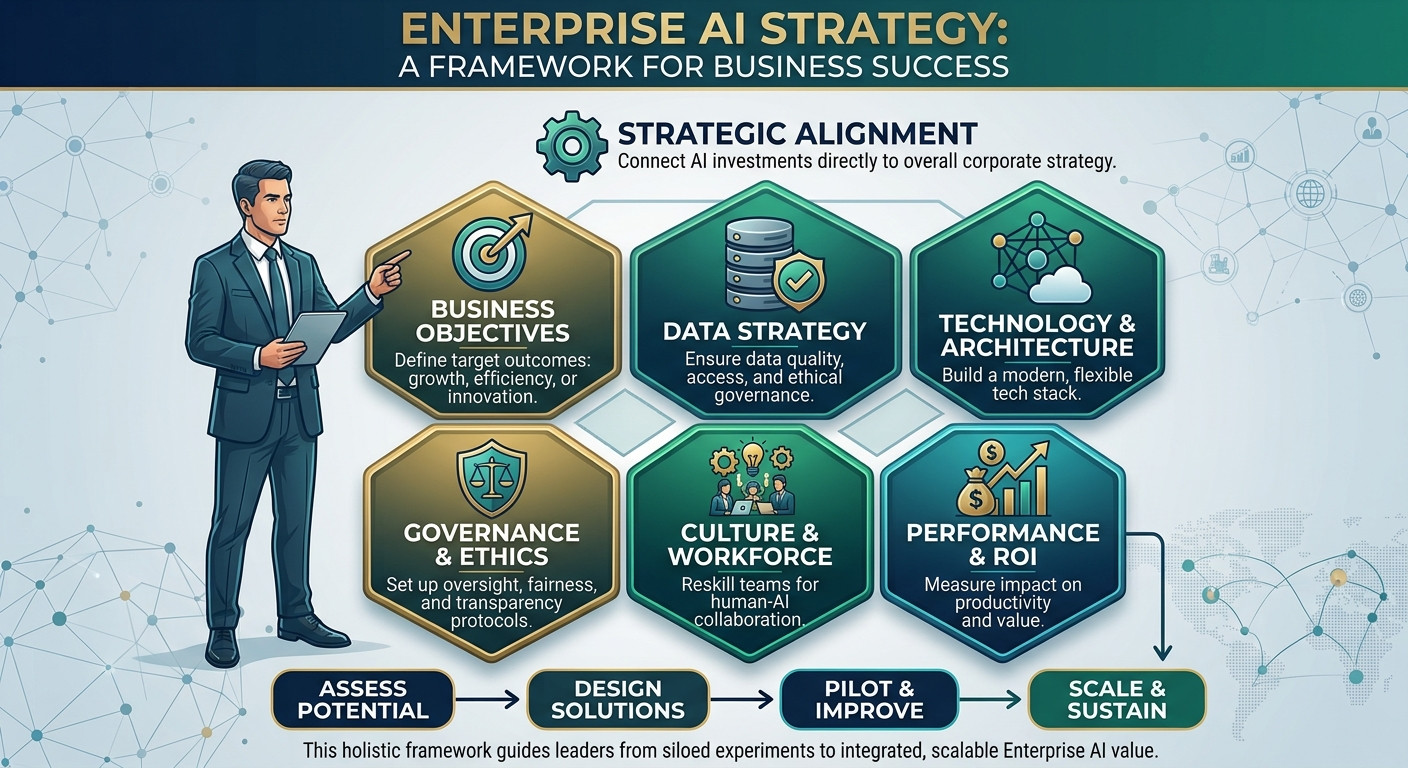
An efficient enterprise AI strategy must cover aspects like business, technology, data, talent, governance, and outcomes.
1. Begin With Business Objectives
The starting point for an enterprise AI strategy is defining what are the organization’s core business objectives.
AI solutions should enhance these objectives instead of dictate them.
Firstly, executives can look at the areas where the organization needs to improve its performance, increase efficiency, create better customer experience, make decisions or gain new competencies.
Questions to Identify Business Priorities
What business results matter the most?
What processes cause the most difficulties in operations?
In which places do people keep performing repetitive actions?
How does the ability to gain more information help one make good decisions?
Where is more speed, consistency or scale needed?
Once the areas of focus have been defined, AI opportunities can be assessed according to them.
Connecting Business Objectives to AI Outcomes
As a result, the simple equation emerges:
Business objective → business problem → AI opportunity → measurable outcome
Beginning with a business objective also allows us to define if the AI project requires investment.
The very technologically sophisticated AI initiative may not be of strategic value at all if it doesn’t focus on addressing organizational issues.
2. Focus on Use Cases of AI
For an organization to have an effective AI strategy, the approach needs to cover many aspects such as business, technology, data, people, governance, and outcomes.
3. Establish an AI Operating Model
There must be a clear demarcation of responsibility for an enterprise AI strategy.
These may include involvement from executive leaders, technologists, data specialists, cyber specialists, lawyers and compliance officers, human resources and business units.
An operating model is necessary to determine how this responsibility is managed.
One of the critical elements that needs to be considered is the extent to which there will be centralized control or distributed innovation.
Centralized control could lead to uniformity of standards related to security, governance, technology, and data management. But, business units have a deeper knowledge of their own processes and challenges.
There can be a hybrid model as well, where central functions develop enterprise-level standards and policies, and business units look at possible use-cases and implementations.
Key Areas of the AI Operating Model
The following should be clearly outlined as part of the operating model:
AI Strategy
Investment in AI
Approvals for use-cases
Data Governance
Security
Risk Management
Technology Architecture
Implementation
Performance Management
Continuous Monitoring
This avoids fragmentation within organizations.
4. Build an AI-Ready Data and Technology Foundation
Scaling AI demands an appropriate technological base.
These are the technologies that help in the development, deployment, integration and monitoring of AI systems.
Build a Strong Data Foundation
Data becomes critical.
It is important to know the location of data, its format, access by others, and quality maintenance of the data.
Some of the things that one might need to look at include:
Data quality
Data accessibility
Data security
Data governance
Integrate AI With Existing Technology
Systems integration
Identity and access management
Cloud infrastructure
Application Programming Interfaces
Access to AI models
Monitoring
An organization needs to look into the way new AI applications will fit with the current system.
Creating isolated systems can lead to problems while making an integrated workflow across the business.
The aim is not to replace existing technologies but rather look into how AI technologies will fit into the organization's existing digital ecosystem.
The technology base for scaling AI should help businesses adopt AI systems without duplicating efforts.
5. Establish AI Governance
AI governance includes the policies, controls, and responsibilities necessary for AI management.
In particular, AI governance is needed in cases when the AI systems have access to sensitive information, interact with the company’s clients, affect decision-making processes in business, or perform activities in enterprise environments.
Key Components of AI Governance
The governance framework can cover:
Data privacy
Cybersecurity
Access controls
Regulations
Model monitoring
Human oversight
Risk management
Documentation
Accountability
Third-party AI services
Also, companies need to define guidelines for pre-deployment and post-deployment evaluation of AI systems.
Human oversight may be required in cases of applications that have serious consequences for mistakes made by the AI system.
The degree of governance depends on the intended use and risks associated with AI applications.
Build Governance Into the AI Development Process
The key point about governance is that it should be built into the process of AI development and not added to an already developed AI system.
AI governance framework allows a firm to assess AI risks and establish innovation conditions.
6. Prepare the Workforce and Redesign Workflows
Organizations often need to reconsider how work is performed.
A process that before relied on employees' ability to collect data, organize it and produce the output might appear different after introducing AI capabilities that could automate the collection, analysis or even creation of the output.
This means that workflow redesign is a crucial element of the AI strategy for the enterprise.
Redesign Workflows Around AI
Executives must consider which elements of the process can be automated, which elements can be AI-enabled and which elements still have to remain human tasks.
Develop AI Literacy
Employees also need proper training.
AI literacy can ensure that employees know how to interact with the system, assess the output and its limitations.
The training should include:
Usage of AI tools
Output verification
Working with data
Security
AI ethics
Supervision by humans
Redesigning of workflows
Enterprises should also create clear expectations about what kind of AI applications the employees are authorized to use and how the organizational data will be used.
Workforce readiness is especially important since effective AI adoption relies on implementation.
Even a highly advanced technical system will not provide much benefit if the employees cannot fit it into their workflows.
The AI-first CEO considers the workforce readiness to be the part of the AI strategy rather than the separate
7. Measure AI Performance and Scale Successful Initiatives
AI investments must be measured in terms of concrete goals.
Organizations should identify their goals before undertaking any AI initiative.
Such goals may differ based on the intended purpose of the AI solution.
Financial Metrics
Examples include revenue generated, savings made and ROI.
Operational Metrics
Here, organizations could look at processing times, productivity, error rates, degree of automation and completion of workflows.
Customer Metrics
Measures like response times, satisfaction levels, retention and outcomes related to services offered could be looked at.
Workforce Metrics
Adoption, productivity and training outcomes could indicate the effectiveness of AI integration in work activities.
Risk Management Metrics
Security breaches, compliance failures, incorrect outputs, etc. are examples.
The goal of measuring should not merely be to demonstrate the use of AI technology.
The goal should be to determine if AI technology is delivering its intended business benefit.
Scaling Successful AI Initiatives
One good scale up approach could be:
Pilot → Measure → Improve → Standardize → Scale
If the pilot generates positive results, the organization would know how to scale up.
In case of poor results, the initiative could be rethought or stopped.
Such an approach makes for a more disciplined AI investment approach.
How CEOs Can Prioritize AI Investments
Investments in AI must be assessed in the same way as any other business investments.
CEOs have access to a well-structured tool allowing them to make the comparison of various options.
Such an assessment may include six criteria.
Business Value
What problem does the solution solve?
Feasibility
Can the company successfully implement and sustain the solution?
Data Readiness
Is there enough data for the purpose?
Risk
What are the potential risks associated with the solution?
Scalability
Can the solution be scaled to other use cases?
Return on Investment
Can the return be measured against implementation and operation cost?
It will help the executives avoid making investment decisions in AI technology purely on the basis of novelty.
The prioritization strategy must also be re-assessed on a regular basis.
AI technology, business priorities, costs, and capabilities may shift, and the approach that used to work before no longer does.
CEOs have to develop a process for ongoing assessment of AI investments.
The Role of AI Agents in Enterprise AI Strategy
AI agents constitute a new dimension of enterprise AI.
In contrast to response-oriented systems, AI agents are capable of completing a set of actions according to predetermined sets of instructions, tools, and permissions.
This creates new opportunities for automation of workflows.
Security and Human Oversight for AI Agents
But increased automation calls for increased awareness of security, access, monitoring, and human supervision.
Firms that want to implement AI agents have to decide what workflows can be significantly benefited by task execution.
This should be followed by the identification of information access, action possibilities, and moments when human approval is necessary.
The objective should not be implementing autonomous AI agents merely because such technologies exist.
It is necessary to understand if the use of an AI agent is justified in a certain workflow and if it is possible for an organization to handle risks related to the use of such a system.
AI agents become another dimension of enterprise AI.
A Practical 90-Day AI Strategy for CEOs
A systematic 90-day strategy could assist executives in laying out the groundwork for enterprise AI implementation.
Days 1–30: Assessment
Start off with an assessment of the organization’s current state.
Determine key strategic priorities, existing AI implementations, data capabilities, technical infrastructure and key challenges.
Check the existing AI experiments and figure out if they have goals and measurable impact.
The goal is to understand what is currently there in order to implement new initiatives.
Days 31–60: Prioritization
Secondly, assess potential AI use cases.
Evaluate them based on their business value, feasibility, data preparedness, risk and scalability.
Choose a limited number of initiatives to implement.
In this phase, determine governance principles, accountability and performance measures.
Each chosen initiative must have a clearly articulated goal.
Days 61–90: Implementation and Measurement
Implement the chosen initiatives.
Provide employees with necessary training and support in using the systems.
Measure performance and compare the results with the established objectives.
Based on the findings, improve, expand or end certain initiatives.
The 90-Day AI Strategy Process
Assessment → Prioritization → Implementation → Measurement → Scaling
What the AI-First Enterprise Will Look Like
An AI-first business does not mean that the processes of that organization are all automated.
In fact, AI gets embedded in those processes where it is relevant.
AI as a Tool for Employees
AI can be used by individuals to support research, analysis, communication, programming and other work.
AI for Business Processes and Decision Support
AI can be used by the company to facilitate information processing, pattern recognition, customer interaction and workflow improvement.
AI gets embedded in larger decision-supporting systems while people make the final decision about things requiring judgment and context.
AI Integration and Business Value
What matters here is not how many AI applications the organization employs.
The real factor is how integrated the AI technology is into the organizational strategy and its operations.
An AI-first firm is constantly evaluating the part that AI is playing in contributing extra value to the business.
Common Mistakes for CEOs to Avoid in Creating an AI Strategy
Following Every AI Fad
There can be excitement about new capabilities in AI, but not every technology may be relevant for every organization.
Investments need to relate to business goals.
Treating AI as an IT Project
AI can impact processes, people, customers, and the business strategy itself.
As such, it needs cross-functional leadership.
Measuring Usage, Not Results
The number of people within an organization using an AI solution does not necessarily indicate success.
Success needs to be gauged based on set objectives.
Not Considering Data Readiness
AI projects can be constrained by bad quality of the data, lack of availability and/or governance.
Data readiness assessment is required prior to deployment.
Implementing Automation Without Workflow Redesign
Automating a bad process does not necessarily mean the process becomes good.
Companies need to consider if the process itself should be changed.
Neglecting Governance
Privacy, security, compliance, and responsibility should be considered during the entire lifetime cycle of AI.
Neglecting Employees
People require proper training, policies, and knowledge of how AI will impact their processes.
Allowing Pilots to Last Forever
Pilots are valuable, but successful projects require a path to measuring, improvement, and scaling.
How Gigmint AI Can Support Enterprise AI Development
Developing the AI strategy is just the start of the journey for enterprises. The technical capability to make the opportunities work is required too.
AI Gigmint can assist enterprises when it comes to building solutions using AI.
The right option will depend on the goals of the company, its current technology infrastructure, data needs and expected results.
Having a plan in place will make it easier for organizations to develop a solution that can be used effectively.
In the case of enterprise-level AI solutions, what should be ensured is the need for us to continue concentrating on solving the issue and having realistic goals.
FAQs on Enterprise AI Strategy
What Is an AI-First CEO?
An AI-first CEO is an executive whose approach is one in which he/she sees AI as part and parcel of the company’s overall business strategy. The strategy centers around determining what opportunities the technology offers and creating conditions to harness them.
What Is an Enterprise AI Strategy?
An enterprise AI strategy is an approach aimed at integrating artificial intelligence into the organization. It may include objectives of an organization, selected use-cases, technologies, data, governance, workforce readiness, deployment and performance measurement.
Why Do CEOs Need to Be Part of AI Strategy Development?
AI can have many implications for the operation of different parts of an organization, such as operations, technology, workforce, customers and risk management. CEOs' involvement ensures that investments in the technology remain consistent with corporate objectives.
How Can Organizations Develop an AI Strategy?
A strategy for AI can be initiated by having business goals, selecting relevant use cases, carrying out feasibility study, establishing governance, getting ready with data and technology infrastructure, training the employees and establishing metrics.
How Do Companies Quantify AI ROI?
It can be quantified as a comparison between the costs of using an AI system and the benefits it can generate for an organization. The benefits might vary according to the case, but they will include productivity gains, cost savings, capacity increases or improvements in customer experience.
What Is AI Governance?
It is the set of processes and controls applied to manage artificial intelligence in a responsible manner. They might include aspects of data protection, security, accountability, risk management, human supervision and monitoring.
What Is the Difference Between AI Adoption and AI Transformation?
AI adoption refers to using AI software or applications. AI transformation means transforming the workflows, processes or capabilities of the company to make AI part of its core activities.
How Do Companies Manage AI Agents?
Companies should choose the right workflows, define the capabilities of an agent, its access to data and systems, set up monitoring and decide when human intervention is necessary.
The AI-First CEO Builds a Scalable AI System
It is no longer surprising how strategic the role of the CEO is when it comes to artificial intelligence.
A good enterprise AI strategy is not a checklist of AI technologies or experiments but rather a structured way of connecting artificial intelligence to the business goals.
In the case of AI-first CEO, the strategy takes place before the actual technology. They define valuable use cases and investments; they design an appropriate operating model, and then they implement necessary data and technological foundations.
At the same time, they understand that responsible AI needs governance, security, accountability, and human supervision.
More than anything else, they understand that the adoption of AI does not equal business value.
Such value can only be obtained by using AI technologies in solving the right problems, in integrating them into proper workflows, preparing people for working with them, and making sure that implemented systems are doing what they are supposed to do.
It means that the path to scalable enterprise AI should be the following:
Define → Prioritize → Build → Govern → Adopt → Measure → Scale