How to Onboard Freelancers: A Frictionless Onboarding Process.
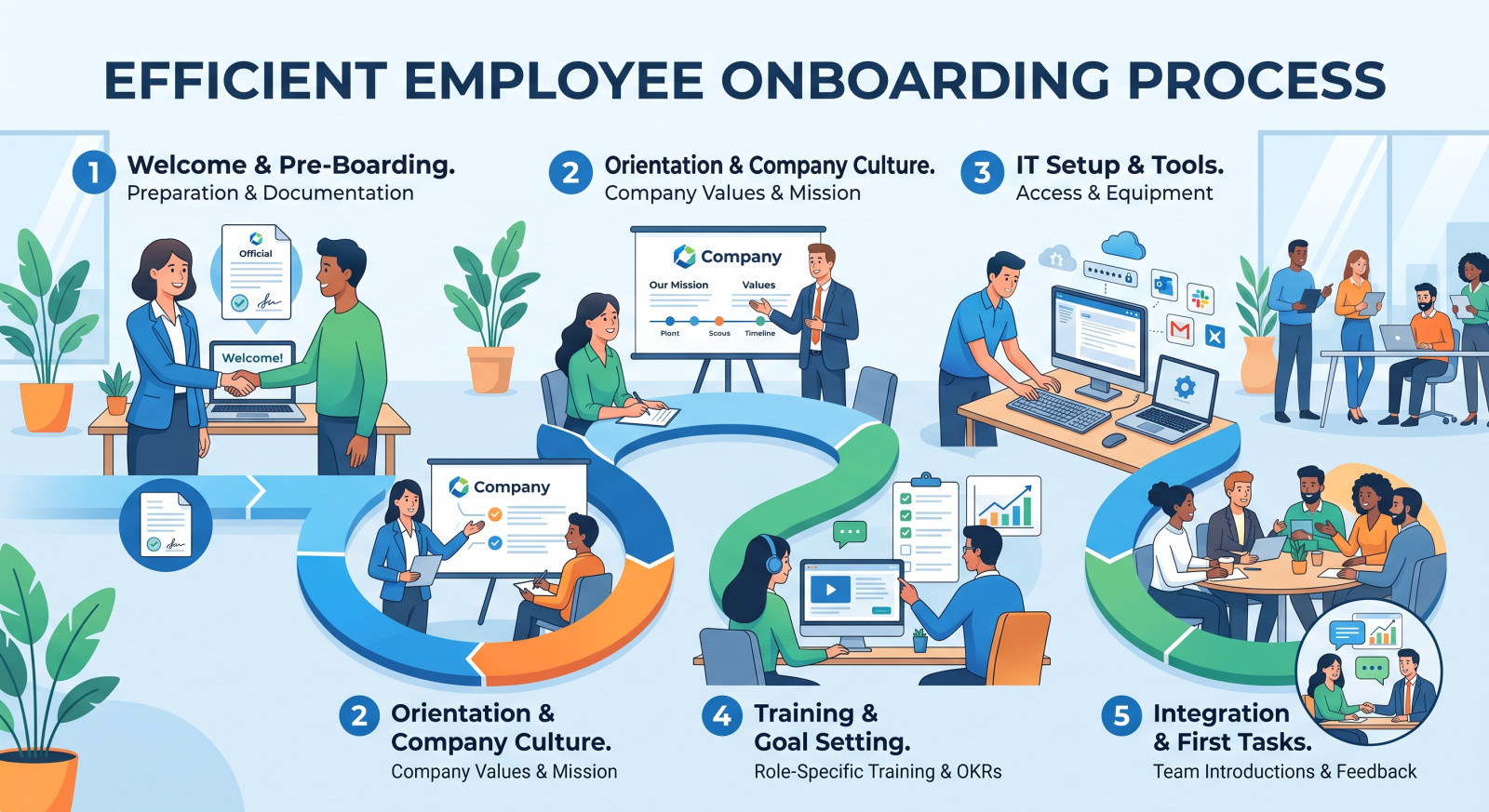
How to Onboard Freelancers: A Frictionless Onboarding Process.
The good news is, you’ve hired a highly acclaimed freelance developer. Your team is working under pressure with tight deadlines and here’s your knight in shining armor.
Unfortunately, after two weeks of having this freelance contractor on board, it becomes obvious that he or she won’t make things faster but will only slow everything down.
Your lead developer spends hours answering trivial questions related to the architecture in Slack, your project manager chases signatures for an NDA, and the freelancer waits three days to get access to GitHub.
All of that is not making things faster, it’s making them slower.
This is what makes the entire gig economy phenomenon so paradoxical. Hiring managers engage independent contractors to speed up processes and tap into their unique skills, but the lack of a streamlined and clear onboarding process completely undermines these advantages.
And when you onboard freelancers the same way as you do your full-time employees—or even have no process at all—it causes friction between your company and your newly acquired talent.
For dynamic scaling of employees, you need a plug-and-play strategy. You need an approach that will be able to quickly incorporate any external talents while keeping the time taken by them to add value to the lowest possible level, while strictly maintaining focus for your core team.
In this detailed guide, we will discuss the frictionless onboarding process for independent contractors. This will include all the important pre-onboarding steps, along with a checklist and tips on smooth integration. We will also discuss how tools like Gigmint.AI can do the work for you.
Freelancer Onboarding process vs. Employee Onboarding
The most frequent error made by hiring managers while acquiring freelance talent is applying the same old employee onboarding playbooks used for recruiting permanent employees.
The onboarding process of a full-time employee is a long-term commitment. It is meant to involve the new hire into the culture of the company, teach them about the organizational structure, present career opportunities within the company, and align them with the five-year vision of the company.
It is not surprising and even required that a new full-time employee takes from 30 to 90 days until he/she becomes productive and independent.
But freelancers are hired for a short term. They are hired for doing their job – for being specialists who will help to complete some tasks, solve problems, or fill the gap of skills temporarily.
They do not need to be familiar with the history of the company, its founders, and its organizational structure of the marketing department if they are supposed to write backend code.
The Hidden Cost of Poor Onboarding
But when you don't distinguish between these two kinds of onboarding, the expenses start piling up rapidly – sometimes in ways that won't be apparent in your company's financial statements.
Scope Creep and Alignment Problems: The lack of clearly defined and documented boundaries from day one may cause freelancers to deliver work that deviates from your undisclosed expectations.
As a result, it will cost extra money to revise the work and make sure it's completed on schedule.
"The Distraction Tax" for Your Core Team: The biggest hidden expense here is that your internal team members need to stop what they're doing whenever your freelancer has some questions.
It's been proven scientifically that once someone is interrupted, it takes over 20 minutes to return to the previous flow of work. Ten interruptions per day would seriously impair the productivity of your lead developer or project manager.
High Freelancer Turnover: Freelancers at the top level have lots of choices available to them. If your organization makes them waste the first days of the project by trying to untangle all the administrative mess, then you should expect the best freelancers to leave your project right at the end of their contract and never return.
Minimizing "Time-to-Value" (TTV)
The objective of onboarding a freelancer is about Time to Value (TTV). TTV is the duration taken from the signing of a contract to the delivery of the very first work by the freelancer.
For a regular employee, it may take weeks for an acceptable TTV. For a freelancer, TTV should be in terms of hours or a few days at the maximum. Frictionless onboarding process means eliminating all aspects that do not help reduce TTV.
The Secret to Zero-Friction Day One
The magic of making day one go smoothly doesn't happen on day one. It actually occurs before the very first day.
This is what we refer to as "Pre-Onboarding." By taking care of all the paperwork and administrative hassles prior to day one, you can guarantee that day one will be devoted solely to working.
Here are the three foundations of effective pre-onboarding.
1. Nailing the Statement of Work (SOW) and Scope
"Clarity is Kindness", specifically in freelance arrangements. The first step towards establishing a successful arrangement is having an excellent Statement of Work (SOW).
An effective SOW becomes your best friend throughout the engagement because it provides you with that certainty about exactly what success entails.
An SOW stops your freelancer from having to guess what success entails. An SOW also stops you from paying for services that you did not need in the first place.
What should your SOW contain?
Specific Deliverables: Do not have generic deliverables, for example, "Write code for the new feature". Instead, say "Deliver fully tested Python scripts for the payment gateway API integration".
Milestones and Deadlines: The project is divided into various small sections with specific deadlines that make it easy to assess their work without having to see one huge output at the end of the project.
Success Metrics: How do you plan on assessing whether the work is satisfactory? What are the performance metrics, word counts, and design specifics that you expect?
Payment Terms: Your pay rate is specified; whether hourly or fixed fee as well as your invoicing schedule and milestones.
2. Legal and Compliance Housekeeping
Nothing will stop a project faster than a freelancer being unproductive on Monday morning since the legal department has not yet completed the Non-Disclosure Agreement (NDA) of the contractor.
Compliance documentation should be done by automation during pre-onboarding and usually involves the following:
NDAs and Confidentiality Agreements: It is important to protect your intellectual property.
Independent Contractor Agreements: The legal status of the relationship needs to be established (to minimize the risk of classification).
Tax Forms: Getting W9s for US freelancers and W-8BENs for international contractors early on will make sure that nothing goes wrong when processing their first invoice.
Gigmint.AI Edge: This is where taking advantage of a platform such as Gigmint.AI is really helpful.
Gigmint does all the hard work related to compliance, identity verification, and standardized contracts inside the platform. By using Gigmint for your talent acquisition, you get rid of much of this overhead.
3. The "Access Protocol": Tools, Repos, and Drives
If you hire a freelancer for the sake of his fast work, making him go through the process of requesting access to five different platforms one-by-one is completely a waste of time.
Make a common “Access Protocol” checklist for your IT/Operations department. Once the contract is signed, kick off a workflow where all accounts and permissions will be provisioned.
By the time when the freelancer is ready to start working, he needs to have active access to:
Channels for communication: An exclusive Slack/Microsoft Teams channel (most likely an isolated channel for his project).
Tools for project management: An access to specific Jira boards, Asana projects or Trello lists which the freelancer will be using.
Resources: A read/write access to GitHub repositories, Figma files, Google Drives or staging servers.
A Dedicated Email Account: (Optional) Depending on your security policies, you might need to issue him a temporary company email account.
The Ultimate Checklist for Onboarding Freelancers
With a tried and tested process in place, there won’t be anything left to chance and your contractors will get consistent treatment. Here is a template you can use in your organization.
Day 1: Context, Not Clutter
Step 1: Welcome Packet (Asynchronous)
In lieu of a meeting where you read through the documents together, send an email with an asynchronous welcome packet on their first day. The welcome packet must be stored in one common place (Notion, Drive etc.) and must include the following things:
Project brief/SOW: A recap of the exact problem they are solving.
Brand guidelines and voice docs: Very important for your designers, writers, marketers.
The “Who’s Who” cheat sheet: A very shortlist of who to reach out to for certain things. (For example, “Contact Sarah for any design assets approval; Contact David in case you have API related questions.”)
Communication Norms: Any rules regarding the communication process between your team and contractor.
Step 2: Kickoff Call of 30 Minutes
Keep it short. This is not a full-blown training but an alignment session.
Introduction: Do a quick introduction to their point of contact (POC).
Alignment of Goals: Go through the SOW and their objectives for week 1.
Q&A Session: Spend most of the time answering their queries about the Welcome Packet.
First Milestone: Make sure that they are clear about their deliverable within 48 hours.
Day 2-3: The First Milestone (The Micro-Task)
Do not wait for two weeks before you see the deliverable of the freelancer. The more you wait to review their work, the greater the chances that they are working in a completely wrong way, and all that time is being wasted.
Micro-task Assignment ASAP: The freelancer should be assigned something like a micro-task associated with the project within the first two days.
Developer. It could be anything like fixing a bug or rolling out a small feature on the staging server.
Writer. An outline or initial 500 words of the article can do the job.
Designer. A wireframe or mood board would be enough.
What Is a Micro-Task For?: The point here is not only in assessing their skills but also in a test of your own process. With a micro-task, you can spot those moments where something is not going smoothly.
Were there any problems with deploying code due to a permissions issue? Were they using the wrong color palette because they could not find the style guide?
End of Week 1: The Alignment Check-in
Within the first week itself, the contractor should be completely onboard with the project process. Take 15 minutes to sync up regarding the first week.
Micro-Task Feedback: Give constructive feedback about their first outputs. Fix all stylistic and technical errors right away.
Blocker Check: Be clear and ask, "Is there anything holding you back? Anything else that you need to do your work effectively?"
Check Next Steps: Talk about the coming milestones from week two onwards.
If you have done well in the pre-onboarding and first week phases, then this is probably your last official "onboarding" session. From this point on, you're into regular project management processes.
How to Integrate Freelance Talent Without Slowing Your Core Team
Even with an excellent list, managing freelancers will continue to be a burden on your full-time employees if you do not put stringent limits to your operations. In order to scale your labor force without slowing down your core team, it is imperative for you to shift your management practices.
1. Assign One Point of Contact (POC)
"One too many cooks" scenario is a very common culprit of inefficiency among freelance developers. If the freelance developer gets mixed messages from CTO, product manager, and the senior engineer, then he/she will freeze.
On the other hand, if the freelancer is contacting five people within the organization with questions, then she/he will disturb everyone in the whole department.
The Solution: Assign one Point of Contact (POC) for the freelancer. It means that the freelance developer will have access to only one person at your company and will not disturb anyone else.
The Point of Contact, who is typically a project manager or a senior person in the relevant domain, will aggregate all the comments coming from other stakeholders of the company and give one unified directive to the freelancer.
2. Implement Strict Rules for Asynchronous Communication
The freelancers usually operate from various time zones, and the most important thing about them is that they can do deep work. Forcing freelancers to do daily stand-ups or requiring instant responses in Slack defeats that purpose.
Move away from synchronous communication and adopt async communication as a default style.
Avoid "Quick Syncs": In case the topic is complicated, do not schedule a meeting. Use Loom or Snagit to create a video of a quick screen-share explaining what needs to be done.
The freelancer will be able to see it when he or she feels convenient and even re-watch the video several times if necessary, which is definitely better than the live meeting.
Strong Ticketing: Work with project management software (Jira, Asana) correctly. The task ticket must include everything required for the completion of the assignment. If the freelancer asks "where is the file for this?", the ticket was poorly prepared.
Batching of Questions: Motivate the freelancer (and the POC) to send questions in batches. It is more efficient to send all ten questions via Slack at the same time or send an email with ten questions than send them one by one.
3. Create a "Self-Serve" Knowledge Base
The most efficient way to keep a freelancer from questioning your team would be providing them with a source where they would be able to get the answer.
Make an easily accessible knowledge base tailored specially for the external contractors. It may include Notion workspace, Confluence document, or just a carefully organized Google Drive folder.
What to put there?
Glossary of terms: All organizations have their slang and abbreviations. Define them all. If you ask a freelancer to "update the CTA on the LDP before the EOD," they must know what it means.
Technical documentation: API documentation, architecture, coding standards.
Frequently asked questions: As you hire more and more freelancers, you get more questions.
If a freelancer encounters any difficulties, the very first thing they should do is find the answer in the knowledge base.
4 Pitfalls of Onboarding Independent Contractors
Although experienced managers are known for making many mistakes due to the improper usage of mental models when handling freelancers. Let me list four mistakes to be avoided during the onboarding process.
1: Too Much Information
The Mistake: Providing the freelancer with a 50-page employee handbook, inviting them to all-hands meetings, and briefing them on the five-year roadmap of products in which they won’t be working on.
The Consequence: The contractor is inundated with unnecessary information and starts work later than intended. This person is being paid an hourly fee to read your company’s dental benefits.
The Solution: Filter ruthlessly the information provided. Ask the question: “Is this information necessary to perform the SOW?” If not, don’t send it over.
2: Micromanagement and "Employee Treatment"
The Problem: Making a highly-specialized, high-level freelance consultant sign up for your internal time tracking software for every hour of the day; making them available only from 9 till 5; micromanaging their work.
The Consequences: It will make them feel uncomfortable and limit their expertise, potentially triggering legal problems. If you dictate everything - when, how, and where they should work - the labor board might see them as your employees and hit you with heavy fines.
The Solution: Work through results, not hours (unless, of course, this is specified in your contract). Deal with them as professionals and businessmen. Discuss what must be done and how, and let them work the way they prefer.
3: Thinking That You Share the Same Language
The Trap: Industry jargon, use of undocumented processes, or assumption that the freelancer possesses the same software that is available within your company.
The Impact: Miscommunication leads to rework. Your freelancer may spend three days working on a particular feature based on misunderstanding an acronym, only to have to scrap all the work.
The Fix: Communicate extensively at the outset. Utilize your knowledge base to define any jargon used in your company. During the kick-off call, be sure to inquire, “Do you have knowledge about our process of [Tool Name]?”
4: Ineffective Feedback Loop
The Error: No feedback loop established. Freelancer delivers a draft, and then it sits untouched in a manager’s inbox for a week. Finally, the feedback is given, which is not very helpful (“Make it pop more,” “This code looks messy”).
The Impact: Freelancer loses momentum, project gets stalled, and frustrations grow on both ends.
The Fix: Establish the feedback loop during the pre-onboarding stage. It needs to specify who is going to provide the feedback, when will the reviewer give feedback (for example, “Within 48 hours of submission”), and how is the feedback going to be delivered (through comments in a Google Doc, or specific project management tool).
The Tech Stack for Seamless Freelancer Management
An effective onboarding process must have the correct tools. Trying to coordinate multiple freelancers solely using email and spreadsheets is a sure way to failure.
An advanced freelancer management stack usually consists of:
Work OS / Project Management: Asana, Trello, Monday.com, Jira or any similar task trackers that allow tracking projects and having all communication organized within them.
Asynchronous Communication: Loom for making videos and Slack for batched threaded communication.
Documentation: Notion, Slite or Confluence that would host the entire self-service documentation and welcome kits.
Access Management: 1Password, Okta or similar tools for giving/restricting access to company resources.
How Gigmint.AI Accelerates the Process
While assembling a tech stack is an unavoidable part of the process, the administrative headache of managing the talent, recruiting, screening, contracting, and paying remains an enormous bottleneck for any internal team.
And this is where Gigmint.AI makes the whole process not just faster, but also fully automated. Gigmint.AI was built specifically for fast talent integration. With Gigmint, the most tedious aspects of pre-onboarding become non-existent:
Pre-Vetted Elite Talent: There is no wasted effort spent onboarding the wrong person – an unqualified freelancer who doesn't have the right skills. With Gigmint's AI-powered matching, you onboard top-talent that is ready to work.
Compliance Included: No more paperwork with filling out W9s and NDAs. Gigmint does all of the contracting for you, making sure that every engagement is 100% compliant.
Automated Payments: The finance team will not have to manually reconcile dozens of invoices coming in at their own terms. Gigmint takes care of the billing, making payments easy and automated.
By adopting Gigmint.AI as your talent stack, your core team will be able to focus exclusively on the actual project management, reducing TTV to absolute minimums.
The ROI of Frictionless Onboarding
Onboarding freelance talent must serve as a boost for your team’s productivity rather than an impediment. If the onboarding process is a major bottleneck, then you’ve failed in engaging the gig economy altogether.
The ROI of smooth and frictionless onboarding process comes in the form of reduced time spent by your team, reduced delivery times and increased rates of retaining the top-tier independent talent.
Change your approach to something different from the one used in onboarding regular employees and you’ll be able to set up a frictionless process built around speed and efficiency. Don’t forget about the key principles of it:
-
Do the bulk work during Pre-Onboarding. Have SOW, all legal documents, system access ready before starting the clock.
-
Provide Context, Not Clutter. Only give them the exact information needed for the tasks completion through a self-serve knowledge base.
-
Protect your core team at all costs. Name one person as the POC and rely on asynchronous communication whenever you can.
-
Test Your Workflow. Assign a task in the first 48 hours in order to find any potential obstacles with access or communication.
An efficient onboarding program transforms your external resource into an integral part of your team right away.
Ready to stop wasting your time on inefficient onboarding and hire the best pre-vetted freelancers
Get started with Gigmin.AI
Freelancer Onboarding FAQ
Q: How much time will it take to onboard a freelancer?
While the onboarding process of a full-time employee can last anywhere between 30 to 90 days, that of a freelancer has to be done in hours.
The final target is reducing Time to Value (TTV). Given that a good pre-onboarding process is set up, an independent contractor must be ready to deliver value immediately upon hiring.
Q: Should I provide my freelancers with a company email address?
It all depends on your organization's security policies and its software stack. In an enterprise setting, it would be easier and safer to set up a temporary email from your company domain to allow them access to Jira boards, Slack, or GitHub without compromising any external email addresses. For simpler cases, their email will do just fine.
Q: Can freelance workers participate in our team meetings?
Usually not. Freelance workers are employed for the successful accomplishment of certain tasks, and they are normally paid per hour.
Subjecting them to corporate meetings not related to their Statement of Work is a waste of their time and yours. Invite them only to meetings that pertain to their deliverables, and use asynchronous communications otherwise.
Q: What do we do about NDA, tax forms, and contracts of freelancers working in various countries?
The task of handling international compliance can sometimes be tricky, with tax forms (for instance, W-8BENs for non-US contractors) and IP law differing from one country to another.
That’s when the value of using the Gigmint.AI platform becomes truly evident. Gigmint takes care of everything related to global identity verification and contract standardization.
Q: What if the freelancer asks too many questions and distracts my core team?
This is usually an indicator of bad documentation or a vague scope of work. To fix this, make sure that there is only one designated Point of Contact (POC) so the freelancer doesn’t message random engineers or marketers.
Also, create a “Self-Serve Knowledge Base” (through software such as Notion or Confluence) that contains all the FAQ's, Brand Guidelines, and Technical Documentation.