Building CEO’s Thought Leadership: How Freelance Writers Can Elevate Your Brand
Building CEO’s Thought Leadership: How Freelance Writers Can Elevate Your Brand
The Human-Centric Shift in B2B Branding
There is a major revolution occurring within the B2B marketing sector. The field had been dominated by bland and sanitized corporate messaging meant to convey an impression of stability and scalability. In this age of information overflow and the growing distrust of advertising in general, the voiceless corporate entities are unable to deliver their message effectively. Customers do not want the product – they want the point of view, the perspective and even the personality that goes along with it.
This shift towards a more human-oriented approach to branding has put the concept of thought leadership in the forefront of the B2B business. To a platform that features many capabilities and services, brands need to prove that they have a certain point of view on things. The visibility of its executives is crucial for such a process. This introduction aims to reveal the factors behind the process and its importance.
The Decline of the Corporate Facade
The "company first" approach to marketing, which is typified by third-person press releases and promotional material filled with stock photos, is losing its efficacy. In today’s economy, where everything begins and ends online, the corporate façade only serves to act as a barrier.
Contemporary consumers, especially those in the tech and professional services spaces, need assurance that their needs will be met through more than just a corporate logo. They want to see who is behind the business and what principles guide them.
As people increasingly lose faith in institutionally-based advertising, "Personal Branding" has become the key factor in building credibility. With social networks such as LinkedIn making everyone their own media outlet, company executives no longer have to go through the old-media gatekeepers to address their audience. The personal brand of an executive allows him or her to deliver insights, lessons learned from mistakes, and contrarian opinions on industry developments in a way a corporate whitepaper would never be able to do.
Why CEO Visibility is a Strategic Necessity
CEO visibility is no longer a branding luxury, it's a competitive advantage . When executives consistently share valuable insights , they strengthen customer trust, attract strategic partnership, and position their companies as industry leaders . A recognised CEO can also improve investor confidence, support recruitment efforts and create new business opportunities that traditional marketing alone cannot achieve.
To investors, an executive, who is seen as a thought leader in their niche, can significantly boost market valuation, showing the "intellectual moat" and visionary leadership.The competition for best talents becomes more and more about CEO brand equity. High-achievers like to join companies led by people they look up to and can learn from.
A CEO who publishes quality content regularly becomes a magnet for talents and reduces recruiting expenses by building brand loyalty. In the market where everyone tries to sell something, visibility of the CEO is the factor that changes perception from "just another vendor" to "indispensable industry partner". Establishing CEO visibility is not a quick process, but it is one of the most compounding assets a business can have.
The "CEO Bottleneck": Why High-Level Content Stalls
Every successful growth strategy sooner or later runs into the “CEO Bottleneck.” The leadership team recognizes that thought leadership is essential, but there’s nothing or there’s little. It is not because of a lack of willingness or a lack of vision on the part of leaders; rather, it is a mismatch between the needs of executive management and the time-consuming process of creating good content.
The Time Scarcity Trap
The first source of conflict is the improper use of what can be considered the most valuable resource of a CEO: time. The CEO's job is to make important decisions, manage their relations with investors, and influence company culture. When the CEO tries to write a 1,500-word piece or an opinion article, he or she becomes a full-time content creator for whom this kind of activity is not optimized and not paid accordingly.
It is a tremendous cost since every hour spent by the CEO trying to type something at his or her computer or finding the proper data is one less hour the CEO could spend developing strategy, hiring new employees, or innovating the market. If a CEO is still good enough to write a paper, he or she still has to switch from the "maker's schedule" (which is the schedule for creative activities) to the "manager’s schedule" (with lots of meetings).
The Curse of Knowledge
Even if they are successful in finding the time, the CEOs usually succumb to the "Curse of Knowledge". As they have spent many years living and breathing the industry they are in, they might end up possessing a wealth of knowledge that is unconscious and cannot be conveyed easily to others. They may know too much, making it extremely hard for them to write for someone who does not know enough.
This results in writing being either too technical or having jargon in it, or expecting that there is an understanding of some background knowledge on the part of the reader, which the reader does not possess. In trying to be precise, the CEO ends up creating barriers in the form of alienating writing. The art of thought leadership involves the capability of simplifying sophisticated ideas in a human-centric fashion. Without the help of a professional editor or writer, the CEO's talent is lost in his own expertise.
The Inconsistency Spiral
The most dangerous thing for a thought leadership approach would be the Inconsistency Spiral. Thought leadership is not something that happens at one time; it is an accumulated effort. It involves constantly building trust, whereby each and every article or post is just one more brick in the process of establishing authority.
If content creation depends on a hectic schedule of a busy CEO and their spontaneous ideas, all of it will collapse in a heartbeat. The CEO may write a fantastic piece in January, then have a gap in February, and then make a disjointed post in March. Such inconsistencies condition the audience to consider the voice of the CEO as being inconsistent. When there is no consistent rhythm, the algorithm drowns out the content, the followers tune out, and the earned "share of voice" disappears.
The Freelance Advantage: Specialization and Scalability
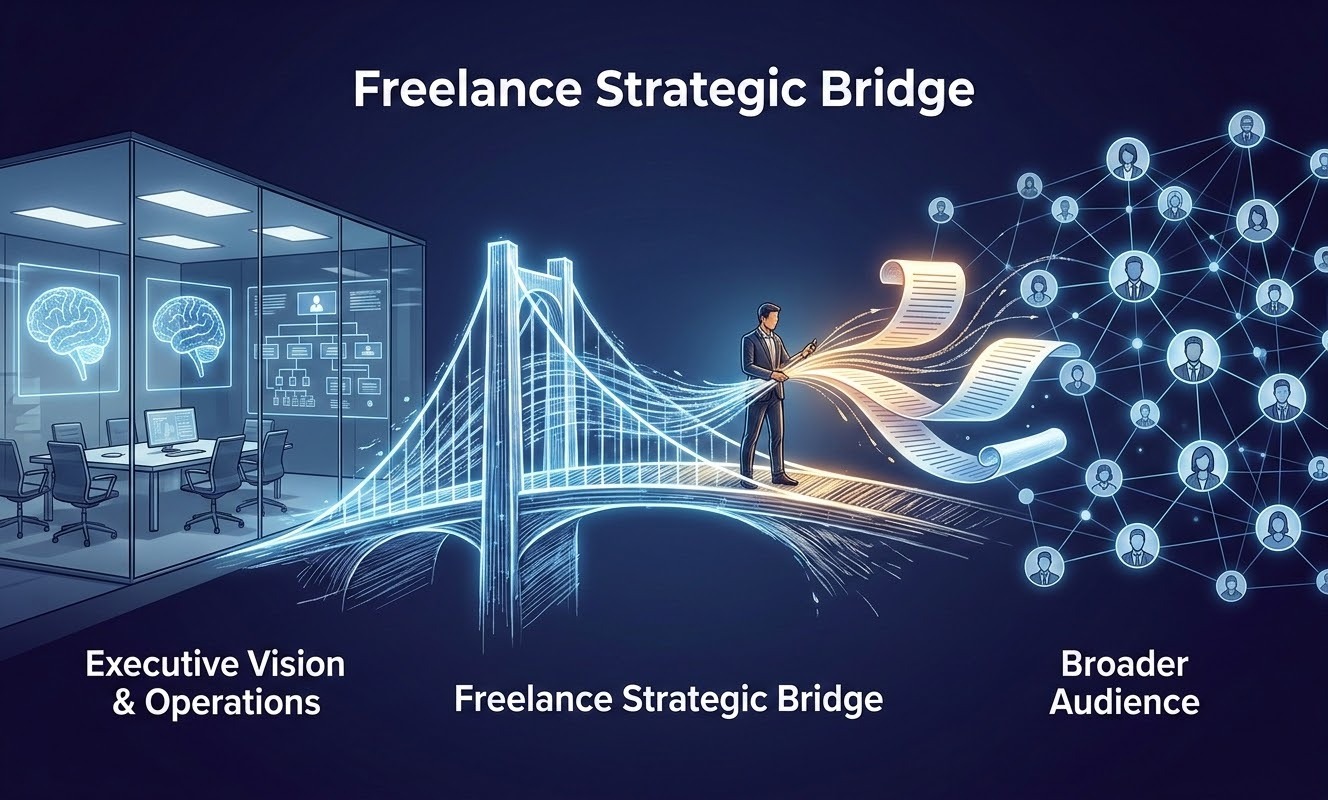
The professional writer becomes the strategic brain behind the executive brand, serving as a link between the vision that the executive has and the story that is told publicly. Through the out-sourcing of writing, the CEO can achieve a frequency that ensures his/her dominance in the industry while not losing sight of the company’s operations. It is at this point that the scale becomes truly apparent.
Subject Matter Specialization vs. Generalist Ghostwriting
While a generalist could potentially craft grammatically correct sentences, the specialist knows the reasons for the changes taking place in your industry. In screening potential freelance partners, focus on those with extensive subject matter knowledge. A writer who is familiar with the ins and outs of fintech legislation, intricacies of B2B SaaS sales cycles or problems with cloud architecture doesn't need to get up to speed with your industry; he will be able to speak your language right away.
This knowledge guarantees that the tone of the piece written will remain high-brow, not the lowbrow one often seen in common blog posts. When your writer is knowledgeable about the competition and pains of your target persona as much as you are, then she won't just be "ghostwriting" for you; she'll co-create. She will know how to present your contrarian points of view in a proper context.
Mastering the Art of Voice Consistency
Ghostwriting goes far beyond simply transcribing the CEO's thoughts. It is a form of intellectual reflection. The elite ghostwriter is not just another extension of the executive but one who perfectly reflects his tone, voice, and perspective. It entails an extensive onboarding phase during which the writer will not only study the past work of the CEO but also interact with him in order to discern his "mental models"—that is, the exact metaphors and language used to conceptualize problems.
The end result is a harmonious partnership that produces a natural synergy between the two parties. The objective of such work is authenticity: the readers are supposed never to be able to doubt that what they read really comes from the mind of the CEO. A good writer will capture the exact rhythm of the CEO's speech, thus making even the most sophisticated arguments appear like something that originated in the CEO's head.
Building a Content Engine Without Internal Overhead
The reason to hire freelancers is both economical and operational. Establishing an effective "always-on" content engine within the company requires hiring dedicated editorial and content teams—an overhead which may be hard to justify in case of growth-stage organizations. But thanks to freelancers, such flexibility becomes possible.
Thanks to their access to a highly-qualified network of specializations of freelance writers, one can boost content generation around the launch of a new product, shift the focus on the emerging themes on the market or slow down during the lean periods while avoiding problems with payroll tax, benefits, and management of the workforce.
Content creation stops being an expense and turns into an advantage. You will be able to establish a presence in different channels of communication: from the LinkedIn posts to the long industry-related white papers. When you approach the issue from the standpoint of the strategic partnership, not only transaction, then there are no limits to scale your content generation capacity.
You get access to the different skills of freelancers: researchers, editors and even the specialists on SEO. And, thanks to that, your executives will have an opportunity to remain always present on the market.
Finding the Perfect Partner: Vetting and Technology
Finding a great partner in the world of the contemporary freelance industry can be quite challenging. All platforms are filled with specialists who can be defined as generalists, and thus, it becomes impossible to find one special person who will be able to fully represent the voice of a company’s CEO.
The 1% Rule: The Difficulty of Manual Vetting
The process of sourcing a ghostwriter for your executive cannot be compared to sourcing a copywriter for your blog post. It goes beyond acquiring content to building trust, developing a strategic mindset, and working in conjunction with your brainpower. There are many people out there but not everyone belongs to the "1%" class, which makes their sourcing extremely challenging.
The manual approach involves going through thousands of applications, reviewing writing samples of all kinds, conducting interviews to find the person who can match your thinking and, finally, checking references. The majority of organizations simply don’t have the systems in place to perform all these tasks and end up spending money on mediocre writers that can rewrite ideas rather than develop them. Therefore, the problem is not about finding any writer, but about finding the one who would be able to turn strategies into premium content.
Leveraging AI-Powered Marketplaces like GigMint
It is at this point that contemporary AI-based platforms like GigMint can step in. As opposed to searching for unqualified candidates manually, the platform makes use of sophisticated AI technology to connect executives’ needs with freelance talents. The first step is creating intelligent prompts to structure your ideas to make sure that the scope is clear from the outset.
Through using its AI engine, GigMint searches its carefully selected network and matches projects’ requirements with a selected pool of top professionals that go through a thorough screening process. As opposed to the conventional practice of posting jobs on sites where profiles are stuffed with keywords, GigMint takes into account the candidate’s industry expertise, style of writing and track record when working on executive projects. Not only does it allow you to save time, but more importantly, it allows you to improve the quality of the process. It eliminates the need for the process of searching for and qualifying candidates and lets you focus on the collaboration part. This way, you get a ready-to-use cohort of qualified writers who have been pre-qualified for their excellence.
Key Qualities of an Executive Ghostwriter
Now that you’ve avoided the noise, what specifically are you looking for? Expert ghost writing is its own art form, one that calls for a special set of three skills. First of all, find a journalist's ability to interview. You want to make sure that your ghostwriter doesn’t only have the ability to put words on paper, but can figure out how to "mine for gold" during an interview, digging up insights from your busy life.
The best ghost writers will not only know how to do strategic research, but how to present it effectively without sacrificing subtleties. Thirdly, ask for proof of experience in executive-level writing. Your prospective writer should provide examples of his ability to convey executive-level business-to-business strategy, contrarian views, and a sophisticated professional tone.
Building an Executive Content Engine
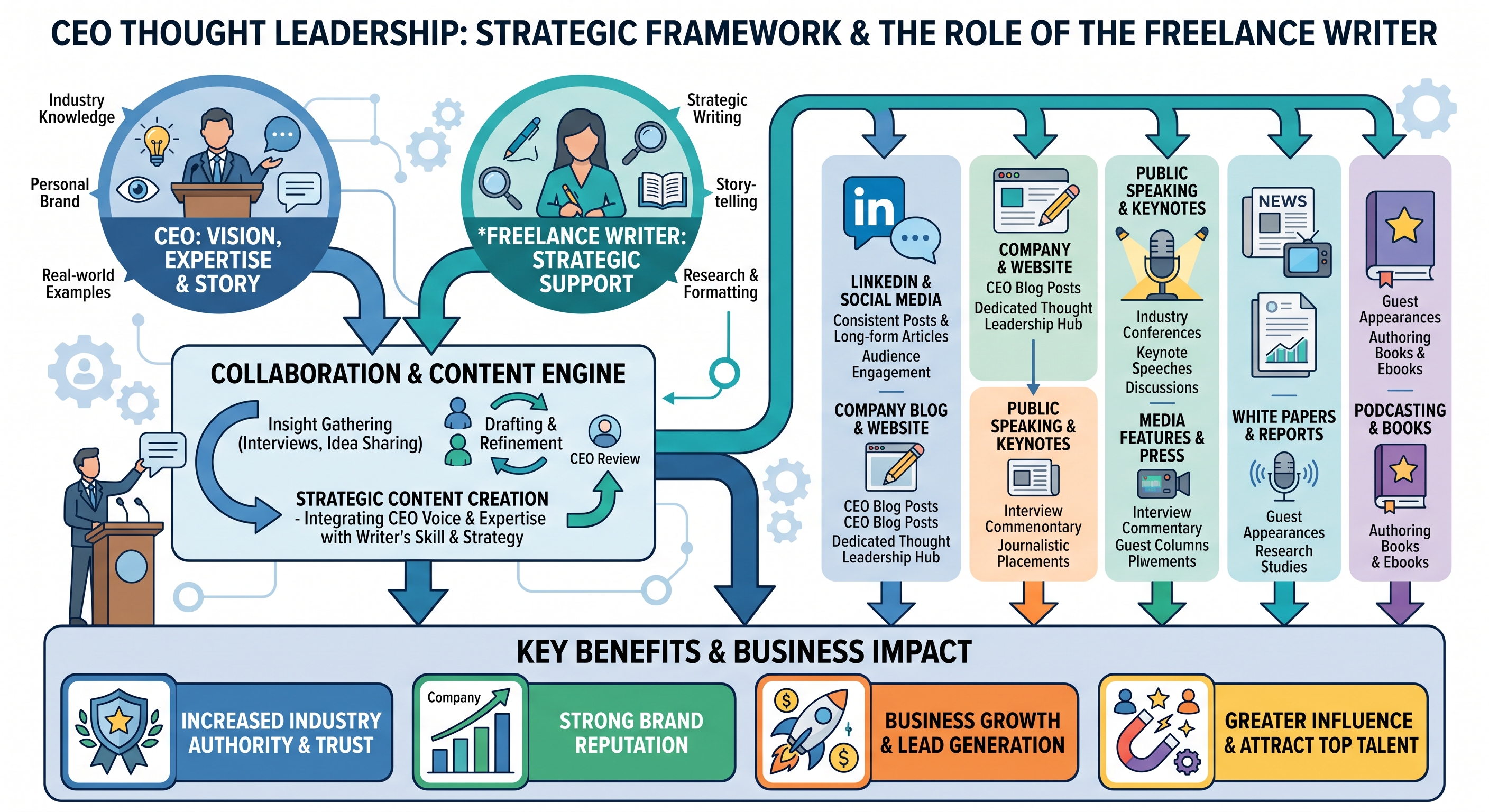
Developing a high-impact thought leadership program entails not only the recruitment of the right writer but also the development of a process that will both honor the time of the CEO as well as preserve the integrity of their voice. Using a standardized "content engine" is an approach by which you take intermittent ideas and turn them into a regular flow of content that builds up the CEO's authority.

Step 1: The Strategic Briefing
It is the foundation document that connects the writer with the strategic direction of the CEO. The briefing is not a generic idea generation exercise but rather a strategic one-point strike that gets to the heart of the pillars of the CEO’s brand. The pain points of the target market are identified along with the CEO’s "contrarian" views – the unconventional ideas that go against the conventional wisdom of the market.
Step 2: The Efficient Interview (SMI)
The biggest mistake in executive ghostwriting is when a writer asks too many general questions resulting in an "information dump". In such a case, one should conduct a Structured Mental Interview (SMI). In essence, SMI should be no more than a high intensity 30 minute conversation where a writer will act like a journalist. While the writer's job is not to get the CEO to actually write the draft, the aim of this process is to receive "raw material"—specific examples, personal experience, and other credible information.
Through recording of the conversation and use of artificial intelligence transcription service, the writer will manage to capture the CEO's speech style and vocabulary. Such an approach takes into account the CEO's tight schedule and allows the writer to have enough "real" content to write an article that sounds just like written by the CEO himself.
Step 3: Drafting, Flow, and SEO Optimization
Armed with their insights, the writer then proceeds to write the piece. Thought leadership writing requires the right mix of high-level strategic thinking and technical SEO optimization. They create their piece of content in the way that makes it easily consumable in today's world – short paragraphs, skimmable headings, and “value hooks” in the content to hook people immediately.
They include the necessary keywords organically to ensure that the content is SEO-friendly but not at the cost of sophisticated messaging. It should follow the same logic that would follow during an executive conversation – a premise, followed by supporting evidence and end with a point of view that's conclusive and decisive. By creating a smooth narrative journey for their piece, they ensure that the reader not only consumes but finishes the entire piece of content.
Step 4: The Review and Approval Loop
The last step in the process is the review loop, and this one has to be smooth to avoid potential hold-ups. Make sure there's a procedure in place where the CEO will only review the logic and voice of the piece but not the grammar or style. Utilize tools that facilitate line-item commenting as opposed to lengthy email exchanges. If everything else went according to plan, the first draft shouldn’t need any more editing. With the "two rounds of feedback" rule, you encourage both the author to write a quality piece and the CEO to give constructive feedback.
KPIs for Measuring Executive Thought Leadership Impact
Thought leadership that delivers any measurable business results should go far beyond vanity metrics. While it's great to have a wide audience, the true power of an executive brand is in its ability to influence a specific, valuable audience segment. Here are the key KPIs to measure your market authority.
Engagement and Community Growth
Influence in any industry is not measured in the number of followers you have, but in the quality of conversation about your concepts. Interaction on LinkedIn through meaningful discussions, sharing with added value, and debates among peers acts as one of the main metrics that can be used to measure “share of voice.” When professionals in your industry or even potential buyers take time to discuss your posts and provide insightful commentary, it means that the ideas expressed in the content posed a challenge to them or brought something new into play.
Inbound Opportunity and Lead Quality
The clearest indication that thought leadership has worked is the effect it has had on the sales pipeline. The CEO’s content must be measured via inbound requests that mention particular blog posts or articles. "Warmed up" leads usually come pre-qualified since they have audited the CEO’s viewpoint and realized that it resonated with them, thus saving the time of the sales team by reducing the sales cycle.
To inbound requests, look for strategic value-added outcomes such as speaking invitations to top industry conferences or unsolicited media coverage. Such results mean that the CEO has been acknowledged as a valuable voice in the market. This type of content does not aim at viral content that ends up targeting a wrong audience. Its sole purpose is to attract those high value-added stakeholders who view the CEO not as a vendor, but as a visionary leader to partner with.
Brand Sentiment and Market Authority
It is imperative that gauging market perception moves into a qualitative approach. Be very cognizant of the tone in which the discussion takes place within the industry, and the comments made in conversations made during sales pitches. When the prospect tells you “I have been following your series on changes within the industry” or when others mention the CEO as the authority, it becomes evident that the transition has taken place. This demonstrates that the brand has transitioned into a “voice of the industry,” rather than just a “vendor.”
The Long-Term ROI of Executive Brand Equity
Thought leadership goes way beyond just being a marketing technique; it is a capital expenditure made in the form of an investment in one of the most important assets of the company – its reputation. Through the implementation of this strategy, an executive is taken out of the shadows and turned into a thought leader, changing his status from a “vendor” to an industry guru. The use of such techniques as breaking down the "CEO Bottleneck" through cooperation with top-notch freelancers will help turn random insights into a consistent source of authority.
Content as a Compounding Asset
In contrast to paid advertisements, which are removed immediately once the spending stops, thought leadership is a compoundable resource. Every single article, white paper, or opinion piece is a forever, discoverable piece of digital property. Over time, these assets will compound into an “authority moat” that your competitors cannot mimic.
Google will take this into account and surface the executive’s knowledge long after the publication date through its search algorithms. If you hire elite writers now, then you are laying the foundation for long-term trust and authority that will help you attract leads and establish expertise down the road.
Closing Call to Action
It is time that you stop being the best-kept secret in the industry. Having expertise is one thing, but it does not bring you any return on investment unless you share it, perfect it and deliver it regularly to your market. The key issue in creating thought leadership is not that you have a vision; it is the execution of it. With help of our team of vetted freelancers you can avoid the friction of the process and begin dominating the conversation.