Machine Learning for Business Applications: 9 Practical Strategies Beyond Simple Automation
Machine Learning for Business Applications: 9 Practical Strategies Beyond Simple Automation
In most cases, when it comes to artificial intelligence, its time-saving capabilities in some very fundamental ways are mainly mentioned, such as sending an email and generating the minutes of a meeting.
While useful, these applications overlook the true capability of machine learning, which extends far beyond basic virtual assistance. Companies invest in state-of-the-art data technology for little gains in efficiency.
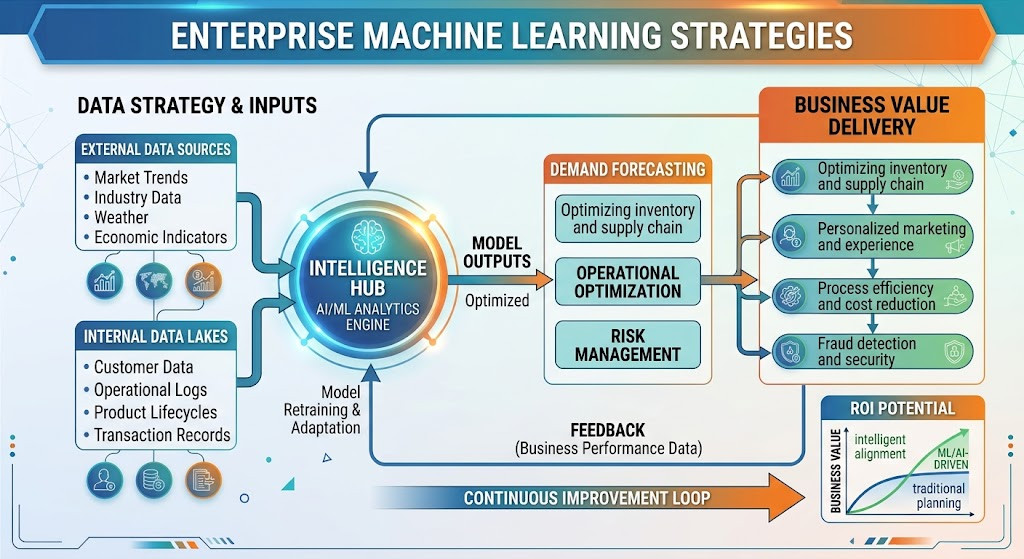
The main economic benefit of machine learning technology is related to the ability to recognize patterns in large amounts of data, predict events and adapt to changes on an enterprise level.
Through the application of machine learning for business purposes other than just automating certain processes, a company’s management team is able to generate more revenues, strengthen operations, and create a competitive edge.
Why Traditional Task Automation Reaches an ROI Ceiling
The Fundamental Difference Between Rule-Based Automation and Machine Learning
Rule-based automation functions based on deterministic intelligence. If a particular event occurs, then it results in a predefined result. Rule-based automation is highly effective in cases when there is no change in conditions; hence the workflows are highly rigid and predictable.
Robotic process automation and transactional workflows can be included in rule-based automation workflow. It is reliable and fast but highly inflexible. As soon as any uncertainty takes place because of changing market demands, unusual customer behavior or document formats, rule-based workflows fail to function properly and human intervention becomes necessary.
Machine learning workflows use probabilistic intelligence. Machine learning systems take into account different conditions to find out which outcome would be most likely for the given input data. Instead of using predefined human-written rules, machine learning uses past patterns and learns from its operation to change its output.
Moving Up the Value Chain: From Cost Savings to Revenue Creation
Automation mainly affects the cost portion of the profit and loss statement. It saves time through reducing manual work, saving minutes in doing tasks every day. But saving cost always has its maximum limit because you can save the labor cost up to zero but beyond zero there will be minimal savings.
Value creation mainly affects the income and growth part of the balance sheet. When you move from saving labor hours to optimizing dynamic pricing or saving customers from churn or avoiding any failures in supply chain management, there is exponential return on investment (ROI). The leading companies consider machine learning as value creation rather than cost saving.
9 High-Impact Machine Learning Applications for Modern Businesses
1. Predictive Customer Churn Mitigation
The Concept
Churn management techniques have been fairly reactive in the past: customer exit interviews, subscription cancellations, or even quarterly reviews of their accounts. At the point where a customer requests you to cancel the contract or ceases ordering inventories, the relationship has deteriorated beyond any repairable extent.
Predictive churn management, in its turn, identifies subtle signals months ahead of customer's cancellation.
How Machine Learning Drives It
Machine learning models evaluate diverse customer touchpoints simultaneously. Behavioral sequence tracking, subtle reduction in platform utilization, slowing down of login rate, decreased API activity, changes in the sentiment of tickets raised to support, and subtle increase in payment frictions – all these factors are assessed through multi-variable regression and neural network models.
Value Proposition
Customer success teams no longer respond reactively to the threats of customer churn but proactively retain the customers. When the algorithm identifies a high-value account with increased churn risk score, it automatically launches a retention campaign – ranging from executive sponsorship to feature onboarding or account health bonuses.
Important Metrics to Measure
The success criteria are the following: Customer Lifetime Value, Churn Rate Percentage Reduction, and ROI on the retention campaign.
2. Dynamic Price & Margin Optimization
The Concept
Cost-plus pricing models and seasonal promotions based on a schedule forfeit potential revenue. Prices could be too high at times when demand is slow, resulting in missed sales volume, or too low when there is high demand, thus giving up gross margin.
Price optimization looks at the current purchasing environment to calculate the optimal market-clearing price for all products and services being offered.
How Machine Learning Enables It
Regression and reinforcement learning algorithms calculate cross-elasticity using internal and external signals of the company and the market.
Continuous calculations of customer segments' price elasticity, inventory levels of the regions, price movements of the competition, local economies, time of day buying speed, and website/sales funnel conversion rates.
Impact on Business
The company maximizes the yield from every sale without compromising its most price-sensitive customers or brand value through random discounting.
Sales teams receive automated margin and price guidance by the machine learning algorithm to help avoid unnecessary sales discounts during enterprise contract negotiations.
3. Intelligent Demand Forecasting & Supply Chain Alignment
The Idea
The bullwhip effect is still one of the most expensive problems in supply chain management. Any small changes in the demand of consumers could cause large inventory changes upstream leading to significant shortages or too much locked up cash as working capital.
Demand forecasting with machine learning goes beyond simple average values and uses multi-dimensional business intelligence.
How It Uses Machine Learning
Complex deep-learning algorithms and predictive modeling analyze hundreds of external factors in addition to the company's sales history data.
The system considers various macroeconomic signals, anomalies in the weather in local markets, congestion indexes of shipping lines, marketing events schedule, variance in supplier lead times, and changes in social sentiment to predict exact inventory needs per location and product SKU.
Impact on Business
The company reduces its working capital invested into extra warehouse stock while minimizing stockouts significantly during peak demand seasons. There will be far fewer emergency rush freight deliveries.
4. Real-Time Fraud & Anomaly Detection
The Concept
The old-school fraud systems depend upon the manual review team and inflexible logic based on rules that identify transactions above a certain dollar limit or reject purchase attempts based on ZIP codes. They generate too many false alarms while being a nuisance to legitimate clients but fail to identify any novel means for perpetrating a scam.
How Machine Learning Makes It Work
Anomaly detection models, graph neural networks, and isolation forests can process millions of transactions in seconds. Rather than measuring individual data points, this technology creates an overall picture of user behavior during each transaction based on such factors as biometrics of the device used, typing speed, geovelocity, account creation patterns, and multi-account identity mapping.
Business Impact
These organizations protect against financial theft, while reducing friction for good customers. By reducing false positive rates significantly, companies are able to preserve their transaction volume while maintaining the trust of their clients.
5. Context-Aware Recommendation Engines
The Idea
Basic recommendation systems make use of collaborative filtering algorithms which make use of very simple rules such as "people who bought this product also looked at this product." Though they are helpful, these basic recommendation algorithms do not tend to adapt to user intentions, timing, or catalog changes in real time, thus becoming outdated and ignored.
How It Works Using Machine Learning
Advanced recommendation engines use real-time session graphs combined with multi-armed bandit learning algorithms. They analyze in-session interactions, including but not limited to dwell time, scrolling, search query tuning, time of day, device type, and cross-category browsing, in order to immediately update the recommendations based on a single browsing session.
Business Impact
E-commerce brands and digital platforms organically achieve cross-sell and up-sell statistics since they show things relevant to the users’ current intentions. The result is enhanced user experience, and revenue expansion is achieved.
Important Metrics to Consider
Conversion Ratio of Recommends, Recommend Click-Thru Ratio, and Cross-Sales Dollar Growth.
6. Automated Quality Control & Visual Inspection
The Idea
Quality control of manufactured items, assembly lines, and maintenance of assets in the field through manual inspection is time-consuming, prone to errors due to fatigue and is expensive to implement.
The Mechanics of Machine Learning behind It
Vision-based computer systems make use of a trained deep learning model based on convolutional neural networks that uses hundreds of thousands of examples to train itself. The model analyzes the surface texture, dimensional accuracy, welding quality, or packaging seals of the products moving down an assembly line within seconds using a high-speed industrial camera.
Business Impact
Defective products are identified early in the manufacturing process, before any costly work on adding value is done, or the defect reaches the customer through shipment. This helps reduce the risk of having to recall the products, as well as decreases the costs of warranties.
7. Predictive Asset Maintenance & Operational Reliability
The Idea Behind It
Conventional maintenance of equipment depends either on the calendar system, whereby machines are serviced after every 90 days irrespective of their actual operations, or it relies on a run-to-failure approach that only allows repair once there is a breakdown.
Machine Learning Behind the Approach
The Industrial Internet of Things sensors generate various data streams related to operational activities like vibration frequency, operating temperature, sound differences, pressure readings, and power consumption. Predictive degradation models analyze the continuous time series data to identify minor deviations in the mechanics of the equipment.
Business Impact
Equipment-intensive businesses (energy companies, transportation firms, manufacturing firms, logistics companies), eliminate major equipment malfunctions and increase the life of equipment. The maintenance team is sent exactly when parts need fixing.
8. Advanced Talent Acquisition & Workforce Analytics
The Idea
Traditionally, recruitment has been done by means of resume scanning, keyword searches, and interviewing candidates. This results in poor fit for the job, delayed hiring, human bias, and lack of any prediction of employee turnover and team skills.
How Machine Learning Drives This
Models of Natural Language Processing create maps of skill graph, project history, and contextually achieved experience of candidates compared to those of top performers in the corresponding job titles.
Internal retention models consider workload balance, career advancement speed, pay equity, and management touchpoints in order to predict employee churn among key business units.
Effect on Business
The leaders in the HR and talent function speed up hiring lead times of critical technical and managerial positions without having to deal with any expensive turnover. The executives get a complete picture of the skill gaps within the organization that help in succession planning.
9. Intelligent Contract Analysis & Regulatory Risk Mapping
The Concept
Enterprise companies work with thousands of contracts on an annual basis. The number includes vendor agreements, client agreements, licensing records, and regulatory changes. Auditing any of those documents for irregular liability clauses, indemnities or changing compliance requirements takes thousands of legal billing hours and allows for human error.
How Machine Learning Does That
Language models and domain-adapted Natural Language Processing systems find, categorize and index structural clauses in unstructured document repositories. They detect buried auto-renewal clauses, service level agreements, lack of indemnities and differences between international standards of operation and local regulation.
Business Outcomes
Legal, procurement, and compliance departments streamline the review process and guarantee that all risks are covered by the organization’s contracts. Enterprises do not get surprised by penalty charges, avoid missing auto-renewals, and increase deal cycle efficiency.
Technical and Strategic Prerequisites Before Deployment
For enterprise machine learning to be realized in terms of its value, three foundations must be established prior to implementing any customized models.
Data Readiness: The True Foundation of Model Accuracy
The performance of machine learning algorithms is highly dependent upon the input data they receive. Unstructured and unreliable data fed to a sophisticated predictive algorithm will generate incorrect business forecasts.
Focus on keeping the data infrastructure clean by integrating separate data silos present within different departments. Implement standardized data input procedures, create automated data validation processes, and fix any duplicates or missing entries.
A simple machine learning algorithm that utilizes structured data will beat the performance of a sophisticated deep learning algorithm using bad data.
Aligning Business Objectives with Mathematical Metrics
In any company's machine learning project, the problem is the misalignment of goals between the data science team and the metrics that drive company performance.
The data science team may optimize its models on mathematically sound figures, but if the accuracy results in high false positives, it will produce adverse consequences in real business terms. In this case, the leadership position requires the formulation of organizational objectives in measurable statistical form.
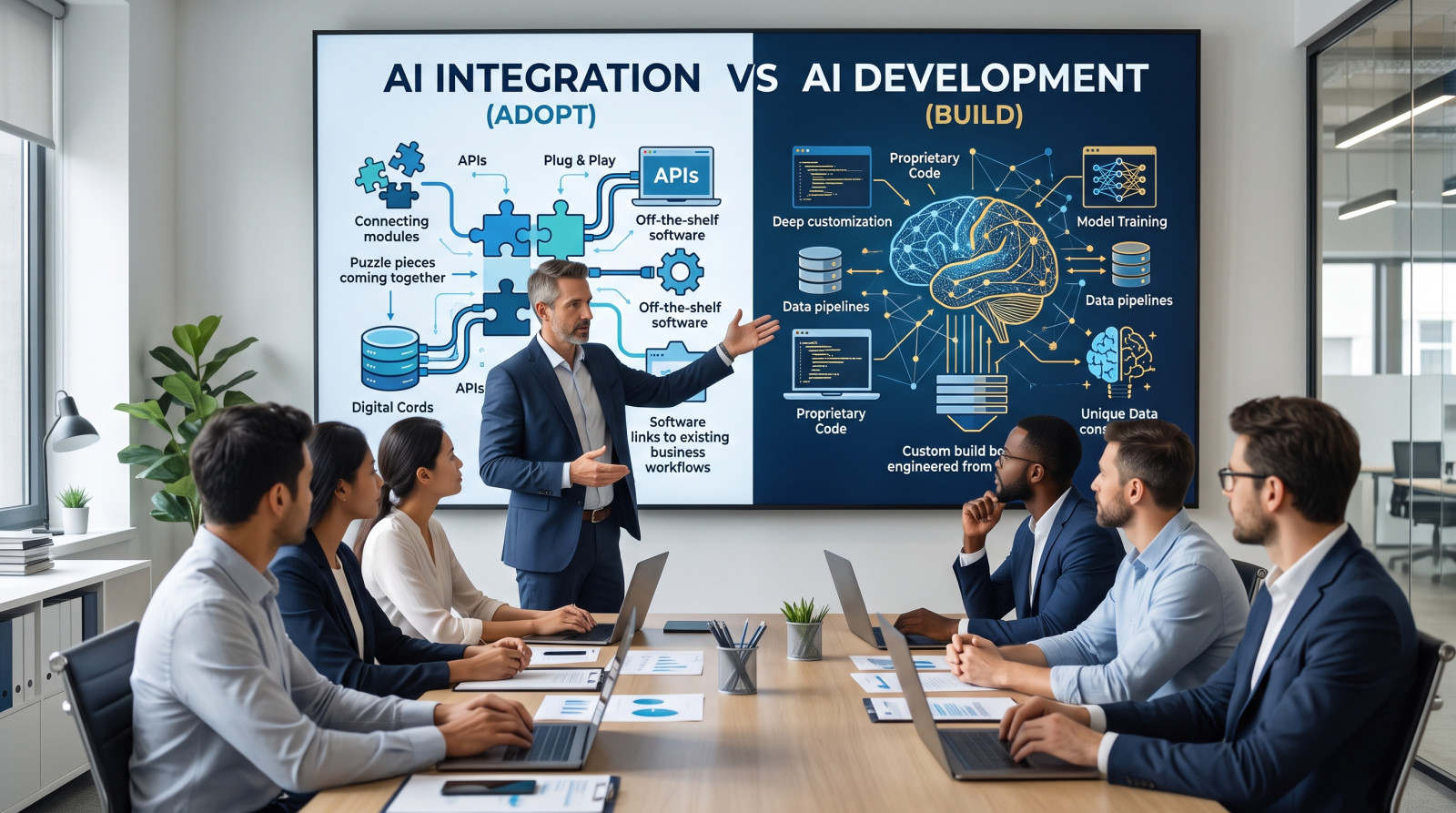
Build vs. Buy vs. Partner: Selecting the Right Path
The following must be considered, taking into account priorities and competencies within the organization:
Enterprise Ready APIs: The right approach for repeatable business operations where time to market is valued higher than intellectual property development.
Hybrid Business Platforms: The right approach for core business operations where platforms can be integrated into your current data platform.
In-House Custom Models: The necessary approach for core product functionality or proprietary business assets offering a direct competitive advantage.
Overcoming Common Enterprise Implementation Pitfalls
Even machine learning programs that receive ample funding face hurdles when put into action. Being aware of potential pitfalls early helps leadership protect project ROI.
Resolving the "Black Box" Problem with Explainable AI
Predictive results that are difficult to comprehend by nature are unlikely to be trusted by executive stakeholders or any regulatory agencies especially in sectors where the issue is particularly sensitive such as credit evaluation, medical diagnoses, or insurance claims.
For this reason, it is advisable to include explainable artificial intelligence frameworks in the processes of using machine learning systems. Using SHAP and LIME methods provides the system with the ability to create a comprehensible audit trail for each of its decisions.
Mitigating Model Drift in Dynamic Environments
The machine learning models are built by training them with historical data. The market dynamics, behavior of customers, economic dynamics, etc. keep changing over time.
Whenever there are changes in the real-world scenarios compared to the historical parameters for which models are trained, then there will be degradation in the model’s performance—a scenario called data drift.
Setup continuous monitoring processes where you can evaluate your model’s performance in live production in comparison to baseline accuracy scores. Any alerting system should inform your engineering teams in case of data drift.
Managing Organizational Change & End-User Adoption
The predictive model is worth nothing unless the teams on the ground have faith in the results and act on them. If your sales representatives do not care for your dynamic pricing models and if your field engineers bypass your predictive maintenance systems, then your money spent on machine learning will be wasted.
Make sure that the machine learning solutions you design can be seamlessly incorporated into the user interface of existing software tools such as CRMs, ERPs, and field service management software.
This will make the transition easier for end-users. Educate them during the implementation phase on how the use of machine learning models makes their work easy.
Frequently Asked Questions
What distinguishes machine learning from conventional business automation?
Machine learning and business automation have different approaches when it comes to programming the algorithm.
Traditional business automation has programming defined by humans, while machine learning involves probabilistic programming which examines huge amounts of data and makes predictions.
What industries enjoy the highest financial benefits from machine learning applications?
Industries that generate a lot of data get quick financial gains. The most obvious beneficiaries are the financial sector which gains from fraud management and risk modeling; e-commerce which makes money with dynamic pricing and recommendations; manufacturing and logistics which save money with predictive maintenance and demand forecasting; and SaaS which retains more customers with churn prediction.
How much time does it take to see ROI from your enterprise machine learning effort?
A well-designed enterprise machine learning project usually sees tangible outcomes after 3-6 months of operation.
The early implementation stages involve verification of the data pipeline and building the baseline model, after which comes the live testing stage, during which the output of the model is compared to the historical performance.
Is it necessary for mid-market enterprises to have their own data science team to implement machine learning?
No. Machine learning frameworks on the cloud, enterprise APIs with pre-trained models, and managed platforms enable mid-market businesses to have advanced predictive capabilities without having to hire costly internal research teams.
Elevating Your Enterprise Capabilities with Gigmint.AI
Going further than mere automation of tasks requires changing the direction of effort from saving costs to creating value.
Machine learning provides robust technology that allows businesses to protect their revenue sources, optimize profit margins, improve supply chains, and create sustainable competitive advantages.
The process begins with choosing high-impact use cases based on credible data of the company’s operations. With the combination of specific machine learning algorithms and well-defined MLOps practices, companies can create a robust, scalable source of business development out of their raw enterprise data.
Learn how Gigmint.AI can help you build and scale machine learning solutions tailored for your business operations right now.