The Definitive Guide to the Best Tools and Frameworks for Machine Learning Development in 2026
The Definitive Guide to the Best Tools and Frameworks for Machine Learning Development in 2026
1. Overview
A paradigm shift has happened within the realm of machine learning (ML). What used to be the territory only for scientific experimentation and development is now at the core of how businesses operate. In 2026, artificial intelligence (AI) is not an extra "feature"; it will become the fundamental part of how companies create user experience and automated business processes.
With the growing accessibility of ML development, the issue faced by engineers and data scientists is no longer related to the possibility of creating AI, but rather with the efficiency and reliability of its scaling.
Choosing the right technology stack for your project is one of the key decisions you have to make as a team, because it defines not only your architecture, but also the speed of your development process, potential for scaling, and, most importantly, your production deployment reliability.
A poor choice made at the beginning of your journey may turn into a source of technical debt for your company, which will slow down your development greatly.
The following article will be a complete exploration of the existing ML development ecosystem. We will examine the industry-standard frameworks; then, we will look at the particular libraries enabling high-performance research; and finally, we will discover the key MLOps tools that should be used to build the transition from the notebook to world-level production.
We are entering the time of interoperability. Due to the development of framework-independent standards (such as Keras 3.0) and the increasing role of Hugging Face, the strong division between different ecosystems comes down. We will show how to operate in this modularity and make sure that your architecture will be compatible with the future.
2. Core Frameworks
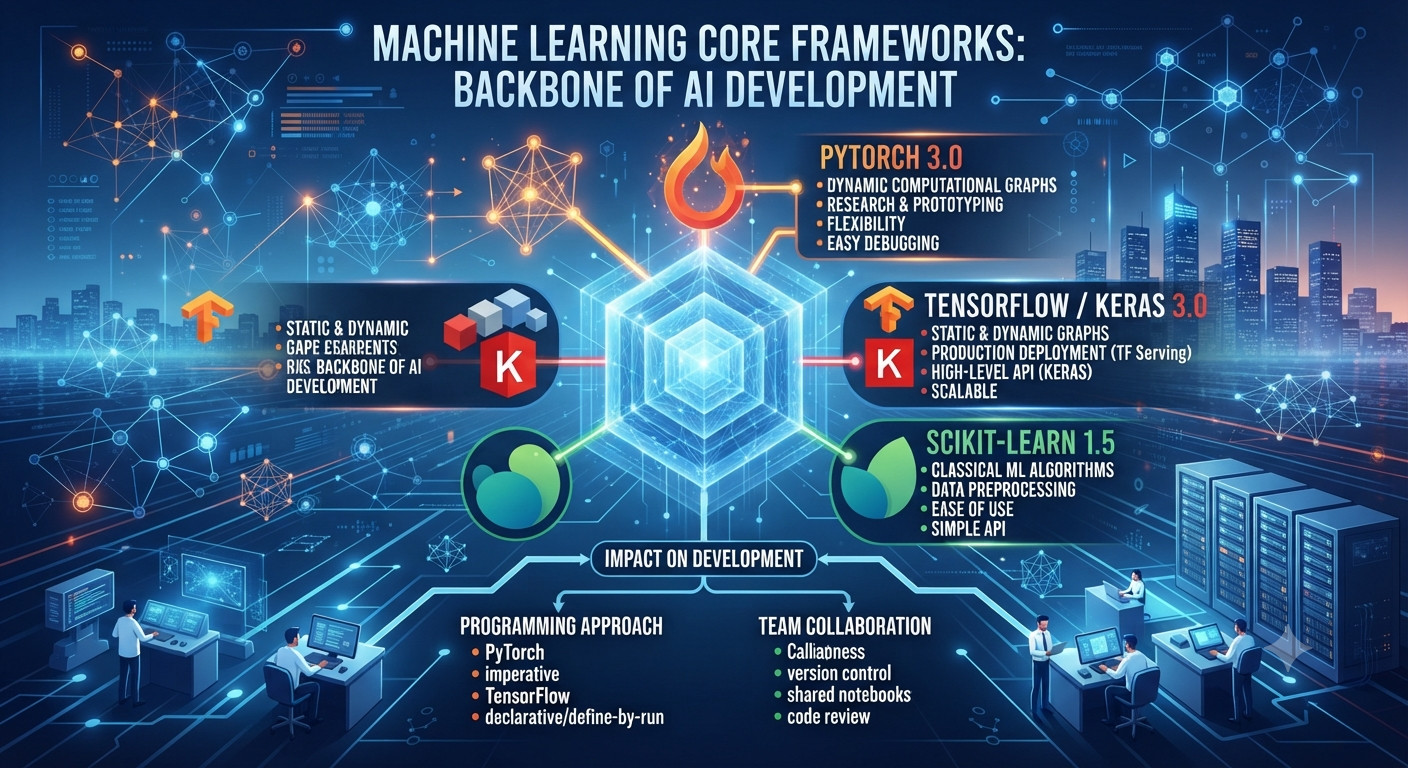
Amidst the plethora of tools that have been developed for machine learning, there are three frameworks which always make it to the top of the list. As newer and more specialized frameworks are being developed continuously, these three frameworks—PyTorch, TensorFlow/Keras, and Scikit-Learn—are the backbone of machine learning technology. Selecting among the three often decides not only the programming approach to be followed, but also how collaboration takes place within the team.
PyTorch: The Researcher’s Best Friend, the Engineer’s Superweapon
The framework has established itself as the "king of research" framework; however, in 2026, PyTorch is well beyond its reputation of being "just for prototyping." Its power lies in the dynamic computational graph structure which facilitates intuitive debugging and experimentation. It is considered to be very "Pythonic" in its nature; if you know Python, you can use PyTorch.
Apart from its programming experience, the whole ecosystem has developed much since then. With TorchServe as a new feature and better support for distributed computing, moving from research notebooks to production environments becomes easier and faster. It is still the best option for rapid iterations on cutting-edge models or gradient manipulations.
TensorFlow / Keras: The Industrial Workhorse
Whereas PyTorch is the scalpel in machine learning, TensorFlow is the big CNC machine. While there are other alternatives, it remains the best option for large-scale deployments due to its maturity of the ecosystem.
While creating your AI solution, you have to think about the whole pipeline rather than only the script for training. Thanks to TensorFlow Extended and support of the edge and mobile deployment (TensorFlow Lite), it provides you with an entire set of solutions for data validation, model analysis, and serving. TensorFlow is the top choice when the key requirement of your enterprise is "set it and forget it" and standardization of the deployment across the whole globe.
Scikit-Learn: The Essential Foundation
In an era of billion parameters LLMs, it can seem tempting to ignore Scikit-Learn. However, this is the essential part of any serious ML solution. It is not suitable for deep learning but is unbeatable when it comes to the rest of machine learning tasks: data preprocessing, feature engineering, cross-validation, supervised and unsupervised algorithms.
As a rule, any production-ready ML pipeline starts from preparing the data, and the API of Scikit-Learn is the standard that almost all other frameworks have
3. Specialized Libraries & Accelerators
Even though these are the frameworks from which models can be built, there is a specific library that gives the precision necessary for excelling in a particular field. The future as of 2026 means that the one size fits all approach will no longer be effective.
The Gradient Boosting Triple Threat: XGBoost, LightGBM, and CatBoost
In many of the corporate uses of structured tabular data, like financial prediction, risk evaluation, or churn prediction, deep learning is simply unnecessary. In such situations, gradient boosted decision trees (GBDTs) rule the roost.
-
XGBoost: The industry-standard original. It is the fastest, provides the most regularization, and has a battle-tested reputation. When looking for a reliable, robust model to work with tabular data, there's really no other choice to make.
-
LightGBM: The fast and memory-efficient model. This model uses the “leaf-wise” tree growing method which makes it extremely efficient at working with massive datasets while using fewer resources than the conventional boosting methods.
-
CatBoost: The model specialized in categorical data processing. While both XGBoost and LightGBM require substantial pre-processing for their categorical data input, CatBoost does not. It performs
Hugging Face Transformers: The NLP and Multi-modal Standard
In the domain of NLP and LLMs, Hugging Face is not simply a library anymore but is the very operating system for all modern AI research. Transformers from Hugging Face offer a unified interface for almost all SOTA architectures.
The library itself is not restricted to NLP tasks, but is also capable of processing audio, visual, and video data with the same ease as text classification. If you require implementation of LLMs, fine-tuning of your foundation models, or using RAG architectures, then Hugging Face cannot be an option – it is a must. Compatibility of Hugging Face with both PyTorch and TensorFlow will make sure that your "Hugging Face" pipeline does not conflict with your underlying framework.
JAX: The Future of High-Performance Research
JAX is by far the most promising breakthrough for the machine learning research field. A product of Google's research labs, JAX is not a neural network framework in the typical sense; it is rather a library of high performance numerical computation and automatic differentiation.
JAX looks at your functions in the manner in which mathematical expressions are viewed. Thus, JAX allows "JIT compilation" of your code using XLA (Accelerated Linear Algebra) for running on CPU, GPU and TPU at native speed.
Researchers looking for performance at the cutting edge of parallelism or for those developing their own highly customized training loops for experiments have more possibilities than PyTorch or TensorFlow can offer them. It is however worth noting that the learning process is more steep since you will be using functional programming techniques.
4. Technical Comparison Matrix (The "Quick Reference")
The choice of a suitable architecture is frequently a compromise of development time, performance, and operational factors. Although the preceding sections give background information on the matter, this matrix provides a summary to aid you in making fast architectural choices.
Quick-Reference Comparison Table
|
Tool/Framework |
Primary Use Case |
Language Support |
Learning Curve |
Community Size |
Deployment Ease |
|
PyTorch |
Research / Rapid Prototyping |
Python (Primary) |
Moderate |
Massive |
High (via TorchServe) |
|
TensorFlow / Keras |
Industrial Production |
Python, C++, JS |
Steep |
Extensive |
Excellent (TFX/Lite) |
|
Scikit-Learn |
Classical ML / Baselines |
Python |
Shallow |
Massive |
High (for batch/API) |
|
XGBoost |
Tabular Data / Kaggle |
C++, Python, R, Java |
Moderate |
Very Large |
High |
|
Hugging Face |
NLP / LLM / Multi-modal |
Python (Core) |
Moderate |
Massive |
High (Inference Endpoints) |
|
JAX |
High-Perf Research |
Python (Functional) |
Very Steep |
Growing |
Moderate |
Interpreting the Matrix for Your Project
Enterprise stability: In cases where your application demands a standardized end-to-end workflow with rigid requirements in terms of model versioning and deployment globally, the TensorFlow/Keras suite of tools is the industry-standard option.
Innovation and flexibility: In case your team is developing groundbreaking models, i.e., those with custom architectures, novel loss functions, etc., you need an environment that allows you to work iteratively and rapidly – PyTorch is a clear winner here.
Domain-specific data challenges: Do not ignore the importance of "right tool for the right job." If your project is mostly based on structured/tabular data, you'd better stick to XGBoost or CatBoost to get a hard-to-beat baseline performance rather than using a deep learning framework.
If you are doing research that pushes the boundaries of available hardware resources and have access to engineers skilled in functional programming, then you can go further with JAX and achieve a performance threshold impossible to be reached within other frameworks that are mostly object-oriented.
This table can be a starting point for decision making. Nonetheless, one should keep in mind that "ease of deployment" refers to not only a particular framework but how it fits into your existing MLOps pipeline, which will be discussed
6. Choosing Your Stack: A Decision Framework
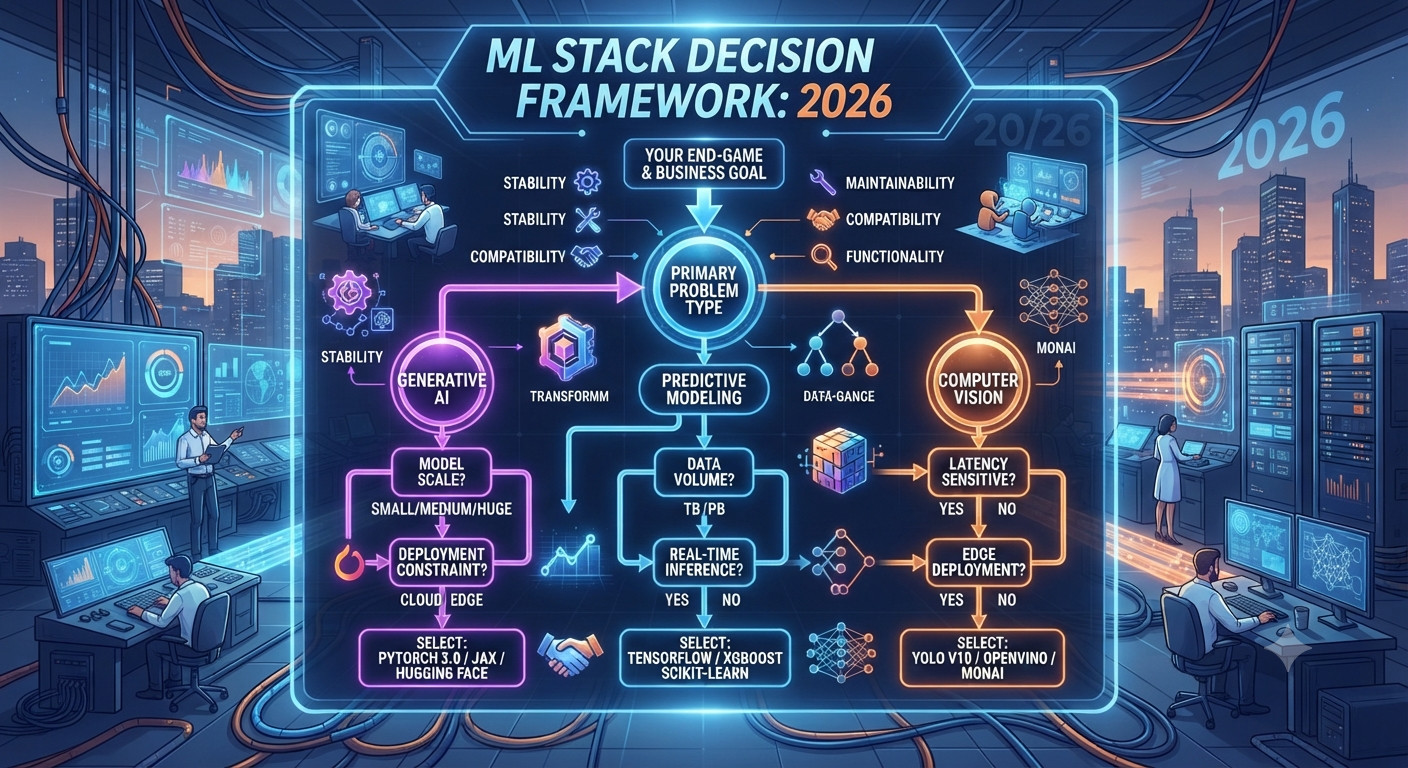
In the constantly changing environment of 2026, the urge to try out all the "shiny new" technologies is strong. Still, the most effective engineering squads focus on stability, maintainability, and compatibility with their business rather than functionality lists. In picking your ML stack, it is better to apply a decision-tree approach and ensure that the selected tools are compatible with your particular end-game.
A Framework for Choosing
In order to find out the suitable stack, classify your project depending on its main constraints and aims:
Scenario A: The "Research-First" Innovation Hub
-
Aim: Advancing the field of custom architectures or developing foundation models.
-
Stack: PyTorch + JAX.
-
Why: You will require maximum flexibility to perform complicated research cycles and get the most of your hardware. They cater to the researcher's experience offering fast iterations and control at a deep hardware level.
Scenario B: The "Enterprise Production" Powerhouse
-
Objective: Integration of reliable and scalable features in a preexisting application (such as fraud detection and recommendation engines).
-
The Stack: TensorFlow/Keras + TFX.
-
Reason: Enterprise-level stability requires the creation of a standardized process pipeline. The TensorFlow framework provides advanced tooling to perform data validation and model monitoring, eliminating the "hidden technical debt" prevalent in most enterprise environments.
Scenario C: The "Legacy Integration" Specialist
-
Objective: Getting value out of huge and preexisting datasets of industries such as finance and healthcare.
-
The Stack: Scikit-learn + XGBoost/LightGBM.
-
Reason: Don't fall into the "Neural Network trap." If you're dealing with structured tabular data, gradient boosting gives you higher accuracy with far fewer computational and training costs. These models are more interpretable, which is absolutely essential for regulatory compliance.
Matching Tools to Team Maturity
Junior - Mid-level Teams: Go for highly performant, highly documented frameworks (Keras, Scikit-Learn). Such tools have a tremendous community around them, which means that all questions to your roadblocks will be answered by a Google search.
Senior - Specialized Teams: Invest in highly performant, low-level frameworks (JAX, custom implementation of boosting on C++). Having expertise in managing your own pipelines gives you a great performance ceiling that can make you stand out from your competitors.
Golden Rule
Do not pick any tool just because it is an "industry standard." Pick the tool that makes your most important constraint the easiest to optimize – whether it is time to market, model interpretability, or performance. If you have problems aligning business and technical architectures, consulting specialized AI experts can help you to make sure that your initial decision will not require costly refactorings later on.
7. Future Trends: What's Next in 2026 & Beyond
Now that we are halfway through 2026, the machine learning world is transitioning from "model-centric" AI to "system-centric" AI. While the recent years have been about the scaling laws of foundation models, the upcoming years will be marked by the combination of efficiency and autonomy.
Edge AI and TinyML
We are moving from the "Cloud-Always" approach. The rising importance of data privacy in regulation and stricter latency requirements create the need for Edge AI and TinyML. Model optimization for the execution of models on microcontrollers, mobile devices, and industrial sensors has now become the primary objective for developers.
Such tasks call for different skills — namely, model quantization, pruning, and hardware-aware neural architecture search. Now, the task for the engineer in 2026 is not only to make the model smarter but also to make it run on a battery-powered device.
On-Device Inference
Closely related to Edge AI is the boom of on-device inference made possible by specialized NPU (Neural Processing Unit) hardware present in contemporary laptops and mobile devices. Thus, large language models can be run locally making applications capable of providing real-time personalized offline experiences powered by AI. For companies, this implies reduced cloud-egress expenses and greatly increased levels of user trust due to data being kept on-device only.
Agentic Shift
Undoubtedly, one of the most important trends is "Agentic" workflows. We are leaving the world of "chat-based" AI interface behind and moving towards that of the autonomous AI agent. Such approaches are more advanced than simple predictions of the next token as they allow reasoning through multi-step workflows, calling external APIs, handling file systems, and correcting mistakes autonomously.
Development of such architectures is one of the most exciting frontiers of today. Very soon, the performance of ML engineers will be evaluated based on their capability of designing such agents.
8. Summary
Looking ahead at the second half of 2026, and beyond, the most effective AI projects will not be defined by the newest library they use, but rather by their architecture being well suited to their business fundamentals. Despite the rapidly growing machine learning landscape, software engineering principles such as scalability, maintainability, and reliability have remained the same all along.
Do not fall into the pitfall of "resume-driven development," rather go for technologies that address your unique challenges whether they pertain to performance or stability and reliability of a production-level solution.
The perfect stack is the one that lets you go as fast as possible while delivering value to the users of the product. When making these decisions, keep in mind that the key asset of any company's AI strategy is its people.
In case you have trouble translating your project needs into a technical solution, or would like to scale up your engineering capabilities with the best professionals on board, we can help you out. Gigmint.ai is a place where advanced AI research and reliable solutions converge.
Frequently Asked Questions (FAQ)
1. Is PyTorch superior to TensorFlow when it comes to deployment? PyTorch has become increasingly production ready, TensorFlow/Keras usually provides a more mature, integrated stack (TFX).
2. Should I learn deep learning for every machine learning problem? Absolutely not. A lot of tabular data problems can be more effectively and accurately solved with gradient boosting algorithms like XGBoost/LightGBM than with deep neural networks.
3. What does the "Agentic" paradigm in AI mean? It means transitioning from basic "chat" interfaces to more complex autonomous entities that can think, use tools, and perform complex tasks.
4. Can I use JAX in production? Yes, but with more attention to engineering details as opposed to PyTorch or TensorFlow because the JAX serving environment is still evolving.
5. What is the most difficult part of MLOps? Most likely it will be connecting "experimentation" (notebooks) and "operations" (reproducible production pipelines) phases.
6. Does Scikit-Learn matter in 2026? Yes, Scikit-Learn is the gold standard for data preprocessing and feature engineering irrespective of which deep learning platform you use.
7. Should I run my models on self-hosting or cloud? Self-hosting will prove to be cheaper for you if you have stringent requirements for the privacy of data and stable flow of traffic.
8. What is TinyML? TinyML refers to the process of optimizing machine learning models for resource-limited hardware like microcontrollers and sensors.
9. How do I pick between DVC and MLflow? You may need both DVC and MLflow in many cases, but use DVC for data/artifact versioning and MLflow for experiments and logging.
10. How can Gigmint.ai assist me in building my team? We act as a bridge between academic AI research and its industrial implementation by providing consultations and hiring premium machine learning engineers for your stack.