How Machine Learning Works: Models, Algorithms, and Applications
How Machine Learning Works: Models, Algorithms, and Applications
I. Overview
Each day, machine learning is used in different ways by people to engage with technology. Some examples of how people are influenced by machine learning include smartphone unlocking through facial recognition, receiving recommendations, calculating the best route through navigation software, and sorting online content.
What is happening behind such software? The core purpose of machine learning is that it enables machines to analyze data patterns and use them to predict outcomes.
A traditional computer program usually relies on rules specified by programmers. Such a program is efficient if all possible inputs and outputs can be predicted. Many challenges require the analysis of complicated datasets where manual writing of a rule is impossible because there are too many scenarios to consider. Machine learning helps to find an alternative solution.
The process of development of a software based on machine learning does not require programming each instruction separately. Programmers just provide a machine learning model with data and then it learns patterns, classifies information, predicts an outcome or recommends something new after being provided with new data.
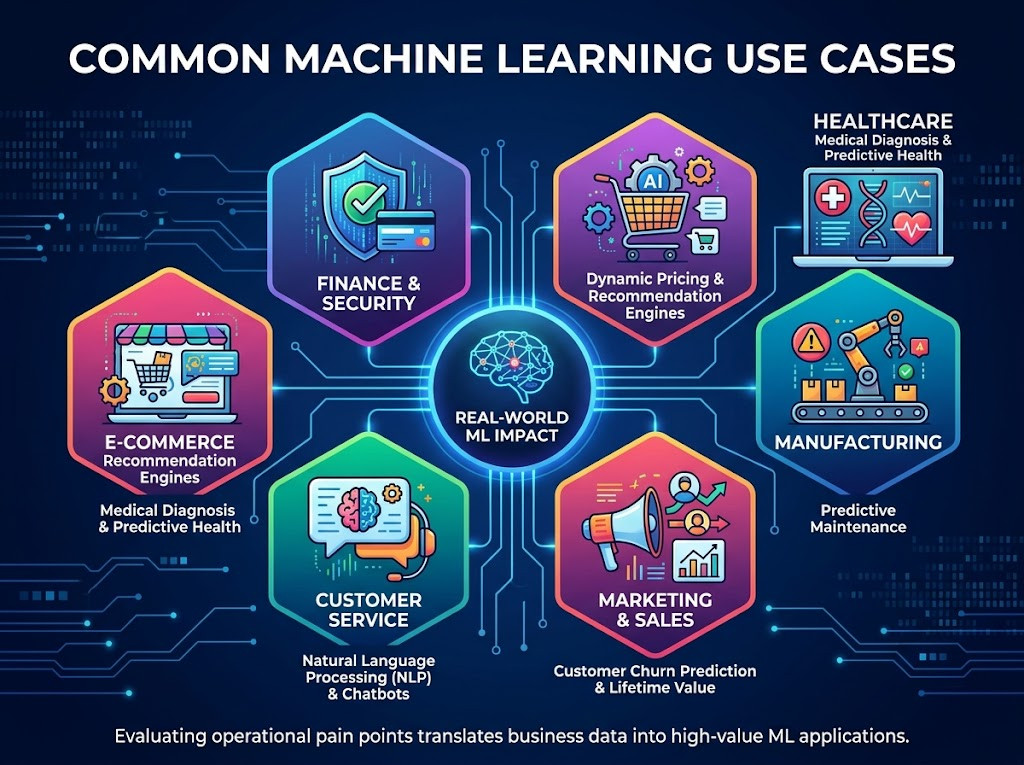
Machine learning has applications in various areas including finance, healthcare, retail, transportation, and technology industries.
If you are a developer creating an automated prediction system, a business person looking into automation, or simply curious to learn how today's artificial intelligence technology works, having knowledge about the basics of machine learning can be helpful.
II. Demystifying Machine Learning: Core Concepts
Machine learning is a field within artificial intelligence that allows computer programs to identify patterns in data and then apply those patterns to making predictions or decisions without the necessity for the programmer to explicitly specify each and every rule. While the technology itself may seem highly sophisticated, the fundamental concepts underlying machine learning may be explained in terms of four main components – data, algorithm, model, and statistics.
In conventional programming, programmers give a computer some set of data along with the rule that needs to be applied in order to generate an output. Machine learning techniques depend upon the kind of learning involved. In the case of supervised learning, a model is trained by presenting it with examples of input and their corresponding outputs.
Artificial Intelligence, Machine Learning, and Deep Learning: The Structural Hierarchy
It can be easy to refer to each of these terms as being the same, in truth, these are three concentric circles in the technological world of today:
-
Artificial Intelligence (AI): This is an overarching term which refers to all processes used to make machines think like humans—from simple rule-based systems and game-playing machines to current advanced text generation engines.
-
Machine Learning (ML): This is a specific branch of AI dealing with algorithms which analyze data and make predictions or decisions. Unlike with traditional coding where the algorithmic code is written by human programmers, here the machine creates its own statistical model using historical data.
Why Data is the Fuel: Features, Labels, and Quality
Machine Learning models are insatiable data consumers. Without good data, even the best algorithm won't be of any help, which is well known as the "garbage in, garbage out" rule. There are two main elements in the training dataset:
Features: Independent variables, inputs, or characteristics of the phenomenon under observation (such as the size of the house, age of the customer, or values of pixels in the image).
Labels (Targets): Dependent variable or the right output from history corresponding to the given features (such as the price of the house, churn of the customer, or catness of the image).
Using the correlation between the changes in the features and the target labels, the machine learning model understands how to map inputs to outputs.
III. The Core Engine: Machine Learning Algorithms Explained
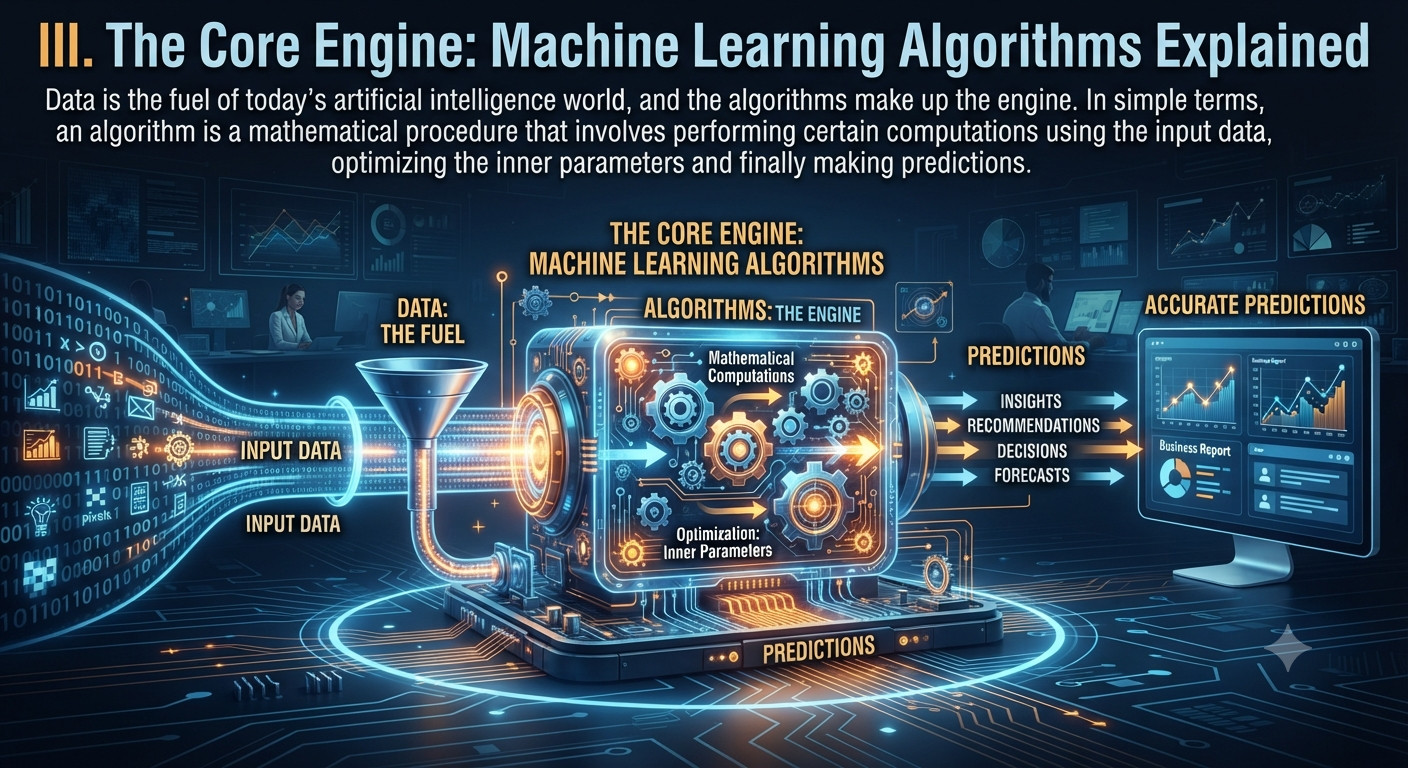
Data is the fuel of today's artificial intelligence world, and the algorithms make up the engine. In simple terms, an algorithm is a mathematical procedure that involves performing certain computations using the input data, optimizing the inner parameters and finally making predictions.
While there are hundreds of different algorithms in data science, they can be classified broadly into three main types of learning approaches: Supervised Learning, Unsupervised Learning, and Reinforcement Learning.
1. Supervised Learning: Learning from Labeled Examples
The most popular and commercially viable method in machine learning is supervised learning. This technique involves training a model using a data set of pairs of inputs and outputs called features and labels.
It is like teaching a child to identify animals through labeled pictures: "This is a cat"; "This is a dog". With time, the kid will relate certain features to certain labels – for example, the shape of the ears, fur and body size, etc. In the same manner, a supervised algorithm analyses thousands of cases when the right output is known, determining the dependence between independent and dependent variables.
Supervised Learning Problems can be generally classified into:
Regression (Continuous Variables Prediction): If the label value being predicted is numeric, then we use regression algorithms. For example, predicting housing prices from size and locality, predicting quarterly revenue of companies, and predicting recovery period of patients. Here, the goal is to fit an equation of a curve/line such that the distance between the predicted and actual historic values is minimized.
Classification (Discrete Class Prediction): If the label value being predicted is discrete in nature (classes), then classification algorithms are used. Examples of such problems include detecting whether emails are spam or not, detecting malignancy or benignness of tumors, and whether a customer will churn or retain.
The algorithms that come under supervised learning are linear and logistic regression which solve simple statistics problems, Support Vector Machine (SVM) to deal with higher dimension boundary classification and decision tree with ensemble techniques like random forest.
2. Unsupervised Learning: Finding Hidden Structures in Unlabeled Data
Imagine having all the data available in large amounts but without anyone labeling them. This is where unsupervised learning comes into play. Unsupervised learning refers to the practice where the algorithm is allowed to analyze a data set that is not labeled by humans in search of any underlying structure or hidden patterns.
This is similar to someone who is fond of music and is listening to a totally new genre which he or she has never listened to before.
There are a few key subcategories of unsupervised learning which do really well when it comes to exploratory data analysis and feature engineering:
-
Clustering: The act of dividing up data points in a data set into different clusters where data points inside one cluster are more similar to each other than to those outside of their own cluster. Examples of clustering algorithms include K-Means clustering and hierarchical clustering, which can be used for things like customer segmentation, gene clustering and organizing documents.
-
Association Rule Learning: Identifying interesting relationships between variables in large databases. One example is the use of association rules in market basket analysis to learn that people who have purchased product $A$ will tend to also purchase product $B$.
3. Reinforcement Learning: Navigating Environments Through Trial and Reward
Whereas supervised and unsupervised machine learning depends on fixed historic data sets, Reinforcement Learning learns dynamically through constant interaction with the environment. Based on behavioral psychology, reinforcement learning revolves around action, feedback, and optimization.
A basic reinforcement learning structure entails an agent interacting within a specified environment. In each state, the agent performs an action. The environment reacts by placing the agent into a new state and giving it a numeric reward (positive reinforcement) or a penalty (negative reinforcement).
-
Objective of the Algorithm: The objective of the agent in reinforcement learning is to obtain maximum total rewards through an optimal behavioral policy.
-
Some of the Frameworks Involved: Complex algorithms such as Q-Learning and Deep Q-Networks are used in applications in which rules cannot be explicitly specified. These include driving assistance, robotics, stock market prediction and playing challenging strategy games such as chess and Go.
IV. Understanding Machine Learning Models
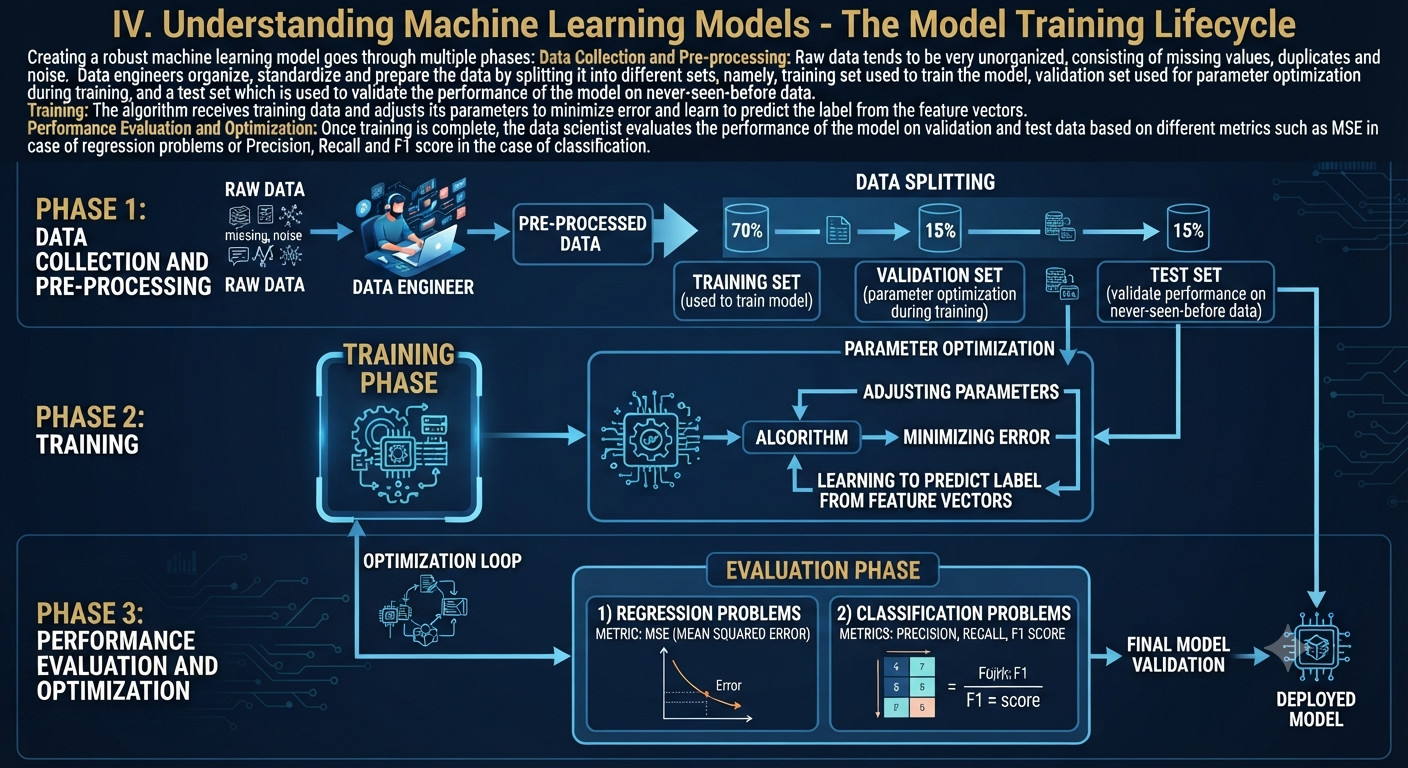
The Model Training Lifecycle
Creating a robust machine learning model goes through multiple phases:
-
Data Collection and Pre-processing: Raw data tends to be very unorganized, consisting of missing values, duplicates and noise. Data engineers organize, standardize and prepare the data by splitting it into different sets, namely, training set used to train the model, validation set used for parameter optimization during training, and a test set which is used to validate the performance of the model on never-seen-before data.
-
Training: The algorithm receives training data and adjusts its parameters to minimize error and learn to predict the label from the feature vectors.
-
Performance Evaluation and Optimization: Once training is complete, the data scientist evaluates the performance of the model on validation and test data based on different metrics such as MSE in case of regression problems or Precision, Recall and F1 score in the case of classification.
Overfitting and Underfitting
Generalization, which involves learning from a set of examples in order to perform well on previously unknown data, is the main aim of machine learning. The two challenges that can arise during this process are:
-
Underfitting: Involves using a model that is too simplistic to learn from the dataset, leading to poor performance on training as well as test datasets.
-
Overfitting: Involves using a model that is too complex to learn from the dataset; the model memorizes random noise in the dataset. An overfitting model is highly accurate on training data but will fail miserably on unknown real world data.
V. Real-World Applications
To understand how machine learning functions in theory is interesting, but to see its true importance is to see its revolutionary effect on today’s industries. Machine learning technology has progressed from an interesting field of study into a crucial element in generating business value, efficiencies, and innovations.
With automation and extraction of insights through huge data sets, new possibilities can be realized. Below is an exploration of how machine learning is creating value in four key industries.
1. Enterprise & Business Automation: Optimizing Operations
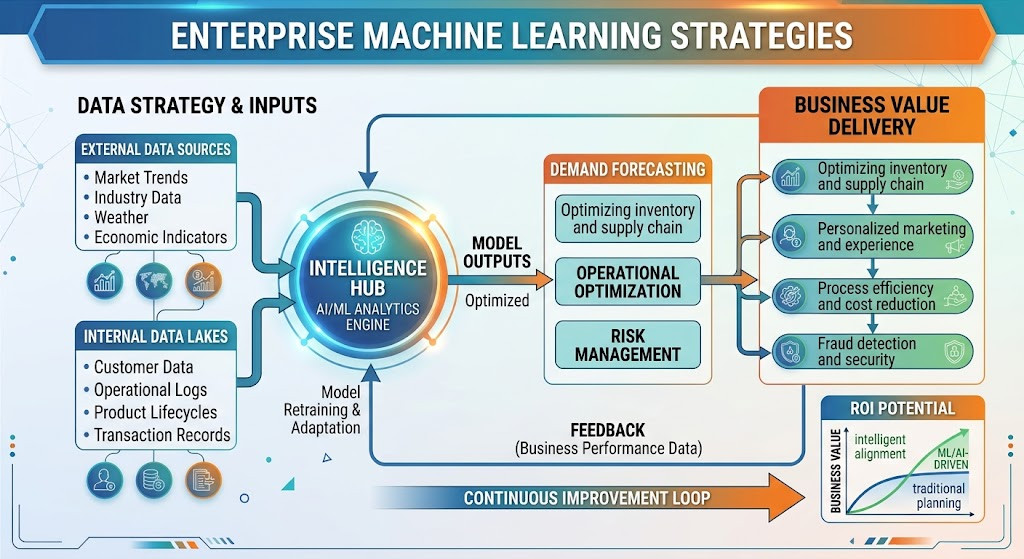
In the world of businesses, efficiency will determine the ability of firms to remain in the market. While regular software automation takes care of repetitive tasks, machine learning technology will handle ambiguities and variations, transforming the business infrastructure:
-
Predictive Maintenance: Unexpected machinery malfunctions cause millions of dollars' worth of lost opportunities in both manufacturing and logistics operations. Machine learning will analyze data from sensors, including vibration, temperature, and pressure, to predict failure times and schedule maintenance accordingly.
-
Demand Forecasting for Supply Chains: The global supply chain industry experiences continuous volatility in their processes. Machine learning systems will make use of the information from previous transactions, weather, geopolitics, and economic factors to accurately predict demand.
2. Customer Experience & Personalization: Tailoring Digital Interactions
Machine learning drives the underlying recommendation engines which control our interaction with content, commerce, and communications:
-
Recommendation Engine: Collaborative filtering and deep learning classification techniques are used by video streaming sites, e-commerce platforms, and social networking sites to recommend products and media based on the preference of the user.
-
Natural Language Processing & Intelligent Agents: State of the art natural language understanding tools help to route support tickets, solve simple questions, and evaluate the image of the brand.
3. Healthcare & Diagnostics: Enhancing Patient Outcomes
Machine learning becomes an effective partner to humans in healthcare due to the improvement of diagnostics speed and precision:
-
Analysis of Medical Images: Convolutional neural networks help recognize the presence of anomalies, tumors, and micro-fractures based on radiological images (X-rays, MRIs, and CT scans) at very high precision rates that may be even superior to those of human specialists.
-
Pharmaceutical Development and Genomics: The simulation of molecular interaction is a time-consuming and extremely expensive process. Machine learning allows for the prediction of molecular properties and the discovery of promising chemical compounds hundreds of times faster than lab testing.
4. Finance & Security: Mitigating Risk and Fraud
The financial industry depends highly on instant data processing and pattern recognition to protect their funds and minimize risks:
-
Fraud Detection Algorithms: Financial card companies and banks use classification algorithms to check multiple transactions simultaneously. Once the abnormality differs from the usual pattern of the user's spending, the system either flags or blocks the transaction instantly.
-
Algorithmic Trading & Credit Scoring: High-frequency market stream analysis is used in quantitative finance to automatically conduct trade deals, whereas credit score is determined by a classification model based on unusual data about the behavior of the client.
Intelligent Matching for the Modern Workforce
The need for skilled workforce and effective workflow coordination is at an all-time high as organizations depend more and more on technological advancement. Through the use of machine learning models, intelligent platforms such as Gigmint AI bridge the gap by connecting highly skilled technical professionals with important projects in enterprises, thus making the process of recruitment more effective and increasing efficiency of the workforce.
VI. Future Trends and Challenges in Machine Learning
Machine learning is on an ever-expanding exponential growth trend and there are many new challenges and responsibilities that come along with it.
-
Explainable AI (XAI): As models get deeper and more complicated ("black box" models), it becomes increasingly important to understand why a certain prediction was generated, especially in highly regulated industries such as healthcare and finance. Explainable AI attempts to make outputs of machine learning understandable to humans.
-
Generative AI & LLMs: Machine learning prediction is gradually evolving to merge with the domain of generative machine learning, enabling new creations of software code, graphics, texts, and molecular structures rather than just making predictions and classifying data.
-
Edge Computing: Moving away from cloud server-based predictions to decentralized edge devices (smart phones, IoT sensors, autonomous cars) for making machine learning predictions enables efficiency, privacy, and decision-making without an Internet connection.
Frequently Asked Questions
1. What is the difference between machine learning and artificial intelligence? Artificial AI stands for artificial intelligence which is a general term used to refer to technologies that allow computers to perform like humans. ML is one of the applications of AI that focuses on algorithms for predicting outcomes using data.
2. Explain how ML operates. ML operates by applying historical data in complicated algorithms whereby the algorithm finds patterns from the data instead of a human providing hard-coded instructions.
3. Explain what features and labels are in ML. In ML, features are the independent variables, that is, input characteristics in the data (like the area of a house), while labels are dependent variables, that is, the historical outcome variables (house prices).
4. What is the difference between supervised and unsupervised learning? The former employs a dataset of labeled examples for the purposes of building predictive models; the latter involves analysis of unlabeled examples, without external intervention.
5. What is reinforcement learning? Reinforcement learning is a method of decision-making whereby an agent acquires knowledge through experience in the process of interactions with the environment, seeking to maximize rewards obtained.
6. What is the difference between an algorithm and a model? While the former is a formula or a set of operations performed on training data in order to construct models, the latter is a resulting product.
7. Why do machine learning models overfit? Overfitting in machine learning models occurs because such models usually have a tendency to remember details, making them unable to work with new examples.
8. In what way are enterprises applying machine learning today? Enterprises apply machine learning in order to achieve automation in predictive maintenance, forecasting in the supply chain, dynamic pricing, customer recommendation systems, medical image diagnosis, and financial fraud detection in real time.
9. What is Explainable AI (XAI)? Explainable AI is a term used in relation to methods and techniques that explain the process of decision making in machine learning algorithms to humans.
10. In what way can Gigmint AI be helpful in machine learning projects? The Gigmint AI platform uses intelligent machine learning algorithms to link enterprises with the best engineers for their projects.
VII. Next Steps
Machine learning has revolutionized the way software deals with data and makes predictions. Unlike the traditional approach where a set of manually created rules is used, machine learning models can learn patterns from the data and then apply these patterns to similar circumstances.
Understanding the distinctions between supervised, unsupervised, and reinforcement learning, and the importance of algorithms, models, training datasets, and evaluation creates a good starting point for further research.
The effectiveness of a machine learning implementation depends not only on the choice of a particular algorithm. The quality of data, proper model choice, training, evaluation, and optimization are all important factors that should be considered when creating a solution. Companies interested in using machine learning should also take into account the skills needed for implementation.
If your company is considering implementing machine learning or any other AI technologies, collaborating with skilled professionals will allow you to turn your technical concepts into working solutions. To find a professional in AI, visit our GigMint AI network.