What Is Machine Learning? A Beginner's Guide
What Is Machine Learning? A Beginner's Guide
I Overview
Do you ever wonder how Netflix knows exactly which show you are going to watch all day on a Friday evening, or how your inbox filters out a suspicious phishing email from entering your primary inbox at all costs? There is some unseen assistant living within your computer or phone that learns about your preferences in real-time. In fact, you are witnessing the workings of modern technology at play – machine learning.
To those who are new to the world of technology, the words "machine learning," "artificial intelligence," and "algorithms" often ring alarm bells, giving the impression that it is something complicated and far-fetched from everyday life. Reality is not as distant from us as one might imagine. Machine learning is no longer a science fiction term; it is what makes the software you use and your work possible.
For clarity on the key concept: Artificial intelligence (AI) refers to the overarching ambition of developing intelligent machines. Machine Learning (ML) is a sub-set of artificial intelligence in which a computer learns from the data without being explicitly programmed with every rule.
Moving closer to the core of the topic, deep learning is a specific approach under machine learning which uses neural networks to solve extremely complex problems such as instant translation and facial recognition. One may think of artificial intelligence as a vast universe of intelligent technologies, machine learning as our solar system, and deep learning as a specific planet.
Throughout this comprehensive tutorial, in this guide you'll learn what machine learning is, how it works, the mani types of machine learning, common algorithms, and realworld applications, the core mechanics behind the process; we will classify the four types of machine learning, analyze important algorithms, and their applications in various industries. Then provide information on what the future holds and how to capitalize on this emerging trend.
Knowledge about machine learning technology is no longer an interesting theoretical question; it has become a fundamental part of people's career skills in today's rapidly changing world. Whatever your profession or field of expertise is, whatever challenges you face, whether it is a professional change to technology, application of artificial intelligence in your business, or scaling up the freelance career, having this kind of knowledge is a must-have for today.
There are companies such as Gigmint.ai bringing together creative human beings and intelligent automation.
Let us look closer at the mechanics of algorithms.
II. What Is Machine Learning? (The Core Definition)
In order to comprehend machine learning, we must take a deeper dive than simply analyzing terms in the popular buzzword sense. Machine learning was first used by pioneer Arthur Samuel as far back as 1959 and defined it as “the field of study that gives computers the ability to learn without being explicitly programmed.”
Until now, computers had relied solely on the logic provided by humans. In order to see how machine learning defies this dependency, it might be useful to see how traditional software development works. In a typical programming scenario, an experienced programmer would analyze the problem, write down the precise conditions and rules for solving the problem, and feed this logic and the raw data to a program. The computer would then compute based on this logic and data to generate the expected result:
Data + Rules = Output
For example, if you wished to develop a software application to identify spam mail using conventional programming, then you would need to develop hundreds of different rules such as "If there is the word 'free' in the mail AND there are greater than three exclamation marks, then mark it as spam mail." This system works very well in situations that do not change much but does not work at all in situations which are very complex, changing and unclear.
The machine learning methodology completely changes this system. In this methodology, rather than making humans write rules, the process of machine learning feeds the computer data and the answer to this data, and this data comprises past data and their correct answers. Then the computer analyzes these pieces of data, finds the hidden structures within them, understands the patterns, and develops its own rules:
Data + Output = Rules
In the case of our spam filter problem, the machine learning algorithm is applied to a vast number of e-mails that have already been classified as spam or non-spam by people. Without any human interference, the algorithm recognizes the linguistic, sender-related, and metadata characteristics of the spam. The product of such an approach is an artifact that is not governed by rigid human rules anymore but generalizes over unseen data.
Why Machine Learning Matters Now
Although the basic mathematical and computational concepts have been around for decades, machine learning has seen an explosive boom in the last few years due to three main factors:
-
Big Data Boom: The amount of digital data that is produced in a day is now more than what was ever created by humanity in centuries gone by. It is through the endless stream of data that algorithms can be fed the raw materials that they require.
-
Computational Power: Today's state-of-the-art Graphics Processing Units (GPUs), Tensor Processing Units (TPUs), and highly scalable cloud computing facilities provide computing power such that training deep neural networks becomes possible in a matter of seconds rather than years.
-
Tools Available: Thanks to the availability of open source frameworks and educational platforms such as Gigmint.ai, advanced data analytics tools have become available to everyone.
III. How Does Machine Learning Work? (Step-by-Step Breakdown)
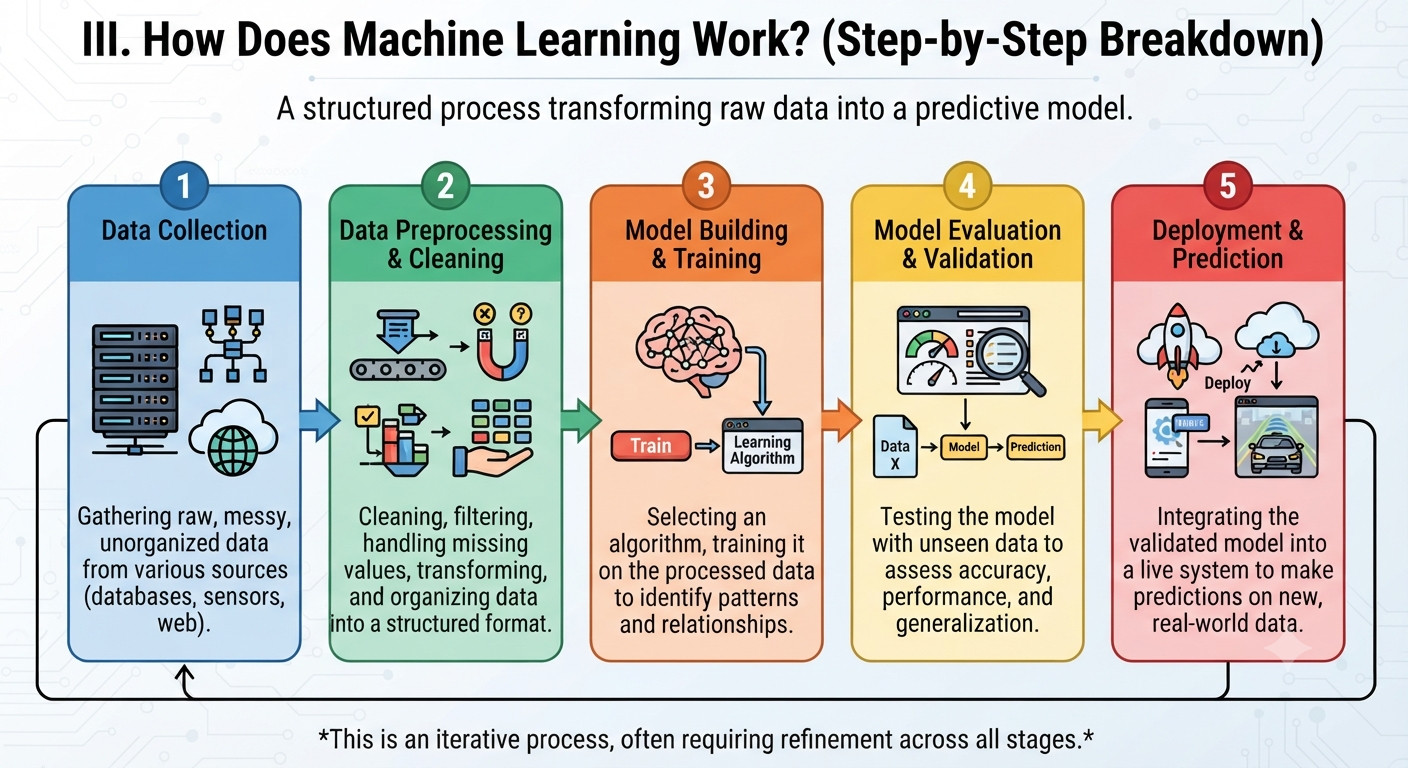
This technology relies on machine learning following a structured process that transforms raw data into a predictive model. The process of turning raw, messy, and unorganized data into a predictive system of high performance depends on going through the following five steps in succession.
-
Data Collection
All successful machine learning ventures require the creation of an elaborate database of data in the first place. The particular type of data to be gathered will vary depending on the purpose and the application of the model to be created, but there are two kinds of data that are generally used in the process. One kind is structured data, which can be found in relational SQL databases, spreadsheets, and transaction logs, all organized in a very neat and organized fashion with well-defined rows, columns, and numeric type.
-
Data Preparation (Cleaning)
The raw data is notorious for being noisy because it has missing data points, duplicate records, format inconsistencies, and extreme outliers. Data preprocessing is notoriously referred to as the longest stage of the entire pipeline process by the experts. It entails thorough cleansing of the data, replacing missing data points, and normalizing features so that all features are at the same numeric scale, so as not to overpower any feature in the learning algorithm. The data scientist must ensure that the cleansed data is divided into three parts: the training dataset to teach the algorithm, the validation dataset to tune parameters, and the test dataset.
-
Choosing a Model
Choosing the appropriate algorithm is a vital architectural choice that is completely dependent on the mathematical essence of the problem you want to solve. Are you trying to predict the value of a numeric variable like predicting the sales revenue for the next month using regression? Or are you trying to classify your input into various categories like determining if a transaction in a bank is fraud or not through classification algorithms? Your ultimate goal decides which algorithm should be used – a linear regression model, decision tree, support vector machine, or even a neural network.
-
Training the Model
During the training process, the selected algorithm is exposed to the organized training set of data for the first time. It iterates through the information hundreds or thousands of times, which are called epochs. Through computing the prediction error of the algorithm (which can be computed using the loss function), the algorithm applies techniques such as gradient descent to optimize its own numerical parameters (including its weights and biases) to reduce the loss.
-
Evaluation and Deployment
Once training is done, the time comes for the final test of the predictive model’s performance, where it is evaluated on its ability to predict using data that is completely unseen and stored within the test dataset. This important process makes sure that the model actually learns some deep patterns and does not simply memorize the examples used during the training phase – a highly undesirable problem called overfitting. Once the metrics show satisfactory results, exceeding the required performance level, the model is put together and released to the production environment.
Understanding "Features" and "Labels"
In order to develop intuition about such terms for people who do not have engineering background, consider the following real-life example: predicting the cost of houses in a major metropolitan area:
Features: Features are input variables that are used in the model as inputs in order for the model to learn something and make a prediction. They include square feet of the house, number of rooms and baths, crime statistics in the area, zip code, age of the building etc.
Label: Label is an output variable that the machine should learn to predict from these features. In the case of our housing dataset, the label is the price of the house.
IV. The Four Main Types of Machine Learning
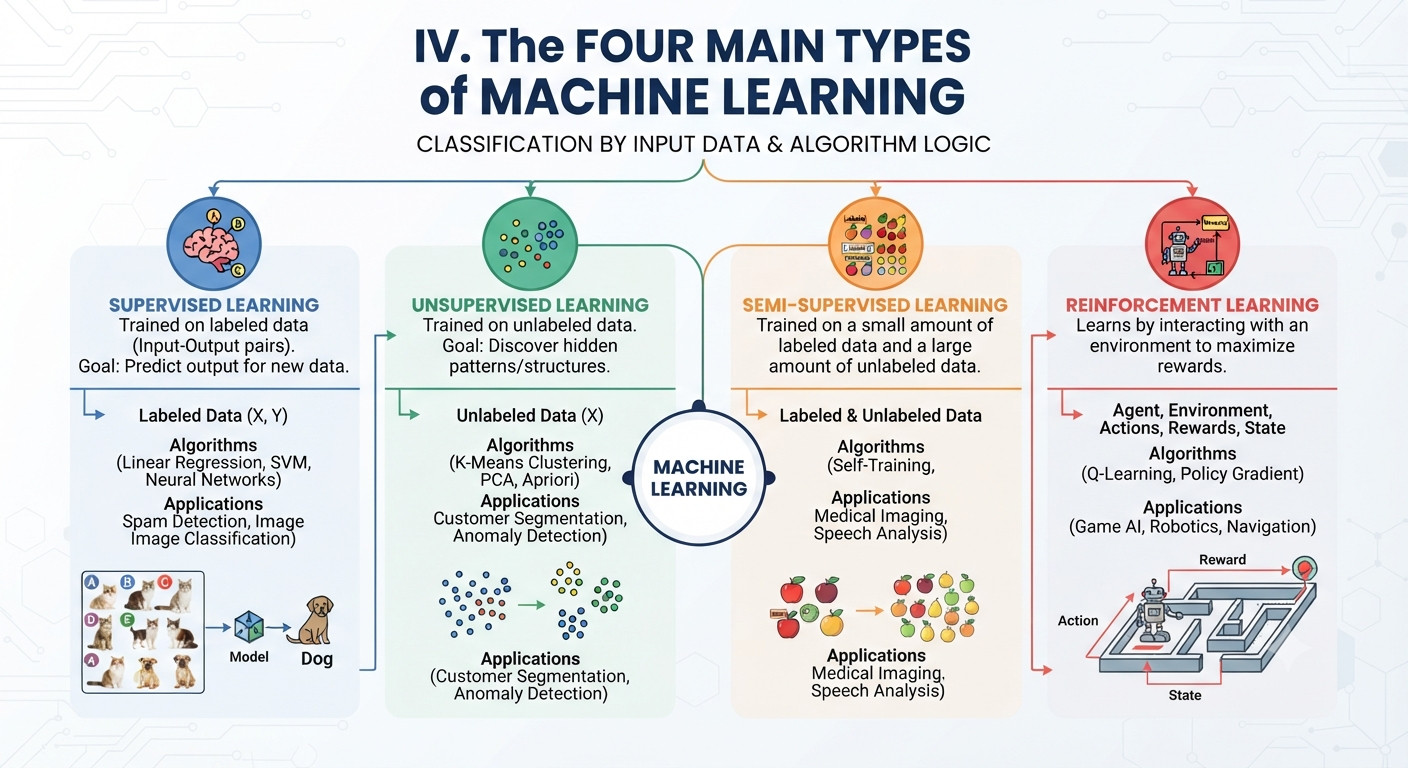
Methods for machine learning are varied, constantly evolving, and carefully selected to suit the particular problem domain they operate within. In order to properly design a system in the field of data science, data engineers typically classify methods for machine learning into four major classes according to the way they work with the input data and their own algorithm logic:
1. Supervised Learning
Supervised learning is by far the most common, commercialized, and well-understood category of machine learning in use today. In supervised learning, the machine learning algorithm learns from a carefully prepared set of training data which serves as the training textbook, incorporating both the independent variables and the correct output labels.
The machine learning algorithm is learning under the direct guidance of the ground truth answers, acting as if an expert instructor is leading the way throughout each iteration of the optimization process.
There are two major uses of supervised learning:
-
Classification: This entails the segregation of incoming observations into qualitative classes or categories. Business use cases can include automatic email spam detection, medical diagnostics in the form of predicting whether an image contains the presence of malignant cells, and customer review sentiment analysis. Popular algorithms used for classification include logistic regression, support vector machines, and random forests.
-
Regression: This problem entails the prediction of continuous numerical values over a wide range. Some popular business applications of regression could include predicting housing prices, estimating future stock prices, and predicting lifetime value of customers. Popular regression algorithms include linear regression, ridge regression, and gradient boosting of decision trees.
2. Unsupervised Learning
Unlike supervised learning where labeled datasets are given, unlabeled datasets are presented to the algorithms in unsupervised learning as there is no expert to teach the machine about anything through labeling. Thus, in unsupervised learning, a computer program is required to investigate the data independently and to uncover any structure or latent pattern existing in it.
Unsupervised learning is a strong discovery tool for both exploratory data analysis and feature engineering:
-
Clustering: Grouping similar data points in a cluster on the basis of some intrinsic properties. An example of a commercial application of clustering is customer segmentation wherein businesses can find behavioral archetypes of their customers to design more personalized marketing strategies without any preconceptions.
-
Association Rule Learning: Discovering the association rules that hold for big chunks of multidimensional data transaction records. Market basket analysis is a famous application in which association rule learning technique is used by retailers to find out if buying a particular set of household items on Friday evening results in buying snacks along with those household items. Some commonly used algorithms in unsupervised learning are $K$-means clustering, hierarchical clustering, and PCA.
3. Semi-Supervised Learning
Collecting real-world data for enterprise use does not tend to be either neat or thoroughly annotated. Although collecting unannotated raw data can be inexpensive, efficient, and plentiful, properly labeling that data with quality annotations usually involves expensive and time-consuming manual labor on the part of humans.
The method of semi-supervised learning helps fill this frustrating gap through a more practical approach. It employs an algorithm trained on a smaller set of good quality annotated data with large amounts of unannotated data.
Through the help of geometrical understanding of the unannotated data, the model will be able to greatly enhance its prediction ability without having to annotate much of the data. Some landmark examples of the technique are advanced speech recognition systems, massive image classification of internet images, and automated fraud detection where only some of the flagged outliers are manually analyzed by security professionals.
4. Reinforcement Learning
Being embedded in the realms of behavioral psychology, optimal control theory, and decision sciences, the concept of reinforcement learning is inherently different from any other computing paradigm. Unlike learning passively from a fixed database, the process of reinforcement learning is about training a self-regulating computer agent to perform sequential actions and interactions with the environment.
The agent works according to an ongoing process of trial and error: it sees what its current state in the environment is, makes some action according to some previously set policy, and gets either a numerical reward or punishment from the environment. The process of making mistakes and getting punished for those mistakes helps the agent improve its performance in the long run.
-
Components of Core System: The Agent (the autonomous decision-making element), the Environment (the external world it operates in), Actions (available options at each decision point), Rewards (numerical signals of feedback), and Policies (policy from state to action).
Autonomous navigation of cars in public places, and playing intelligent game-plays by AI in real life. Real-Life Instances:Game playing AI systems (such as AlphaGo and reinforcement learning agents defeating human champions in strategic games), and intelligent robotic arm control in industrial automation assembly lines.
V. Essential Machine Learning Algorithms Explained Simply
The machine learning algorithms aid the computer in recognizing the pattern in the data and making use of this pattern to make predictions and decisions. The following are six algorithms which are popularly used and explained simply:
-
Linear Regression: Linear regression is used to predict values, i.e., sales, earnings, and house prices. This algorithm determines the relation between variables and then predicts outcomes on the basis of this relation.
-
Logistic Regression: Contrary to its name, logistic regression is a classification algorithm. It predicts the probability of an event and is usually used for predicting an event with two outcomes.
-
Decision Tree: The decision tree operates on a series of questions/conditions to arrive at a final decision. In essence, it works as a flowchart.
-
Random Forest: Random forests make use of several decision trees to come up with predictions that are more accurate. By taking into account the output of many decision trees, random forests can sometimes be able to perform better than a single decision tree.
-
Support Vector Machines (SVMs): Support vector machines are used for the classification of data by determining an optimal boundary that separates one set of data from another. This technique is especially helpful where the distinction between sets of data is very clear.
-
Neural Networks: Neural networks are modeled after the working of the human brain. These are a combination of layers that are used to detect complex patterns in the data.
VI. Real-World Applications of Machine Learning
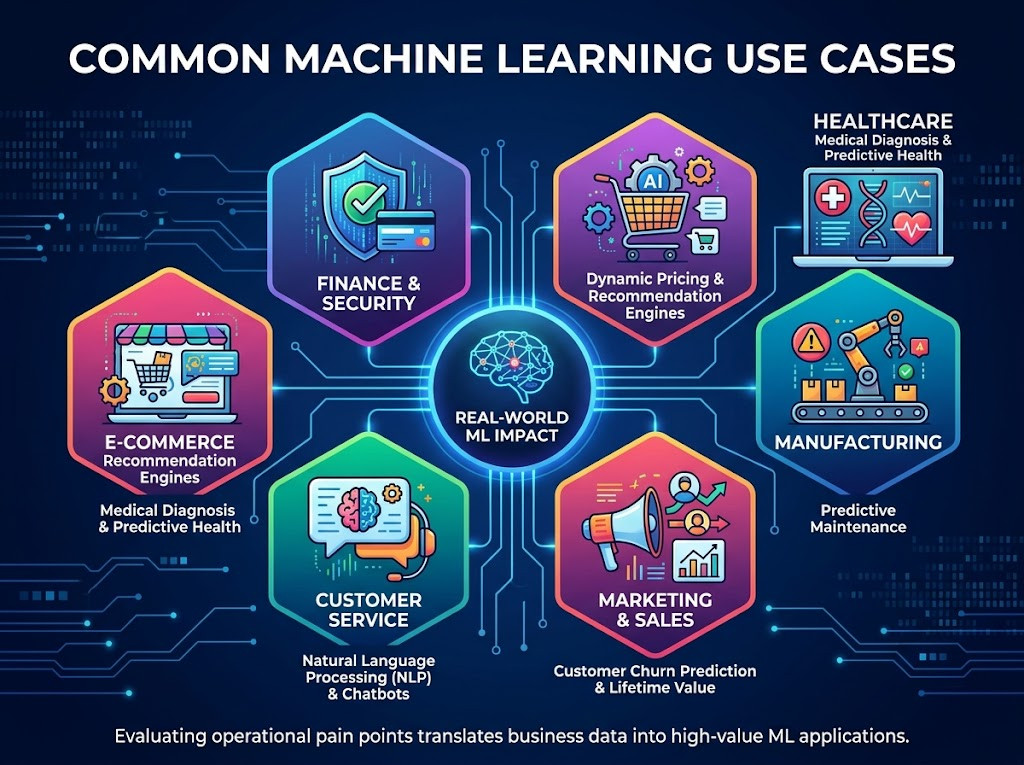
Machine learning is now used in many industries to automate tasks, analyze large amounts of data, improve decision-making, and deliver more personalized experiences. From healthcare and finance to transportation and entertainment, its applications continue to expand.
-
E-commerce & Retail: E-commerce platforms make use of machine learning recommendation engines to study consumer behavior, suggest products according to that, predict future demands for inventory, and also change their prices according to real-time changes.
-
Healthcare: The machine learning models help the radiologists in analysis of images related to medical issues for finding out tumors, along with making the drug discovery process faster by simulating molecular interactions within a fraction of time taken earlier.
-
Finance & Banking: Machine learning classifiers can be used by banks to identify any fraudulent transaction, conduct high-frequency trading, and scoring for credit applications.
-
Transportation: Autonomous cars and ride sharing apps utilize computer vision and reinforcement learning algorithms to map out the environment and plan their route accordingly.
-
Entertainment & Social Media: Entertainment websites as well as social media apps use advanced recommendation algorithms to customize the feed for users.
VII. Challenges and Limitations of Machine Learning
Despite being a very powerful technology, machine learning is not the panacea, and there are some critical issues related to this approach that need to be understood:
-
Quality Issues of Data ("Garbage In, Garbage Out"): The quality of data you use for training influences the quality of prediction that the algorithm produces.
-
Algorithmic Bias and Discrimination: Machine learning algorithms can unconsciously pick up the biases of people who worked before and discriminate against people in areas like job hiring, lending, or policing.
-
Overfitting vs. Underfitting: Overfitting is when the algorithm learns the input data too well and cannot make predictions for the unseen data. Underfitting is the inability of the algorithm to pick up the patterns in the data because it is too simple.
-
Interpreting Model Decisions: One of the problems with deep learning algorithms is that the decision-making process can be seen as a black box and be very hard to interpret for a person.
-
Privacy and Security Issues: Huge amounts of data needed for training algorithms raise questions about user privacy and data security.
VIII. The Future of Machine Learning & Career Opportunities
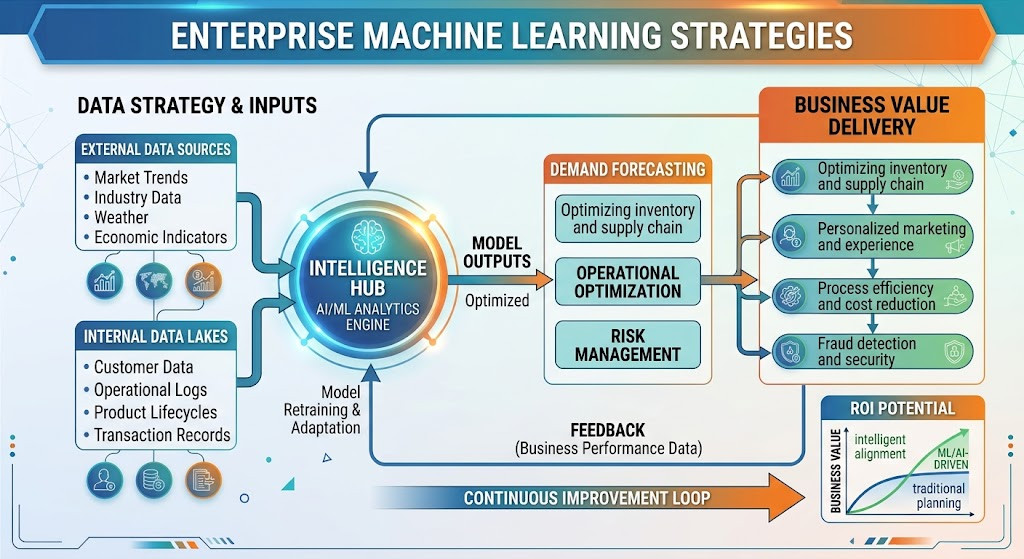
With technology ecosystems around the world developing faster than ever before, machine learning is no longer limited to being used only for research within academia. Instead, machine learning has become one of the essential building blocks of modern digital economies.
Emerging Trends to Watch Generative AI and Large Language Models (LLMs):
Not only do today’s machine learning architectures enable the generation of entirely new content, authoring of computer code, generation of high-quality graphics, but they also support human-to-machine interactive natural language conversation. Edge AI: By moving computational processing from central cloud-based servers to edge computing devices like personal smartphones, IoT devices, smart industrial wearables, and smart home appliances, edge AI greatly reduces latency and increases privacy.
Automated Machine Learning (AutoML): Empowering business analysts, domain scientists, and software engineers to create custom predictive models without much coding.
Intelligent Ecosystems On the rise of automation in old industries, the future belongs to collaboration networks that can connect advanced human professionals with intelligent AI-based processes. Understanding the basics of machine learning is no longer an exclusive knowledge area that should be left only to Ph.D. level data scientists.
It is becoming a fundamental career multiplier in finance, health care, marketing and engineering industries. By learning how to use those intelligent machines effectively, professionals prepare themselves for directing the future of work and not being displaced by it.
How to Start As a Beginner Learn Python: Gain the fundamental skills in the most important programming language in the field of data science along with mastering analytical libraries, such as NumPy, Pandas, and Scikit-Learn. Create Theoretical Background: Become familiar with introductory statistics, probability theory and linear algebra. Practice on the Real Data: Apply the acquired skills in practice through working with real-world data, create a professional portfolio and participate in open-source and freelance technology communities.
IX. Call to Action
Machine learning has evolved from a specialized area of computer science into an important technology used across many industries. From healthcare and finance to marketing, transportation, and entertainment, machine learning is helping organizations analyze data, automate processes, and make more informed decisions.
Although challenges such as data quality, algorithmic bias, privacy, and model interpretability remain, continued advances in AI are creating new opportunities for businesses and professionals. For beginners, learning programming, statistics, and practical machine learning skills can provide a strong foundation for exploring careers in this growing field.
Frequently Asked Questions (FAQ)
-
Is machine learning difficult for beginners to study? Not always. Although the newest theories require complex mathematics knowledge, practical studying of machine learning basics, python packages, and work flows is absolutely possible for beginners with perseverance.
-
What is the precise difference between AI, Machine Learning and Deep Learning? The first one, artificial intelligence, is an overall idea of constructing smart machines. Machine learning is a certain branch of artificial intelligence where machines learn based on data. Deep learning is a certain part of machine learning based on neural networks.
-
Do I require math skills to start learning machine learning? No, you don't have to obtain a PhD degree in math before starting machine learning. Knowledge of linear algebra, calculus, and descriptive statistics would be great, howev you will be able to construct your model right away with high-level python packages.
-
What is the most suitable language for machine learning algorithms? It is Python without any doubt because it has simple syntax, high readability, a large set of specific libraries and a very big community of developers across the world.
-
How much data is needed to create the machine learning model? The answer to this question depends on the level of complexity of the problem and the algorithm used. For example, simple linear regression requires several dozens of data points while deep neural networks need hundreds or even millions of labeled data points.
-
What is overfitting and how can it be avoided? This problem takes place when the machine learning model learns the noise in addition to the general data pattern from the training data set. It can be prevented by the usage of clean validation splits and regularization techniques.
-
Can machine learning algorithms entirely substitute for human decision-making ability? No. Machine learning algorithms perform admirably in the handling of big data and correlation identification, but do not have any real comprehension of context, morality, or emotions.
-
In which industries do we see the most advantage from machine learning? Every large industry has benefited from machine learning, especially healthcare (diagnostics and drug development), finance (fraud detection and algorithmic trading), retail (recommendations), and logistics (route planning).
Supervised Learning vs Unsupervised Learning
-
The supervised learning approach utilizes training data in the form of input-output data pairs (i.e., input-output is known due to the ground truth labeling done by a teacher), while the unsupervised learning algorithm tries to understand the unknown structure of unlabelled data on its own.
-
Where do professionals get their machine learning projects?
Gigmint.ai, Kaggle, GitHub, and numerous open source platforms provide fantastic platforms for getting into real-world datasets and collaborating with fellow practitioners on their projects.