How to Outsource Your MVP Development Successfully
How to Outsource Your MVP Development Successfully
Launching a startup is a high risk activity and most founders get launching to market mixed up with becoming successful at it. In the end it creates the Founder’s Dilemma at its most extreme – how fast can you get a product out the door?
A Very Bad MVP Development is one that was launched too quickly, with a focus on being able to launch instead of creating a high quality product. These products are implemented with Very Bad Technical Debt, meaning that there is a huge amount of technical impedance that remains in place for the bare-est of features. Then, as new features are added, the amount of impedance grows exponentially. This makes it very difficult for such a product to scale.
To achieve this without sacrificing speed, the traditional "hire local first" approach is no longer viable. Most local markets simply lack the specialized talent pool necessary to drive rapid innovation. Today’s sophisticated founders must adopt a global, agile outsourcing model to secure high-velocity engineering.
This is where GigMint comes in. We facilitate your venture from concept to code by connecting you directly with the top 1% of global engineering talent. Whether outsourcing your initial MVP Development or onboarding a senior-level partner for scaling, GigMint provides the elite professionals necessary to build your venture right from the get-go.
2. The Strategic Value of Outsourcing Your MVP
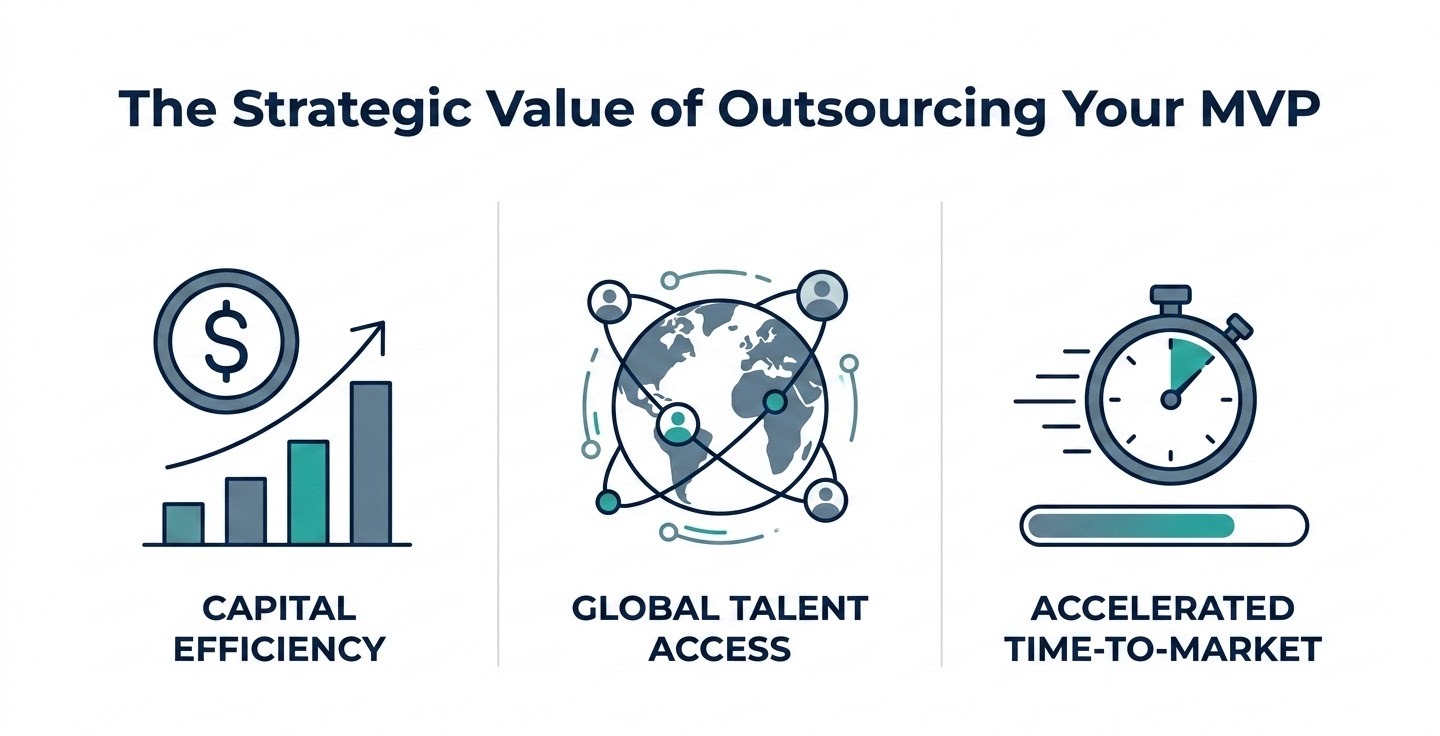
Capital Efficiency and Burn Rate Optimization
Every dollar that you spend on overhead is the same dollar that you could have spent on product development or user acquisition to grow your customer base. When you outsource your startup’s MVP Development, you are also outsourcing the hidden costs of full-time employment such as payroll taxes, health benefits, dedicated office space, and the depreciating value of your company’s hardware to name a few.
Being extremely frugal with your spending as a startup is crucial, and it allows for extreme fiscal agility. You can spend your money to develop your startup MVP Development, instead of throwing it at the hidden costs of having full-time employees such as paying their salary plus the respective payroll taxes, their health benefits, the cost of dedicated office space, the depreciation of company hardware, etc.
Instead of locking up that money to pay for a permanent payroll regardless of the project’s cycles, you can spend it on actual development and acquire high value technical output in exact amounts of development hours, which in turn will allow you to be as efficient as possible with your spending, and extend your startup’s runway to achieve product-market fit.
Accessing the Global "Top 1%"
The biggest bottleneck to launching any new venture is the local talent pool. Restricting your hiring to a 30 mile search radius to launch a venture is equivalent to playing roulette with the talent that happens to be in your geographic area at the time you are launching your venture. By limiting your hiring to local talent you are inevitably forced to settle for less than ideal talent at increased cost.
In a global, online-focused, digital economy, geographical constraints just don’t apply anymore. By outsourcing development via a platform such as GigMint, you can avoid the limitation of searching for talent in a 30-mile radius.
Rather than settling for local developers or overpaying mediocre developers for their services, you can choose from the best developers for the job on a global basis. You can find specialist developers in high-demand, niche technology stacks such as Rust, or another technology stack such as Flutter; or find emerging technology experts, who can integrate AI/ML into your existing technology foundation.
By accessing the global tech talent market via a platform such as GigMint, you aren’t just hiring a body to fill a seat. Rather, you’re hiring a team of expert developers who have already developed complex technology solutions for previous clients. With such developers on your team, you can be confident that your venture will have a solid technical foundation upon which to grow.
Drastic Reduction in Time-to-Market
For a Startup, having an edge in speed is a competitive advantage against others. However, the process of recruiting and onboarding full-time engineers at a typical large company like to take 3-6 months for them to find the right candidates through interviews and to fully onboard them.
When you use an outsourcing partner who offers MVP Development cost-effective strategies, the time frame for finding, interviewing and onboarding full-time engineering talent collapses instantly. You get pre-vetted talent who starts working for you on day one.
As opposed to traditional hiring processes where you get to experience the wonderful phenomenon of vetting fatigue, onboarding delays and the inevitable ramp-up period for new talent, by leveraging an outsourcing partner with already agile-engineered development talent, you immediately start working with them, jumping straight from concept to code in a matter of weeks, as opposed to months, while keeping the much needed momentum for your company.
3. Preparation: The Blueprint for Success
Idea Validation and the Problem-Solution Fit
The most dangerous assumption any founder can make is that their solution is inherently valuable, without any evidence to back up this claim. Don’t invest a penny in development until you have clearly validated that the problem you think you’ve identified really does exist for your target audience, and that yes, they’ll pay to solve it. Start up idea validation is not a ‘nice to have’, it’s a critical risk-mitigation strategy.
The idea validation process for a startup requires the Founder to complete deep-dive user interviews to uncover the pains of potential customers on an ongoing basis. They must also simultaneously test low-cost landing pages as well as Concierge experiments that represent the Service that their product is intended to automate.
By testing the problem and confirming that potential users are willing to pay for a solution to the problem when the product is just an idea (i.e., a page on a web server), the Founder can save himself from the enormous costs of building out a product that contains many features that nobody wants.
Defining the Core Feature Set
To keep your cycles, budget and focus, you have to apply a strict prioritization framework such as the MoSCoW method:
Must have: these are the core value proposition features of your product or service without which it will not work at all and thus are non-negotiable for your MVP development.
Should have: Important features for your product, but not crucial for launching it. These features will likely be included in the next sprint (i.e. development cycle).
Could have: These are nice to have in your first release. They would delight your users, but they do not solve any of the problems that you were trying to solve for your users in the first place.
Won't have: Features that are outside of the scope for this build.
MVP Developement feature prioritization keeps the development cycle short, budgeted and focused on the features that yield the most learning for your startup.
Technical Documentation and User Stories
When working with an external team, I'll know it when I see it quickly become the opposite of efficient development. Thus, I believe that a clear software requirement specification (SRS) is crucial to bringing your vision to life.
As a minimum, your SRS should clearly list out functional requirements of the software. In addition to that, a good set of user flows that detail out the process that a user will go through from signing up to the main action of the software would be ideal. Last but not least, high quality wireframes or interactive prototypes that show off the layout of individual pages of your software will be extremely valuable to a developer.
With this information, your team will have a solid software requirement specification that will allow your team to work autonomously to develop the software while hitting all of the required scope. This will help to ensure that your project does not get victim to scope creep that can end up wasting a lot of budget in the long run.
4. Finding Your MVP Development Partner
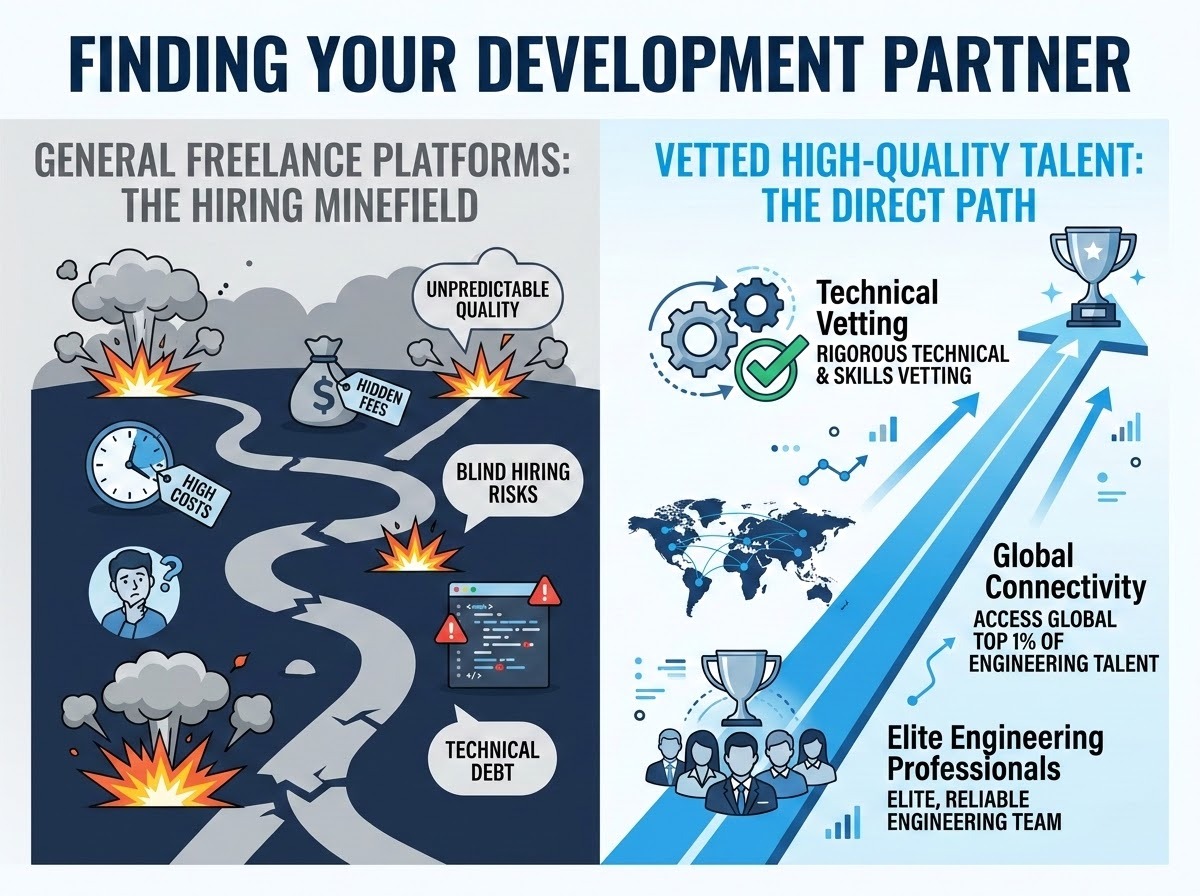
Navigating the Vetting Minefield
The temptation to start looking for someone to outsource your MVP Development on general freelance platforms is natural for many founders. However, hiring on such platforms (e.g. freelance marketplaces, job boards for general programming jobs) leads to what we call blind hiring - hiring in volume, based on a criterion that has no correlation with job performance (e.g. how cheap is this person’s time) leading to large communication problems, incorrect assumptions, and subsequent technical debt.
Hiring for MVP Development Team on a low hourly rate can prove to be a false economy. At first, you may save a few hundred dollars per week by not hiring a proven expert, but this cost will surface elsewhere – in bugs, in suboptimal architecture, in prolonged delays to launch.
People who underestimate the cost of the requirements misinterpret them or miss strategic vision of the product in development. You need to get your head around the fact that hiring a good software development partner for the long term is needed as much as the founder does.
What to Look For: The Trifecta of Success
-
Technical Skill – Don’t hire a developer, hire a specialist at a particular area of software development. Review their portfolio for work that matches your tech stack and level of complexity. Instead of asking for examples of code they’ve written in the past, ask for examples of architectural decisions that they’ve made in previous roles.
-
Communication: Great engineers can lose value fast if they cannot articulate a technical road block, consistently provide updates, etc. We’re looking for someone with solid “soft skills” who can thrive in collaboration with others who speak in similarly candid terms. Time zone issues present natural points of friction when working remotely; ensuring that others work in overlapping hours for instant turn-around is key here.
-
Reliability: “Ghost developers” plague the market by abandoning projects in the middle. You can’t rely on someone to finish your contract when they leave you hanging in the middle of build-out. A proven, verified record of completed contracts and on-time meeting of milestones is the most underrated skill in engineering. The developer that meets their commitments and takes care of their work is the one you want.
Why the Top 1% Matters
Most companies gamble when it comes to their startup by hiring the cheapest developer to complete a task in the hope that it turns out right. GigMint’s mission is to create an ecosystem of exceptional talent for the early stage company and we have implemented a hiring process that redefines the way that most companies ‘hire’- a rigorous vetting process that accepts fewer than 1 in 100 applicants to the GigMint network.
Beyond merely reviewing a candidate’s resume, GigMint enforces a strict screening process based on deep analysis of a candidate’s deep-stack technical abilities, problem solving skills, and past reliability on client projects.
By connecting with freelance developers who have been vetted by GigMint, startups and small businesses are able to integrate a team of elite experts into their workflow in order to take a given concept and transform it into production-quality code. With the right partner, the minefield of the hiring process is eliminated entirely, replaced by a fast and efficient track to launch.
5. Managing the Development Lifecycle
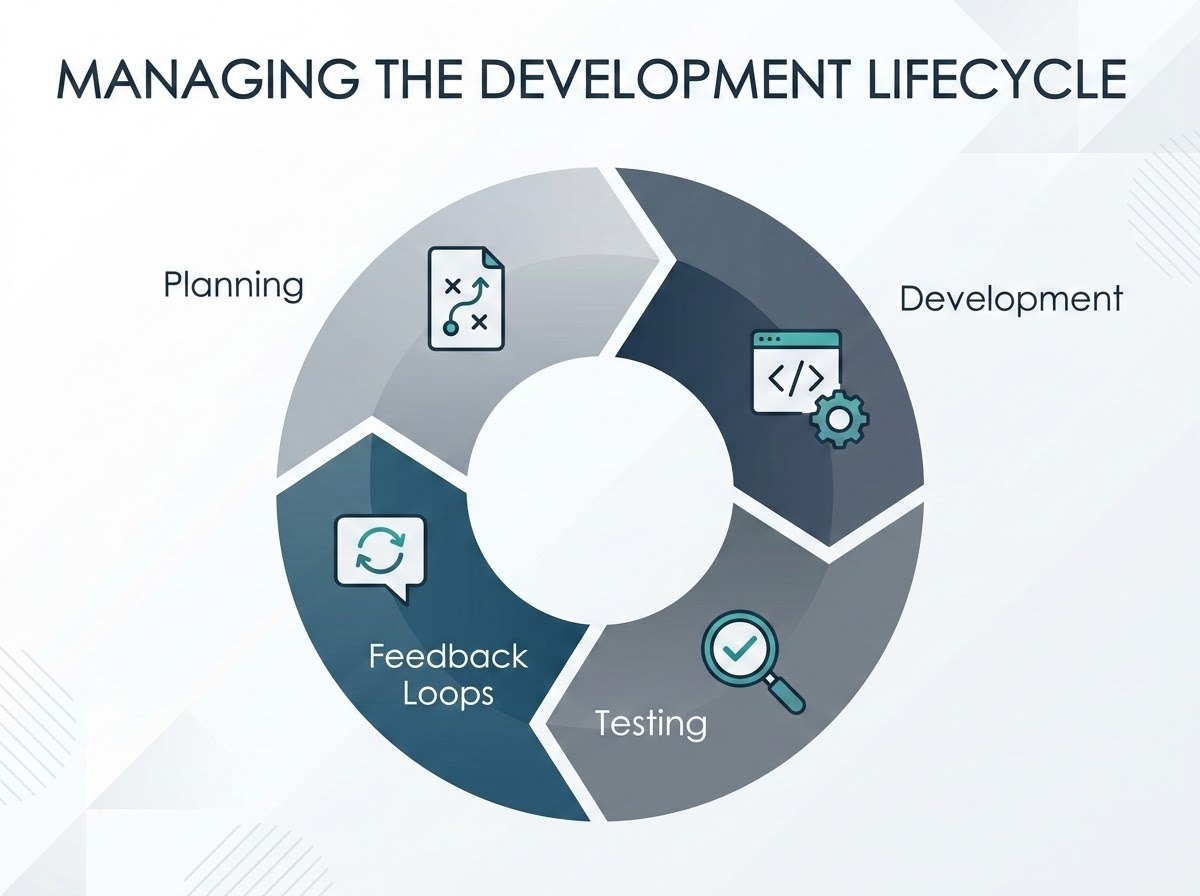
Agile Methodologies and Feedback Loops
To deliver an MVP Development you are operating in a high uncertainty environment. Instead of a fixed plan which you stick to whilst learning more about your customers and market, you need a system that allows you to adapt and change quickly as you go.
This is in direct opposition to a traditional approach such as the Waterfall method that requires a complete design and requirements document before you even write the first line of code. Such approaches consistently fail to deliver for startups as they implicitly assume that you have all the answers prior to launch, never taking into account the uncertainty that exists in starting a new business.
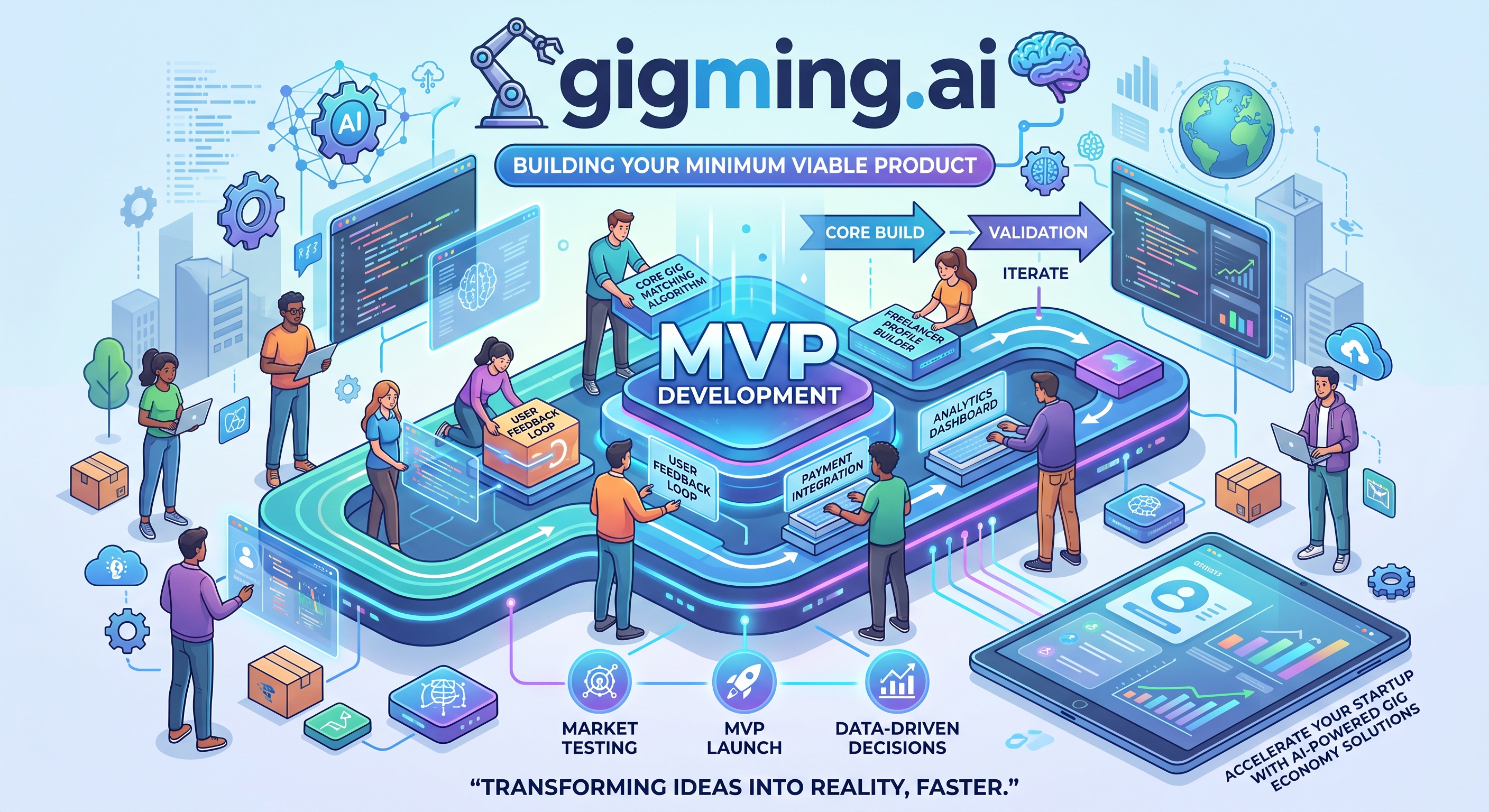
While there are many ways to build an MVP Development, by far the most effective method is Scrum-based Agile development. A true Agile process is a continuous process of improvement where work is divided up into short iterations or Sprints where a set of goals are achieved before moving on to the next set of goals.
Rather than attempting to validate a single feature in an MVP Development, with Agile you can validate many features, get lots of user data and make changes and work in short cycles of work and thereby make huge progress without becoming bogged down in work that eventually turns out to be useless.
Agile also makes the work of building the MVP Development a transparent process where you have a significant amount of control and can be an active participant and become very smart about the process quickly rather than just watching as work gets done in a black box.
Leveraging the GigMint AI Task Pipeline
The briefing gap is one of the biggest pain points in the remote outsourcing of work. A founder with a rough idea of what they want to build can easily get lost in translation when communicating with developers. The back and forth of emails, hours of discussion and explaining, and rework can be frustrating and time consuming.
Using an advanced AI task management system, the GigMint AI transforms high-level conceptual ideas into structured and organized project briefs for remote outsourcing in a matter of minutes.
Using the founder’s goals and objectives as input, the system generates technical requirements, essential feature sets, and organized and trackable tasks to facilitate a project of any scope and size.
With the founder and remote technical resources on the same page (i.e. having all been working off of the same high-level conceptual ideas from Day 1), this type of task management eliminates both the briefing gap and the project scope creep that inevitably occurs when founder’s time is spent by technical resources to debug misunderstandings about what is being built, as opposed to being used to build the correct features of a founder had envisioned for his or her start-up in the first place.
Setting and Tracking Milestones
In the absence of a shared office, visibility is the currency of trust. You cannot manage what you cannot see. Milestones for a project to hit need to be clearly set. In our case, we recommend a regular check in of bi-weekly ‘demos’ where the developer presenting the updates can functionally demonstrate what has been going on.
These demos are NOT status meetings. Each demo will include the release of a shippable increment of functionality. By making the team work under the discipline of releasing functionality every two weeks, you can maintain high momentum and immediately see the results of your team’s efforts. As soon as a feature stops working as intended, as soon as a design decision feels wrong, it can be corrected before it becomes ‘baked into’ the solution’s architecture.
6. Ensuring Quality and Financial Security
The Escrow System: Protecting Your Investment
One of the bigger risks to remote development work is the non-delivery scenario where payment is made for work to be completed and for some reason that work is never fully completed or is severely lacking. Why payment escrow for developers is non-negotiable for GigMint. We utilize a secure payment escrow as an intermediary to the transaction.
When you pay for a milestone to be completed and you fund that, the funds are held in the escrow until such time as the work has been completed and you’ve reviewed it and approved it for payment. That ensures the developer is incented to complete the work of the milestone in the best way possible and aligns with your goals and objectives as the client and holds your assets in safe keeping which allows you to focus on your strategy rather than be fearful of the loss of your capital.
Global Payouts and Compliance
When it comes to cross-border payments, filling out tax forms and dealing with a bank’s processing delays can make managing international payments a real hassle. At GigMint, we keep payment easy by sending out global payouts through your account on Stripe, all with as little friction as possible to keep you in the loop and in the development flow.
And while managing international payments is already challenging enough for startups, managing data and IP is even more so – since the biggest risk for startups are data leaks and the theft of their intellectual property.
At GigMint, we consider the protection of your data, your code and your business-logic very important. Therefore we operate on a SOC 2 compliant infrastructure. This ensures that all your information is protected as best possible, and that you can be shared with customers and partners from all over the globe without a start-up having to fear that its competitive edge will be lost.
QA, Bug Tracking, and Code Reviews
The dreaded “it works on my machine” trap that no founder ever wants to fall into. Avoiding technical debt, that which turns your cozy MVP Development into a soul-sucking beast that cannot be scaled or even supported, requires that you instill Quality Guarantee into every single Sprint. Professional code reviews, QA processes and proper unit testing should become second nature to your team.
Automate as much as you can and run tests on every change to catch worst case scenarios of how code could regress before they hit your users. What founders mistake for finished code, is in reality just the starting point for a software outsourcing contract that has a solid base of clean, modular code, that can be further developed and evolves over time. In reality, only by treating quality as a hard requirement, you’re building a valuable asset that can grow and evolve, rather than just shipping an MVP Devopment.
7. Post-Launch: Moving from MVP to V1.0
Iterating Based on Real-World Data
Stop guessing what users need and actually figure out what they are doing. Use analytics to track engagement (e.g. where users are falling off) and feature usage. Find out if your Must-Have is actually getting traction while your Could-Have is pulling amazing retention numbers.
Use that to pivot and maximize value with your engineering resources. What you want to get off is the build and pray model of software development and get into a continuous feedback loop where every single sprint will be informed by how users are actually interacting with your MV.
Scaling Your Team
As your product reaches market fit and starts to grow in complexity your team will also start to grow as well. Scaling a startup is not the same as scaling a larger company, it’s not just adding more developers. As the single person that ran and built your MVP Development into a V1.0 you will not have the capacity to deal with the increase in load on yourself, the added security that needs to be in place as well as the increased velocity of features.
Outsource your hiring to a true partner and evolve your current strategy with GigMint. Rather than working with a bunch of different experts one at a time to build outsource hiring, work with a cohesive team of specialists that will scale with your company. Need a QA team, DevOps team or even a team of UI/UX designers to help with your growth? We can bring that to you in a matter of weeks, all under one umbrella and with the stability of a company, not the risk of hiring a traditional agency. .
8. Your MVP Development is Just the Beginning
While taking a product from concept to launch on the market is very challenging, it does not have to be lonely. By outsourcing your product development in a strategic manner, you avoid the typical “hire local” bottleneck and work with the best in the world to build your vision to exacting standards. A high-trust partner such as GigMint, does not merely provide more heads – it provides the security, the AI powered structure and the necessary screening to build a minimum viable product which can be scaled.
Get your product to market before technical issues can impede you. Post your project for free on GigMint and match with a vetted expert in seconds or less. Start your journey to building a market-ready product today.