How to Build Scalable AI Applications: A Strategic Blueprint for Growth

How to Build Scalable AI Applications: A Strategic Blueprint for Growth
Picture yourself putting in six months’ worth of budget and your best engineering minds to build an innovative artificial intelligence solution. At the pilot stage, everything works flawlessly – your ten beta testers are happy, processing speeds are lightning fast and the accuracy rate is impressive.
Then comes the launch day. A hundred people sign in at once, the data load is multiplied by four – and in less than five minutes, the whole system collapses.
Does it sound like something familiar? If you are in any way involved in business decisions, then this example is definitely one of your worst nightmares.
As you must have known, artificial intelligence is the future – the only way to stay ahead of your competitors and offer your customers a unique personalized experience. Creating a pilot project and utilizing artificial intelligence on a corporate level is quite another matter altogether.
Through the process of acquiring skills in how to scale AI apps from scratch, you become prepared to avoid bottlenecks and have your tech stack future-proof and always generate ROI for your enterprise even as it grows.
Scaling should not be an IT issue to handle in a server room alone; it’s an essential element for your business survival in the industry. In case your tech is unable to cope with growth, your competition will not hesitate to accommodate that excess load.
With this definitive guide, you are set to discover how to achieve success with scalable AI applications. From the proper infrastructural setup to deployment strategies, you will learn all about building intelligent apps that scale effectively.
Why Scalability is the Secret to AI Success
Before we talk about implementation details, we should clarify what "scalable AI" means in practice. The scalable AI applications app is a software which can process an enormous load of information, perform a large number of users' requests at once, and execute a complex algorithm without reducing its productivity and raising the expenses. Your model performs equally well for millions of customers as well as for dozens of them.
One may think that such considerations are irrelevant at the early stages of development. After all, you just want to test whether your algorithm works well, don't you?. You should consider scale even before you design your algorithm and build a model. Otherwise, you risk losing profits.
Developing a highly accurate machine learning model for a fixed architecture of the system might be good enough to win a competition. It is quite inappropriate in the real world. Scale directly correlates with costs.
The scalable AI applications allow saving money because you only spend money on computing resources that are currently being used. There is no need to buy expensive servers which would lay idle in low-load periods of time.
Failing to address scalability issues at the beginning is going to lead to an enormous "technical debt." Technical debt associated with machine learning projects is usually very costly.
If you choose to build your solutions rapidly but without any regard to scalability, through hard-coded data pipelines and monolithic architecture, you accumulate crippling technical debt. When you hit production-level user loads, minor refactoring won't be sufficient to keep the system online. You will face a costly, full-system rebuild
The Core Pillars of a Scalable Machine Learning Architecture
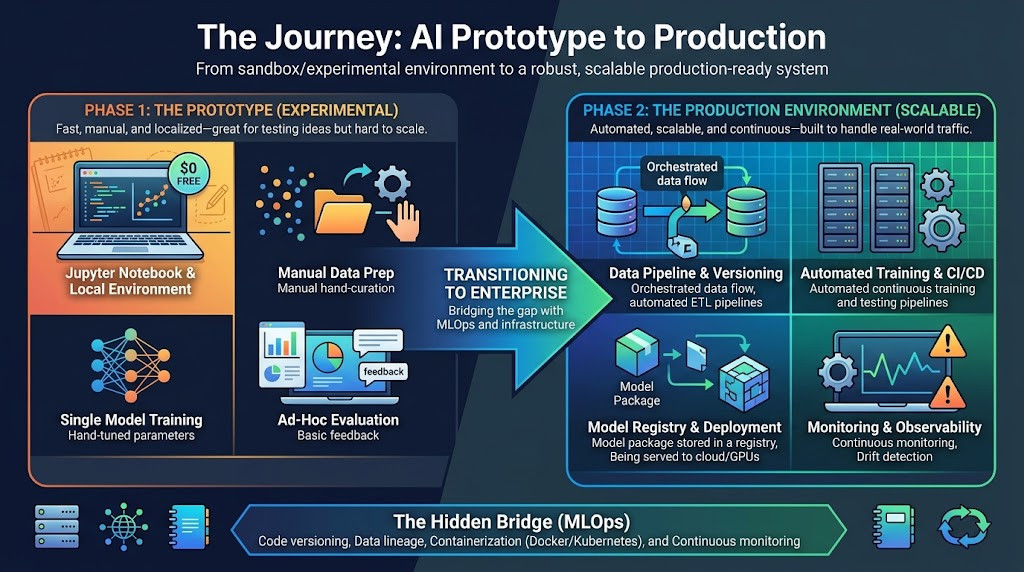
To make sure that you future-proof AI for your company, you will have to lean on a technical backbone. Scalable machine learning systems do not depend on any one software. They are based on three pillars - infrastructure, data pipeline, and deployment.
Choosing a Flexible Cloud Infrastructure
Hosting large servers with declining values in the back office is not an option anymore, particularly in terms of artificial intelligence. On-premise services are simply incapable of offering sufficient flexibility for modern enterprise implementation of artificial intelligence solutions.
Imagine that your model suddenly requires two times more power to deal with increased amounts of users and the process of purchasing, installing and setting up additional physical infrastructure will take weeks. You will not afford to keep your customers waiting.
Cloud scalability lies in flexibility of the cloud infrastructure. Most cloud vendors offer elastic computing via their managed service offerings such as AWS SageMaker, GCP Vertex AI, and Azure Machine Learning.
It will allow your app to scale its compute capacity when demand spikes, for example, by adding more GPU nodes to run LLM inference, and then scale back down immediately after the spike ends.
Your application becomes responsive during the peak time and your finance department remains satisfied as you stop paying for resources once you do not need them. While choosing the vendor, select machine learning environments which provide the possibility of separation of computing and storage resources.
Building Data Pipelines That Grow With You
The intelligence of your artificial intelligence depends entirely on the quality of data that it feeds on. While your infrastructure may be the engine, your data pipeline is the fuel line for your projects.
In the early stages of your projects, it is tempting to download the datasets manually and feed them to your models in batch mode. This practice turns out to be one of the biggest obstacles to success due to the growth of your business.
To create scalable AI applications, you have to move away from static batch processing (such as overnight uploading of the bulk of data) towards real-time data streaming with the help of event-based architectures like Apache Kafka or AWS Kinesis.
This means that your systems require a central repository for the data storage of massive amounts of both structured and unstructured data without causing any lag. A scalable pipeline will automatically process and clean up all the incoming data prior to reaching your models.
By doing so, your engineering department will no longer be performing manual data clean-up and your artificial intelligence will have access to the latest data for making predictions.
Mastering MLOps for Seamless Deployment
The fourth and final principle is called Machine Learning Operations, or MLOps for short. MLOps is the key link between the development of your model in a controlled laboratory setting and its deployment in the real world. Without MLOps, updating your AI system becomes a scary and manual process that typically involves bringing down your system to do any changes.
Expertise in MLOps implies automation at all costs. Creating CI/CD pipeline optimized for machine learning allows you to make improvements to your algorithms and code in a completely automated way without even a second of downtime.
Your MLOps platform will automatically test every version of your model against the baseline metrics in order to check whether it doesn’t destroy the current performance. If the new version of the model doesn’t pass the test – it gets rejected.
It gets deployed to your end-users.Take, for instance, an intermediate-sized ecommerce firm that recently implemented this automated MLOps approach for its recommendation system. They managed to decrease the time required for updating their models from three weeks to merely 45 minutes, thus eliminating all downtime faced by their customers.
Step-by-Step: How to Build Scalable AI Applications
Knowing the building blocks of a scalable machine learning system will only take you half the distance. What is needed is a strategic step-by-step approach towards implementing these ideas. If you aim to develop artificial intelligence systems capable of easily accommodating your business's growth in the future, here are the crucial steps.
Step 1: Define Clear, Measurable Business Objectives
Avoid developing AI simply because it adds another item to your resume or makes you seem up-to-date at your next board meeting. Artificial intelligence is an extremely specialized technology and like all tools, needs a job to do.
Defining what success means is absolutely crucial in the process of developing an enterprise-grade scalable solution.
It is imperative that you define the relationship between the KPIs of your project's performance and the overall KPIs of your company.
If your project is an NLP-based chatbot, don't just measure how efficiently it handles sentences - measure the decrease in man-hours spent by the customer support team. Is it a recommendation engine? Measure its effect on the average order value.
By defining your business goals from day one, you will make sure that as your app scales up, it is scaling up the right things. It will also be far easier to justify the cost of cloud infrastructure when you can prove without any shadow of a doubt that it generates income.
Step 2: Prioritize Modular Design (Microservices)
One of the greatest dangers in the software development process is developing an architecture which becomes monolithic. In a monolithic architecture, everything is interconnected – the front end, the backend processing logic, the machine learning algorithm, and the database – into one large piece of code.
Updating any small feature requires redeploying the entire application, and failure in one place leads to failure across the entire system.
If you want to create scalable AI applications, one of the things that you need to do from the very beginning is implement a modular architecture of your system, which is known as a microservices architecture.
Divide your application into containerized, independent services that communicate via clear APIs. For instance, if your Natural Language Processing module suddenly experiences a massive spike in user text inputs, containerization allows you to independently spin up more instances of that specific NLP module without paying to scale your entirely separate image recognition service
Step 3: Implement Robust Monitoring and Retraining
While conventional computer programs stay static until a person makes any modifications to them, machine learning algorithms are living and breathing entities.
They will deteriorate with time. What your application learned from the data you used to train it a year ago may not be relevant for your market any longer. And this is called data drift or concept drift, which is the invisible enemy in AI implementation by enterprises.
One cannot just deploy an AI solution and forget about it. One needs to put in place automated monitoring tools to measure your model's performance in relation to actual results. You should create alerts that will alert your data science team whenever the confidence score of your algorithm drops to a certain level.
But above all else, you need to create an automatic feedback loop. As soon as there is any change in real-world data, there will be an automatic initiation of a retraining process to provide new data and let the model learn the new reality.
Common Pitfalls When Scaling AI in Business (And How to Avoid Them)
Even with the best architecture design plan, implementing AI in a business has its own set of hurdles. Knowing about these typical barriers will prevent you from getting frustrated and losing money.
To begin with, most companies tend to grossly underestimate their cloud expenditures. Even though elastic cloud computing is very effective, it can also result in huge bills that you did not anticipate.
Although auto-scaling is very handy, it will automatically trigger additional cloud computing whenever you have an error in your code leading to an infinite cycle of data processing. To prevent this, put a limit on your auto-scaling and set clear billing alarms.
The second step would be to pay attention to the talent shortage problem. Creating a prototype is a job for an exceptionally talented data scientist. Growing a prototype into a company-wide product is a task for the whole team of professionals with different expertise areas.
You should have Data Engineers in order to create reliable pipelines and MLOps Specialists in order to manage the deployment and the monitoring process. Forcing a data scientist to deal with the enterprise infrastructure is a formula for disaster and exhaustion.
The final point here is to avoid over-complicating the first iteration. It is always very tempting to start building a big, perfectly scalable and enterprise-wide solution from the very beginning.
This approach normally ends up with endless development cycles and project delays. It would be much better to start from the MVP. The main idea here is to create this MVP in a scalable way – using cloud infrastructure and microservices – but make its feature set really minimalistic.
Your Next Steps to Scale AI
Succeeding in the intricate landscape of artificial intelligence demands much more than an inventive algorithmic concept – it entails an unwavering dedication to building engineering resilience. To create scalable AI applications that will fuel your company’s development in the long run, it is crucial to prioritize flexible cloud infrastructure, design data pipelines able to handle real-time streaming, and use a modular MLOps methodology for uninterrupted deployments.
Linking your technical architecture with tangible business KPIs and being proactive in terms of data drift detection will help you turn your brittle experiments into highly-reliable sources of income generation.
Look carefully at the intelligent systems that you are currently using in your company. Do you have any doubts about their potential for development? Do you suspect that your present-day projects will not be able to withstand stress?
If you are determined to go further than the pilot project and make sure that your technology stack is going to work in the future, you do not have to walk this path alone. Get in touch with the Gigmint.AI team right away to receive professional advice on enterprise AI deployment.