6 Components of a Reliable Enterprise AI Application

6 Components of a Reliable Enterprise AI Application
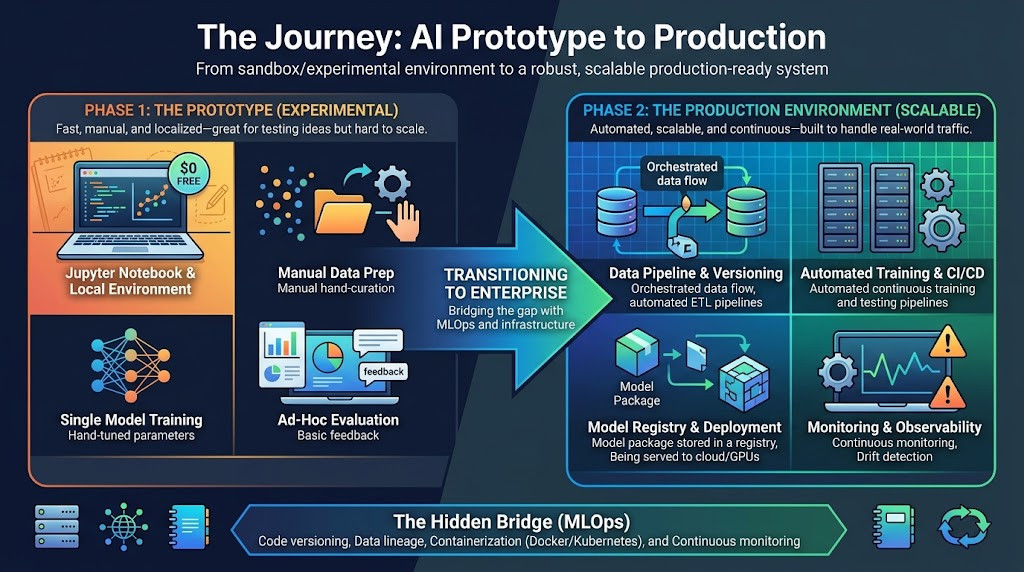
Did you know that almost 80 percent of enterprise AI initiatives fail to leave the experimental phase and move into full-fledged production? The figures speak for themselves and are certainly something to keep in mind if you are the IT director, CTO, or an executive of any kind at your enterprise. All those millions you spend on new algorithms are doomed to fail somewhere along the line.
The thing is that creating an AI prototype in a sandboxed environment is no problem whatsoever. Deploying the system which will be able to work in real-life conditions of an international corporation is another story altogether. There is more to it than an algorithm that does not crash, does not leak confidential data, and makes decisions which cost the company dearly.
Once you learn about and utilize the key ingredients of dependable enterprise AI solutions, you will be able to turn your AI projects into highly valued and very secure assets for your business.
Knowledge of these basics guarantees that you have a perfectly clear understanding of how to achieve data safety, comply with regulations, and see your ROI clearly. It helps you bridge the gap between all those promises and your business, making you the hero of your company.
Why Building Reliable Enterprise AI Applications is Different
Why is it significantly more difficult to implement AI at the enterprise level than consumer applications? If you have used any standard chatbot app on your phone, you know it works like magic.
But the difference between a consumer using an AI to create a grocery list and a multinational company implementing an AI for its supply chain logistics or financial fraud detection is huge.
It is a fact that there is exponentially higher risk involved when it comes to enterprise AI solutions. If a consumer app made by the AI malfunctions, it is nothing but a small annoyance. If an enterprise AI solution does not work properly, there can be losses of millions, regulatory penalties, and harm to the brand reputation.
The consumer application of AI technology usually takes advantage of publicly available data sources. In contrast, the application of AI within the enterprise has to be able to process very sensitive and proprietary information. This data is vital for your business and can never be exposed to any risk. It is crucial that your system ensures maximum availability, for example 99.99%, because any system downtime means money loss.
The development of consumer applications does not require worrying about corporate governance and the compatibility of a solution with old IT infrastructure.
Enterprise solutions should fit well into complex ecosystems that might involve software which is even decades old. The development of enterprise AI is not only a matter of data science but of software engineering and business strategies as well.
Component 1: Robust Data Infrastructure and Management
Of course, there is an old saying that "garbage in, garbage out". But when it comes to AI, it is much more than just a saying – it is an irrefutable law of physics. AI works the way it gets fed by the data it uses to work. And if your data foundation is poor, disjoined and incorrect, then your enterprise AI solution is doomed to fail.
Establishing Uncompromising Data Quality
Prior to beginning development on any machine learning algorithm, the first task at hand should be organizing the data.
Many companies fall victim to data silos where data for marketing, sales, and customer support are all stored separately. When attempting to gather data for use within an AI application from all these separate and dirty silos, the data insights will be inconsistent.
In order to create AI applications that are reliable, you must have stringent data cleansing, de-duplication, and verification processes in place. This is necessary for making sure that your data is not in different formats and there are no duplicates.
It’s important to take a look at your current data silos. Are the data insights accurate? Are they complete? Is the data up to date? Creating uncompromising data quality requires the cooperation of multiple departments in order to achieve a single source of truth. Your data will yield incredibly insightful and accurate predictions.
Scalable Storage and Processing Architecture
When your data is ready, you still have to think about where to store it and how to process it at unprecedentedly high speeds. Regular databases are just not capable of working with such huge, diverse, and fast flows of data.
Here is where an advanced enterprise data architecture becomes absolutely vital. You need scalable storage services such as data lakes and data warehouses. With the former, you will be able to store your massive raw and unstructured data, while with the latter, you will be able to analyze and process all the necessary data.
It is also important to mention real-time processing which is also critical for an efficient data infrastructure. Whatever method of data processing you choose, whether batch processing or stream processing, whether you train your AI algorithms in the night time or you want your algorithms to detect fraud in real-time, your infrastructure should scale elastically.
Component 2: Advanced Model Selection and Training
Since we have already laid out the rock solid foundation of our data, it is time that we move on to the modeling process itself.
One of the mistakes that people often make while implementing AI in their business enterprises is the pursuit of the latest fad. This is the fact that just because a particular Large Language Model (LLM) is trending does not necessarily make it suitable for your enterprise issue.
Aligning Algorithms with Business Objectives
The main factor in creating scalable AI models is alignment. You should fully understand the business objective in order to choose the right algorithm. For example, if the aim is to develop email reply automation for customer service, the fine-tuned LLM would be a good choice.
If you work for a logistics company and your goal is to improve delivery routes, the LLM becomes redundant. What you need is a very specialized predictive algorithm or RL model.
Here is a practical example. There was a major supply chain corporation that was facing problems with the delay of delivery. They decided to use a generic, generalized AI to forecast weather and traffic conditions.
But the technology was not specific enough and could not provide any return on investment. With the help of the specialized predictive time series model, developed only based on the historical data of the company's fleet, they saved thousands of hours of delivery per year.
Implementing Continuous Learning Mechanisms
Enterprise systems are highly dynamic environments. The tastes of consumers change, macroeconomic factors change supply chain dynamics, and there are constantly new cybersecurity risks being discovered every day.
In such an environment, if you only train your machine learning algorithm once and leave it at that, your machine learning algorithm will quickly grow outdated.
A good enterprise-level artificial intelligence application is one that has continuous learning built into the architecture.
Your algorithms should have been designed in such a way that they will be continuously learning from new data coming in while not forgetting the important patterns they learned initially. This effect is known as “catastrophic forgetting” among data scientists.
Through the use of active learning and online learning, among other methodologies, your machine learning application will continuously update itself.
Component 3: Ironclad Security and Compliance Protocols
"But what if our sensitive data leaks?" It's the one and only valid argument made against the implementation of AI technology within enterprises. There are a huge amount of security challenges connected with enterprise AI.
The risk of leaking either the model or the poisoned data may result in a huge data breach. Security should be the primary concern in building an application.
Data Privacy and Encryption Standards
The security is an inseparable part of your AI architecture, which cannot be added as an additional step when the project has already been completed. It all starts with having high-end standards for data privacy and encryption.
All the data that will be used by your AI should be encrypted both when it is stored in your databases and while traveling from one server or API to another. In case if someone tries to intercept your data, it should be impossible for the hacker to read it.
There has to be Role-Based Access Control (RBAC) in place. All the developers and data scientists do not need to access all the data, especially if it is sensitive.
Only the people who are authorized can change and see the models and information. The use of data masking and synthetic data creation can help to train the models without using any PII.
Navigating AI Governance Frameworks
In addition to malicious attacks, there is also the issue of compliance and regulatory fines. In accordance with your sector or geographical location, your AI application has to be in compliance with stringent legal regulations such as GDPR in Europe, the California Consumer Privacy Act (CCPA), or the Health Insurance Portability and Accountability Act (HIPAA) in the case of the healthcare sector.
It is in such a context that AI governance frameworks are of importance. The concept of AI governance framework entails the manner in which AI is designed, tested, and implemented in the organization.
This is achieved through the creation of an audit trail in which you can prove that a particular model has been trained using specific data and that it has been approved. Effective enterprise AI applications include compliance in their design from the start.
Component 4: Seamless Integration with Legacy Systems
You may be asking, "How do we actually get this state-of-the-art artificial intelligence integrated into our ERP system that we bought ten years back?" This is a highly important question.
IT infrastructures for enterprises are not greenfield ones. It is a highly intricate network comprising legacy and monolithic systems and specialized third-party software. The AI which is unable to integrate with such systems is practically useless.
Adopting an API-First Architecture
The key to seamlessly combining modern AI with legacy systems will be through using an API-first strategy. Application Programming Interfaces (APIs) work as mediators between various software systems. Rather than redesigning your entire legacy environment to include AI, you create APIs which will allow the AI to draw data from and send decisions to the legacy system.
The use of microservices is critical in the architecture of enterprise AI applications. Instead of designing an all-inclusive huge application, you decompose the AI features into small autonomous services.
In case of any updates in the AI application used to predict the inventory level, you simply update the microservice without compromising your entire enterprise resource planning system.
The Importance of User Experience (UX) Integration
While integration is a problem of backend technical integration, it is equally a problem of a very human nature. The AI you build needs to integrate seamlessly into the workflow of your staff.
Imagine rolling out an advanced sales prediction tool that needs your sales reps to open up three apps and copy paste all the information to get a lead score. It will never be adopted. If the user experience is awkward and clunky, usage numbers will drop drastically and ROI will be a non-entity.
The AI must offer its insights right where it makes sense - in your dashboards, CRMs or email clients.
Component 5: Transparent Explainability and AI Ethics
The issue of 'Black Box' is one of the major issues associated with the use of AI in organizations. There have been many cases where highly advanced AI algorithms, especially neural networks, make decisions on data whose rationale cannot be deciphered by people easily.
It would be quite problematic for the decision maker in the organization to explain how he arrived at a decision that cost the organization $1 million. "It's what the computer says" will definitely not suffice in such a scenario.
Engineering Explainable AI (XAI)
In order to build trust between your leadership, employees, and consumers, it is critical that you have an XAI system in place. XAI refers to the utilization of various approaches that help explain and interpret the output of machine learning systems.
In case your AI system rejects a loan application of any customer, XAI approaches can help identify the particular reason behind such rejection like the customer’s recent failure to pay his/her dues or the customer’s very high debt to income ratio.
In case AI suspects any cross-border transaction to be fraudulent, it needs to present all suspicious aspects in a form of report to the human fraud analyst.
Proactive Bias Detection and Mitigation
Just as important as explainability is the issue of AI ethics, particularly with regards to bias. AI learns through historical data, which is prone to containing biases from humans. If these biases are not addressed, then your AI will be perpetuating them in a very large way.
Take the case of your automated HR screening tool which was trained on a decade of recruiting data of an engineering firm that employs mostly men; it may have learned to discriminate against women applicants.
Not only does this make you lose your business's moral high ground, but it can also lead to legal issues and negative publicity.
Enterprise-ready AI should be capable of checking for any signs of bias in their output.
Component 6: Machine Learning Operations (MLOps)
Too many companies think that getting an AI algorithm out into production is the end game. It is actually just the beginning. Once the AI model becomes live, it starts encountering the chaotic nature of the world around it. Unless it is managed, its performance will deteriorate quickly.
Performance Tracking and Drift Detection
In order to ensure the validity of your models, you have to constantly monitor them for two principal reasons: data drift and model drift.
Data drift is defined as the situation where the characteristics of your data change over time due to the evolution of language, consumers' spending patterns in hard economic times, or seasonality.
Model drift (also known as concept drift) refers to the case when the connection between the input and output data shifts.
If you do not monitor the performance of your AI system on an ongoing basis, then you will miss the signs of drifts until they affect your business negatively. In other words, you have to develop advanced monitoring systems that will immediately inform you about any drop in accuracy.
Automated Retraining Pipelines
One can never count on manual effort each time the model becomes drift; it is time-consuming and expensive. Here is where Machine Learning Operations (MLOps) comes into play as the most precious resource you have.
MLOps is the link between machine learning and continuous software delivery. MLOps is all about creating automated pipelines to handle the whole life cycle of your model.
Once your model becomes drifting and you detect it through your monitoring system, an automated pipeline of MLOps can initiate a process of acquiring new batches of fresh data, train your model, validate it according to the quality standards, and release it into production without any interruptions in your systems.
Moving from Architecture to Execution with Gigmint.AI
Coordinating data pipelines, legacy API integration, XAI, and MLOps automation is hardly an amateur effort; especially if the internal IT department is already busy keeping the company’s infrastructure running.
Efforts to construct such a complex ecosystem typically take up too much time and prevent projects from being successfully deployed.
And here comes the value of working with a team of specialists at Gigmint.AI who will not only accelerate the process but also reduce risks of any possible failures along the way. Instead of delivering you some ready-to-use algorithms, we work together with companies to construct an ecosystem which consists of six vital elements mentioned above, and integrate it into your current system.
Starting from auditing your data silos and ending with building automated continuous learning pipelines, we handle all aspects of enterprise AI engineering. And you will be able to concentrate on the really important thing – using your insights to make profits and beat your competitors.
Future-Proofing Your Enterprise AI Strategy
Engineers trusted AI solutions for your organization and this is not a game of guesswork. It is an engineered approach that consists of good data management, business alignment, top-notch security, efficient API integration, ethical explainability and MLOps automation to make sure that your investments pay off.
Six pillars are necessary to move from experimentation to production with robust systems. If you are ready to take the next step and build an AI system that can scale, then contact the experts at Gigmint.AI.