The Ultimate Guide: How to Choose the Right AI Architecture for a Business Application
The Ultimate Guide: How to Choose the Right AI Architecture for a Business Application
The problem is never with a vision in enterprise AI projects; the problem arises when there is a lack of proper AI architecture that can support this vision at scale. Without having the correct architecture, any advanced use cases of enterprise AI turn into a nightmare with significant technical debt, huge expenses related to cloud services, and critical security risks.
As a CEO or an executive sponsor of an enterprise project, you need to remember that the choice of technologies becomes not only a matter of IT but also a strategic decision. The inability of a database or machine learning platform to cope with high loads means that the customers' data will be exposed, and you won't get ROI from the application yet.
Here is a strategic roadmap of picking the proper AI architecture from a business perspective. You'll be able to save yourself from many months of development and optimize the expenses on cloud services.
Understanding AI Architecture in a Business Context
Before we get into the complicated technical considerations, let’s begin with defining what we understand by the term 'AI architecture'.
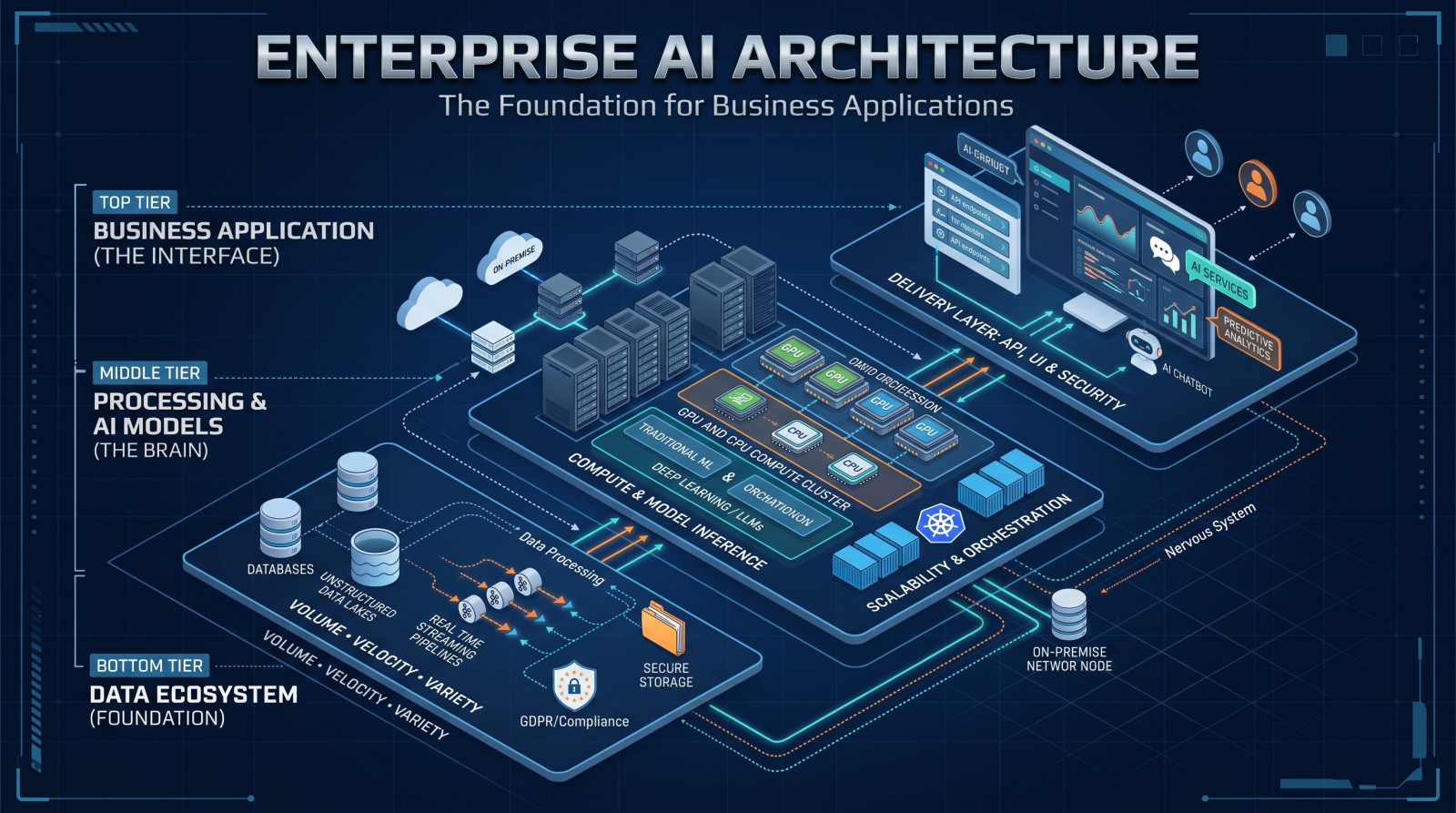
In layman's language, AI architecture is the overall design that makes your data work together with intelligent models to provide a result to the user through an interface. It is the unseen nervous system of your program.
It defines how the information goes from the database, passes through a machine learning algorithm, and ends up becoming valuable for the one who is clicking buttons on the computer.
To understand what role does architecture play in your AI solution, you should think of building an AI project as creating a skyscraper.
If all of your efforts go into the interior and glass façade but not into a solid and deep foundation made of concrete, your building will collapse immediately once it is faced with a storm.
In the world of programming, this "storm" is an unexpected number of users that appears all of a sudden or a great increase in data-processing requirements. An enterprise AI architecture is the foundation here.
In most cases, many managers believe that the application of ready-made AI solutions would solve all their needs. Although ready-made solutions can solve simple problems, it is practically impossible to use them for solving business-related challenges in a special and complex way.
Every business organization has a unique way of managing its data and security concerns. Eventually, using any general framework will be a limiting factor for business growth. For any business to gain any competitive edge, it must create its own architecture.
Step 1: Define Your Core Business Objectives

The most important thing that you have to take care of while building an artificial intelligence application is the beginning with the right approach.
Never go for database technologies and machine learning models just because they happen to be popular among developers at the moment. It is always important for you to do a very tough job of assessing what kind of business value you want to achieve.
Identifying the Exact Problem You Want to Solve
Your architecture’s design completely relies upon what issue it is that you want to solve. So tell me what exactly you want to improve or revolutionize using technology? Is it a live customer service chatbot designed to interact effortlessly with hundreds of unhappy customers all at once? Or is it a sales forecast software which analyses millions of data points every month?
The former definitely needs a different kind of architecture where speed and low latency are the key elements, involving fast API calls and real-time data fetching. The latter one, however, has no concern about split-second responses and requires an architecture designed specifically for heavy computational workloads processing big amounts of data.
The more defined your problem is, the easier it will become to select the architecture, as you will be able to rule out dozens of other technologies right from the start.
Measuring Success and ROI
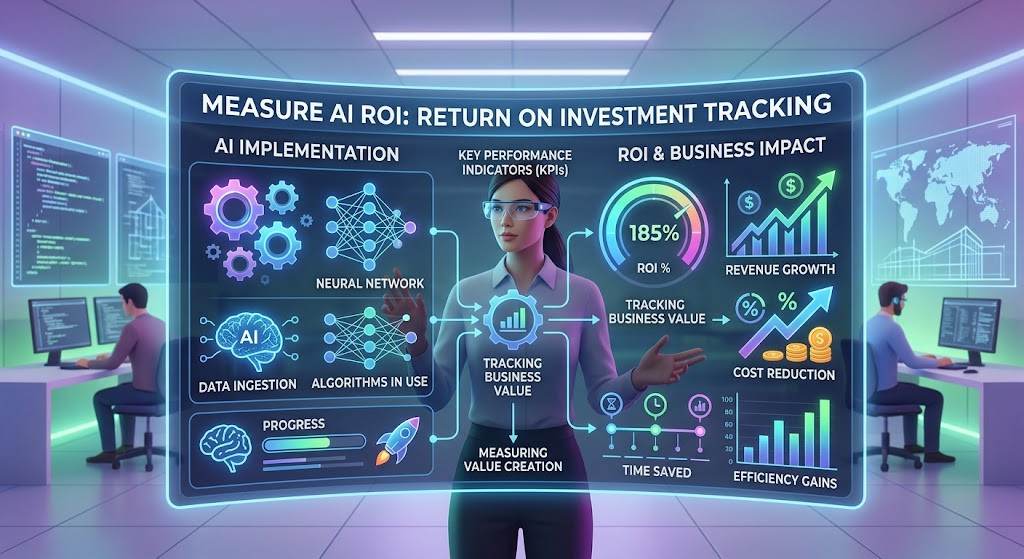
The real AI architecture will address your business KPIs. The very first thing that you have to determine is what constitutes the success of your system in measurable business metrics. Would it be a success for your system to reduce customer wait times by thirty percent? Should your system increase sales conversions by five percent in order to pay off the development cost?
After you've figured out the measurable business metrics, you have to convert them into technical requirements such as latency, throughput and accuracy.
In case the response time of your application is less than a second in order to not let customers abandon their shopping cart, your architecture should be designed accordingly and include such solutions as edge computing and efficient caching layers.
In case your medical diagnostic application needs to have 99.9% accuracy in order to be considered legitimate and valid, then you have to place a great emphasis on data validation and model training rather than performance.
Step 2: Analyze Your Data Ecosystem
Now that you have a solid understanding of your business goals, it’s time for you to change your approach and pay attention to what drives every artificial intelligence solution on the planet – data. The intelligence of your application depends directly on the quality of the data you’re working with. That’s why data analysis is an important part of developing AI solutions.
Managing Data Volume, Velocity, and Variety
When it comes to structuring your data architecture appropriately, there is no other way than to segment your ecosystem through the use of "Three Vs" of big data - namely, Volume, Velocity, and Variety.
Find out the size of your dataset. Is your dataset one that contains gigabytes of clean spreadsheet-based customer data or do you have petabytes of logs containing historical user data?
Now consider the velocity of your data. How quickly are new data elements coming into your system? If your AI app is one that detects fraud and watches all credit card transactions globally, your data structure needs to be able to take in and process constant streams of real-time data at high velocities, meaning that you need streaming technology solutions such as Apache Kafka. If you update your datasets weekly, a simple batch-processing structure will be sufficient for you.
Look at the variety of your data. Does your data have a high degree of structure – meaning it is well-formatted, and is structured in tables and rows? On the other hand, does your data lack any structure at all – being made up of text documents, audio data, customer support emails, and images? In cases where unstructured data plays a big role in the AI app, data lake architecture is required.
Ensuring Data Privacy and Security Compliance
There is no way to talk about data architecture without mentioning the gigantic, lurking threat of compliance and security. It will depend on your industry and geography, but chances are that you have to deal with stringent regulations such as GDPR in Europe, HIPAA in healthcare or a range of financial compliance guidelines. To ignore this in your architecture is to face disastrous fines and destruction of reputation.
It goes without saying that you should develop your architecture in the full consideration of security and data governance. It means you have to apply strong encryption of your data in both storage and transfer modes – in your databases and when the data travels between your servers and the end user.
You should build solid access rules in your architecture so that only your authorized services and people can access your sensitive data. Proactive data governance will give you the opportunity to expand without fear because your architecture will take care of your data security needs.
Step 3: Evaluate Cloud vs. On-Premise vs. Hybrid Deployments
The Agility and Scale of Cloud AI Solutions
For most startup firms and nimble companies operating today, there is no option but to adopt cloud computing technology. Cloud technologies such as Amazon Web Services, Google Cloud, and Microsoft Azure present one of the best sales pitches out there – limitless scalability at the click of a button.
Once you set up a cloud native ML architecture, you do not have to worry about the need to acquire hardware, rent warehouses, or upgrade the hardware after your user base grows by thousands in just one night.
There are very robust AI services provided in the cloud that make it easy for your software developers to act at lightning speed. Rather than waste weeks setting up your databases, you are able to set up a fully optimized environment within minutes.
If your application goes viral and the traffic skyrockets to ten thousand times its previous levels, a well-designed cloud-based system would automatically increase its capacity to handle the increased traffic and scale down automatically once traffic decreases.
The Security Control of On-Premise AI
Although there is no denying the conveniences provided by cloud services, there are very convincing reasons as to why certain enterprises may wish to stick to an on-premise system and host all their own hardware within their own private data centers. The main reason is, of course, security and complete control over data.
If you are a defense contractor, a highly regulated financial enterprise, or a hospital handling extremely sensitive information about patients, you may simply not be permitted, either by law or morality, to send this information off-site to a third-party cloud service provider. With an on-premise model, your data will never leave your physical location.
For businesses operating huge, round-the-clock deep learning applications, it turns out that purchasing your own GPU servers can cost less during a five-year period than paying hourly rental fees to a cloud provider.
Finding Balance with a Hybrid AI Architecture
But what if you need both? What if you want to have the benefit of being able to scale infinitely in the cloud while also having the rock-solid security that comes with using an on-premises data center? Then your solution would be a hybrid AI architecture, which will give you the best of both worlds.
Let's say there is a financial services company creating an AI application that will allow them to analyze the applications that people submit for a loan. Their mandate is that all personal information related to customers (SSN, bank balances) is going to be hosted only on their own highly secure on-premises server.
They also need a massive amount of computing power to train their AI on recognizing patterns in their data. With hybrid architecture, they can anonymize the data, send it to AWS and use the cloud computing capabilities to train the model and then bring the trained AI back to their server.
Step 4: Selecting the Right AI Models for Your Application

The infrastructure will be your physical body while your models of artificial intelligence will be the brain of your application. The choice you make regarding your brain will influence your choice of computing resources in terms of power, memory, and dedicated hardware.
Traditional Machine Learning vs. Deep Learning Models
You have to differentiate the architectural requirements for traditional machine learning models from the deep learning models. Traditionally trained models (like the random forest or the linear regression models, which are used for simple numerical predictions), tend to be relatively lightweight. These models can be executed effectively on general-purpose CPU servers and are cheap to deploy into production.
On the other hand, deep learning models are a whole different story. Such complex neural networks, as are typically employed in tasks like image recognition, advanced natural language processing or autonomous systems, involve complicated mathematical computations and require extremely specialized hardware, i.e., GPUs.
If you decide to use a deep learning solution, you will have to provide yourself with sufficient funding for such hardware as well as with complex configuration management of your GPU clusters in the cloud or in your own server rooms.
Leveraging Generative AI and LLMs
Today’s tech world is absolutely flooded with the emergence of Generative AI and Large Language Models (LLMs). In case your business application is related to the generation of some text, summarization of some documents, or using some conversational agents, you are to make an important architectural decision about how you are going to connect these LLMs.
The first approach would be to use the API architecture in which you connect a proprietary model of the firm like OpenAI or Anthropic.
It is extremely efficient for developers since you transfer all work to somebody else’s shoulders; you simply send a prompt to their servers and get a reply without constructing a large internal infrastructure. However, you pay for each call and give away your data to the third party.
The second way to proceed with your task would be to run an open source model like Meta’s Llama 3 on your servers. In this case, you ensure ultimate privacy and do not spend money on each API call, but you will have to construct a very big infrastructure.
Pre-trained Models vs. Custom Training Pipelines
One has to figure out if their application runs on pre-trained models or requires custom training for that purpose..
In case your product is about performing basic sentiment analysis of customer reviews, you will be able to simply grab any pre-trained model off the shelf and put it to use right away. All your architecture will need is "inference" (model's prediction), which is a simple and inexpensive procedure.
If you want to create an AI for defect detection within a very particular manufacturing process, an out-of-the-box model will definitely be of no use to you. You will have to create architecture for continuous custom training of your models.
It will involve creating complicated data pipelines in order to constantly provide manufacturing images for your system, creating automated test environments for validation of AI's learning process and providing continuous deployment of new models to the production environment.
Step 5: Factoring in Scalability and Future-Proofing
Creating an effective AI system is not only about making sure the application works for your first ten beta users; it is about making sure that the system is able to accommodate all the challenges and growing pains of an expanding business venture. You need to ensure that there will be no build-up of technical debt that will end up slowing down your business in the long run.
Handling Increased User Demand
As a result of your increased number of users from 100 to 100,000, scalability has become a necessity for your architecture due to the efficiency of your marketing. Scalability is enabled by architectural factors such as containerization and orchestration..
Imagine containerization technologies like Docker as standardized shipping containers for your code. Your AI app is put into this isolated and standardized box together with all of its dependencies and runs identically regardless of the hardware.
With such containers and orchestration technology such as Kubernetes, you become unstoppable.
Kubernetes is a great traffic cop and factory manager at the same time. If some number of your users logged in at the same time to your AI app, Kubernetes will notice it and create new copies of your app containers to distribute all the load between many servers, preventing system crash.
After your users are done and went to sleep, it will shut down these extra containers to save money for you. Containerization and modular architecture is a must for any modern scalable solution.
Avoiding the Vendor Lock-In Trap
In architecting your solution, you have to be extremely careful not to fall into the very risky pitfall of vendor lock-in. When you architect your solution completely depending on proprietary and closed systems provided solely by one particular cloud provider, you put yourself totally at their mercy.
If the cloud provider chooses to double its prices the next year, or offers poor quality customer support, you will be totally stuck since switching your solution to another cloud provider would be a time-consuming and expensive process.
To ensure that your company has a bright future ahead, you have to build a modular solution with open standards and frameworks where possible.
You have to create your application in such a way that the data storage component, the machine learning models and the user interface are decoupled pieces that work independently of each other. This will give you the capability to switch to any new, cheaper and faster alternative available on the market.
Step 6: Assessing Your Internal Talent and Budget
No matter how sophisticated your AI architecture will be, without the right people behind it and enough funding to support its implementation and further maintenance, it will just be useless. Thus, you should first evaluate your own resources carefully before committing yourself to a particular architectural solution.
You face the classic problem of choosing between building and buying. The creation of a sophisticated enterprise-level AI architecture from scratch means recruiting very expensive specialists, namely MLOps engineers and cloud architects.
If you have a small development budget as a startup, trying to build your own infrastructure will drain your funds even before you are able to bring your product to the market.
In case you do not have an enormous AI development team within your organization, there is no need for you to give up.
It means that you can fill this important gap in talent by using the help of specialized platforms and consulting services. This way you will not spend money on solving the simplest problems connected with server configuration.
Common Pitfalls to Avoid in AI Architecture
As you near completion of your architectural design, be on the lookout for the following three common pitfalls that regularly ruin potentially promising business cases:
Over-engineering the MVP: Don’t attempt to create a distributed across multiple regions Kubernetes deployment for a Minimum Viable Product with only fifty test users. Start simple with a monolithic architecture and deliberately design your architecture in a way that you would eventually have to break it down into microservices once traffic requires that.
Ignoring Quality of Data Pipeline: As accurate as your AI can be, it is only as good as the data you train it on. Spend a significant amount of money on state-of-the-art models and ignore building an infrastructure for the proper cleaning and formatting of data. You’ll get very confident and very wrong predictions.
"Model Drift": Real-world data changes. The more it changes, the less accurate AI models become. If you fail to create monitoring tools within your architecture to measure the accuracy of these models, your application will become increasingly ineffective while you won't even notice it.
Frequently Asked Questions About AI Architecture
What distinguishes an AI model from an AI architecture?
In order to make an analogy, one could describe the AI model as the engine of a car, while the AI architecture would be the whole car. The former is the actual math algorithm performing the process of “thinking” (i.e., some kind of a Large Language Model or a neural network).
The latter is everything else needed in order to make the engine useful: the database that provides the fuel (data) for the engine, secure APIs for the data exchange, and the user interface where the driver steers the car.
How much will it take to develop an enterprise AI architecture?
There is not going to be a set flat fee, as this will vary according to your own needs. It can take very little to create a basic architecture on the cloud using pre-trained models accessed through APIs at a cost of perhaps $300 a month for servers and tokens.
It may take up to hundreds of thousands of dollars to create an infrastructure that is safe and scalable enough to keep training models through deep learning all the time.
What cloud provider should I choose for AI applications?
The question of what is the best provider is relative. The best one always depends on your current tech stack and technical capabilities. Amazon AWS provides the most extensive and mature set of flexible services and is a leader in terms of market share.
Google Cloud Platform (GCP) is considered to have the most advanced and user-friendly native machine learning services by developers. Microsoft Azure is usually used in cases when an organization is deeply integrated with Microsoft technology stack and requires tight integration with Office 365 and enterprise-grade security.
Which type of hosting should I use – cloud, on-premise or hybrid?
In case fast scalability, agility and reduced investment in hardware are the main goals, cloud hosting is your choice.
In case you work in a strictly regulated environment, deal with highly classified information or have constant heavy computation loads in 24/7 mode, when purchasing GPUs is cheaper than leasing them, then on-premise solution can be considered.
For a combination of both scenarios, e.g. keeping confidential customer information in-house, but using the power of cloud computing for training models, hybrid hosting is the right choice.
Building Your AI Future Today
The process of selecting an appropriate AI architecture for the business application you need to develop cannot be reduced to a simple technology choice because, in essence, it implies that you have to make a number of related strategic decisions and align your key business goals with the specifics of your data environment.
You will need to consider both cloud and on-premise approaches as well as choose the most efficient and at the same time cost-effective AI models. Creating a flexible and secure architecture is crucial in order to save your money and ensure a seamless user experience.
Now that you know what you need to do to create a solid basis for your future project, implementing all of these ideas in practice might prove to be quite challenging indeed.
Looking to develop a scalable and reliable AI application and having no clue on how to start? Learn about how Gigmint.AI can assist you in designing, building and managing an enterprise AI architecture that would perfectly suit your business needs and budget.