The Ultimate Guide to AI Application Development: 9 Essential Pre-Coding Steps

The Ultimate Guide to AI Application Development: 9 Essential Pre-Coding Steps
Companies all over the world try to implement artificial intelligence, afraid of lagging behind in this constantly developing field. But, according to industry surveys, a striking number of these grandiose initiatives do not even make it halfway to the consumer.
You feel compelled to develop an advanced solution that will beat your competitors. But starting right away with coding, without any foundation, is definitely a guarantee of losing money, energy, and time.
A successful release of a software product is very unlikely to be dependent on coding. In most cases, its success depends on all the work that is done before any algorithms are implemented.
Rushing into developing an AI application, without having a strategy first, may lead to a solution that is desperately looking for a problem to solve.
Having grasped the fundamental stages of creating an AI application prior to coding, you can avoid potential mistakes, make sure that the technology perfectly suits your business needs, and create a top-notch product for your customers.
This detailed article will be your guide in this process. We will show you how to pass through nine key stages to avoid months of developing hell and turn your technological expenses into money.
1. Define a Clear Business Problem (Not Just a Cool Idea)
There is no doubt about the effectiveness of artificial intelligence technology, yet it does not form a business strategy itself. When you begin working on developing an AI solution, you have to identify a certain problem you can measure and solve using this particular technology.
Start from "Why" Instead of "How"
The most dangerous mistake business owners can make when dealing with AI is using it just because it is there.
As you read some article about a large language model, you immediately decide to add this functionality to your software even though your customers may not even need it. This happens very often.
Do you want to minimize the number of cancellations? Do you need to automate routine data entry in order to save time for your employees? Do you wish to offer personal shopping experience and increase the average amount per order? The more detailed and understandable your problem statement is, the clearer it will be for any person in your company what exactly you want to accomplish.
Assess the ROI of Solving This Problem
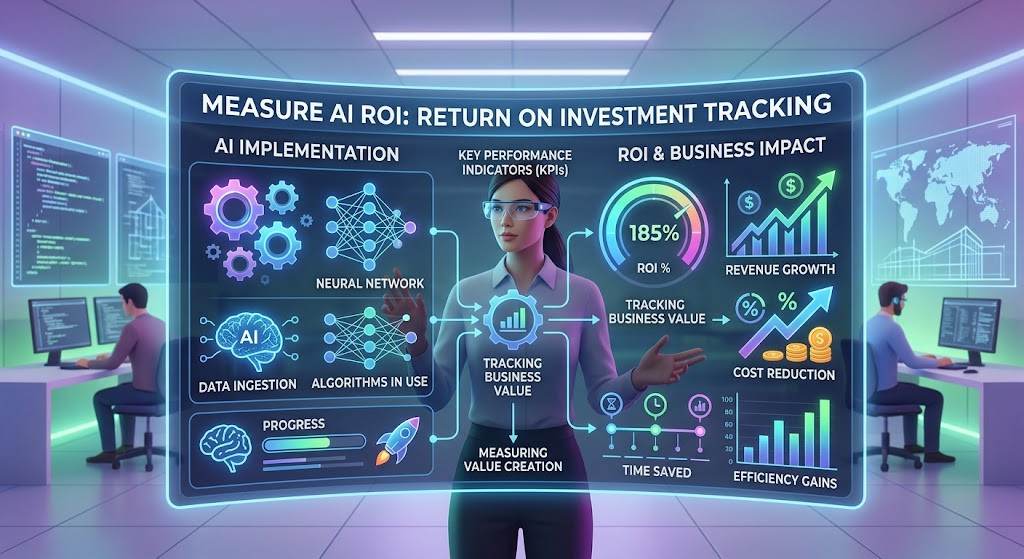
After defining a problem, it is imperative to assess whether it is financially viable. Development of such systems is a costly affair and time-consuming too. If developing your own system takes $100,000 but only gives back $10,000 per year to your company, there really isn’t any reason for investing in it.
You will have to predict how much money can be saved by your proposed solution in terms of man-hours, increased conversion rates, or decreased errors. You make sure that you connect the technology directly with some ROI; in doing so, you get early buy-in from the stakeholders.
2. Conduct a Thorough Data Readiness Assessment
The success of an AI development project depends on the data used by the models. These models are not smart by themselves but can be trained with the data.
Do You Have the Relevant Data?
There is a big difference between having "a lot of data" and having "relevant data." You might have many terabytes of data regarding your customers, but it won't be helpful if it doesn't have a direct relation to the problem you defined in step one.
Suppose you want to identify equipment failures in a factory setting. It won't matter to you if you have a decade's worth of payroll data, but if you don't have the data related to the history of the machine temperatures, vibration and maintenance, etc. You have to identify if you have the appropriate data or if you have to start collecting it at once.
Data Cleaning and Structuring (The Unglamorous Truth)
There is no glamorous side to the world of tech: up to eighty percent of the job of a data scientist is spent on cleaning and arranging the data. Imagine trying to bake a fancy cake – it would be impossible to do so using poor ingredients which are thrown into a big pot without any sense.
The raw data is known to be rather chaotic. There is always some duplicated information, missing data, inconsistent formats, and typos. All this should be taken care of prior to even thinking about using a model.
It is necessary to standardize all the formats, determine how to deal with the missing information, and have a properly arranged database to work with the algorithm. Otherwise, there is no point even trying to proceed further.
Legal and Privacy Compliance
In case your software is dealing with the customer's data, it would be impossible for you to overlook legal compliance. How will you deal with sensitive data under such stringent laws as GDPR in Europe, CCPA in California, or even HIPAA in the health care sector?
Not taking care of the legalities from the beginning makes a lot of legal mess for your firm which could lead to irreparable damages to your firm's image and huge financial penalties. Your legal and compliance departments need to get involved at once.
Figure out if you need to de-identify users, how will you seek their permission for using their data, and what will you do in case there is a data leak.
3. Choose the Right AI Approach for Your Goals

A challenge doesn’t always have to involve designing a complicated, custom-made deep learning model from the ground up.
In the sphere of AI applications development, there are several technological solutions available to you, and the selection of the most appropriate one might save you huge amounts of time and money.
ML vs. DL vs. Generative AI
In order to make well-informed choices, it’s important for you to be aware of the key differences between the major types of artificial intelligence.
Classic machine learning works great when it comes to finding patterns and making predictions based on structured data, e.g. predicting the cost of a property or detecting fraud on credit card transactions.
Deep learning is based on the use of complex neural networks in order to analyze unstructured data, thus being perfect for image analysis and even real-time voice translation.
The recent buzzword—generative AI—is best for creation of completely new material, be it text generation, image generation, or even coding.
Build vs. Buy: Evaluating Existing APIs
One of the most important choices you are going to have to make is the classic "build or buy" choice. Should you develop an internal proprietary solution or should you capitalize on some existing commercial solutions?
Using existing APIs of leading companies can halve the development time. In case you require simple sentiment analysis or tagging of images, it does not make much financial sense to create it yourself; you can just connect to some existing solutions.
But in case your data is a competitive advantage and is unique to your niche, a proprietary model has to be built.
By taking advantage of already-available solutions when such an opportunity arises, you make the development process of your AI product easier, as well as letting your team focus on its unique features.
4. Map Out the User Experience (UX) and Interface
One of the biggest mistakes made by developers when developing AI applications is neglecting the end user until the last stage of the process. The most ingenious algorithm becomes completely useless if your customers find the interface too confusing or too intimidating or not trustworthy enough.
Creating an Interface to Inspire Trust and Transparency
The problem with artificial intelligence software is the so-called "black box syndrome." The application gives out an answer but does not explain how it got there. In order to gain your users' trust, you will have to create a transparent user interface.
Your users will want to know why the system chose this particular recommendation. For example, if your application rejects a user's request for a loan, the interface should clearly and in simple terms inform him what particular reasons (such as bad credit rating or poor debt-to-income ratio) led to this particular decision.
Handling AI Errors Gracefully in the UI
You need to accept a basic reality; your application is going to make mistakes. At times, your application will produce incorrect facts or predict something totally erroneous. Your real challenge in terms of UX lies in the way you deal with these errors.
Your application cannot allow itself to interrupt the workflow of your user because of an incorrect prediction.
What you need to do is create an error-handling mechanism that can deal with this problem effectively. You can give your users some kind of warning messages indicating that your application is a learning one.
5. Establish Key Performance Indicators (KPIs)
Prior to your team of engineers starting coding your AI application, you need to determine precisely what success means for you. To measure the success of the development of the AI product, one needs to look into both technical performance of the system and its business performance.
Technical Metrics (Accuracy and Latency)
Technical metrics determine whether the algorithm itself works correctly. There are two main technical metrics, accuracy and latency, and your requirements for them may differ drastically depending on your industry.
Think of the accuracy. If your company is developing a system that diagnoses tumors in patients, then you would need almost perfect accuracy as a false negative could mean death.
If you develop an e-commerce recommendation system suggesting socks based on purchased shoes, a seventy percent accuracy would be quite sufficient. Latency, the second metric, is also extremely important.
The algorithm for the self-driving car has to process the data in milliseconds to prevent crashes, but the one for forecasting the finances for a night would not have any issue taking several hours to accomplish that.
Business Metrics (User Retention and Cost Savings)
There would be no use of any perfectly functional technology if it does not do anything for your business. Your metrics must reflect how well your technology solves the business problem you formulated during the first stage of your work.
What metric will show you if the technology is really saving the time of your workers or bringing additional revenues to the business? The metrics like user retention rate, the drop in customer support inquiries, or growth of monthly revenue should be used here.
Constant assessment of the system from the business point of view makes your investment a valuable one instead of a costly experiment.
6. Assemble the Right Cross-Functional Team
The formation of a team to develop AI applications goes much farther than the recruitment of some talented programmers. An effective solution requires an array of specialists from various areas to be formed.
Beyond Data Scientists: The Specialists You Really Require
Though the role of data scientists is crucial to develop a core for the algorithms, they cannot release a product independently. The whole team should be involved to get an application from a local machine to the live environment.
You will definitely need Data Engineers to develop pipelines which continuously provide the system with clean data. Absolutely necessary are MLOps Engineers, who are responsible solely for deploying, maintaining, and monitoring the models after their deployment.
The models will be degraded with time. UX Designers will help to design the interface and Domain Experts who know the specifics of your industry are needed.
Bridging the Gap Between Engineering and Business
AI application development, in essence, requires that by isolating your technical team from your business personnel, you guarantee an utter disaster.
The engineers could develop an outstanding algorithm to solve the problems that the sales people know that the customers don’t really have.
In order to avoid this kind of disconnect, you must champion good leadership that transcends all these functions.
You require an effective Product Manager who understands “the language of business” and “the language of algorithm.” He/she becomes the crucial interpreter that makes sure the technical possibilities and market needs coincide exactly.
7. Determine Your Infrastructure and Cloud Strategy
Artificial intelligence demands substantial computing power. The need to have a good, scalable place where your application will run is inevitable, and poor choices in infrastructure can severely hinder the success of your AI development endeavors.
To scale up the development of your AI application, you need to understand where the processing of your application takes place.
Cloud vs. On-Premises Hosting
There are two ways of hosting your application – cloud or on-premises. For almost every enterprise, using cloud services of Amazon Web Services, Google Cloud, or Microsoft Azure becomes the way to go.
Cloud services bring unmatched flexibility, allowing one to lease tremendous computing power whenever one needs it without buying costly and fast-depreciating equipment. There are powerful and well-built tools available in the cloud which help in the quick launch of your application.
When one is dealing with an industry that is heavily regulated, such as defense or high-end finance, the decision can only be one: to go ahead and build your servers. Think about the adaptability of cloud computing and the complete control of on-premises hosting.
Estimating Computing Costs and Scalability
You must take into account in advance the expenses that are associated with computing. The training of an intelligent model is famously resource-consuming, involving powerful processors for days and even weeks.
Many CEOs are astonished when they understand that using the system in real time by the users—inference—is becoming even more expensive as your number of users is growing.
You need to be capable of accurately calculating these costs and consider the scalability from the very start. In case your app turns out to be successful and gets a hundred thousand users overnight, your infrastructure should scale automatically.
You need to work with your cloud architects to achieve automated scaling and strict budget notifications so that you do not receive a bankrupt server bill by the end of the month.
8. Address Ethical Considerations and Bias
Today’s extremely critical digital world requires you to consider responsible technology in order to protect the reputation of your brand.
Responsible AI application development requires you to actively eliminate any existing bias and ensure that your application is treating everyone fairly.
Finding Bias in Your Historical Data Before It Happens
Algorithms are biased based on the data they have been trained on. If there is a problem with your historical data, the algorithm is going to reflect that problem exponentially.
Remember how automated hiring algorithms would automatically rank resumes of candidates with women’s names lower just because of historical data that was full of men’s resumes?Bias against certain races, genders, ages, and socio-economic statuses should be looked out for when analyzing your historical data.
Establishing AI Governance Frameworks
The ethical considerations must be practical and not simply theoretical. It is important that you have a governance structure set up before making the product available to the masses.
Whose responsibility will it be when the system is wrongfully discriminatory towards one user group or another? This is an important question.
There needs to be an establishment of accountability lines. An ethics committee or a compliance officer should be appointed in order to oversee all outputs of the application.
9. Create a Realistic Minimum Viable Product (MVP) Roadmap

The last stage prior to developing your artificial intelligence application is developing a strategic road map for your product launch. Never even try to develop a flawless and full-featured product right off the bat – start with small steps and use data collected from your actual users to develop your product further.
Core Features for Your MVP
You have to cut out all the extras and unnecessary elements from the scope of your project. What is the minimum set of features that your system should possess in order to demonstrate its value to your potential customers?
If you are developing an AI customer service bot, then the basic version of your software doesn’t have to deal with refunds and troubleshooting just yet – it only has to be able to answer the five most frequently asked questions and pass all the others to human support.
Prototyping Before Full-Scale Development
Before investing hundreds of thousands of dollars into backend model training, it is important to prototype the experience.
You can apply "Wizard of Oz" testing, wherein the user interacts with what appears to be an automated system, while, in fact, a human is controlling everything behind the scenes.
You can design basic wireframes for user interface testing and evaluation of client interest. If users are not able to understand or use your prototype, you will save tons of time and money. By prototyping, you will be able to prove your assumptions relatively easily and make sure that the product you will start developing in code really wants to be used by the users.
Below is the FAQ section designed to fit perfectly into your article. You can place this section right before the "Conclusion" to increase your SEO ranking and attract "People Also Ask" traffic.
It is formatted in the usual way with standard heading tags, which makes it very convenient to enclose in your Rank Math FAQ schema when you publish it on WordPress.
Frequently Asked Questions About AI Application Development
How much does AI application development typically cost?
The cost is completely variable based on the scale and process that you use. The creation of a basic model using existing commercial APIs may cost just several thousands of dollars.
Full-scale model training may become quite pricey – up to the hundreds of thousands of dollars. That is precisely why it is vital to define your MVP and properly estimate the "build vs buy" conundrum to keep your budget under control.
How long do you require for the preparatory phase of coding?
The duration of the phase preceding the coding phase can range from a few weeks to even months. Data preparation and validation will most likely eat up the biggest chunk of the preparation process.
Do I need to hire an internal team of data scientists?
This is not entirely true. Although having internal skills is extremely important in terms of ongoing support, many businesses manage to find successful partnerships with external professionals to develop their initial product.
It is also possible to use pre-built cloud solutions that will help to avoid creating any custom algorithms. With the help of external professionals, for instance, the team at Gigmint.AI, you will have access to the best people and manage to develop AI applications avoiding huge costs associated with executive salaries.
Why do artificial intelligence projects fail?
Absolutely the number one reason for failure in such projects is a total misalignment with a real business problem.
Companies spend millions of dollars on developing intelligent technologies just because it is a trend to do so without considering whether their customers really need the end-product, want it, and understand how it works. That is why it is crucial to understand the "why" and get ROI beforehand.
How can I tell whether the data of my organization is adequate?
Your data is considered ready once it is highly pertinent to the specific issue you are attempting to address, is safely stored, legal, and is completely devoid of inaccuracies.
In case your historical data is poorly organized, siloed within the different departments of your organization, and biased, the application which you will derive from it is going to be highly inaccurate.
Conclusion
In essence, the preparation phase is where your software battle is either won or lost. With a well-articulated business problem, proper preparation of your data and coordination of a cross-departmental team, the coding phase will become the easiest part of the whole process. Be careful not to be swept away by innovation and ignore these basic processes.
Eager to transform your idea for intelligent software into actuality without unnecessary expenditure and risks? The experienced specialists of Gigmint.AI are ready to help you get started on your path of development from strategy planning to smooth deployment of your product. Contact us to receive competent advice on how to develop your AI application successfully.