AI Agent vs AI Application for Business: Which to Build?
AI Agent vs AI Application for Business: Which to Build?
You boot up your computer, looking to make the most out of today, but you are greeted with nothing but articles about new advances in artificial intelligence technology. Everybody is telling you that you have to have an AI strategy to stay in business for the next ten years.
Once you start working on your development team, you come across a major obstacle – you cannot just pick any basic model, you have to choose an entire architecture.
In the current technology landscape, the two major lines have been drawn already. On the one hand, we have the standard AI applications. And on the other hand, we have a much more exciting and somewhat scary field of AI agents.
Which way should you go for your business? Picking the wrong direction could get you an overly expensive budget, a disgruntled engineering team, and software solutions that will either not work at all or make simple things overly complicated.
But knowing the fundamental distinctions between AI agent vs AI application for business could turn your technological investments from high-stakes experiments to sources of efficiency and income. And that's exactly what this guide is going to tell you.
Decoding the Core Concepts
But before you can think about where to spend your development budget, you have to know for sure what all these words mean. There are too many buzzwords in IT, and one of them is "agent." It often refers to something that is not an agent at all, but a simple application. Let's define them.
What Exactly is a Standard AI Application?
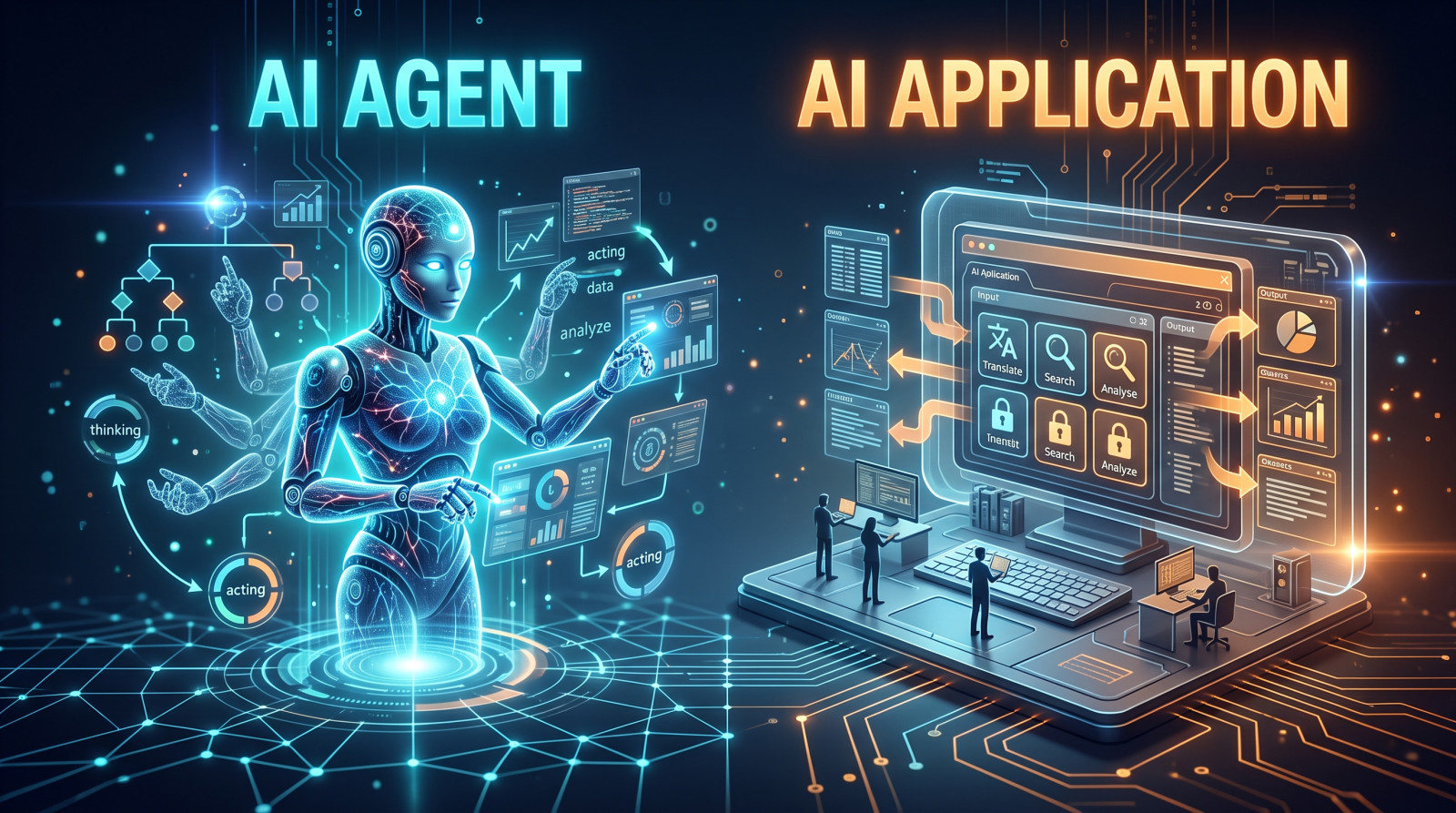
An AI app is basically an enhancement of a standard piece of software in which a machine learning model or large language model (LLM) has been installed at its core. It can be imagined as an extremely competent assistant who just waits for your orders.
ChatGPT, Midjourney, or even a grammar checker based on AI is an example of an AI app. Such applications are highly competent, yet completely reactive. They need a prompt from a human user to start their operation. If you ask a question, then the application will reply to it. If you give a dataset, the application will summarize it for you.
The key feature of an AI app is its linear character – an input and output one. The software doesn’t ponder about the wider context of your day or decides by itself to search some information for you, if such information hasn’t been explicitly programmed to it.
What is an Autonomous AI Agent?
This is a whole other animal. Whereas an AI application can be likened to a personal assistant that waits to receive commands, an AI agent is an expert you pay to attain a certain objective.
These agents have been created with complete autonomy in mind. Instead of providing them with a task such as "Write 500-word email on our new product," you provide them with an objective such as "Increase our email marketing conversion rate by five percent this quarter."
The agent will, therefore, have the capacity to reason, divide the larger objective into small objectives, employ external tools, and accomplish those objectives without any human intervention.
The AI agent might conduct analysis of previous emails, research trends on the Internet, create several emails, test those emails using an A/B testing method, and then provide you with the outcome.
The Fundamental Shift: From Assistant to Actor
The movement from applications to agents means that software has moved from being a tool to become an actor.
When using applications, the intelligence of your mind directs the workflow. You should be able to tell exactly what needs to be done, but just use the AI to hasten the process of doing each step.
The agents do the cognitive work of directing the flow of work. They determine how things should be done while you just tell them what should be done. This is the most significant leap in software development in the past two decades.
5 Key Differences Between AI Agents and AI Applications
In order to compare an AI agent from an AI application with respect to its usage in business, one needs to consider the differences in five major dimensions of software engineering.
1. Autonomy and Decision Making
The major discrepancy arises from the person behind the wheel.
In case of an AI application, you are the person behind the wheel all the time. The application may be a very powerful motor, but it moves right where you guide it, bit by bit. Once you stop giving the commands, the application comes to a halt. The application makes no decisions other than those defined in your input data.
The AI agents are the drivers of the applications. You give them the address to go to, and they make all the decisions about how to get there using certain tools, relevant information and order of actions that would lead to the desired outcome.
2. Scope of Tasks and Workflows
AI applications perform very well in stand-alone and point-of-time jobs. If you have to translate a document, create an image, or write some code, applications will come in handy for you. But usually, such tasks are only a fraction of bigger business processes.
Whereas agents perform well in complex multi-step workflows. They are built for handling long-term processes that demand retaining the context over the period. For example, your customer support AI application may suggest an answer to a customer's ticket.
But your customer support AI agent will read the ticket, search your CRM for the purchasing history of the customer, find his or her package using your shipping database, give back a refund through your payment gateway, and send an apology email.
3. System Integration and Tool Usage
Classical AI applications usually function within a silo. While they may have the internet connection to fetch some data in order to provide an answer, they very seldom initiate anything involving your other software systems.
Agents are inherently engineered to employ tools. They receive the API (Application Programming Interface) access to all your software systems. An agent can read from and write into Salesforce, communicate within Slack, execute the code within the isolated environment, and even make queries to your internal SQL database. It is the capability of manipulating the external systems which makes them digital workers and not mere chatbots.
4. Error Handling and Course Correction
If a normal AI system does not work, it does not work at all. If it produces an answer that it imagined or if it cannot get to the required web page, it gives out an error message or faulty output. You will have to do the troubleshooting yourself.
The agents have the capability to correct the course. This is because agents work under a certain aim, and hence they can assess the consequences of their actions.
If an agent fails to login to the database, it can make sense of the mistake and take another route. For example, it may choose to use some other credentials or consult the available API documentations to access the information.
5. Development Complexity and Infrastructure
Constructing a typical AI system has become incredibly easy. Given the current state of technology, any skilled developer will be able to construct a wrapper for a commercial LLM in several days. The architecture is quite simple: the user sends input to the model, which then generates output that is sent back to the user.
Designing an AI agent has become extremely complicated. It's not just about sending a prompt to the model. You are actually creating an architecture of cognition.
You have to design systems for short-term and long-term memory, implement fail-safe mechanisms to prevent the agent from doing anything harmful, create a planning system, and make perfect API integrations. The infrastructure necessary to deploy a multi-agent system is much more difficult.
Why Choose an AI Application for Your Business?
With the amazing abilities of autonomous agents, one may think that creating a typical app would be going backwards. This, however, is not true at all. For many companies, a typical artificial intelligence application is the perfect solution.
Ideal Use Cases for Standard AI Tools
Predictability and human oversight are crucial in most cases.
For example, take that of an AI company working on medical diagnoses. Here, you would like an AI to read your x-rays and identify possible abnormalities.
In any case, you definitely would not like the system to diagnose your illness without any physician's intervention and notify you via email. Here, you require a specific AI program to work as an assistance to your expert.
Some other use cases might include generating content for your marketing people, completing code for your developers, or assisting your HR guys in finding information from your knowledge base.
The Cost and Speed Advantage
In case you need to launch your AI application on time or deliver an internal project within a quarter, an app would be the best choice.
The architecture is much easier; therefore, you will be able to create a standard AI app very fast. You would pay less for the development time, need fewer AI experts, and would not spend too much on the cloud services. This is perfect for the budget of both a startup and an enterprise company looking into implementing AI.
When Predictability Trumps Autonomy
In situations where there is a highly regulated and compliant environment, the inability to trace why the autonomous system made that decision will be seen as a major risk. In the financial sector, in law, and in health care, it is important that the system is able to tell the reasoning behind making a particular decision.
AI systems have a high level of predictability. Since AI will operate on the instructions of humans, there is a way in which you can trace the process of decision making. The exact amount of data and the instruction used by the machine to make a decision is known to you.
Why Invest in an AI Agent vs AI Application for Business?
With standard processes being such fast and reliable processes, why do tech giants and innovative organizations keep spending millions of dollars on agentic workflows? It all comes down to one word: scale.
Automating Complex, Multi-Step Workflows
In today’s world of business, almost all the value creation happens due to complex work processes and not individual activities.
Here, just take your outbound communication task for example. The procedure will include research on the prospective customer, finding out ways of reaching out to him, creating a customized message for him, sending him the email, recording this action on the CRM tool, scheduling the reminder, and metrics analysis.
The basic AI solution will be able to assist you in writing the email only. But an AI agent will be able to carry out the entire process for you. When you invest in the agents, you do not just speed up the activity of your workers but completely eliminate the requirement of multi-step processes.
Scaling Operations Without Adding Headcount
The same problem exists for every business executive: growth entails needing more people, and people are costly.
The AI agent defies this paradigm of growth. After having designed and rolled out a capable sales agent, customer service agent, or data analysis agent, the scaling of its work requires virtually no cost as opposed to employing a person.
You could manage the increase of 500% in customer service tickets during the holiday rush just by assigning more server computers to your agent system instead of desperately looking for new hires.
The agents create elastic operations. They offer your business an opportunity to scale execution capacity infinitely and instantly, making your organization a powerful competitor to others that depend only on human labor and regular software applications.
Real-World Examples of Business AI Agents
In order to appreciate its full capability, one only has to observe what these agents are doing now in the real world.
In software companies, AI software developers have been developed which are capable of reading the Github issues, cloning the repository, coding the fix, testing the fix, and making a pull request of their own accord.
In e-commerce companies, agents have been employed which keep a tab on the level of inventory, monitor the shipping delay, forecast the demands for the future through current market trends, and place purchase orders automatically with the suppliers.
Marketing agencies are employing research agents which monitor the competitor websites, social media sentiments, and come up with a strategy report at the end of the week.
What Does It Take to Build?
Getting the differences in strategy right is one part of the equation. But you have to understand what it takes to make the system happen. This can be entirely different from the requirements to implement an AI application versus an AI agent.
Frameworks for AI Applications
Typically, a standard app development entails connecting a UI component to an open API of some commercial AI model such as GPT-4 by OpenAI and Claude by Anthropic.
In most cases, orchestration software is used to build applications, like LangChain or LlamaIndex. It makes it easier to handle prompts, to plug the AI into your specific sources of data (retrieval augmented generation, or RAG), and to format the output data for the end-user.
The key technical obstacles in this process are data chunking, vector database handling, and prompt engineering so that the AI would provide meaningful results rather than "hallucinate." The infrastructure of this type of application is stateless in the sense that it needs to "remember" only the conversation thread itself.
Frameworks for AI Agents
Creating an agentic system leads you to the world of complex software architecture. You do not need to build just a pipeline anymore, but rather a loop.
Engineers working on agents use complex architectures such as LangGraph, AutoGen, or CrewAI. With these platforms, you can give different "personalities" to your agents, assign different tools to them, and dictate how these agents should interact with each other.
The challenges are enormous. You need to create strong memory systems in order for the agent to remember what it was doing yesterday.
It is necessary for you to design fail-safe and “human-in-the-loop” authorizations to ensure that the agent does not tamper with your production database. It is essential for you to design planning processes to ensure that your LLM can decompose the goal into actions.
Data Security and Infrastructure Needs
Security is a whole new ball game when you provide AI with the capability to act.
In an application, security is mainly about making sure that your data does not end up in the public domain via the training of the LLM.
In an agent, security is about having strict control over the systems which the AI is allowed to change. You have to use granular API permissions, safe credential storage, and comprehensive logging. An agent runs permanently in the background, so your cloud platform needs to have the capability of running permanently.
The Financial Aspect: Cost of Development and ROI
All technology decisions come down to the bottom line. What is the relationship between the cost-benefit equation in terms of AI agents vs applications to a business?
Budgeting for an AI Application
The development process of an AI app is fairly predictable from a financial point of view.
In many cases, the MVP can be developed by existing internal resources or just a handful of freelance developers.
The only costs incurred will be developer pay over a period of several weeks/months, the price of a vector database required for your RAG system, and the API calls made to your LLM vendor.
Due to the fast time-to-market, you can achieve a quick return on investment right away. For example, developing an internal solution that saves your lawyers ten hours per week of work on document review gives you a precise ROI calculation within a month of implementation.
The Hidden Costs of AI Agents
Agencies demand a huge initial cost and have a lot of associated hidden costs.
You may have to bring in dedicated AI engineers who are well-versed with the workings of cognitive architectures that earn hefty paychecks. The cycle time involved in their making is quite long, as they usually go through several months of extensive testing in secluded sandbox environments.
Moreover, since agents involve reasoning loops, they utilize many more API tokens. An agent may call upon an LLM about fifty times to find ways of completing one task. Thus, the bills for APIs can shoot up unexpectedly every month.
Measuring Success and Return on Investment
Though the initial investment will be greater, the ceiling for the return on investment (ROI) in the case of agents is much higher exponentially.
Whereas an application only gives a slight increase in ROI by making an existing process somewhat more efficient, an agent is able to offer transformative ROI by removing the requirement of human intervention altogether in the process.
In the calculation of an agent's success, you need not just consider time savings but also other parameters such as increases in throughput (e.g., being able to close 300 support tickets a day rather than 100).
The Future of Enterprise AI on Gigmint.AI
As we look toward the future, the conversation will shift from building single agents to building multi-agent systems.
Moving Towards Multi-Agent Systems
Leading organizations aren’t developing a single large AI agent anymore; rather, they’re developing teams of AI agents that work together.
Think of a marketing department that consists only of software where you have an "Agent of Research" that discovers trends, provides data to a "Copywriter Agent" who develops a blog post, after which it goes to the "Editor Agent" for a brand voice check, and at the end of the chain, it’s published via the "Social Media Agent."
At Gigmint.AI, we consider this model of AI agents as a necessary direction for enterprise software development. Companies that will lead in the next decade will be those companies who know how to manage their digital workforce together with a human one.
Preparing Your Workforce for Autonomous Tools
Such a transition will require a dramatic cultural change. Your human employees need to learn how to move from being "doers" to becoming "managers of AI."
Your organization will have to spend time training its employees in goal-setting for autonomous systems, auditing and evaluating the performance of the agents, and managing a situation when an agent fails to perform.
The most important skill in your organization will not be task execution any more, but rather management of AI task execution.
How to Decide: A Simple Framework for Leaders
Assessing Your Current Workflow Bottlenecks
Where the problem lies in a certain task taking too long to complete (such as preparing meeting notes, writing repetitive code, drafting legal responses), then one needs an AI Application.
Where the problem lies in an elaborate process having many human interventions, involving multiple software tools, and being susceptible to failure on account of human error or limited capacity, such as lead qualification and nurturing, supply chain tracking, and customer onboarding, then one needs an AI Agent.
Evaluating Technical Readiness
Assess your engineering skills and your data infrastructure honestly.
Do you have neat, organized data and people skilled in basic API integration? It means that you are prepared to create an application.
Are you able to provide your company with a strong and secure infrastructure, documented internal APIs, and a budget for hiring AI engineers? Then you have what it takes to start playing around with agents. If not, developing an agent is most probably going to end up being a waste of time and money.
Taking the First Step
Don’t get caught in the pitfall of analysis paralysis. The worst thing you can do is stand around and wait for your competition to innovate while you do nothing.
If you are a beginner in terms of AI development, begin with developing a normal app. This will give your team knowledge about LLMs, vector databases, and prompt engineering. After you have succeeded once, you can use the experience you gained to make your first agentic workflow.
Final Thoughts
The choice of the AI agent versus AI application for business isn’t the choice of the better technology because it’s a choice of the more appropriate solution for your problem.
Standard applications provide you with extraordinary speed, reliability, and safety for single operations. Autonomous agents provide you with extraordinary scalability, complex problem-solving, and a chance to transform your business capabilities completely.
Making a thorough analysis of your workflows, readiness in terms of technology, and business goals will help you to utilize the appropriate architecture in the proper time. The age of business powered by artificial intelligence is now.
Don’t hesitate about what to develop – begin developing the future of your company right now. To know how to apply these techniques and find the best AI specialists to create your application or agent, visit Gigmint.AI.