The Ultimate Guide to AI Integration vs AI Development: What Does Your Business Actually Need?
The Ultimate Guide to AI Integration vs AI Development: What Does Your Business Actually Need?
Based on recent research in the industry, almost 80% of attempts to integrate AI in business never manage to progress past the pilot stage. This is not due to lack of vision or budget, but due to a major disconnect at the core of the project from the beginning.
With boards of executives aggressively pushing the introduction of artificial intelligence into business to secure their market positions and increase efficiency, the management of a business ends up in a serious dilemma: to integrate AI or develop AI?
Will you introduce a tested machine learning API in your infrastructure or develop a custom AI model?
It is no longer simply a matter of “build versus buy” when it comes to software procurement. Make the wrong choice, and you could end up wasting a year’s investment on an advanced machine learning system that does not fit into your business logic.
Choosing the “ready to use” option will result in your company becoming dependent on a third-party ecosystem that will compromise your own data and forever restrict your competitive edge.
In order to add value to your business through artificial intelligence, you need more than technological knowledge. In this detailed guide, we will go over all aspects of both integration and custom development of AI systems and discuss costs, requirements, and how you can actually make money out of it.
Understanding the Core Concepts
What is AI Integration?
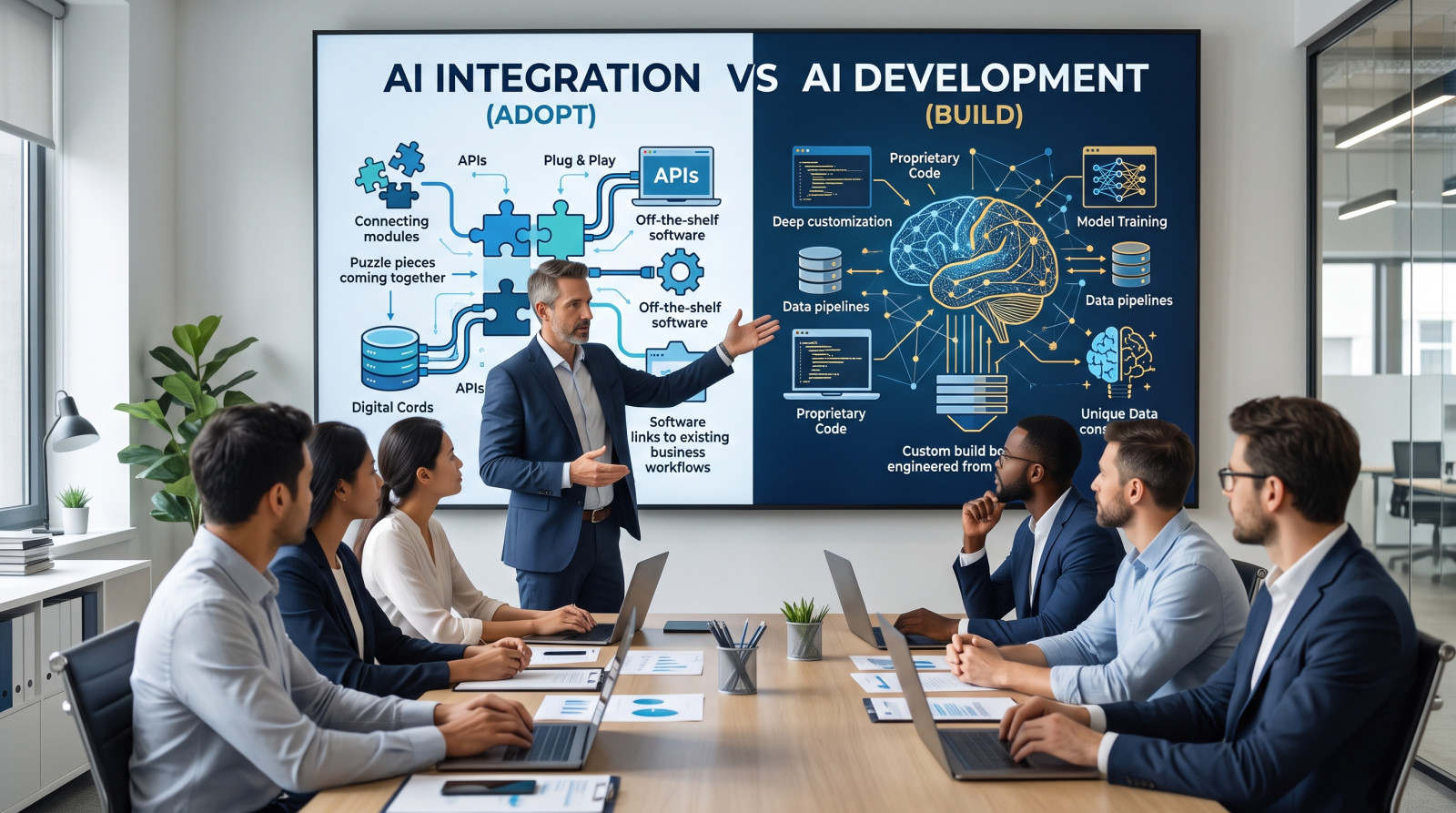
AI integration involves the act of plugging a pre-existing and ready to go Artificial Intelligence system into your current software stack.
Imagine yourself renting an employee who happens to be extremely skilled, super-fast and already has an innate knowledge on what exactly his/her job requires him/her to know. You do not need to spend time educating this employee on how to talk the language, identify patterns or solve some math problems because all the education was completed by another person before.
You do not build the "brain" of this employee by yourselves, you simply plug your existing systems to a ready-made brain using Application Programming Interface (API).
The classic The example here is to integrate your customer service platform (Zendesk or Intercom) with the large language model (GPT-4 by OpenAI or Claude by Anthropic) in order to build a customer-facing chatbot.
It will be done by some third-party, who will take care of all that incredibly expensive and hard part about training your model and providing all the servers needed to run it and update it with fresh data. And your job is just to put two and two together.
What is Custom AI Development?
On the other hand, custom AI development is an extremely complex and specialized process involving the creation of a totally unique machine learning model from scratch.
To use our earlier analogy again, this means not employing a highly skilled worker, but raising a child from his or her babyhood, sending him or her to a specialized university, and educating in all the necessary things related exclusively to your business. You are creating and building proprietary intelligence.
In case you decide to go for custom AI development, you assume complete responsibility for the whole machine learning life cycle: you are to collect tons of historic data yourself, to organize and structure this data, to select the exact algorithms to be used, to train your machine learning model for weeks or even months, and finally, to deploy it to your internal infrastructure.
You will have your own customized AI system which knows all the secrets of your business logic and speaks your language. No other technology can repeat your experience.
Exploring AI Integration
How Integrating AI into Existing Systems Works
Incorporating AI into your existing systems typically consists of an extremely predictable, efficient process for your development team. Here's an example scenario.
Your IT team is overwhelmed by the number of internal support tickets, and you are aiming at automating the process of categorizing such requests. Your developers find out about an external AI solution that is great at text categorization.
By using their API, your developers implement a couple dozen lines of code. It intercepts each newly created support request and automatically sends it to the AI service via secure connection. The AI analyzes the request, understands the context due to pre-existing knowledge in its database, puts the request into the appropriate category (for example, "Password Reset," "Hardware Failure," or "Network Outage"), and returns it to the ticketing system immediately.
Your developers were spared from having to know anything about machine learning processes, such as neural networks and natural language processing. They only used their web development skills to combine two tools together, and paid only a tiny amount for each API request.
Key Benefits of Choosing AI Integration
Speed to Market: This is arguably the greatest benefit of opting for the "buy" option. The reason being the pre-existing core AI model which is tested and implemented by a giant technology company.
In less than weeks, sometimes days, the AI model can be integrated into the business processes. If the organization is faced with an urgent need for solutions, then integration will be the only route that will provide value very quickly.
Lower Upfront Costs: By going for integration, the company is able to circumvent the high cost of building an AI application. There is no need for hiring a team of expensive and rare data scientists. Nor do we need to rent expensive cloud GPUs for training the models. Let us put it in simple terms: it is the cost of software development plus a highly predictable monthly fee.
Reliability and Constant Updates: By relying on the AI tool provided by one of the tech giants, you will receive the direct benefits of the multi-billion dollar budget that these companies invest in the research and development of their products. They will take care of all difficult debugging, security updates, and continuous costly training to improve the efficiency of the model.
Potential Drawbacks of Off-the-Shelf AI
Absence of Highly Customizable Algorithms: Pre-developed AI models, in their very essence, have been created keeping in mind a wide audience. In other words, they are generalized solutions.
If your organization works in a very niche domain and uses highly customized language, then your company might not receive high accuracy from a generic model. Although you may customize the pre-developed models in some way or the other, you may never be able to reprogram them according to your needs.
Privacy and Security Issues: It’s a huge constraint when we talk about enterprise-level organizations. The reason being that when you use APIs of such pre-developed algorithms, then essentially you’re sending your company’s data through the internet to a third-party server.
And if your company has highly sensitive data related to patients' health records (HIPAA compliance), highly protected European consumers (GDPR compliance), or highly confidential business algorithms, then using APIs can be an issue.
The Trap of Vendor Lock-In: As soon as the most important processes of your organization become dependent on the use of AI integration of a particular vendor, it will be hard and costly to leave them.
Your operational success depends upon their business model. Should they suddenly start charging twice the price for their API, or change their data policy or deprecate a particular feature you use, there is nothing you can do about it.
Exploring Custom AI Development
If using ready-made AI systems is getting an off-the-shelf suit, building a custom AI system would be like having it made for you at a place like Savile Row. It will be tailor-made to suit your business to perfection, but that comes at a cost of considerable time and expense.
The Process of Building a Custom AI Model
Creating an AI necessitates dedication to a very different software engineering development lifecycle for creating specialized AI systems.
Your process starts with perhaps the most important stage: huge amounts of data acquisition and processing. In the world of machine learning, the models' intelligence is strictly limited by the data that is being input into them.
Your first task will be gathering, processing, structuring, and thoroughly labeling a huge amount of high-quality historical data from your company.
After the processing of the data, your data scientists come up with the algorithmic architecture for your model and begin the training of the model.
The model analyzes the data, makes predictions, checks them against the real historical value, and through mathematics adjusts the parameters of the internal process. That cycle repeats millions of times – typically using very powerful and expensive computers for weeks – until the AI acquires a significant statistical precision.
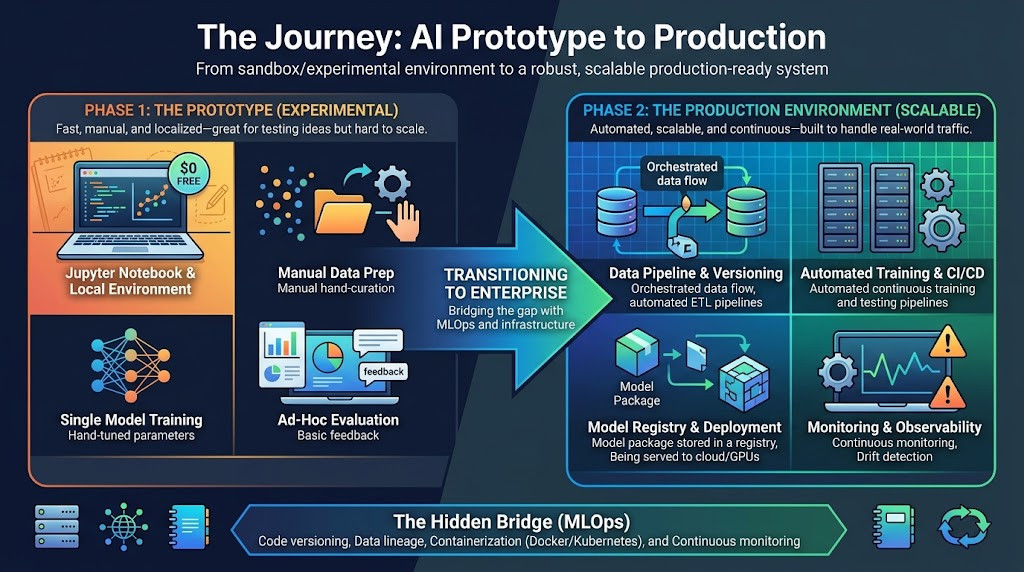
Your AI is deployed in the live production environment. Your journey doesn't end there. Your custom-made AI needs to be continually monitored and updated to avoid gradual decline in accuracy due to changes in the real-world data – a very complicated phenomenon called "model drift."
Key Benefits of Custom AI Solutions
Total Control and Unique Customization: An artificial intelligence model customized for your business will do exactly what you program it to do, without any extra features that may be superfluous.
Being trained using your historical data only, it is going to know your particular customers, your exact supply chain, and your particular brand language much better than any out-of-the-box solutions can.
Competitive Advantage: Here comes the power of custom development. When you use exactly the same pre-made artificial intelligence vendor as your competitors, you just have technological parity.
You are not falling behind, but you are staying on track. When you create a custom artificial intelligence solution that helps solve an industry problem better, faster, and more economically than anybody else, then this technology becomes your proprietary advantage.
High Level of Data Security and Compliance: When using a customized model, you will not have to transfer your confidential information outside your internal network. The model can be deployed on your internal "on-premise" servers or inside a well-isolated private cloud. It guarantees full compliance with any of the most stringent data protection regulations existing anywhere in the world.
The Hidden Costs and Challenges of AI Software Development
The operational gains that result from custom-made artificial intelligence software are enormous; yet one needs to realize that there are significant hurdles that come with that journey.
High Start-up Cost: To be very clear, developing one's own AI comes at a high price. One needs to budget heavily for the sky-high salaries of the machine learning engineers and data scientists.
Not only do you need to prepare for the high prices of data collection and labeling but also you will have to pay dearly for cloud computing to train even the most complex of deep learning models. Getting to know about the real cost of AI software development upfront is important if one wants to avoid a partially completed unfinished product.
The Problem of Talents Shortage: Finding talents who actually know how to develop, train, and deploy AI-based software solutions is not an easy task. The market for such professionals is extremely narrow and competitive. Moreover, it is hard to retain the best AI developers from the tempting job offers of the tech behemoths in Silicon Valley.
Long and Unpredictable Timeframes: The creation of a custom AI should not necessarily be positioned before a company’s leadership as building software, but as running a high-level scientific experiment.
One could invest three months into the meticulous preparation of the data and training of the model, just to realize that the algorithm can simply not reach the desired level of accuracy, no matter how hard you try. There is no guarantee whatsoever of success during your first try.
AI Integration vs AI Development: A Head-to-Head Comparison
In order to ensure that you make the right, strategic decision for your firm, you have to pit these two options against each other. Let us examine them on the basis of the four factors that matter most.
Cost and ROI Expectations
In the event that you need to save money and show a quick return on investment to your board right now, then the AI integration will easily take that category. Your initial investment is small, and since deployment happens within weeks, you get to reap the benefits of automation right away.
You have to look at the bigger picture. In the case where your software performs millions of API calls a day, then usage fees charged by vendors might eventually be higher than your initial development costs.
In the case of custom development, a huge investment needs to be made first before you see any return on investment, meaning you will be losing money for months on end. Once the system is up and running, your operational costs become much lower compared to what a third-party vendor charges you on an ongoing basis.
Implementation Timeframes
And here is another vital question you must ask yourself: Does your organization need this problem fixed next month, or next year?
AI integration is something that can be completed in a sprint. With an ordinary software development team, it is not difficult to integrate a third-party AI to the organization's CRM or ERP in just a few sprint cycles.
Developing a custom AI system is more like running a marathon. The data engineering pipelines, model training and testing, deployment, and other processes involved will take you multiple quarters to develop and deploy. If you need to solve this problem immediately because of market pressure or fierce competition, then custom development is probably not the way to go.
Technical Expertise Required
The human capital necessary for both these strategies cannot be any different from one another. The main requirement for integrating AI is nothing but the basic software engineering skills.
If your current team of developers has the knowledge of working with APIs and writing code for production as well as managing web requests, then you have the right team to integrate AI into your application.
For custom software development, you will need to hire a costly mix of these three types of people. The company will require Data Engineers who would develop the data pipeline for transferring the data, Data Scientists who could build complicated mathematical models and MLOps engineers who could deploy them.
Scalability and Future-Proofing
Off-the-shelf AI scales fantastically well for one basic reason – the vendor manages the server load entirely. Should your application go viral and your traffic surge by 1,000% within a day, then it won’t be a problem for the infrastructure of theirs to handle that gracefully.
The problem arises when it comes to future-proofing. You cannot have any sort of control over the vendor’s product roadmap.
Custom AI offers you perfect, dictatorial future-proofing, as the road map will be entirely under your control. You would be able to actively train your algorithm on new data according to your business pivot.
But in order to scale it up, you would need your internal IT department to increase the server provision and take care of the rest of the infrastructure-related tasks.
How to Choose the Right AI Strategy for Your Business
Now that you know what they mean, have balanced the advantages, and have considered the disadvantages, what is the best way forward for you to make a decision for your organization? Whether or not to adopt or build artificial intelligence can only be decided after evaluating certain pillars within your firm.
Assess Your Specific Business Problem
Begin by considering whether the problem that you want to solve needs a critical analysis. Is it a universal problem for business, or a very unique problem, proprietary in nature?
When the problem is universal such as summarizing lengthy legal documents, generating marketing text for specific use cases, translating emails or providing customer support through basic conversations, there are hundreds of excellent AI vendors who can do this perfectly for you. In this case, the best thing to do would be to integrate. Do not re-invent the wheel!
If your problem is very unique in nature—for instance, predicting imperceptible defects in your manufacturing processes using unique acoustic sensor data—there is simply no way in the entire world that anyone else has built any off-the-shelf solution for this problem.
Evaluate Your Data Maturity
The reality of artificial intelligence is that it literally eats up data. When you consider custom software development for your company, you should first of all pose yourself a tough question: do we really have the necessary data for training a machine learning model?
If there is too much siloing of your company's data – if you have a lot of messy unstructured Excel tables, then custom AI development is not available to you at all. You may spend a whole year just putting all this data in order and only then start training your models. If you don't have huge amounts of clean structured historical data, you can use only AI integration and apply an already trained model.
Analyze Your Budget and Timeline
It is important that you develop a very realistic assessment of the available organizational resources. If the management insists on having a working prototype that is able to produce revenues within the same quarter, then custom development is out of the question.
If the innovation budget of the department is limited, then it is impossible to afford the tremendous computing power needed for deep learning.
With integration, you have an opportunity to cautiously enter into the field of artificial intelligence without sinking the whole ship. This will enable you to be sure that it works effectively and creates value for money.
Consider Your In-House Technical Capabilities
Do an honest assessment of your existing engineering staff. Are they capable of taking on such a huge and complex new project? Are they experts in advanced mathematics and statistics needed for machine learning applications?
In case your IT staff is struggling with day-to-day issues and they are under constant pressure, then requiring them to build an artificial intelligence from scratch would definitely lead to a burnout and an inferior product that is not functional at all.
Real-World Scenarios: When to Integrate and When to Build
Scenario 1: The E-commerce Store Boosting Customer Service
The Business: A mid-size online retail brand experiencing very rapid growth and currently experiencing an overload of “Where is my order?” and “What is your return policy?” emails during the holiday period.
The Decision: Integrating an AI. The Explanation: The primary expertise of this company is selling retail products; it is not a technological pioneer. The issue they are having is entirely universal for all e-commerce retailers.
It is wise of them to integrate a ready-made AI conversation tool directly into their current Zendesk helpdesk solution. In just two weeks of development time, the integrated AI automatically answers 60% of all basic queries by searching the shipping database from Shopify instantly.
Scenario 2: The Healthcare Startup Predicting Patient Outcomes
The Business: A medical technology start-up company that is well-funded in order to be able to detect early heart disease by analyzing the patient’s past EKG scans using very specific, proprietary genetic markers.
The Decision: Custom AI Development. The Reasons: The entire market worth of this company is dependent upon their ability to have a proprietary algorithm that has high accuracy and uniqueness – one that none of the hospitals have.
Patient health information falls under the guidelines of HIPAA regulations, which means that the start-up company has absolutely no way of being able to send patient scans to any public API of AI.
Scenario 3: The Logistics Firm Optimizing Routes
The Business: A big trucking business that operates nationally, which is facing rising fuel costs and routing inefficiencies owing to unpredictable weather conditions and traffic in cities.
The Decision: A Combination Approach. The Rationale: The business smartly begins by implementing AI quickly, integrating their dispatch system into a third-party, commercially available route optimization AI.
They begin realizing much needed fuel savings right away during that phase. After two years of using it successfully, they discover that the commercial off-the-shelf AI does not completely take into account their particular needs for refrigerated truck routing and the special way these trucks must be handled.
With the vast amount of capital saved during the integration phase, they decide to hire an AI agency to build a specialized model of AI over the generic one.
Why Partnering with Gigmint.AI Makes Your AI Journey Seamless
As you can clearly see, choosing between AI integration and AI development is far from being an easy and clear-cut task. The technological environment changes incredibly rapidly, and the wrong basic technical choice can push your company way behind your rivals for several years to come.
This is precisely where you need something that goes well beyond informative articles—you need a truly experienced and knowledgeable strategic partner.
Navigating the Complexities with Expert Guidance
Here at Gigmint.AI, we know that you need practical results from business, not technical troubles. We understand that everything depends solely on your unique case.
In case your company needs fast and smooth integration of some advanced foundational models (such as OpenAI or Anthropic), which is going to give you an instant lift in your employees' productivity or a completely new architecture of a robust and ultra-secure custom machine learning solution, our unique world-class expertise is always ready to help you achieve that.
You should never expect us to force upon you a ready-made solution in order to close the deal with you.
Our team of experts spends enough time analyzing your unique workflow, evaluating your data preparedness and creating a completely unique AI strategy which will fit your current budget and long-term growth objectives.
We take care of all the complex technicalities for you, letting you and your management do the job you are good at - managing and growing your business.
AI Integration vs. Custom AI Development
|
Feature |
AI Integration (Off-the-Shelf) |
Custom AI Development |
|
Speed to Market |
Days to weeks |
Months to quarters |
|
Upfront Cost |
Low (API usage fees + standard web development) |
High (Specialized talent, cloud GPUs, data labeling) |
|
Technical Expertise |
Standard software and API developers |
Data engineers, machine learning scientists, MLOps |
|
Data Requirements |
Minimal internal data needed |
Massive amounts of clean, structured, historical data |
|
Security & Compliance |
Data is sent over the internet to a third-party vendor |
Maximum security; deployable on-premise or in private clouds |
|
Future-Proofing |
Vendor dictates the product roadmap and pricing |
Full control over algorithmic updates and capability scaling |
Frequently Asked Questions (FAQs)
What is the distinction between the integration of artificial intelligence and custom artificial intelligence development?
Artificial Intelligence Integration refers to the process of integrating your application with a third-party artificial intelligence algorithm through an API.
This method is characterized by quick implementation based on regular engineering skills. Artificial intelligence development is a process during which you train a unique machine learning model based on your data.
What is the difference between the cost factors of integration and custom development of artificial intelligence?
Although artificial intelligence integration is marked by low initial expenses, large API consumption costs may occur quickly and overwhelm your initial development expenses.
As for custom artificial intelligence development, it presupposes large initial investments in machine learning specialists and cloud technologies; its operating expenses will be much lower.
How does custom AI increase data security and compliance in enterprises?
Using the API provided by the third party necessitates the need to send company data to the external servers, which could be bottlenecks for highly regulated businesses.
Developing custom AI permits enterprises to run all models either on-premises or within the isolated private cloud and thus maintain full compliance with highly regulated requirements such as HIPAA and GDPR.
The ownership of the full model architecture enables enterprises to comply with highly regulated AI Risk Management Framework by the NIST.
When should a company use custom AI instead of a ready-made solution?
A company should spend resources on developing custom AI, in case the problem that a company tries to solve is highly proprietary (for example, anomaly detection with the help of special manufacturing sensors) or in case the need to keep all company data on-premises is a must, or if securing competitive advantage with technology is crucial for being dominant in the market.
Taking Your Next Step Toward AI Transformation
The current discussion regarding the integration of AI versus the development of AI is not a fight about which type of technology is innately better in a vacuum, but rather about which one is precisely the right fit for your particular business task.
If fast implementation and efficient problem-solving are your main needs, then AI integration is the clear way to go.
In case your entire business depends on using proprietary data and complying with security, and you desperately need to build an impenetrable technological barrier against your fiercest rivals, you will definitely have to invest into AI development.
The one thing that you should do above all others at this moment is nothing.
Begin today. Determine what your top operational constraint is. Analyze how clean your data is, determine what budget you have available, and determine whether you should be renting the services of an exceptionally talented digital brain or creating one from scratch.
The AI revolution does not wait for anyone. Through making an educated decision about exactly how to implement it, you can guarantee not only your survival but total dominance in your market for years to come.