Freelancer Onboarding: Best Practices for a Smooth Working Relationship
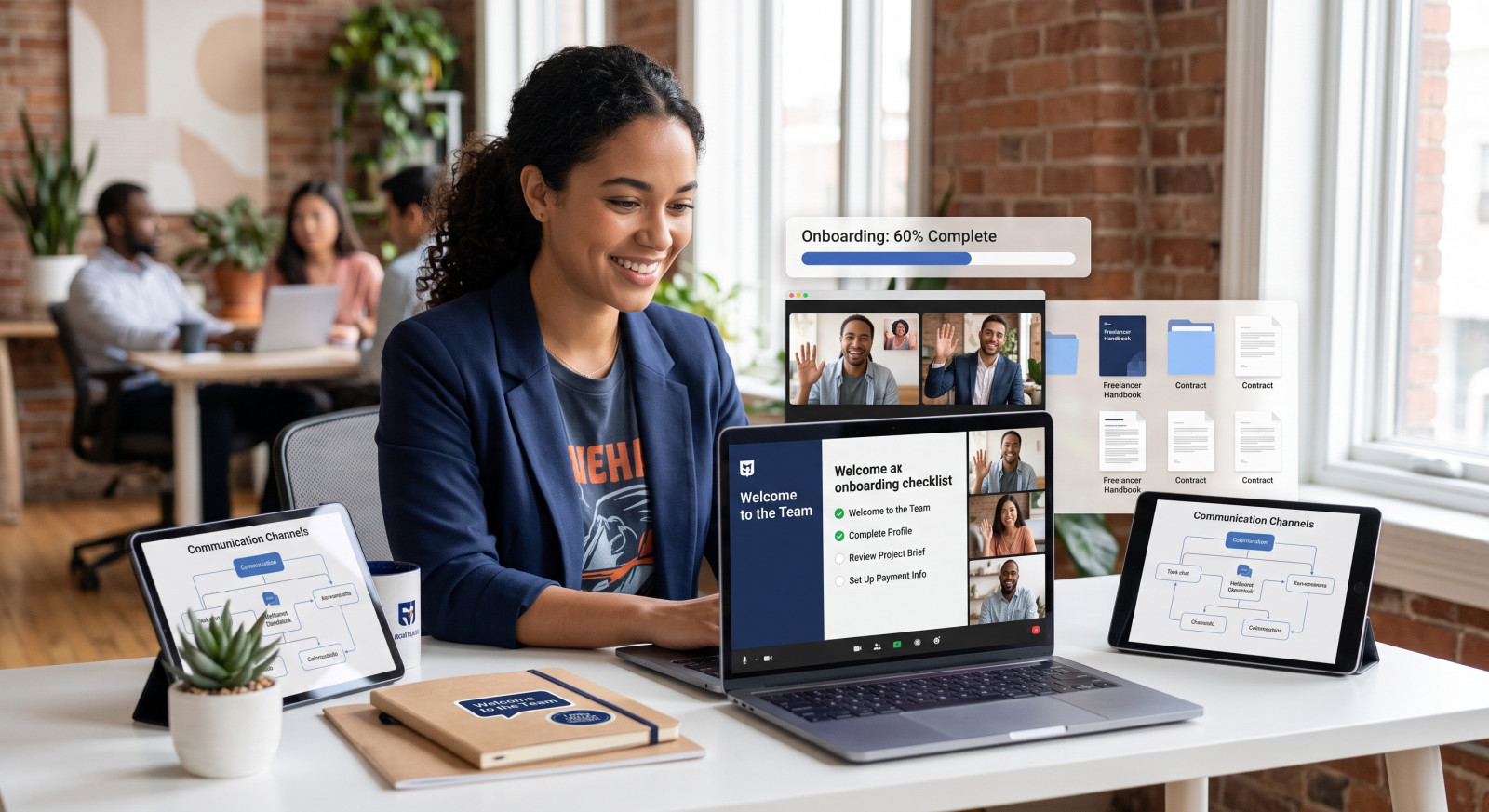
Freelancer Onboarding: Best Practices for a Smooth Working Relationship
After going through all sorts of applications and interviews, you found your ideal freelancer. This individual's skills match your requirements, the price is affordable, and he/she is now ready to start work. Feel free to ask if anything is unclear," – you write to him/her in an email.
But two weeks later, it becomes apparent that the deadline is fast approaching, the work is totally off-brand, and the freelancer is irritated because he/she could not get the necessary information about the job.
Such stories are incredibly widespread. There has been a real gig economy revolution taking place, and more and more businesses are using independent contractors' help. However, what many firms are doing wrong when dealing with freelancers is neglecting the development of the proper freelancer onboarding process.
It can go one of two ways: either they treat freelancers precisely the same way as they treat their full-time employees by making them wade through unnecessary corporate background and HR videos or completely ignore them and simply give them a task.
Both approaches fail.
The process of onboarding freelance professionals is important for connecting the best people to achieve success. It serves as an introduction to a successful and fruitful working relationship that is also compliant and quick-to-results.
We are going to explore the exact definition of freelancer onboarding, how it differs from employee orientation, and provide a step-by-step checklist in order to have a successful collaboration with your next freelancer.
What Does Freelancer Onboarding Actually Mean?
Essentially, what freelancer onboarding entails is the carefully planned process of embedding an independent contractor into a particular project or process.
Unlike the conventional onboarding process, which is mostly concerned with integrating employees into the corporate culture and preparing them for future growth within the organization, onboarding an independent contractor involves immediate integration into the current project.
And while the purpose of traditional onboarding is usually making the new hire feel like a part of the team, in this case it is simply getting them ready for the project.
Onboarding an independent contractor means everything from processing all the necessary paperwork (contracts, NDA, tax forms) to making sure they have access to the right project management software and know the communication protocol to be used throughout the process.
The ROI of Proper Freelancer Onboarding (Why it Matters)
Putting in the effort to develop an effective onboarding program for your independent contractors will be viewed as an additional administrative task; however, it will be greatly rewarding for your business. This is how the importance of having proper freelancer onboarding for your business will be realized:
Time to Value
The main thing that attracts companies to using the services of freelancers is the speed of delivery. You have an empty space that needs to be filled fast. But a freelancer won't be able to hit the ground running if he doesn't know what track he is supposed to run along.
Through the help of the effective onboarding process, a freelancer will receive everything he needs right away – briefs, tools, assets, etc. The less friction there is because of "I can't log in" and "Where is the brand guide?", the faster a freelancer will get started.
Less Friction, Less Misunderstanding
Confusion is the death of a successful freelance project. Confusing instructions will result in an inappropriate product, which will lead to many revisions. Onboarding makes you, as a client, clarify your expectations. This will prevent the miscommunications and make sure that the first draft will not need many changes.
Enhanced Security and Compliance
There are security and legal issues that come with contracting third parties. Information and access to internal systems, along with taxes, are all considerations when engaging in this type of relationship.
The standardized onboarding process will ensure that compliance procedures are always followed. This involves having a NDA signed, an IP agreement in place, and having tax documentation in hand (such as W-9s in the US and W-8BENs for foreign workers).
Establishing Long-term Relationships
It is not easy to find qualified freelance talent. Once you do, you do not want them to get away from you. The onboarding experience is a positive one because it demonstrates that you appreciate their time and knowledge, as well as your level of organization.
Employee Onboarding Versus Freelancer Onboarding: Important Distinctions
It happens often that the company makes an error of introducing the freelancers in the same manner as the employees. Not only does it create inefficiencies, but it may also prove to be legally problematic for the organization.
Avoiding Co-Employment Risks
One of the determining factors of whether an individual is a freelance worker or an employee is the amount of control that you exercise over him or her.
If you make a freelancer attend your mandatory culture orientation sessions, direct them when to come and go, and spend a lot of time training them on how to perform their duties (instead of training them on the output expected from them), you will end up making a mistake. Being found guilty of such misclassification means serious penalties and taxes for you.
Project-Focused over Culture-Building
When hiring an employee, you are essentially putting money into their future career path within your organization. You are making sure that they know about all your values, your history, and the way your teams work.
When hiring a freelancer, you are paying someone to do something. While he or she needs to get to know your brand voice if they are working on any content-related projects, they do not have to know your CEO's history or do trust-building activities.
Speed is Paramount
Employee onboarding is often a phased process spread over weeks or even months. Freelancer onboarding should ideally be completed in hours, or at most, a few days. The focus is on rapid enablement.
-
Primary Focus:
Employee: Company culture, long-term retention, deep integration.
Freelancer: Project specifics, deliverables, rapid execution.
-
Duration:
Employee: Weeks to months.
Freelancer: Hours to days.
-
Training:
Employee: Extensive training on tools, processes, and company policies.
Freelancer: Minimal training; assumed expertise in their field. Briefings on specific project needs.
-
Autonomy:
Employee: Lower; directed by management, set hours.
Freelancer: High; focused on output, manages own time and methods.
Ultimate Guide to Freelancer Onboarding: Step-by-Step Process
Phase 1: Pre-Board
Pre-boarding is all the work done before the freelancer starts working on the project. This stage includes all the necessary preparations which have to be done properly.
1. Statement of Work (SOW) and Contracts
Whereas MSA gives an overview of your working relationship, SOW is the document that you should concentrate on during onboarding.
It should clearly state:
-
The Scope of Work – what is going to be developed?
-
Milestones and Deadlines – when will each milestone be delivered?
-
Payment terms – how much money is a freelancer going to get? Is it an hourly rate or project-based or retainer? The terms of payment (Net 30)?
-
Number of revision rounds – how many revisions are covered in the initial payment? (It will help you avoid the problem of scope creep).
Make sure that it is signed by both parties.
2. Legal and Compliance Documents
As per the nature of the job, you might have to get the freelancer to sign a Non-Disclosure Agreement (NDA) for your proprietary information. Also, make sure you have included a "work for hire" or Intellectual Property (IP) assignment clause in the agreement.
Lastly, get the required tax forms (W-9 form for US based freelancers and W-8BEN form for international) so that your accountancy department can be well-prepared during the tax season.
3. Creating Necessary Access and Permission Settings
There is nothing more irritating for a freelancer than having everything set up but still not having access to what he needs. Make all the accounts ready before their planned start date.
-
Communication: Give access to their relevant Slack or Microsoft Teams groups. (Tip: You can create special channels for your freelancers to avoid involving them into your internal conversation)
-
Project Management: Add them to your particular board/project in Asana, Jira, Trello, Monday.com.
-
File Management: Put them in your Google Drive Folder, Dropbox or any other internal Digital Asset Management System.
-
Access Special: If your freelancer needs access to your CMS/CRM, it is necessary to give him/her an additional access account.
Phase 2: The Kick Off (Day 1)
Having the paperwork completed and access provided, it is time to begin the project formally. And in this phase, context and communication are what you are going for.
4. The Welcome and Introduction
There is no need to provide an official HR orientation; however, an introduction can go a long way in setting up the right tone. It can take the form of a short introductory video conference (no more than 15 to 30 minutes) or a well-written welcome e-mail.
And a good welcome e-mail should contain:
-
A short and excited welcome.
-
Verification of access (Slack, Asana, Drive) granted.
-
Key contact information (to whom do they address regarding invoices, the brief?).
-
A link to the project brief and brand guidelines.
5. Sharing the Project Brief and Context
The project brief is the North Star of the freelancer. There is no such thing as a generic brief; you get what you see in it.
Give them a document that includes:
-
The Goal: What is the business goal of this particular project?
-
Examples of Success: Give them the link to examples of their or competitors' works that were done correctly. "Make it look like this, but better" is much more actionable than any abstract words.
-
Anti-Examples: Sometimes the "Don't make it look like this" examples help them understand even better what you want.
6. Creating Communication Rhythm
The freelancers are working with multiple clients and need to understand how you operate to include you in their schedule.
Create the communication rhythm by setting expectations about the following things:
-
Channel: Would Slack be used for informal queries while email is used for formal queries?
-
Time of Response: How soon can we expect a response from them regarding their questions, and how soon can we expect a response from them to us?
-
Weekly Check-In: Weekly check-in via telephone or project management platform?
Phase 3: The First Project & Feedback Loop (Week 1)
Your onboarding program will be tested on the efficacy of its performance only once your new hire starts working on the first deliverable.
7. Small Steps First (The Milestone Method)
In case you have hired a freelance writer for a large task, then don’t expect to check out his work only till the final submission. Split that big assignment into smaller portions instead.
Should your task involve the preparation of a 3,000-word essay, get them to submit the outline of the essay before writing it. Should the project be related to website creation, then have them present the wireframe for the homepage before doing that.
8. Giving Constructive and Early Feedback
The initial round of feedback becomes a precedent for your collaboration. In the evaluation of this first milestone, be absolutely clear, precise, and objective.
-
Be Precise: Do not say, “It seems strange,” but say instead, “This style is too official for our target audience; please rewrite in a more accessible way.”
-
Choose Clarity over Politeness: Of course, you need to be professional, but do not put anything unnecessary into the feedback. Vague and excessively polite feedback is always confusing.
-
Establish a System for Feedback Delivery: Figure out what method of feedback delivery would work best for you – comments in Google Docs, Loom videos, or Asana feedback.
Automation Tools for Freelance Worker Onboarding
Doing everything through email threads and Excel sheets just isn’t going to cut it – especially if you want to expand your base of freelancers. Utilizing the proper tools will allow turning chaos into automated workflow.
Here’s a list of tools you should use during the freelancer onboarding process:
Contract and Documents Management
Those old times when contracts used to be printed, signed, scanned and emailed are long gone. DocuSign, HelloSign (Dropbox Sign) or PandaDoc: These software will assist you in creating templates for your MSAs, SOWs, and NDAs. You'll be able to send documents automatically and track their views and signing.
Project Management and Collaboration Tools
Asana, ClickUp, Trello, or Monday.com: With those tools, you can make onboarding templates or checklists. When hiring a new contractor, simply duplicate a template and assign necessary tasks (like “Read Brand Guidelines,” “Review SOW”) and monitor their onboarding process.
Notion or Confluence: They will help you create a “Freelancer Wiki” that will contain brand guidelines, style guides, invoicing instructions, and other company information relevant to contractors.
Identity & Access Management (IAM)
The security of your internal systems is essential while working with third-party contractors. It's necessary to provide the contractors access but not compromise on the security of your internal system.
1Password, LastPass, or Okta: When you need to share your login information with an external contractor for using software which does not have individual user license options, you can use a secure password manager.
With the help of such managers, you won't need to share passwords with contractors. In addition, you can quickly revoke access once the contract expires.
Freelance Management Systems (FMS)
While using the combination of the above-mentioned solutions is effective, you will still be managing multiple subscriptions and integrating various tools. For those businesses which want to leverage the gig economy efficiently, there is a perfect solution - a Freelance Management System.
Systems like Gigmint.AI are created especially to manage the work of contractors. They integrate everything into one place. Instead of using several tools including DocuSign to sign documents, Asana to track projects, and accounting software to make payment, you'll be able to manage everything from one place.
Such systems include sourcing, onboarding process (including all compliance requirements and document signing), assignment of tasks, and invoicing.
5 Common Pitfalls in Freelancer Onboarding (and How to Avoid Them)
Yet, with the help of the checklist, problems may still occur. Here are some of the most common ways in which businesses self-sabotage their freelance relationships in the process of onboarding, and how to prevent them.
Pitfall 1: No Response After the Signing of the Contract
-
The Issue: The freelancer signed the contract, sent it back and heard nothing for a whole week. There is uncertainty whether they are supposed to get to work already, the brief is not at hand, and they are being ignored.
-
The Solution: Pre-boarding communication. Right after the contract is signed, an automatic (or at least quick) e-mail must be sent in order to confirm the receipt and to set out further steps.
Pitfall 2: Scope Creep Due to Ambiguous Onboarding
-
The Issue: The freelancer finishes the project, but the client is still requesting “one final small change” which was not mentioned in the initial briefing. The freelancer is feeling taken advantage of, and the business relationship becomes strained.
-
The Solution: Rock-Solid Statements of Work (SOWs) and very detailed project briefs at the kickoff stage. Onboarding is the time to outline precisely what goes into the project, and especially what the revision policy is.
Pitfall 3: Treating Them Like Employees
-
The Problem: The client wants the freelancer to work from 9 am till 5 pm, make him/her attend meetings each day, which are not related to the job that the freelancer is doing, and also tries to control the way the freelancer performs his/her work.
-
The Solution: Respect them. The person that you have hired is a professional who should be able to accomplish the job instead of merely taking up your space. You should measure them by their efficiency and timely submission of the work.
Pitfall 4: Information Overload
-
The Problem: The client wants to cover all bases, and so they provide the entire company handbook (100 pages long), three years' worth of marketing reports, and access to every single slack channel. The freelancer cannot operate because of the plethora of irrelevant information.
-
The Solution: Curation. Onboarding the freelancer has to be focused. Provide only the information, context, and access which is pertinent to the particular project they are working on.
Pitfall 5: Assuming Knowledge of the Internal Jargon
-
The Issue: The project brief has too many abbreviations and jargon terms. This prevents the freelancer from spending valuable time on actually completing the deliverable.
-
The Solution: Never assume the freelancer – even if they are an expert in their area (for example, design or coding) – is familiar with the inner workings of your company. Provide a list of definitions or briefly explain any terms used in the brief.
Setting the Stage for Freelance Success
Approaching the onboarding of freelancers as an afterthought is definitely a surefire recipe for wasting your time, money, and the best candidates.
The amount of effort that you invest in the integration of a freelancer—communication, expectations setting, and all that—is directly proportional to the level of quality of the work that you are going to receive from him/her.
Onboarding is not some bureaucratic formality; it is an investment in your projects' success. With the help of the difference between onboarding and traditional employee orientation and an approach of doing things step-by-step, you can revolutionize your cooperation with freelance talent.
No more struggles with fragmented tools and scattered emails. For maximizing the efficiency of your freelance collaboration and fostering strong relationships with the best freelancers, you need an approach specifically made for the gig economy.
Formalize the process today and discover how Gigmint.AI can handle your freelancers' onboarding and payment management automatically.
FAQs
How long is the process of onboarding in case of freelancers?
Unlike in the onboarding process for employees, which can last several weeks or even months before one joins the company’s culture, in case of freelancing, the process should be quick and geared towards a particular project.
It is better when administrative onboarding takes a few hours and project kickoff is done within one or two days.
Do I have to pay the freelancer for the onboarding time?
Onboarding practices are different from company to company. But, usually, administrative onboarding, which includes signing of contracts and creation of accounts, is not considered as working time of the freelancer.
Though, if you need a person to complete the onboarding process and to undergo extensive mandatory training or many kickoff meetings before starting project work, you should pay for this time at an agreed price.
What is the most important document during freelancer onboarding?
NDA and MSA are important documents in terms of safety. But the Statement of Work is the document that is most crucial for the success of the project. SOW establishes all the terms of the engagement in relation to a certain project.