How AI Is Transforming Modern Web Development

How AI Is Transforming Modern Web Development
The Paradigm Shift in Web Development
For many years, the process of turning a web application idea into a fully functional product was done in a traditional manner, which involved several weeks spent on static wireframing and even more spent on developing hundreds of lines of HTML, CSS, and JavaScript, not to mention the tiresome process of manually testing all of that across different browsers. With AI integrated into web development, such an approach seems outdated and no longer necessary. Instead of focusing on how quickly one can manually write the required syntax, developers will have to play the roles of architects and directors of AI systems.
In 2026, AI in web development will no longer be something distant and hypothetical—this will be the way we work now. A product, which used to require a group of engineers for several weeks' worth of manual labor can now be created, polished and released within just days, or sometimes even hours. By offloading tasks of generating boilerplate code, style sheets, and writing test suites to the intelligent models, we can focus on the higher level system architecture and its business logic.
Here at Gigmint, we feel that keeping up with such technology trends isn’t merely beneficial but crucial to gain a real competitive edge. As the best place for finding elite tech talent in Australia, we have seen how AI-enabled processes make lean startups, agile agencies, and local companies outsmart their global rivals at a much lower cost. In this guide, we will show you how exactly the layers of intelligent technologies transform the web and help you take advantage of them when designing your future products.
The Core Tech Stack: What Is "AI-Driven Web Development"?
To comprehend the magnitude of the revolution, we must dig deep under the layers of user interfaces. The web development of today is based on a complex neural network system that converts the abstract intents of humans into executable logic.
Understanding LLMs, Code-Specific Models, and Neural Networks
Central to this transition are Large Language Models (LLMs) and neural networks that have been engineered for software engineering. As opposed to conversational AI models, LLMs for coding such as o3/o1 by OpenAI, Claude 3.5 Sonnet by Anthropic, and Gemini 2.0 Pro by Google are trained on a huge multi-language corpora of source codes. They not only generate predictions on the characters but also comprehend abstract syntax trees (ASTs), logical patterns, and dependencies in complex frameworks such as Next.js, Django, and Laravel.
What is equally important is that the industry has moved past the point of inline autocomplete. It has moved away completely from the concept of agentic environments. While earlier, tools like AI web development used to suggest lines of codes and functions, modern agentic environments such as Cursor (Composer), Windsurf (Cascade), and Claude Code (terminal-native) generate entire multi-file codebases based on a single natural language input.
How API Integrations Bring Machine Learning to Standard Apps
Creating an ultra-smart and interactive web app no longer means developing custom machine learning models through scratch training processes. Instead, API integrations in today’s software development allow developers to implement machine learning features straight into existing software architecture. Integrating front-end apps with inference APIs offered by cloud computing platforms like Hugging Face, Cohere, or OpenAI enables instant embedding of vector embeddings, semantic search, and intent classification on web pages.
This enables developers to create elaborate cognitive loops right in regular React component files or serverless functions. This helps startups and corporations develop advanced and predictive web components without heavy infrastructural investments and turns regular forms and rigid dashboards into conversational interfaces.
The Context Window: What It Means for Developers Consider the context window to be the short-term memory of an AI model. It is measured in “tokens,” which can represent syllables, words, or pieces of code, and it indicates the amount of data from the codebase that the AI can analyze at once.
Since modern AI models can have context windows of up to 200,000 to over 1 million tokens, it means that you can feed all your files, databases, and external APIs documentation into the AI model. The extensive memory will ensure that the code created by the AI matches your architectural standards and dependencies.
6 Key Ways AI Is Transforming Modern Web Development
The effects of AI can be observed during each stage of the modern web cycle. In order to effectively examine web development, let us consider the six pillars of this great revolution in technology.
1. AI-Powered Code Generation & Intelligent Pair Programming
The traditional IDE has evolved into a more interactive system. Previously, software such as earlier versions of GitHub Copilot was just an advanced version of "tab complete," predicting what the next line of syntax would be. The emergence of systems like the Cursor editor has revolutionized how developers work today.
Using plain English, the developers are able to request refactoring of the whole system's codes or creating architecture from scratch in a matter of seconds. There is no need for scouring documentation on how to connect the API because a developer can simply state, "Add Stripe integration to this billing controller using our existing environment variables." The system analyses the project, imports the required dependencies, takes care of the error handling, and creates the required files.
There is a huge reduction in syntax writing, hence moving the cognitive burden away from memorizing syntax and allowing the humans to work on the edge cases, business logic, and safety of the code. Products go to the market at amazing speeds because less time is spent trying to fix brackets errors and writing API wrappers.
2. Revolutionizing UI/UX: Prompt-to-Design & Functional Prototyping
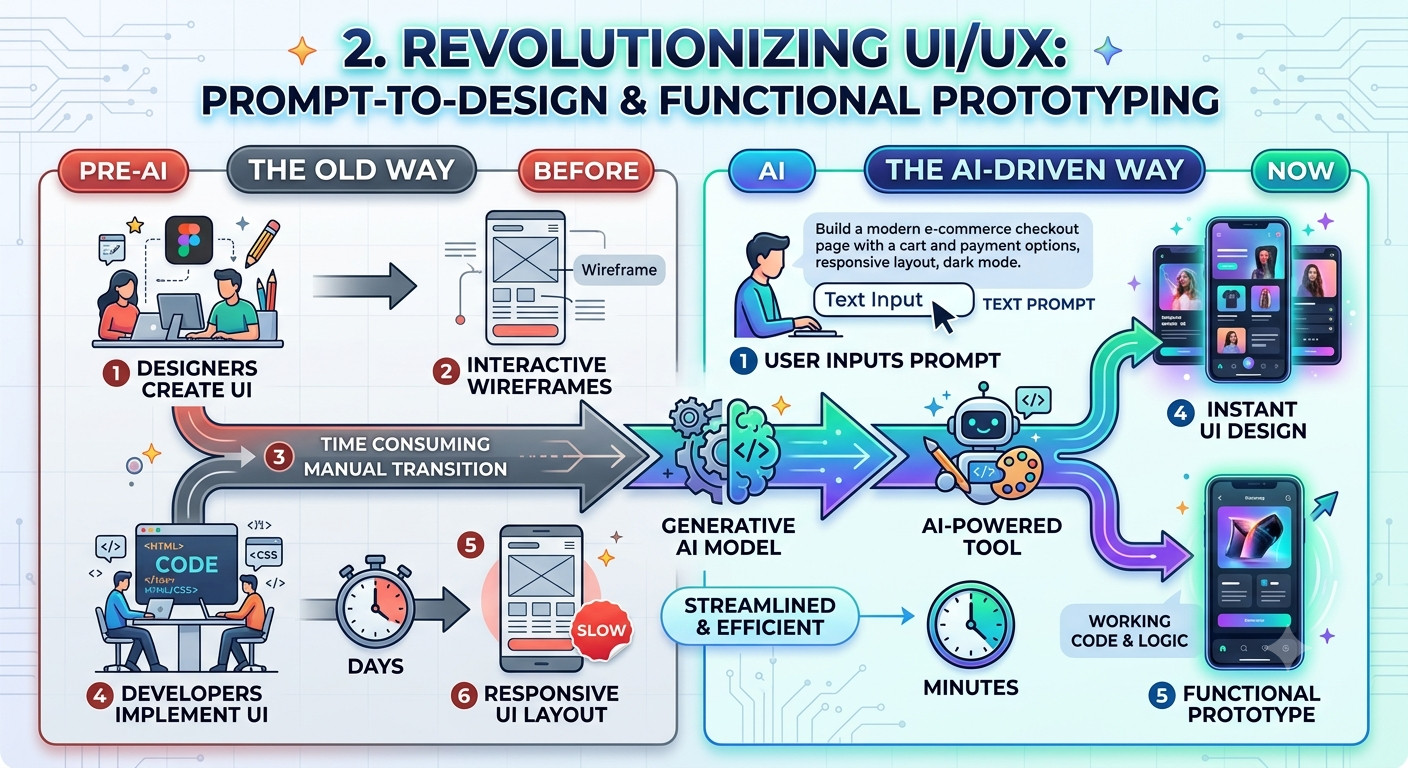
Designers used Figma for creating interactive wireframes, while developers would spend days implementing these visual designs into responsive UI layouts. Thanks to artificial intelligence in web design, all this has become outdated.
With the help of innovative design-to-code tools, like v0.dev (by Vercel) and Galileo AI, anyone is able to produce fully functional, responsive, and beautiful UI components from a text prompt only. For example, a command such as “Create a user profile dashboard with dark mode and activity feed along with tabs” will result in high-quality Tailwind CSS and React code in less than one minute.
This kind of front-end web development automation is not limited to simply creating mockups but provides production-ready React components that are stylized using accessible libraries, such as Radix UI and Shadcn. With their help, teams are able to validate complex layouts and create responsive prototypes right in the browser environment in no time. Design is no longer a static picture but becomes an immediate interactive codebase that developers can work with and integrate.
3. Intelligent Testing, Debugging, and Automated QA
Software engineering teams have historically seen testing as the most boring task. Programmers often rushed or skipped unit tests just to be able to release their products in time. AI technology has put an end to this issue once and for all. Contemporary AI-driven QA technologies set completely new standards of code reliability.
With the help of AI, modern web development platforms like CodiumAI and script generation by Playwright write comprehensive contextual test cases for newly submitted code on their own. Instead of having to map assertions for every single button and state change, programmers can rely on neural networks to detect the potential bugs, regressions, and to maximize test coverage.
Predictive debugging technologies allow us to revolutionize application monitoring. Not only does the intelligent error tracker like Sentry AI record all crashes but also acts as a diagnostic system. As soon as a production issue occurs, the AI first compares the server crash log to the current code submission and determines which line of code caused the issue and what the actual vulnerability was and solves the issue using pull requests.
4. Hyper-Personalization and Real-Time Dynamic Content
For a long time, the gold standard for dynamic content used to be a recommendation engine which would refresh its data after 24 hours. As for 2026, the trend for designing websites is becoming real-time context-aware. With modern-day AI technologies, it becomes possible to change website behavior right on the spot depending on the specific user.
With dynamic content generation, a web application is able to change its layout, its pricing plans, navigation and copywriting depending on the telemetry of the user who visits it and their intention. Should the telemetry show that the user intends to use enterprise features, the landing copy and CTAs will adapt themselves to communicate directly with corporate customers.
Apart from reconfiguring website layout, this revolution has brought about an entirely new conversational UX. Flow-chart chatbots have become extinct; they were replaced by voice- and text-based autonomous AI agents which operate right within the frontend stack and which have full access to the database schema. They are able to do everything from troubleshooting user accounts to completing checkout flows or giving customized product recommendations.
5. Next-Generation SEO Automation and Conversational Search UX
SEO is facing the biggest upheaval since the existence of search engines. In 2026, the emergence of AI Overviews, Perplexity, and ChatGPT Search has revolutionized the SEO model into GEO and LLMO. The aim is no longer only to rank at page one of Google. It is to have your brand synthesized, cited, and recommended within AI-generated answers.
In order to succeed in this era of synthesis first, current web developers are using native automation within the headless CMS AI architecture. Sophisticated sites automate with AI the injection of deeply contextual FAQPage, Product, and Article schema markups. This data serves as a machine translator that allows AI web crawlers such as OAI-SearchBot and PerplexityBot to extract site assets.
In order to optimize the sites in favor of the LLMs, it is now required to write both for humans and semantic engines. Developers create self-contained 40-to-60-word answer blocks underneath H2 headings and provide a clean and accessible server-side rendering (SSR). Interactive UI components should be carefully developed since hidden tabs or accordion dropdowns do not allow AI crawlers to parse the important facts. With this automation of metadata pipeline, current websites are by default "citation-ready."
6. Automated DevOps, Cloud Infrastructure, & Performance Tuning
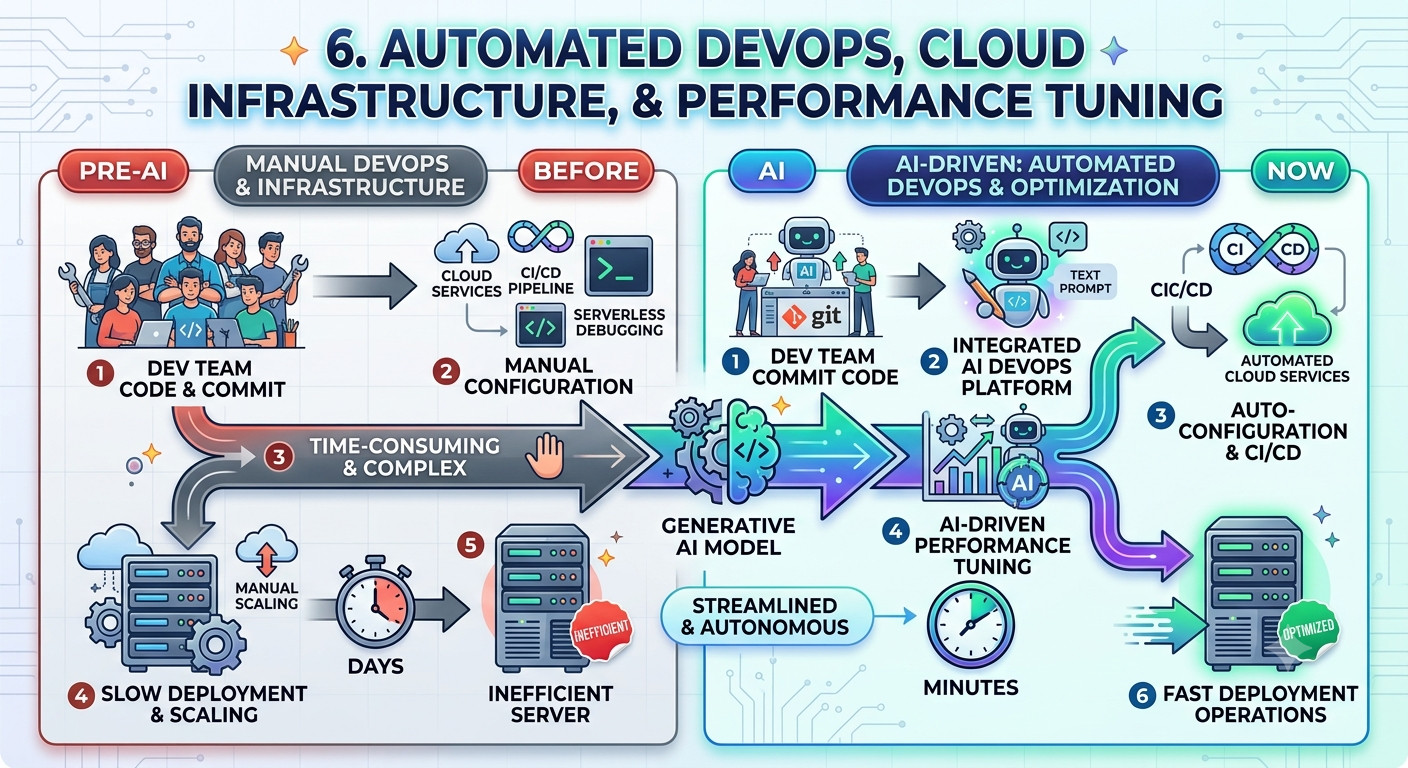
Like all other phases of the modern web life cycle, deployment, maintenance, and hosting have also been automated using artificial intelligence technology. Previously, configuring cloud services, setting up a continuous integration pipeline, and debugging serverless runtimes required dedicated DevOps professionals.
Engineers can use AI assistants such as Pulumi AI, AWS Q, and Cloudflare's optimization assistants to automatically create an "Infrastructure as Code" (IaC) setup. Instead of manually coding IaC configuration through YAML in hours, engineers simply need to say something like "Deploy a high-availability auto-scaling Next.js stack in Sydney with isolated staging environments."
Post-launch, AI takes care of optimization and hardening of the application. Predictive load forecasting takes place through advanced monitoring tools, which dynamically change the memory caps of serverless functions and route the regional traffic before any peaks occur. At the same time, automated vulnerability scanning tools check for vulnerabilities in each commit of code in the DevOps pipelines, and automatically prepare pull requests for fixing the dependencies before pushing them into production. This ensures highly optimized and self-healing infrastructure with minimal costs of cloud hosting.
Will AI Replace Web Developers?
The speed at which these technologies are developing cannot but evoke existential discussion, namely whether AI will take the place of human engineers or not. While science fiction envisions the future where all the software coding is done by machines, the world of 2026 proves to be much more complicated. Instead of replacing the developers, AI changes their role completely.
Shift from "Coder" to "Software Architect"
Before the arrival of AI technology, one of the largest time expenditures for developers was involved in low-level implementation: typing syntactic lines, debugging syntactic mistakes, and manually translating business needs into syntactic logic loops. Such manual drawing led to an artificially imposed constraint on the efficiency of developers in general.
Today developers create value less by writing every line of code and more by designing systems, reviewing AI-generated solutions and solving complex business problems. The role of the software engineer changed from a simple syntax writer to that of a “Software Architect” who is able to orchestrate all the elements of the process. Instead of writing regular CRUD (Create, Read, Update, Delete) endpoints, the developer teaches the agentic models how to create systems, set relationships, boundaries of integration, and limitations of security. Such technological shifts transformed the idea of “10x engineer” into “100x developer”, a person who is capable of launching whole platforms alone via coordinating the activities of his/her digital AI agents.
The Vital Importance of Domain Knowledge and Quality Control
The crucial flaw of artificial intelligence is rooted in its basic design; LLMs are prediction engines trained to predict the most likely next word or piece of code. They are extremely advanced pattern simulators; they have no real understanding, critical thought process, or empathy for the local business context.
With insufficient human domain knowledge, systems created by AI will soon become architecturally dysfunctional. Models tend to "hallucinate" and come up with seemingly valid pieces of code full of severe hidden security issues or obsolete dependencies. AI does not have an understanding of the context behind business decisions and, therefore, cannot make any concessions in technology due to the budget limitations of the startup and cannot take into account the UX peculiarities of the target niche market. Human engineers are the vital system gatekeepers—conducting thorough code review, sanity check on edge cases, and debugging sessions during multi-system integration failures. The importance lies not in coding itself but in knowing what kind of code to ask for.
How Can Australian Companies Benefit From Using AI Web Development?
With the rise of paradigms powered by artificial intelligence, the competitive advantage of large organizations has become obsolete in the highly competitive online world. Previously, small Australian technology companies and SMEs did not have the opportunity to create their own software due to enormous investments and timelines required to develop software from scratch. International corporations could afford multi-million web development projects, but locally operating companies were forced to use generic models. Now, all that is changing.
Thanks to the implementation of AI-assisted processes, businesses based in Australia can develop unique web portals, localized directories, or marketplace websites without the same expenses as hiring an agency would cost. The trick here is to look for specialists in a different way. Instead of relying on expensive agency services with weeks of generic work, you can make use of the Gigmint platform and hire innovative freelancers who will create the product using AI coding platforms.
Speeding up innovation does not translate into ignoring key compliance processes. The Australian companies need to uphold high governance standards in implementing AI models. For example, while developing AI chatbots that are personalized or automating processes for data analysis, it is essential to comply with the Privacy Act in Australia.
In light of major changes in regulation, such as the major decision of the court case Bunnings v Privacy Commissioner (2026), which set high standards on the profiling of transient biometric and conversational data, and the new December 10, 2026 ADM regulations, which will introduce greater transparency in AI systems, the Australian firms need to make sure that their pipelines are compliant with all requirements.
Embracing the AI-First Web Era
AI is not shutting down the window for web development; rather, it is opening up a very advanced, democratic window. The move from programming to intelligent system operation is an unprecedented liberation for the developers. Developers are relieved from the burden of syntax to engage in conceptual creation. Businesses gain time savings, hyper-personalization for users, and significant cutdowns in the overhead of development.
There are no ifs and buts involved in this regard. Developers need to keep themselves updated with respect to agentic tools and system architecture, whereas business owners will need to review their legacy systems to prepare themselves for AI. With the help of talented people from Gigmint, you can smoothly sail through this period of rapid technological change.
Looking to build AI-powered web applications?Gigmint.Ai connects businesses with experienced developers who can help you design , build and scale modern Ai-first products
The 2026 Developer Tech Stack Checklist
To ensure your web development strategy is aligned with current industry standards, leverage this checklist to audit your technical processes and tools:
|
Dev Phase |
Traditional Workflow |
2026 AI-Augmented Workflow |
Primary Objective |
Recommended Tools |
|
Logic & Coding |
Manual syntax drafting & StackOverflow searching |
High-level system orchestration & agentic coding |
Maximize code generation speed and minimize boilerplate |
Cursor (Composer), Windsurf (Cascade), Claude Code |
|
UI/UX Design |
Static Figma mocks to manual CSS/HTML conversion |
Prompt-to-UI generation & instant functional component output |
Bridge the gap between prototype and deployment |
v0.dev, Galileo AI |
|
QA & Testing |
Manual test scripting & reactive bug hunting |
Autonomous test generation & real-time predictive diagnostic tracing |
Achieve total test coverage and self-healing systems |
CodiumAI, Sentry AI, Playwright AI |
|
User Experience |
Static landing copy & pre-designed flowchart bots |
Real-time dynamic layouts & autonomous LLM agents |
Deliver highly personalized, context-aware web interactions |
Dynamic Telemetry, edge personalization APIs |
|
SEO Strategy |
Manual meta-data tagging & keyword stuffing |
Generative Engine Optimization (GEO) & automatic Schema injection |
Ensure discoverability and citation by major search engines |
Headless CMS AI, OAI-SearchBot/PerplexityBot |
|
DevOps & Cloud |
Hand-crafted infrastructure scripts & manual CI/CD |
Natural language "Infrastructure as Code" & self-healing servers |
Lower cloud operations costs and maintain zero downtime |
Pulumi AI, AWS Q, Cloudflare AI assistants |
Frequently Asked Questions
Question 1: What does "Generative UI" mean? How will Generative UI affect frontend development?
The concept of Generative UI is revolutionary since there will be a transition from a static pre-coded frontend component layer to an intelligent UI layer that is designed and built by the AI orchestrator, depending on user intention, context and available information. We build modular, highly accessible component systems that can be safely assembled by AI.
Question 2: Is there a chance that code generation by AI will fully replace human web developers by 2026?
Not at all. While AI tools do most of the work for us in terms of generating boilerplate code and debugging, the developer becomes an AI architect and reviewer, who should ensure proper performance, security, system architecture and business logic in the system.
Q3: In what ways is backend architecture evolving to accommodate agentic AI workflow?
Conventional REST and GraphQL-based APIs will be shifting to the Agentic Backend architecture where backends have been developed as decoupled systems of 'AI Tools'. An agentic workflow uses LLMs that chain the microservices to discover the best way forward in meeting the demands of the end-users in an automated manner.
Q4: What is AI Engine Optimization (AIO)? Why is AIO important for web development?
SEO, in how it used to do things before, optimized websites for search engine spiders, and AIO will optimize websites for AI agents to make sense of, parse, and work on them. AIO needs neat data, which should be presented in JSON-LD form, API schema (e.g. OpenAPI specs), and semantical HTML.
Q5: What are the key security threats associated with AI-powered web applications?
A new range of threats is identified. Main vulnerabilities in 2026 include:
Prompt Injection: The use of malicious input to manipulate the underlying LLM to get around certain limitations.
Output Insecurity: The lack of proper sanitization of generated output, allowing for Cross-Site Scripting (XSS).
Data Poisoning: The manipulation of data available publicly through the app that may interfere with AI training or retrieval process.
Q6: How does AI influence the performance and latency of web applications?
Latency is incurred when performing LLM inference mid-request. To meet the 2026 standard of instant loading time, hybrid approaches are required: progressive loading of AI results to client UI, asynchronous processing of computationally expensive inference tasks, and using edge-computing infrastructure to cache AI vectors near the client location.
Q7: Are there any use cases left for state management libraries (Redux/Zustand) in AI-native applications?
Yes, but the purpose of state management has shifted from managing several dozen UI toggle states to maintaining a neat "Context Window" or session history that is passed into the AI engine. The state becomes the single source of truth that helps the AI understand what the user is currently doing.
Q8: Has the testing landscape changed with autonomous AI agents?
Testing has become mostly automated, and manual QA and even writing unit tests are now done automatically. The focus of testing has shifted towards behavioral and guardrail testing, where developers create an automated framework that stresses the AI agent using thousands of user inputs in order to not let the AI hallucinate or leak data and logic.
Q9: What stack should a developer learn now in order to stay relevant in this environment?
To the basics such as JavaScript/TypeScript and frameworks such as Next.js or Remix, the 2026 strategy includes knowledge about the following:
Vector databases: Pinecone, Pgvector, or Qdrant – technologies for retrieving semantically related information.
AI orchestration frameworks: LangChain, LlamaIndex, or Vercel AI SDK.
LLM security tools: input validation frameworks specifically made to detect prompt injections.
Q10: What impact does AI-driven web development have on a11y?
The influence is both positive and negative. On one hand, AI has the potential to automatically correct issues like lack of alt tags, build proper semantic headers, and adjust contrast ratio. At the same time, a Generative UI engine without a11y restrictions may end up building a totally unusable broken DOM tree for screen readers.