Frontend vs. Backend Development: Understanding the Key Differences
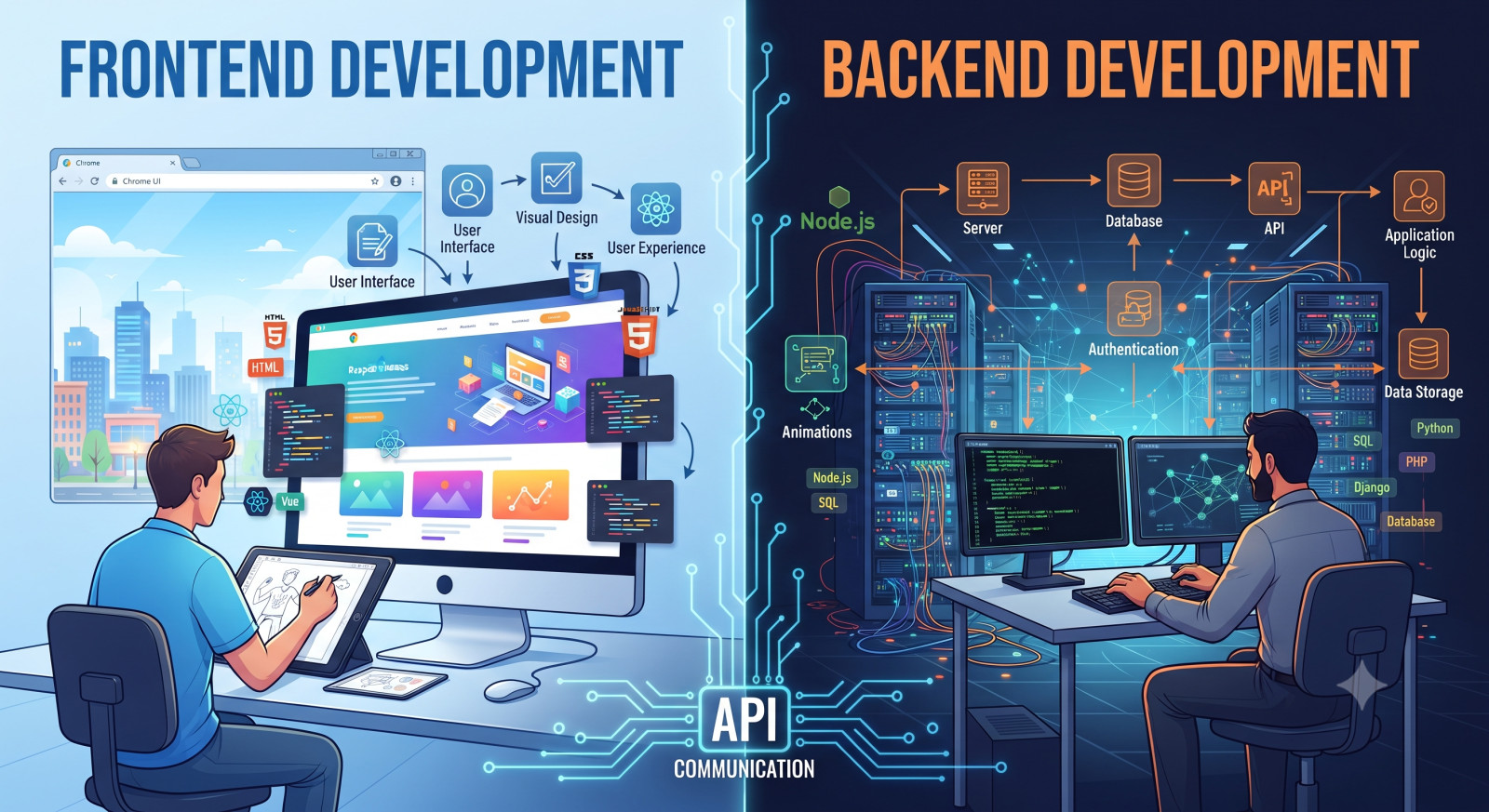
Frontend vs Backend Development: Understanding the Key Differences
All is well-lit, the seating is comfortable, and the menu is beautifully displayed. Everything in this case happens by interaction with a cheerful waiter as you place your order. All this interaction and other contacts you make constitute the front end.
But all this demands a lot of activity behind the doors in the kitchen.
Chefs coordinate, food ingredients are picked up from the pantry, and complicated recipes are made. All this hard work happening behind the scenes is the backend.
In the tech world, every website and app works in this way. People wanting to get started in this field, and businesses wanting to hire competent people face a difficulty in understanding the difference between these two important parts of app development.
In the comprehensive guide, we will explain the main differences between Frontend and Backend Development. We will look at the details of the client-side vs server-side programming, consider the modern technologies that make it possible, discuss the salaries, and, finally, see how these two very different domains can work perfectly in unison to deliver all the digital services we use daily. This is the first step towards your success with GigMint.
What is Frontend Development? (The Client-Side)
Once you access a website, all the elements that you will be using immediately are created through frontend development. This process is also referred to as client-side development and consists of the Graphical User Interface (GUI) of a website or an application. The frontend is basically the look of the website/application that includes its colors, layout, typography, buttons, etc.
Core Focus Areas of Frontend Development
Apart from creating a beautiful-looking website, the job of a seasoned frontend developer is also associated with how users are going to interact with the digital product. The following aspects are seen as important for him:
User Interface (UI) and User Experience (UX): Turning design concepts into reality through creation of the beautiful and user-friendly interface that will make users happy.
Responsiveness: Making sure that the website/application will look beautiful no matter what kind of device users are going to use – whether it is desktop or mobile devices.
Essential Frontend Languages and Technologies
The frontend technology space is constantly changing, it is all based on three fundamental languages and a slew of powerful frameworks to build on top of them.
-
HTML (HyperText Markup Language): This is the structure of a Web page which consists of elements such as headings, text, images, etc. CSS (Cascading Style Sheets): This is the design layer of the Website sitting on top of the HTML layer. It controls the way content is displayed. The predominant approach that will be taken to style the web is utility-first CSS frameworks like Tailwind CSS. They enable rapid development of scalable user interfaces.
-
JavaScript (JS) & TypeScript: The Engine of Interaction – This is the programming language that introduces features of interaction to a web page (modify the page without refreshing it, animate objects etc.). To create high-quality applications nowadays JavaScript is often used in conjunction with the programming language TypeScript – an enhanced version of the language with static typing.
Modern Frontend Frameworks
While HTML, CSS, and JavaScript are the basis of frontend development, there are frameworks and libraries that will help you deal with complex applications efficiently.
-
React – React is a framework for creating user interfaces (or SPAs, Single Page Applications) developed by Facebook and which continues to be extremely popular.
-
Next.js – As the Next.js framework is built on React, it has become extremely popular thanks to a unique combination of features that makes it the perfect solution for developing websites, including server-side rendering (SSR), static site generation (SSG)..
-
Vue.js – Vue.js is a relevant alternative when it comes to frameworks due to its intuitive learning process and elegant architecture.
-
Svelte – Svelte is a library that has gained popularity owing to the optimization of the entire web app during the build process.
The Role of the Frontend Developer
A modern frontend developer plays an important role in the development chain. A frontend developer works in close collaboration with UX/UI designers in bringing their design ideas to life and in collaboration with backend developers in integrating data using APIs. The end result is a smooth, accessible and efficient user experience on the client side.
What is Backend Development? (The Server-Side)
While the frontend can be compared to the beautiful dining room of our restaurant, the backend would represent the extremely well-organized and efficient kitchen. Sometimes referred to as server-side development, the backend development represents the engine of our application. It includes the server, the database, and the server-side application that does all the processing and business logic behind the scene.
Backend development works when you make an account, buy a product or search for a certain term on the website.
Core Focus Areas of Backend Development
While frontend programmers work for the users, backend programmers work with data, logic, and system architecture. Their major roles include the following:
-
Server Architecture and Application Logic: Writing the main code which defines how the application operates, processes user requests and implements the business logic.
-
Database Management: Creating, maintaining and querying databases to make sure the data is safe and can be accessed fast enough.
-
API Development (Application Programming Interface): Writing the secure interfaces that connect frontend and backend and integrate external services, such as payment processing services.
-
Security and Authorization: Implementing security measures to keep user data and the website protected from attacks and authorize users safely.
Top Backend Languages and Frameworks
The server-side ecosystem consists of a large number of different programming languages and is used for different applications. On this page we will go through the leading backend technologies .
-
Python: As the world is experiencing the massive growth of Artificial Intelligence and Machine Learning, Python is on top and is getting even stronger. The number of projects created with Python’s two biggest frameworks for building full featured web applications quickly - Django and FastAPI - is growing exponentially. A big number of new data driven projects are created with Python every day.
-
Java: Being the reliable solution for businesses, Java is used to create large, complicated and secure enterprise software applications. Often it is used alongside Spring Boot.
-
Node.js (JavaScript): This technology lets you deploy server side applications written in JavaScript. And since TypeScript/JavaScript applications can be developed on the client side too, then in this case, Node.js suits perfectly. It is extremely popular.
-
Go (Golang) and Rust: The price of cloud computing has grown exponentially in recent times and thus the demand for effective computing has increased significantly. Go because of its amazing concurrency support, and Rust due to its safety features and high performance, have become popular languages for developing scalable microservices for the cloud-native environment.
Databases: The Backbone of the Backend
These are basically divided into two types:
-
Relation: Highly structured through tables which perform well in complex querying and maintaining data integrity. (Example: PostgreSQL, MySQL).
-
No Relation: Highly flexible through documents which perform well in unstructured data and scaling. (Example: MongoDB, Redis).
The Role of the Backend Developer
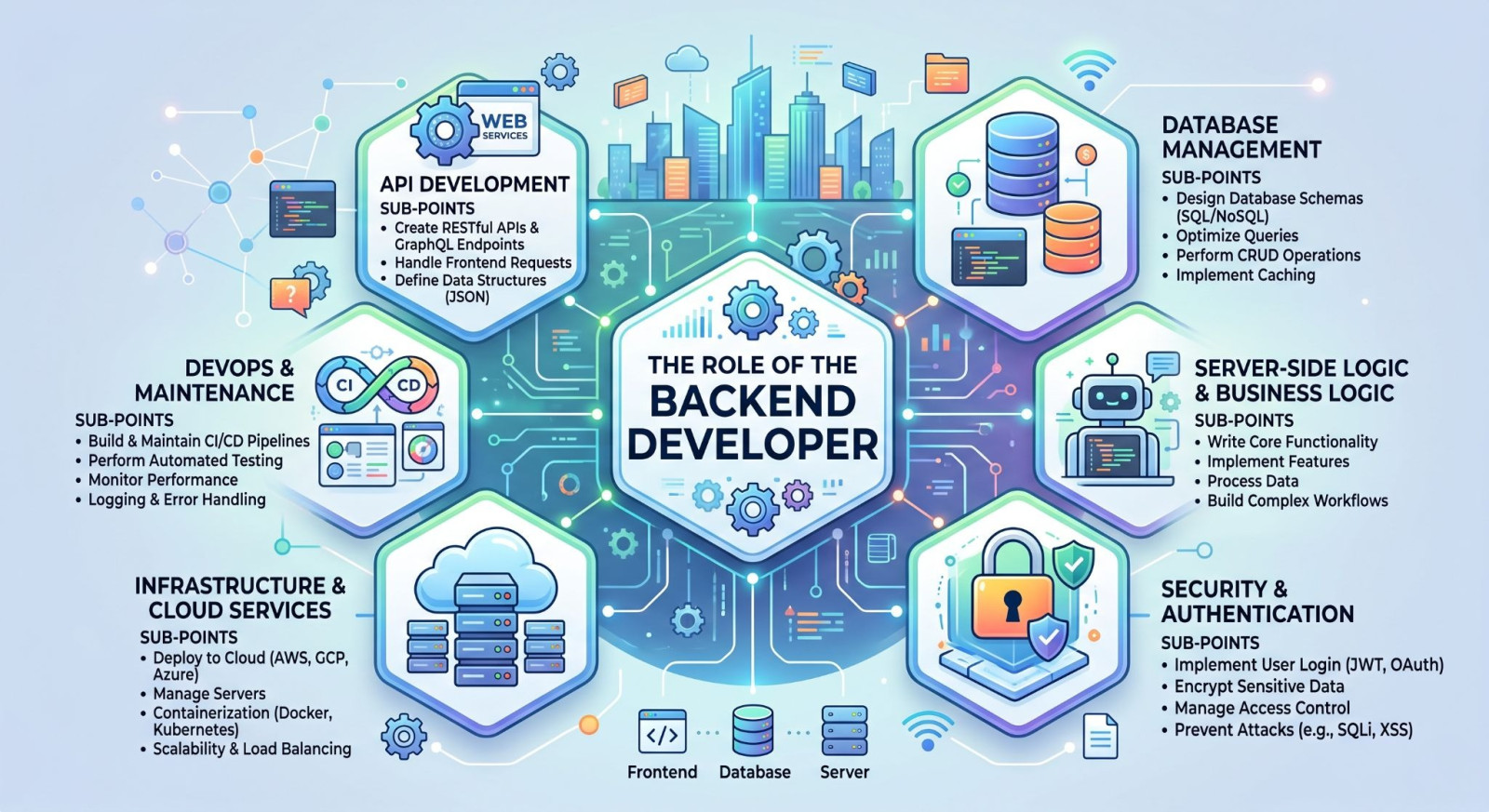
The backend developer is a troubleshooter who enjoys logic. They dedicate their time to building complicated algorithms, tuning down slow database queries, setting up cloud servers via AWS or Azure, and making sure that there are no errors in the data of the application. They are the builders who keep the digital kitchen from catching fire no matter how many orders you have to process.
Frontend vs Backend Developer
Key Differences
|
Feature |
Frontend (Client-Side) |
Backend (Server-Side) |
|
Primary Focus |
Aesthetics, Layout, User Interaction, UI/UX |
Data Management, Business Logic, Security, Architecture |
|
Environment |
Runs in the user's web browser or mobile device |
Runs on web servers and cloud infrastructure |
|
Feedback Loop |
Visual and immediate (you see what you code) |
Abstract (monitoring logs, data models, API responses) |
|
Concurrency |
Handles one user's experience at a time |
Must handle thousands of concurrent users simultaneously |
|
Core Languages |
HTML, CSS, JavaScript, TypeScript |
Python, Java, Go, Rust, Node.js, SQL |
How They Work Together: The Request/Response Cycle
From the Frontend Side and from the Backend Side, developers are working on the same Project – therefore they have to communicate in any case, on a fundamental Basis, the Basis of the Internet: the HTTP request/response cycle.
Here’s a real life example of a user browsing online for goods, in this case adding to cart via clicking the Add to Cart button.
The Frontend Action: The frontend is registering the click on the Add to Cart button. The Frontend is immediately sending an API request over the internet to the backend.
The Backend Processing: The server logs the Frontend Action and then, after checking the database (e.g. to see if the required item is in stock), authenticates the user session and then updates the corresponding cart in the database.
The Response: Once the item has been added to the users online cart the backend sends a response back to the frontend usually in a JSON format with a message saying that the item has been added to the users online cart in this case it says ‘Success’ the item has been added to your online shopping cart.
The Frontend Update: After receiving the response from the backend, the frontend updates the User Interface of the online shop (for example by playing an animation or by changing the cart icon’s number from 0 to 1 in case of a product).
What is Full-Stack Development?
Since frontend represents the dining area while backend represents the kitchen, the full-stack developer refers to that single individual who cooks the food as well as serves it to the guests. Full-stack development can be said to be the meeting point of both these areas, since the full-stack developer knows how to work on the client side as well as the server side.
Why Business Adore Full-Stack
Complete Product Knowledge: These professionals have complete knowledge regarding the whole product; hence, they make great technical leads and architects.
Time to Market: When you are a startup and want to build MVP, you can develop your entire feature without waiting for any other developer.
Elimination of Communication Silos: They bridge the gap between frontend and backend team; hence, helping you eliminate unnecessary silos.
Though extremely important, full-stack developers are usually "jacks of all trades and master of none." When an application grows into a huge enterprise-level platform, it becomes necessary to go back to hiring dedicated frontend as well as backend engineers who can solve niche problems.
Salary Comparison: Frontend vs. Backend
The tech salaries are still very competitive , yet, their differences depend greatly on the location of employment, experience, and technologies used by the developer. As far as the general salary differences between these fields are concerned, the developers of backend programming languages earn a little more than those working in frontend development.
-
Salaries for Frontend Developers: On average, a mid-level frontend developer earns between $100,000 and $135,000 per year in the US. Those positions which involve complex knowledge of frontend technologies such as complex 3D WebGL rendering or complex performance optimizations in enterprise Next.js apps pay much more, up to $150,000+.
-
Salaries for Backend Developers: The backend jobs are generally considered to be paid even better than the frontend ones and their salaries are usually around $115,000-$155,000 per year.This is why the work of a backend engineer is extremely responsible. Not only must he/she provide the enterprise security and prevent data leakage, but also bear the entire weight of avoiding bringing down a massive cloud infrastructure.
Which Career Path Should You Choose?
Whether you want to be a frontend developer or a backend developer to build products is dependent on your problem solving skills and what excites you to build products..
If You Choose Frontend Development...
-
I am fascinated with design and UX.
-
Enjoy immediate feedback from writing code.
-
Appreciate working together with designers and product managers.
-
What I Want To Learn About Frontend Development Is...
Choose Backend Development If You...
Thrive on solving complex logical puzzles and organizing complex data structures.
Caring about the efficiency of the way things work internally over how things look.
Interested in cloud computing, cyber security, and building huge scalable applications.
Enjoying API programming, troubleshooting server logs, and database optimization over CSS layout tuning.
Advice for Beginners: One very popular and very effective approach would be starting with frontend development (HTML, CSS, and JavaScript). Having visible progress keeps motivation going when learning the basics of programming. As soon as you feel confident in developing interfaces, it will be natural to introduce yourself to backend stuff such as databases and RESTful APIs.
Trends Shaping Web Development
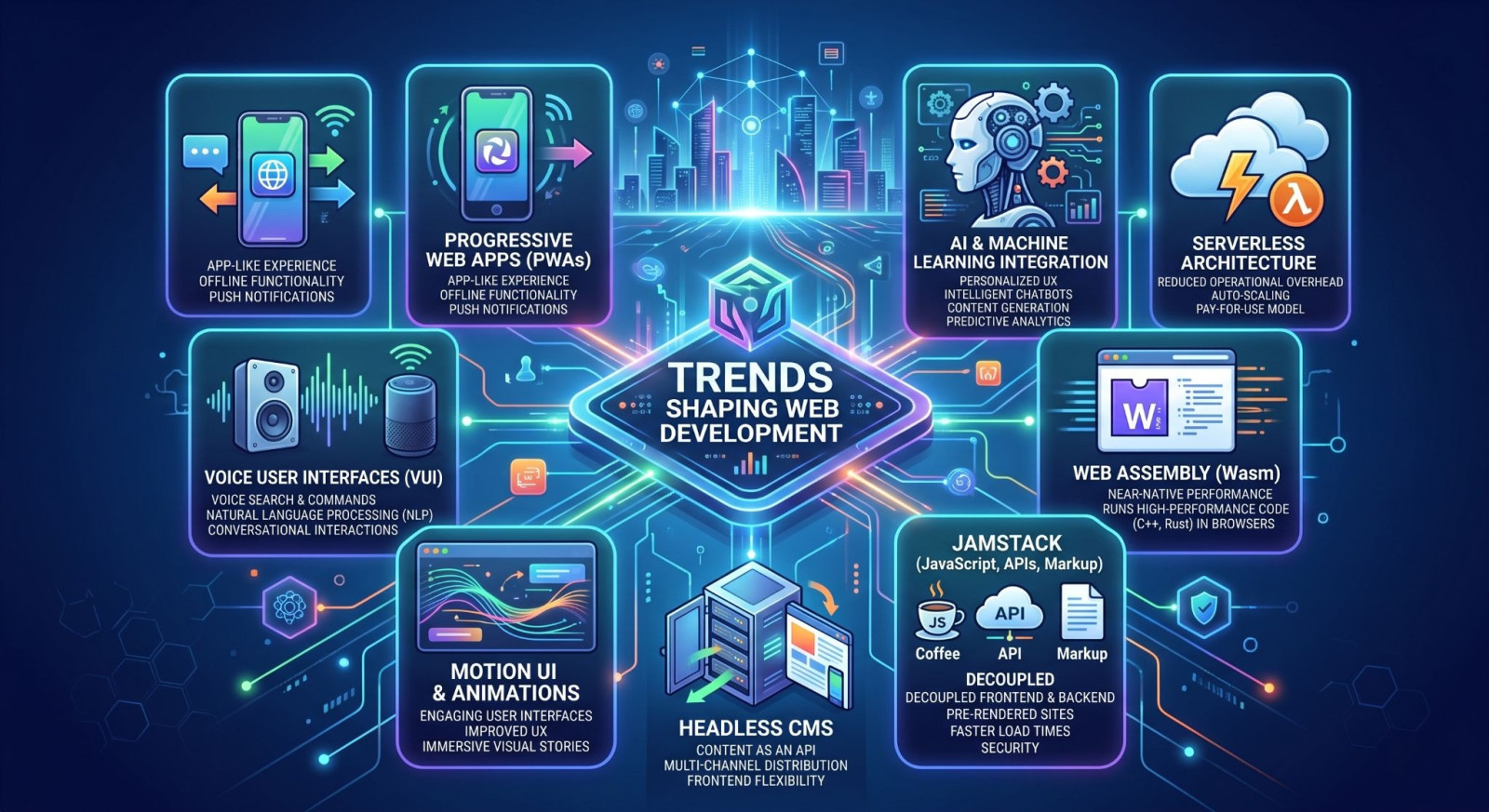
There is always something new happening in web development. If you wish to remain relevant, be aware of these main web development trends that are going to change the way frontend and backend interrelate:
-
AI-Enabled Programming: The introduction of such AI-based coding tools as GitHub Copilot and conversational models is revolutionizing web development as we know it today. The use of artificial intelligence makes it possible to generate boilerplate code much faster for frontend and backend purposes.
-
Serverless Computing & Edge Computing: Backend logic becomes closer to the user's experience by using edge computing that allows running server-side logic from distributed nodes around the world. As a result, there will be very fast loading and the developer should think about the ways of getting information differently.
-
Framework Boundaries Are Fading Away: Current frameworks such as Next.js and Remix are blurring the boundaries between the client and the server sides of applications. The meta-frameworks provide the ability for developers to run the logic of the backend (such as querying databases) right in the frontend code.
Focusing on Core Web Vitals. Websites under pressure by search engines’ SEO requirements. The performance of your website is no longer an option.
Frequently Asked Questions (FAQs)
1. Which is difficult to learn between frontend and backend development? It completely depends upon your mindset because frontend development is visually and contextually challenging, where you have to deal with several sizes and problems related to many devices and browsers. Whereas, backend development is logical and complex because it involves the knowledge about data structure, algorithms, and architecture of the system.
2. Can a frontend developer learn backend development? Yes, he can become a backend developer with the help of his JavaScript knowledge by learning Node.js and then switching to database and API architecture.
3. Which role is more in demand ? Both roles are extremely in demand. To what extent is there more demand for specialized backend engineers (cloud, AI, etc.) as well as full-stack developers, who prototyping end-to-end applications for startups can, is extremely in demand as well.
4. What coding language should I start learning first for web development? web development languages are HTML, CSS, and JavaScript. First you should learn the basic HTML and CSS structure. After you get the basic structure of the web down then move onto learning one of the many flavors of JavaScript and start building out the interactivity of the website.
If you decide to go with JavaScript then you should start with learning one of the many frameworks for Front-end development (e.g. React or Next.js) and then you can easily start building out Back-end development as well with Node.js and become a full-stack developer with only one programming language.
5. Does a front-end developer need knowledge about databases? It’s not needed to a great extent but some general knowledge will come in handy. A frontend developer does not need to be familiar with the writing of intricate SQL queries or working with database tables but needs to know how the data will be organized once it reaches him via the API.
6. Difference Between Web Design and Frontend Development? The web design involves the appearance and functionality of the website which is done using the help of Figma or Adobe XD. On the other hand, frontend development means writing of the codes in order to build a fully functional website.
7. What kind of math do you need for backend development? Less than people think. If you aren’t developing complicated mathematical functions for AI, finance-related software, or games, then you will not need higher math skills. You will be better off with strong logical thinking abilities, algebra skills, and knowledge of data structures.
8. Should I have a computer science degree to become a frontend or backend developer? No. Though a traditional education in computer science can help build the basic knowledge and background, the technology industry is very skills-oriented. Having a solid portfolio of your work, experience, and readiness to keep learning can be considered equally valuable as a degree.
9. How are AI tools changing frontend and backend roles? There is a huge amount of “dumb” boilerplate code in most applications, and AI is starting to write that for developers, as well as basic syntax for new functions. This is going to allow developers to work faster and focus on higher-level parts of the system, such as architecture, security, etc. but still be actual developers.
10. How long does it take to learn frontend or backend development to become productive? in order to start building small sites and grow from there in 3 to 6 months for the frontend part (simple sites), and sometimes a bit longer for the backend part (server, database, etc.). Note that it takes years to become an expert in any of these 2 main areas.
Call to Action
The knowledge of the distinction between frontend and backend development is the cornerstone of understanding the tech world. The frontend is the interface of the application – the beautiful dining room, where users engage, click, and have their experience with your brand. The backend is the engine – the buzzing kitchen that provides for secure data management and functionality under high loads.
They both are equally necessary. Without the frontend, the internet would just be a pile of incomprehensible data. And without the backend, those beautiful designs would just be lifeless shells, which do absolutely nothing.
No matter if you are a business owner, who looks for the ideal team of engineers, or an aspiring developer who builds his career, knowing the way these client- and server-side aspects cooperate is your path to success further. Looking for experienced frontend , backend, or full-stack developers? Explore Gigmints vetted talent pool and hire skilled professionals for your next web development project,