Top Web Development Trends Every Business Should Know in 2026
Top Web Development Trends Every Business Should Know in 2026
In 2026, the world of digital technology is changing at a rapid pace. The days when an old or out-of-date website could be considered a small nuisance are gone forever. People expect to be offered instant and fully personalized web solutions. And if you fail to provide such an experience, your users will choose another company offering an outstanding service.
The times when your website could be regarded as nothing more than a digital brochure are gone forever. A good digital strategy requires dynamic, interactive and fully protected web solutions which would be an engine of your business working 24/7.
It can be really hard to navigate through this ever-changing digital sphere. There are always many new frameworks, terms and technologies that make it really difficult to separate temporary trends from something really worth considering. You have to understand where to invest money for maximum ROI.
This is precisely why we have put together this guide. In order to be competitive, scalable, and generate conversions consistently, it is not an option but rather a necessity for you to incorporate some of the best web development trends.
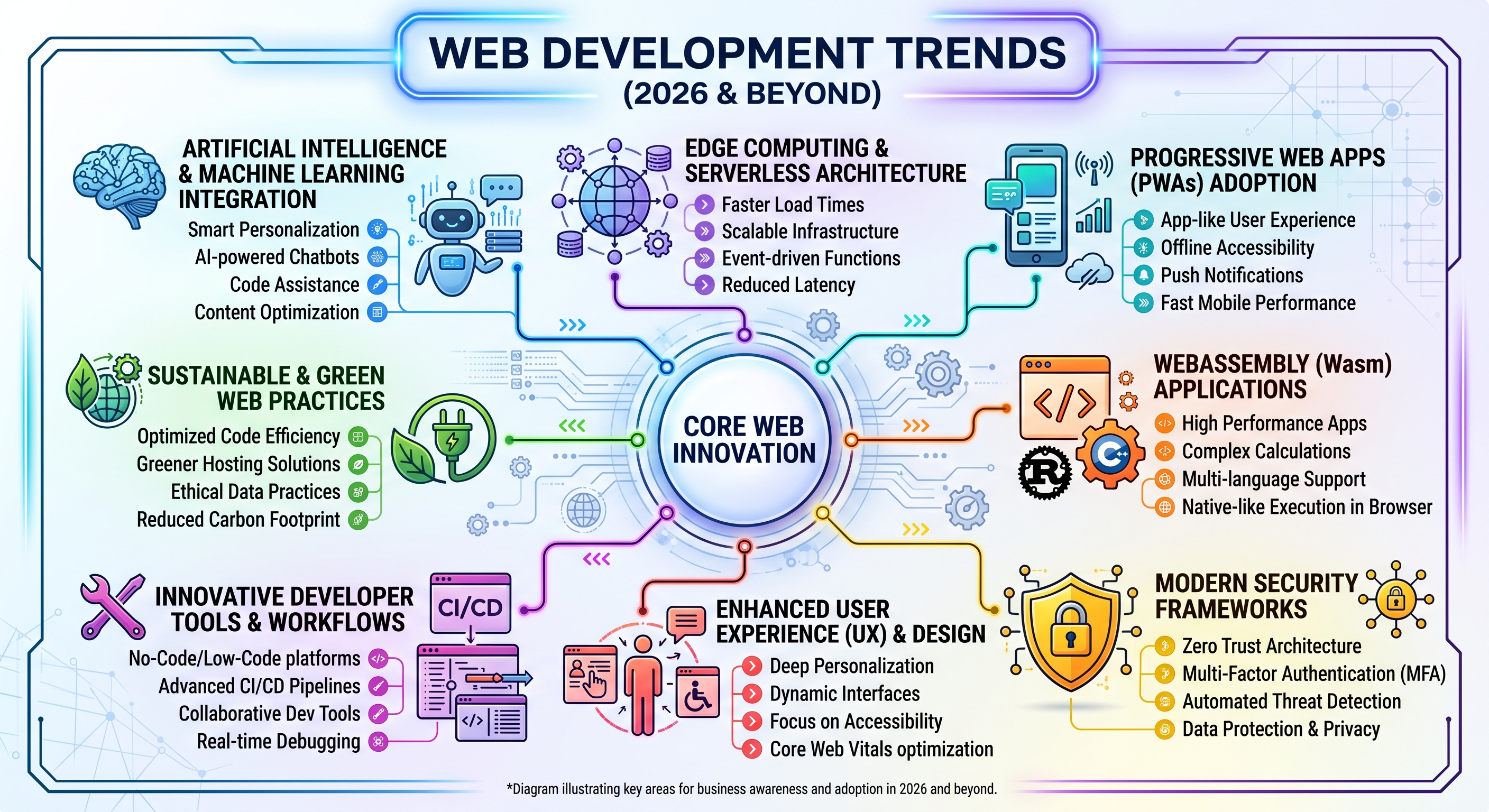
In the upcoming paragraphs, we will cover the essential technologies that are changing the game. From artificial intelligence implementation, web architecture changes, mobile optimization, to ironclad security measures—these are the technologies that you need to master.
1. Artificial Intelligence and Machine Learning Integration
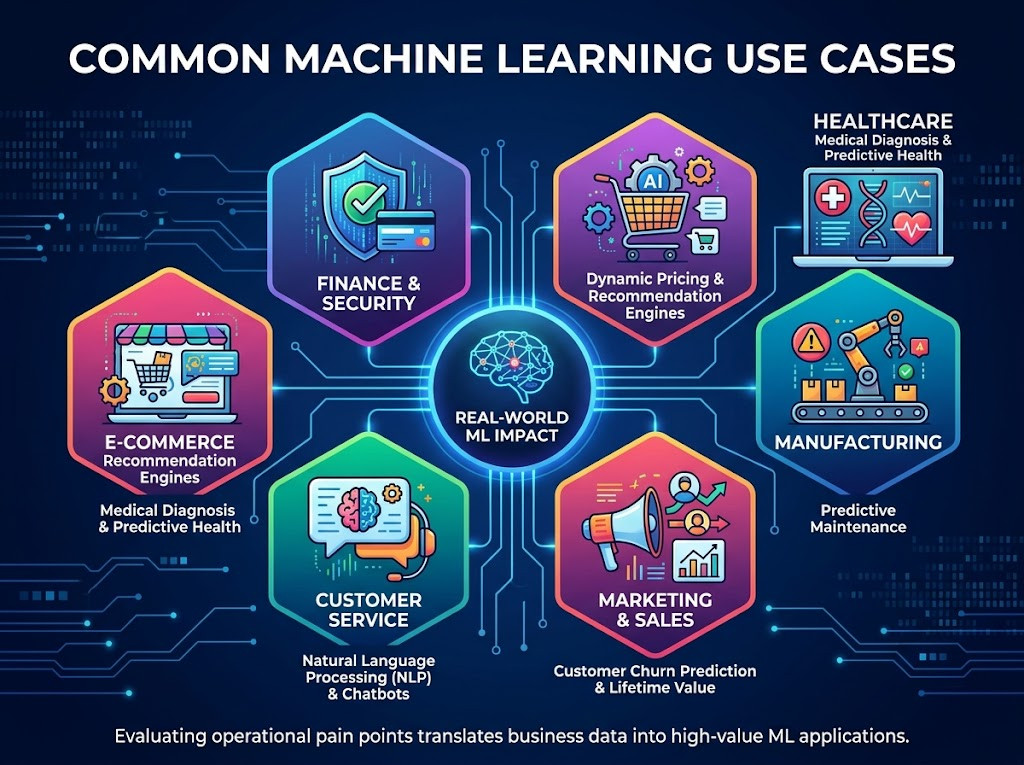
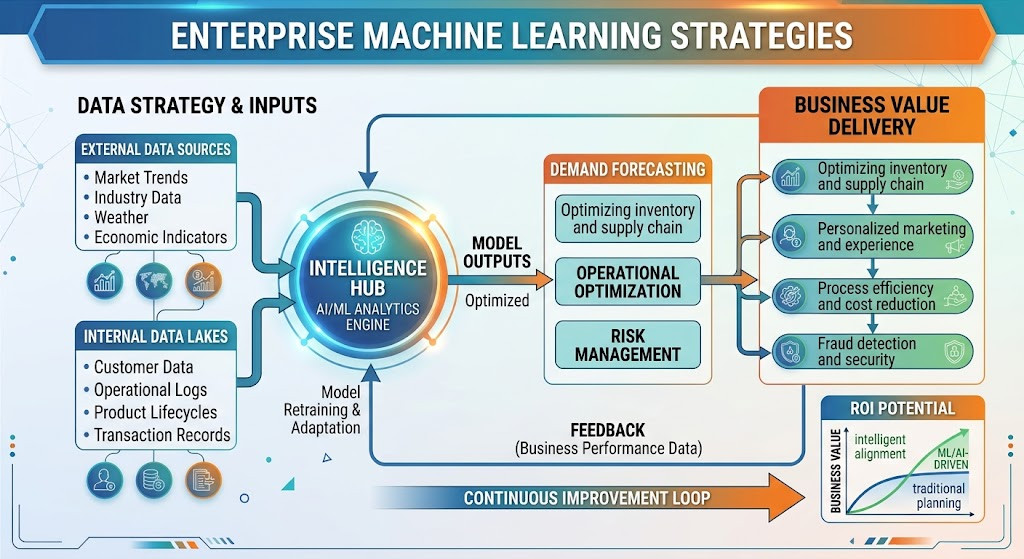
While talking about the future of web development, Artificial Intelligence (AI) and Machine Learning (ML) cannot be left out. AI has moved from the realm of a buzzword to the very foundation of modern web development. Incorporating AI into your web application means turning your digital asset into a smart and active business tool.
Achieving Unmatched Conversions
The customers of today demand highly personalized experience, something that can be achieved through highly tailored content, such as Netflix and Amazon do in their services. This can be done through machine learning algorithms based on analysis of user actions like clicking behavior, browsing history and previous transactions.
Rather than providing a generic webpage, which does not take any account of the user's intentions and preferences, AI makes it possible to deliver personalized content to the user. You can use AI to adapt recommendations, advertising banners and even user interface (UI) according to user's intentions, which helps increase your conversion rate significantly.
Advanced Chatbots and Virtual Assistants
We are officially beyond the age of annoying scripted customer service bots that make people go through endless decision trees. With the introduction of LLMs (Large Language Models) and Natural Language Processing, we have come up with a new breed of virtual assistants.
AI-powered conversational tools that are able to understand the context, recognize the sentiment of the user, and solve complex customer service queries around the clock have emerged. If it is a technical problem, a refund, or product recommendations your customers need – the new chatbots will be able to help them with human-level interaction. And this usage of AI for web development will take a huge load off your shoulders.
AI in the Web Development Process
It is not only about the user experience improvements that AI makes possible – it is revolutionizing the process of building web apps as well. More and more developers rely on AI coding assistants to help automate coding processes, write boilerplate code and run comprehensive automated tests.
With all bugs detected early and deployment made easier, AI can make web developers work much faster and more efficiently. This means that for the companies, it will translate into sharply cut web development costs and extremely shortened time to market for the new features or apps.
Conclusion for Business: By incorporating AI and ML into the web strategy of your company, you are getting a threefold return on investment – improved user engagement via personalization, lower customer service costs and fast yet inexpensive development cycles.
2. Serverless Architecture and Cloud Computing
In recent decades, web infrastructures have required forecasting server usage, purchasing excess capacity, and having to manually scale up server capacity in response to traffic spikes. Now, serverless design and cloud computing technology are addressing such issues by ushering in a radical change to web app design.
While the term serverless may sound like there are no servers involved, cloud providers (AWS Lambda and Azure Functions from Microsoft Azure) take care of the server management without any need for you or your developer team. This way, your developers can concentrate solely on coding and functionality.
The biggest benefit for the business is the unique scaling feature. Think about your company’s big holiday sale or viral marketing campaign. Your classic server infrastructure will simply fail under the burden of the extra traffic, losing your lots of money. With the serverless architecture, your web app will scale its computing resources automatically up or down depending on the number of users in real time.
The Bottom Line for Business: The serverless architecture is based on the extremely economical “pay per use” pricing model. Thus, you will be charged only for the actual computing power used by your application, which means that there will be no need to spend extra money for running idle servers. Along with the extreme availability and decreased IT costs, it is the most economical web technology in 2026.
3. The Rise of Headless CMS
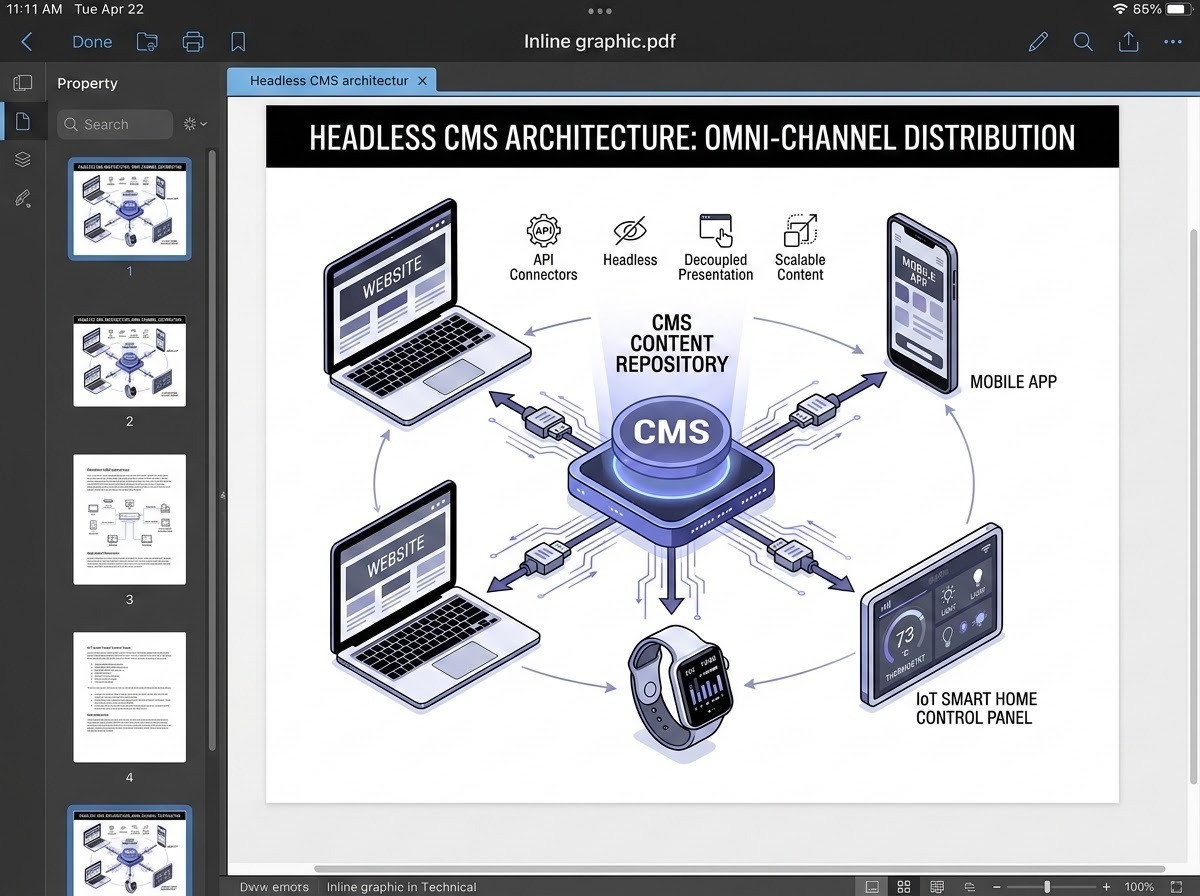
In the past, organizations would use a monolithic Content Management System where the back-end database that had the content was tightly integrated with the front-end presentation layer. Although easier to implement at first, such an archaic method is fast becoming irrelevant in the dynamic multi-device digital world of 2026.
Introducing Headless CMS—an innovative structural change in contemporary website development. The Headless CMS separates the back-end content management system (the “body”) from the front-end presentation layer (the “head”). The content is managed from one central place and is provided to any conceivable device using API integration.
This allows your company to truly achieve an omnichannel distribution model. Your marketing department can create a single item of content, which the headless CMS will deliver immediately to your company’s website, a native mobile app, smartwatch applications, digital point-of-sale devices, and even IoT smart-home devices. What’s more, thanks to the ability to decouple the front-end, developers are not bound by the constraining nature of any particular CMS architecture. The developers can leverage the best performing front-end technologies available.
The Bottom Line for Business: Using a headless CMS gives you flexibility and improved front-end performance. This technology future-proofs your content management needs by allowing your company to deliver content to the latest digital channels almost instantly without having to undergo the hassle of creating an entire website from scratch again.
4. Progressive Web Apps (PWAs) Continue to Dominate
In view of the fact that mobile traffic constantly exceeds desktop browsing, providing a perfect mobile experience becomes mandatory. Nevertheless, requiring customers to visit the app store, to download a hefty application, and waste the space on their gadgets is a serious source of friction. Introducing Progressive Web Applications (PWAs) – the technology that makes it possible to combine the best features of a website and a mobile app.
PWAs are essentially web applications that provide exactly the same experience as the native mobile app does. They feature super fast loading time, work in offline mode, and enable sending push notifications to the user's gadget via the standard web browser.
For businesses, there is one reason to consider developing a PWA only – financial and practical. Developing a separate iOS application, another Android app, and finally a responsive website will cost you more money than creating a single progressive web app that works perfectly well in any situation.
The Conclusion for Businesses: PWAs save your money on web development and maintenance while increasing the rate of mobile conversions at the same time.
5. Motion UI and Micro-interactions
In the very visual world of business website trends, static web pages may get quite boring for people. At the same time, over-complicated sites overloaded with heavy videos and large-scale JavaScript animations are known to have slow loading speeds and scare away visitors. A modern-day solution to that problem would be the use of Motion UI and micro-interactions.
Micro-interactions with the help of Motion UI involve small but effective CSS animations used to catch users' attention, give visual response, and create a natural and animated feeling of interface. Consider a button that turns into a checkmark after clicking on it, or a card that slightly rises after hover-over by users.
These small interactions are not simply there to give the site a modern appearance but rather play an important role psychologically as well. They provide incentives for the user’s actions, lower their cognitive load, and smoothly move them through the sales funnel process without their even knowing.
The Takeaway for Businesses: With a combination of good aesthetics and strong performance, Motion UI positively impacts your brand image and helps decrease the bounce rate of your website.
6. Voice Search Optimization (VSO)
As a result of the prevalence of smart speakers, virtual assistants, and voice-enabled in-car systems, how users conduct their searches has changed completely. The act of typing out one’s query has gradually been superseded by asking the question through voice commands. Voice Search Optimization (VSO) has thus become an essential element of web development.
Unlike typed searches, voice searches are lengthy and formulated as full-on questions with a high degree of conversationality. In response, web developers are employing voice recognition API and building sites that better cater to natural language queries. This includes using schema markup for maximum clarity of your content in relation to search engine bots, which will make it THE answer your voice assistant should announce.
Voice search optimization is a very similar process to web accessibility optimization. Making your site more accessible through screen reader commands means that not only you are doing yourself a huge SEO favor, but you also increase your target audience.
The Bottom Line for Business: Not taking into account voice search implies exclusion of a large and quickly growing group of users. Using VSO technology helps to attract conversational traffic and increase digital accessibility to make your business visible in the screenless search environment of 2026.
7. Zero Trust Architecture and Enhanced Cybersecurity
With the increased complexity and interconnectivity of web applications, the cybersecurity landscape has undergone a corresponding transformation. In 2026, the notion of perimeter security—where anything inside your company’s network can be considered trustworthy and anything outside of it cannot—is utterly outdated. The Zero Trust Architecture is the standard of web development of the future.
Zero Trust architecture is based on one very simple principle—"never trust, always verify." Whether a user/device accesses the web application from an external IP address or right from the office network, there is always a chance of a breach. This means that each and every access is rigorously authenticated and constantly monitored for anomalies.
From the point of view of web developers, the implementation of Zero Trust requires enforcing strong multi-factor authentication (MFA), using end-to-end encryption, as well as automating the process of vulnerability scanning in the pipeline. It requires the use of granular access controls so that users have access only to data which is needed for their work.
Bottom Line For Business: The loss of sensitive data through data breach in 2026 is not only an IT issue; it is a disaster for your company in terms of branding and finance. Zero Trust is here to help you protect your sensitive information, ensure compliance with growing regulatory requirements, and keep your client's trust.
8. Practical Blockchain and Web3 Elements
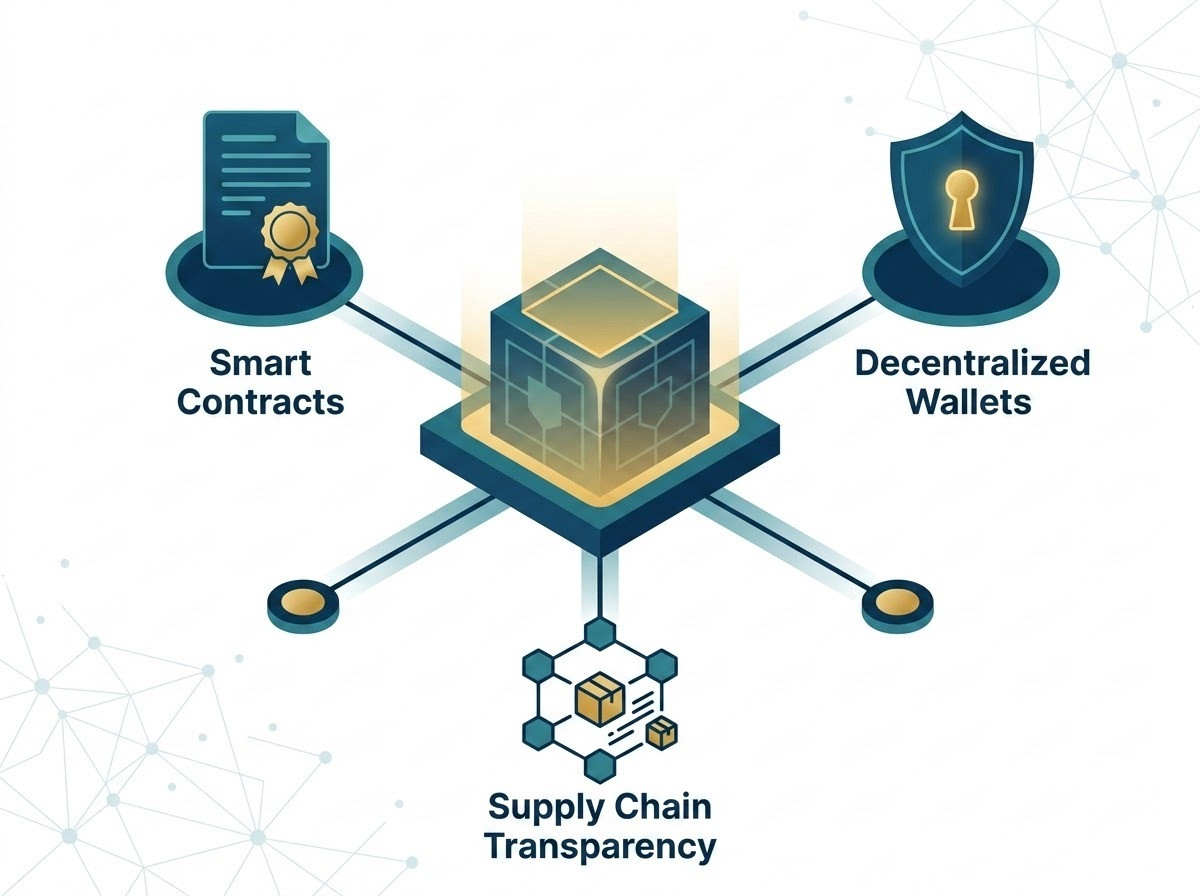
Whereas the initial buzz about cryptocurrency has settled down, the underlying technology—blockchain—is being applied in very practical, safe ways to modern web app development. There is an ongoing integration of decentralized (Web3) elements to make businesses more secure and transparent.
One of the best examples of the practical application of blockchain technology is the implementation of smart contracts on web apps. The smart contract is a self-enforcing agreement which doesn't require any middleman to be in place. This way, it becomes possible for B2B websites and online shopping websites to have a secure and transparent chain of supply, authenticity of the products and fraud-free release of payments when the product has been delivered.
Another area where blockchain elements have been transforming things for the better is data privacy. Instead of the business storing huge databases of user passwords and sensitive information, Web3 allows the identity authentication through a decentralized digital wallet of the user.
The Bottom Line for Business: Practical use of blockchain elements creates the unchangeable degree of trust and transparency that cannot be achieved by any regular database. It eliminates the need for costly intermediaries and minimizes the risk for your company regarding data storage.
9. Single Page Applications (SPAs) Evolving for Peak SEO
Single Page Applications (SPAs), created using popular JavaScript frameworks such as React, Vue, and Angular, have been the norm for years now. By updating the present web page by fetching new data from the web server rather than reloading the whole page, SPAs offer the user a very smooth experience similar to a mobile application.
On the flip side, SPAs used to be a major cause of concern for businesses due to their non-friendly behavior towards search engine crawlers, affecting SEO. 2026 marks a major change in this web development trend.
These techniques are being adopted by today’s developers in the form of meta-frameworks such as Next.js and Nuxt.js which are able to pre-render the pages on the server side before sending the results to the browser. This way, your content will be immediately accessible and indexed by search engines, while at the same time users will have a smooth experience that is typical of traditional SPAs.
The Bottom Line for Business: With the advancement of SPAs, there is no need anymore to make a choice between a highly efficient user experience and good search engine visibility.
10. API-First Development
Web development used to be a process where user interfaces were created in priority, while data connections were not considered until the very end. In our current ecosystem, things have to be done exactly the other way round – API-First Development should be applied.
With API-first, you plan out and implement APIs before even starting coding the application interface. With the communication guidelines being established right away, your web application is designed to be modular from scratch.
This is vital for businesses. A modern enterprise uses an enormous amount of external applications - Stripe for payments, Salesforce or Hubspot for CRM, Mailchimp for marketing, etc., and all analytics tools. API-first web application is integrated with such services effortlessly, safely, and fast. Also, it perfectly fits in with headless CMS and serverless infrastructure, where various teams can work on front-end and back-end simultaneously without any restrictions.
Conclusion for Business: API-first approach is the best driver of business agility. You can integrate new marketing or operational software tools in no time and for much less money.
Choosing the Right Path for Your Business
Even though the above trends will shape the future of the web, blindly following all of them at once is sure to lead to overspending and bloated project scope. The best digital transformations begin with conducting an audit of the current infrastructure of your business.
Start by setting your main business objectives. If you want to reduce the cost of customer service, go for the AI chatbots. If mobile conversions are what you strive for, then PWAs and Motion UI should be your priority. As an enterprise with ambitions of secure scaling, Zero Trust and Serverless architecture will be the foundation of your transformation.
After you have set your objectives, it is time to choose the appropriate web development trends based on them. The process can require expertise; that is why you need to partner up with advanced technical specialists to ensure your money is well spent.
Future-Proofing Your Digital Presence
A digital environment of 2026 needs more than a basic online presence, and it calls for a web infrastructure that is not only secure but also fast and intelligent. Right from the personalized capabilities of Artificial Intelligence to the multi-channel approach of Headless CMS and the enhanced level of security through Zero Trust, these are just some of the latest developments that form the standard for success.
Adaptability and keeping pace with the latest technology innovations are the only sure ways of staying ahead of the pack and delighting your customers.
Interested in making use of these web development technologies? Ready to future -proof your business?. Gigmint web development experts can help you implement Ai, cloud-native architecture ,PWAs, and scalable web solutions tailored to your goals.
Frequently Asked Questions (FAQs)
Which web development trend is currently the most important one for business owners?
Though all trends have considerable benefits, AI and Machine Learning would probably be the most innovative ones. The use of AI enables the creation of personalized content, customer service with the help of LLM-based chatbots, and considerably speeds up the development process providing immediate ROI.
Are traditional sites outdated in 2026?
Yes and no – having a static brochure site is not enough to stay in the game. Modern clients want an interactive, fast, and secure experience. By switching to more advanced technologies such as PWAs and API-first, you will be able to provide this experience and convert visitors to clients.
What is the difference between PWAs and native mobile applications?
Progressive Web Apps are web applications that are available via mobile browsers; these types of applications have the same interface as well as the features of the native application, including availability offline, fast loading, and notifications. The most important feature is the lack of necessity to download the application from app stores, which allows saving money needed for the web development and support of two versions of the app for iOS and Android systems.
How can small or medium-sized businesses afford new technologies on the web?
Modern technology trends are very cheap in use. For instance, Serverless Architecture works according to the pay-per-use scheme, which means that you will pay only for the amount of computer resources used by the application. Another way to save money is the usage of API integration.
How long does it take to upgrade my current platform using these trends?
The timeline is quite variable based on your purpose. An easy integration, such as integrating an AI chatbot or adding some Motion UI, would probably be completed within a couple of weeks. A total rebuild of the website in terms of a Headless CMS or PWA, on the other hand, may take many months. An audit from a company like Gigmint would give you an accurate timeline.