Custom Website vs. Website Builder: Which Is Better for Your Business
Custom Website vs. Website Builder: Which Is Better for Your Business
Choosing between a custom website vs website builder is one of the biggest decisions a business will make when building its online presence. The right choice depends on your budget, growth plans , customization needs and long-term goals
As we move into 2026, this question gains even greater significance. Considering the increasing preference of search engines for AI-driven responses and the stringent metrics regarding user experience, the architecture of your website cannot be taken simply as a technical issue—this is a business strategy that you need to consider.
Website builders are recommended to startups, solo entrepreneurs, and local businesses, which need to achieve quick and inexpensive launching to get a foothold online or test out their business ideas. In contrast, custom websites should be considered by already operating companies, expanding businesses, and aspiring brands that need something more advanced, such as special functionalities, full control over technical SEO, and performance architecture.
This thorough guide prepared by the digital strategy experts from Gigmint.ai is here to cut through all marketing hype and provide you with an objective and technical comparison.
Key Takeaways: What You Will Learn in This Guide
-
Architecture and Ownership: Core differences between leasing a SaaS solution and owning the digital asset in its entirety.
-
The True Cost (5-Year TCO): A comparison of initial capital expenditure requirements versus the TCO in the long run.
-
Performance & Search Engine Optimization Ranking: The effect that choosing one route over another will have on your SEO ranking in the age of AI Overviews and Security Protocols.
-
Choosing Your Path Scenario: An easy-to-use decision matrix designed to help you select the right route.
II. Understanding the Basics: Definitions and Core Differences
Prior to exploring the intricate metrics of technical SEO and CRO, it is essential that we define both methodologies and understand precisely what we are talking about when discussing these two different methods of website development. The landscape has changed greatly, and so have the definitions.
What is a Website Builder?
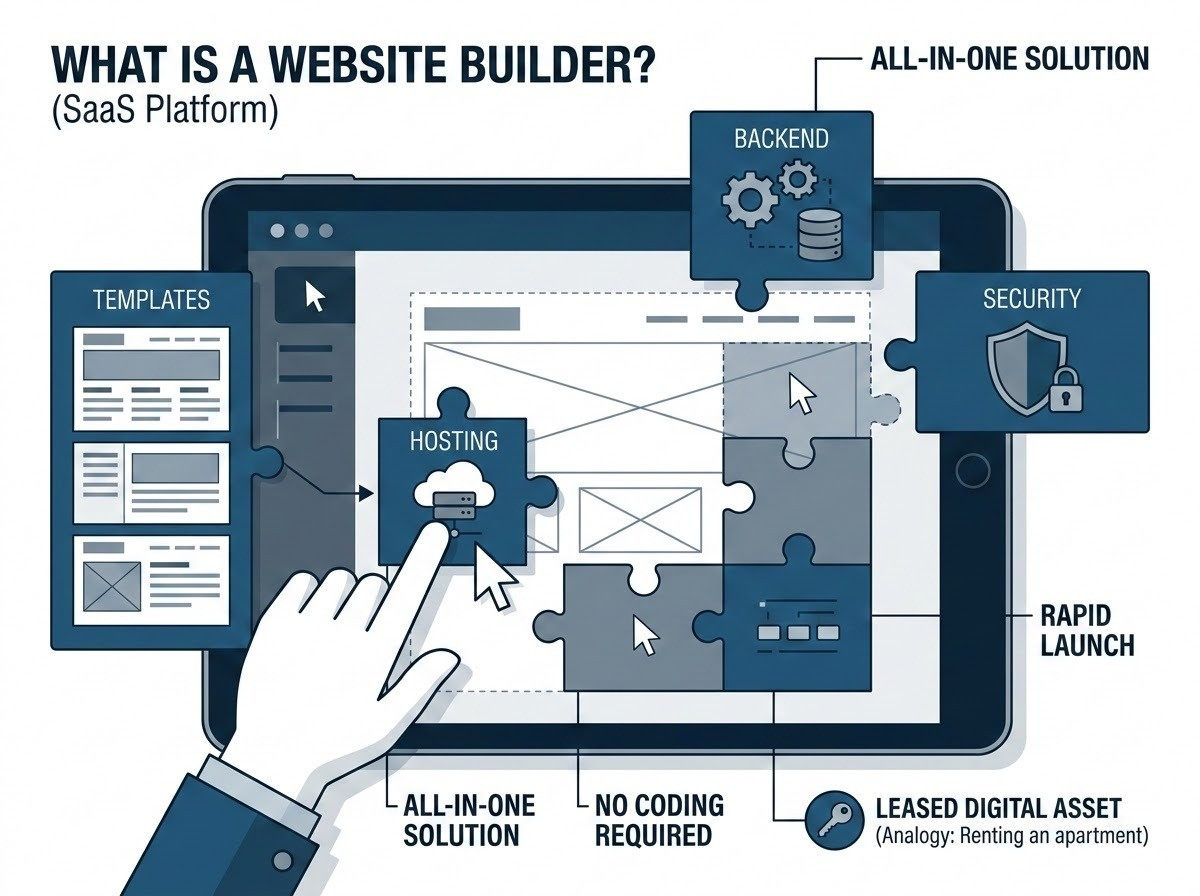
Website builder refers to the SaaS platforms that provide the functionality required for building, managing, and hosting a website without the need for coding knowledge.
The website builders utilize easy-to-use graphical user interface (GUI) and thousands of pre-made templates. Using website builders, the platform provides all-in-one services where the provider takes care of the backend servers, CDNs, hosting, and other security features.
The main market players include Wix and Squarespace, which offer solutions for general-purpose sites, while Shopify and BigCommerce cater for ecommerce solutions.
Evolution of Builders: website builders have made significant improvements in their technology. From basic flash editors to very advanced and sophisticated systems with app marketplaces to add additional functionalities such as email marketing, CRM tools, and social media integrations with a click.
The Analogy: Imagine yourself building a website through the use of a website builder, but imagine this process as though you were renting out an apartment in a luxury tower block that has everything taken care of for you. You could move around the furniture, paint the walls inside, and even put up your own artwork to make it your space. But you are not allowed to knock down any walls, install any plumbing, nor are you allowed to build any additional wings to the building.
What is a Custom Website?
Custom Website refers to a bespoke website developed from scratch by website developers utilizing the fundamental programming languages or a customizable content management system (CMS).
As opposed to building websites, custom development does not involve fixed templates and an enclosed software-as-a-service (SaaS) ecosystem. All the elements – ranging from the design of UI/UX to the database architecture, server setup, and APIs integration are tailored to address the unique needs of your business.
Modern Custom Stack: Whereas "custom" in 2026 will no longer refer to coding all HTML tags from scratch, custom development in this era makes use of the "Headless" architecture or composable commerce. The frontend of the website which includes what users interact with (usually built using advanced JavaScript frameworks like React, Vue, and Next.js) is separated from the backend database (which could be a custom WordPress, Contentful, or a bespoke Node.js application).
Analogy: Suppose a web design company is renting an apartment for you, then creating a customized website for yourself is akin to purchasing your own land, hiring architects and contractors and building your own house according to your requirements. In this way, you will be able to have complete authority over how deep you want the foundation to be and what material should go into making the structure.
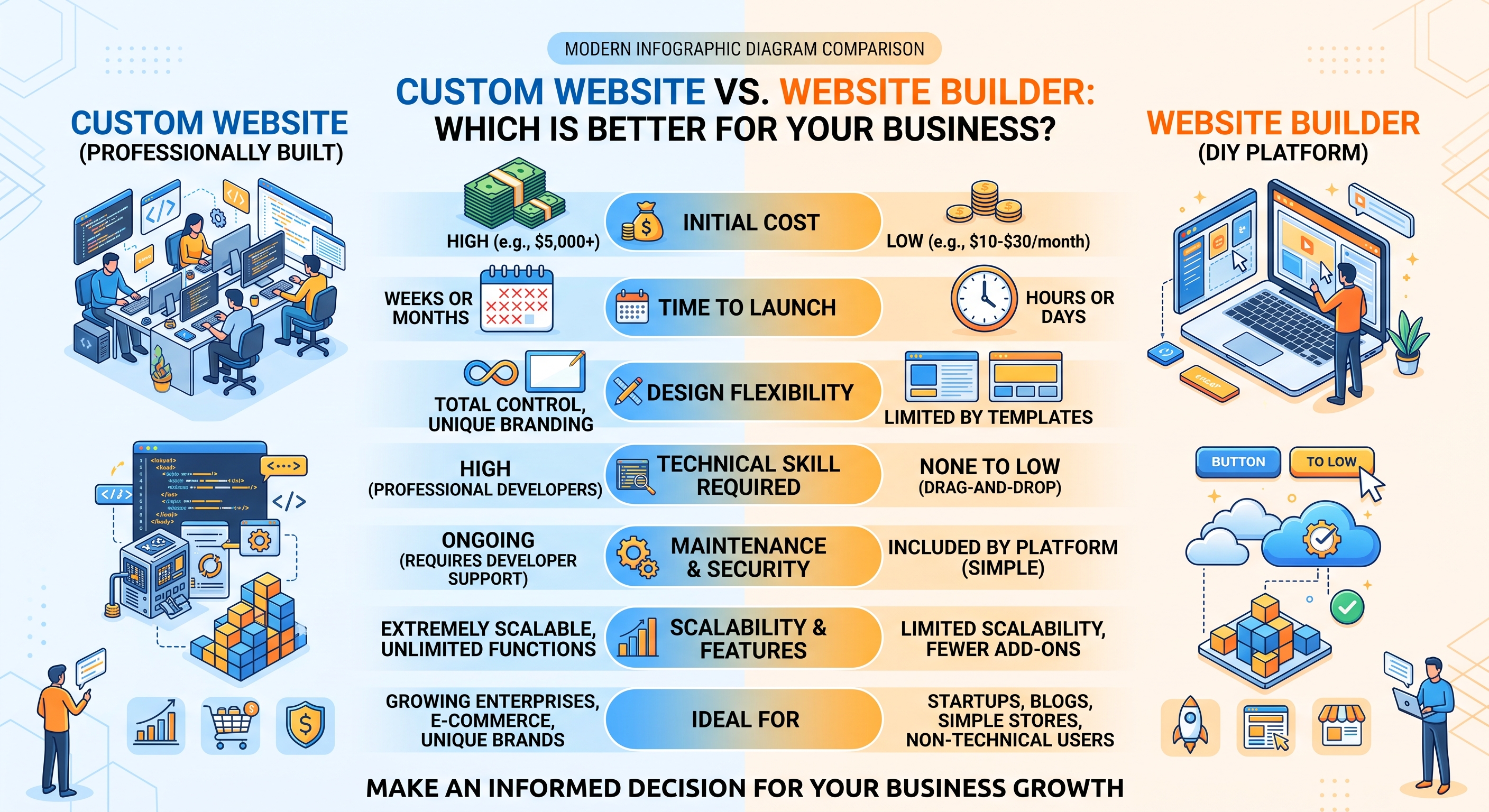
III. Head-to-Head Comparison: The 6 Critical Factors
In order to make a well-informed choice, companies have to look beyond the launch stage. Websites are living digital assets, and your choice of a platform will determine how agile you will be for many years. This is an insight into the six key aspects that distinguish custom websites from website builders.
1. Cost and Budgeting (Short-term vs. Long-term TCO)
Quick summary: Web builders provide dependable, affordable points of entry ideal for tight budgets but tend to incur large unforeseen costs in the future. In contrast, custom websites demand an initial Capital Expenditure (CapEx) but often result in a much better Return on Investment (ROI) and significantly reduced scaling costs.
Website Builders: The Subscription Plus Add-ons Approach The key allure of website builders lies in the astonishingly low cost of entry. One can set up a professional website for a monthly subscription that costs between $15 and $300+. This ensures that budgeting becomes very easy for start-ups at their early stages.
But the Total Cost of Ownership (TCO) sneaks up quietly. Website builders employ a "freemium" model. With your growing traffic, you will have no choice but to go up the pricing tiers.. Websites are dependent on third-party plugins which enable you to use advanced SEO tools, client testimonials, customer loyalty programs, and cart abandonment recovery. All of those come with their own monthly fee.
With ecommerce, most builders charge you a portion of your revenue via transaction fees if you are not using their proprietary payment gateways. Businesses scaling to $1M in revenue via builders could end up paying several thousands of dollars per month on the fees.
Custom Websites: The Asset Investment
A custom website represents an investment. The cost for the initial website build varies between $10,000 to over $100,000 depending on the complexity and the agency you hire for this. This includes the professional web design process (UI/UX), the development part (front-end and back-end), QA testing, and technical SEO architecture.
Though the initial price tag is considerably higher, the continuing costs are entirely different. With the site built, your ongoing costs will typically be limited to hosting fees on typical servers (AWS, Digital Ocean, Google Cloud), domain renewals, and the occasional developer maintenance. As you are no longer shelling out money on high-end subscription packages for third-party software applications, the TCO often plateaus over time.
Scenario After Five Years: Let's take an example of an ecommerce company that is growing fast. In year one, they will be spending about $5,000 in SaaS platforms; after year five, platform costs, application subscriptions, and transaction fees could bring up their costs to around $40,000 yearly. On the other hand, while the upfront cost of a custom-built website is $60,000, yearly costs remain $5,000.
2. Customization, Design, and Brand Identity
Answering The Question Directly: Website builders are restricted to their own templates and grids, making it very difficult to stand out among the competition, not to mention the impossibility of including any unique features. With custom websites, there is unlimited freedom when it comes to design and functionality, guaranteeing everything works according to plan.
Website Builders: Trapped by Templates Modern website builders have amazing templates which appear "good enough" to many local businesses. The problem here is that there may be tens or hundreds of thousands of other businesses, including your competition, who are using the same template for their websites.
Changing colors, fonts, and images is easy. Changing the grid and overall structure of the website is usually impossible without losing its responsiveness on mobile devices. Using a template limits your options regarding how you present your brand. It requires you to adapt to the limitations of the software rather than creating the ideal UX for your specific target audience.
Custom Website: Freedom to be Creative and Accessible The design of a custom website is solely based on the business plan rather than any software. This gives you the freedom to chart out the exact journey your users will take with data analysis, and customize the interfaces accordingly.
This means that no matter what it is — complex micro interactions, special 3D configurators, augmented reality integration, or creative visual storytelling — custom development will ensure your online store is exactly how your brand looks.
Apart from that, custom websites make sure you abide strictly by the Web Content Accessibility Guidelines (WCAG) and the Americans with Disabilities Act (ADA). Even if your builder has some basic accessibility options available, custom development can code your website right from the beginning to make sure it works perfectly with screen readers, keyboard and has proper color contrast.
3. Scalability and Future-Proofing
The Bottom Line: Website Builders Are Good for Getting Started But Often Face a "Glass Ceiling" in Terms of Functionality and Databases. Custom websites utilize modular architectures that enable infinite scalability along with your business activities.
Website Builders: Hitting the Glass Ceiling With the growth of any business, there is a huge need for much more advanced technology. You may want to develop custom portals for customers, integrate with various APIs using a proprietary CRM or ERP system (Salesforce, SAP), handle complex multi-language localization with regional-specific content, or work with a database containing 100,000+ SKUs.
It is extremely difficult for website builders when it comes to customizing websites with unique features. The fact of the matter is that you will be completely dependent on the development roadmap of the platform you're using. If the feature isn't supported in the platform or the marketplace, then there's no way to get that feature implemented into the website at all.
Custom Websites: Composable Architecture and Infinite Expandability Custom websites are developed from the ground up to make sure that they're future-proof. The developers can integrate literally any kind of modern day API, create a custom relational database for it, and extend its architecture in any possible way.
The cutting edge of custom scalability by 2026 will be composable commerce architecture. It means that the website will consist of independently running best-of-breed components (checkout component, site search component, CMS component). If there comes a new amazing AI customer service solution next year, you can just take it out of the old system, and put a brand-new one right into place via APIs.
4. SEO (Search Engine Optimization) and Performance
Even as website builders have advanced their own SEO skills, they are limited by their inability to overcome an issue of code bloat that affects their page speed and the Core Web Vitals. The custom websites provide total and complete control over technical SEO, schema markup, and performance optimization, making them necessary if you want to win in competitive search landscapes.
The Problem with Website Builders The platform of builders such as Wix, Squarespace, and Shopify have made huge advancements in the area of basic SEO (meta tags, dynamic XML sitemaps, clean URLs, and simple redirects).
As they use a one size fits all codebase that is meant to accommodate any functionality offered by any template and every third-party app that a non-technical person may install on his site, they end up with "code bloat".
This greatly reduces the loading time of pages. The search engines prefer to optimize websites in terms of user experience, such as through core web vitals including INP and LCP. This slow loading speed, along with the shared hosting environment which is uncontrollable, becomes a constant drag on your organic rankings.
Custom Websites: Engineering for the AI Search Engine Custom websites are efficient by nature. In the development of the website, only the exact amount of code required for the functionality of your website is written. This ensures very quick load times, smooth mobile performance, and efficient server responses.
In search evolution, where it will shift from keyword searches towards AI overviews and advanced generative search experiences, context plays a great role in the search process. In this case, there is great scope of technical SEO in custom builds in terms of Schema markup, dynamic rendering, and internal linking structure.
5. Ownership, Portability, and Data Sovereignty
Answering the Question Head-on: You do not actually own the website constructed through the SaaS builder; you rent it. Websites that are custom-built allow you to be the true owner of all your intellectual property, raw code, and especially customer data.
Website Builders: Locked in By the Vendor All you are ever doing when using a website builder is agreeing to all their Terms of Service. Should they decide to hike their prices by 50%, you’ll have to accept that. In case they believe that some item you’re selling doesn’t conform to a new rule, they can simply shut down your website.
You can never transfer the website to another hosting company. The code is theirs to begin with. In case you want to leave, you can’t transfer the design or even the functionality of your website; it’ll have to be rebuilt elsewhere from scratch.
Custom Sites: True Digital Asset Ownership and Data Privacy A custom site belongs to you. It contains the custom-built code base, assets, databases, and server settings. This makes the process completely portable. In case the hosting company does not perform as expected or charges too much, your dev team can move your site to another server in just a few hours. You will be the only one in full control of your digital asset.
With your ownership of the database, all the stringent data privacy requirements such as GDPR in Europe or CCPA in California become completely manageable. You have full control over how the data is hosted, encrypted, and accessed, which greatly reduces any potential liabilities that arise when using a third party’s cloud services.
6. Security and Maintenance
Quick summary: Website builders provide effortless security and maintenance, which can be a great relief for small companies that don’t have their own IT department. Custom websites need regular maintenance but also enable you to establish advanced, custom-made security measures.
Website Builders: Peace of Mind What makes website building most appealing to many small business owners is the lack of hassle regarding IT maintenance. The engineers responsible for the platform take care of all major updates of the software itself, security measures on a global level, DDoS attacks prevention, and automatic renewal of the SSL certificate.
Custom Websites: Custom Security & DevSecOps Ownership The benefit of having a custom website is that you (or your hiring agency) own its maintenance. It is your duty to update the CMS kernel, external libraries, server software, and other components to ensure the absence of potential threats to the application security.
The ability to do so becomes the main benefit of having a custom website in case if your company operates in one of highly regulated industries such as healthcare, finance, defense, or law firms, where it is necessary to comply with certain standards like HIPAA or SOC 2 Type II, deploy customized WAF, implement unique encryption technologies, etc.
IV. The Decision Framework: Which is Better for your Business?
The critical part lies in the knowledge of where your company currently stands, the amount of capital you have, and where you would like to take it in 3 to 5 years from now. This list offers specific scenarios to help you make the choice.
When to Use a Website Builder
You should use a website builder if:
-
You are at the Validation Stage: You are exploring an idea, creating a product or a service and require a minimum viable product (MVP) website to check the market response without spending a lot of money on development.
-
The Budget is the Key Factor: The entire project budget does not exceed $3,000, and you do not have sufficient cash flow to spend on capital investments.
-
There is a Time Constraint: You need to have a website launched in days or weeks.
-
There are No Advanced Requirements: You are a local business person (plumber, landscaper, coffee shop), and all you need is an online brochure along with some contact forms or a micro-ecommerce site with a few products.
When to Invest in a Custom Website
You will need a custom site when:
-
You Are an Established or Scaling Brand: The website is the major driver of revenue for your business and you have already surpassed out-of-the-box solutions that are holding back operational efficiency.
-
You Need Advanced Functionality: You require developing custom web applications, advanced multi-vendor e-commerce sites, interactive customer portals, or advanced bi-directional syncing between ERP systems and other web solutions.
-
SEO Is Your Major Lead Generator: You are in a highly competitive industry where milliseconds in page loading time, flawless technical SEO, and complete domination over AI Overviews separate you from millions of revenue or obscurity.
-
Security and Control Are Paramount: You process sensitive customer information, have strict compliance requirements, and refuse to jeopardize your business with vendor lock-in.
The 2026 Compromise: The Hybrid Approach
It is important to note that there are some mid-level firms that have started to adopt this mixed approach. It is an approach in which a very reliable headless CMS, such as Sanity or Contentful, is adopted and controlled by the developers while a visual frontend builder, like Builder.io, is used where marketing teams can drag-and-drop landing pages without coding.
V. Transitioning: Moving from a Builder to a Custom Build
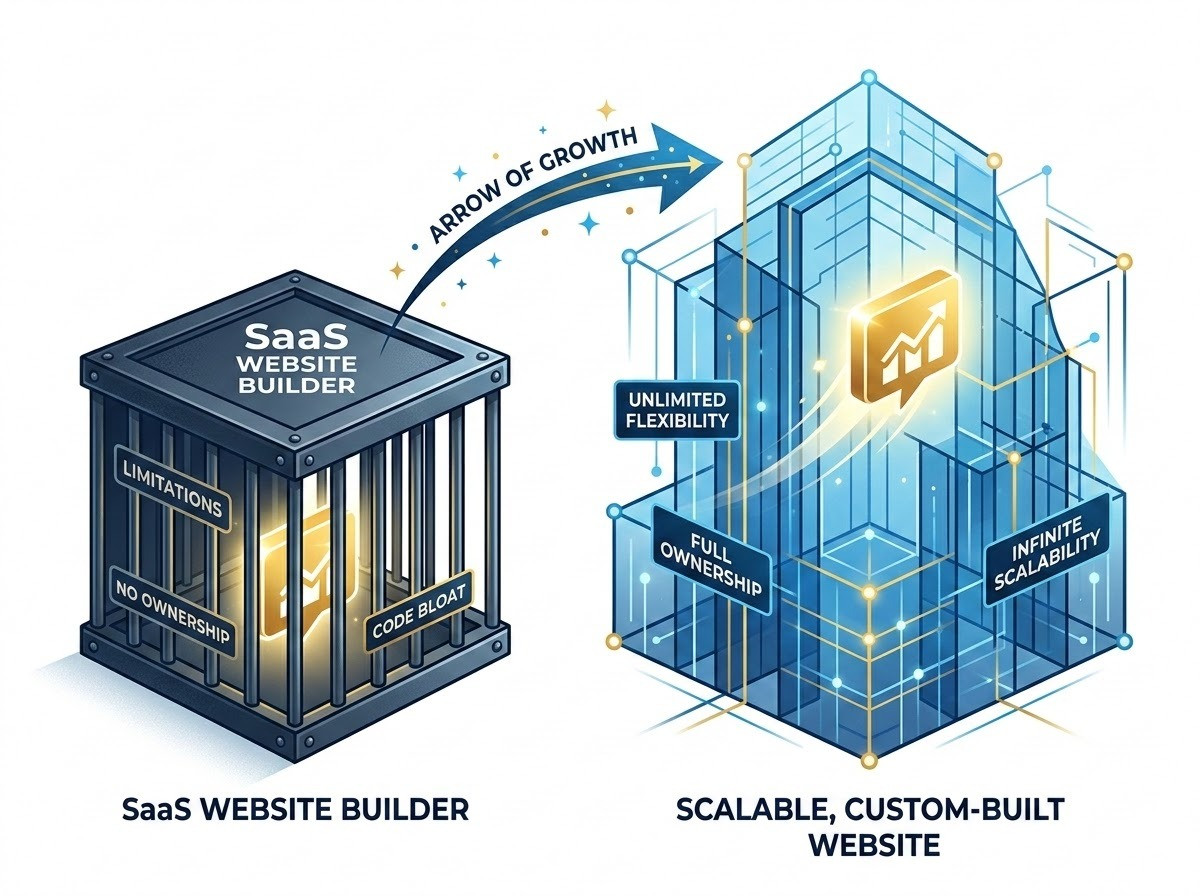
It is all too typical a story that a successful business grows to such a degree that it begins to grow beyond the capabilities of its website builder. When your existing SaaS is becoming like an iron cage—pages load slowly, integrations fail, and you cannot implement any additional feature which your clients want—you have to change to custom-built software.
But migration to custom software is never as easy as it may sound. The fact is that there is no way to export either source code or database structure from proprietary builders.
Migration Checklist: Your development and SEO agency will have to implement a careful migration strategy:
Building a New UI/UX: Constructing the whole frontend experience from scratch.
Data Migration: Safely exporting and transferring your databases of customers, orders history, and blogs via CSV files or API scraping.
The SEO Lifesaver (301 Redirects): Developers should carefully create and set up each single redirect from your old website built with a page builder to the corresponding pages on the new custom one. And if it is not done right, you can forget about the years-long accumulation of organic traffic on your site.
Pre-Launch Testing: Careful performance audit that will confirm that the new custom infrastructure will pass all Core Web Vitals requirements.
Even though such migration requires much work and money, the gain in terms of performance and SEO almost always make it a worthy decision for scaling companies.
VI. Call to Action
The issue of choosing a custom website over a website builder does not generally have anything to do with deciding which of the two technologies is objectively "better." Rather, the question here is which one fits better with the particular stage of your business development.
Using a website builder is an excellent way to make yourself known today, to get started quick and cheap and look good. Having a custom website means building something for tomorrow, something that can scale up and be very secure and unique, just like you will, without the restrictions imposed by rented grounds.
When you find yourself struggling with the limitations of the current platform that you use, falling down the ladder in search engine rankings because of slow speeds, or are about to introduce a new brand that requires a robust online presence, then you don’t need to go through the process on your own.
Get in touch with the team of experts in digital strategies from Gigmint.ai right away to explore how a custom web development plan can help you achieve success.
VII. FAQs (Frequently Asked Questions)
1. Can a custom website be said to be better than the likes of Wix and Squarespace when it comes to SEO? Yes. Though there are good SEO options within a builder, custom websites give you total control over technical SEO. This translates to quicker server responses, optimally structured codes (no more bloated codes like those found in builders), as well as advanced structured data implementation for better rankings.
2. How much is a custom website compared to a website builder? A website builder costs about $15 to $300 monthly subscriptions. A custom website will demand that you have a bigger upfront capital outlay (beginning at $10,000 and beyond) but the TCO is cheaper than that of a website builder.
3. Is it easy for me to transfer my website straight from a builder to a custom WordPress or headless website in the future? No, because of proprietary software used by builders, you cannot export the code of the website. The developer needs to make a new custom site, copy all of your text content, images and domain routing using 301 redirects to maintain your current SEO rankings.
4. Do I have to be good at coding to operate my custom website after it is made? No, because of the fact that modern custom sites come with intuitive Content Management Systems (CMS). Your development team will set up an easy-to-use backend dashboard just for you to manage text, publish blogs and even add products without having to write any code.
5. How much time does it really take to develop a custom website vs website built with a tool? To use a website builder, a dedicated person can launch a basic website within a week or two. Developing a custom site takes quite a lot of time – usually 8 to 16 weeks or more depending on the level of complexity of the project.
6. Are website builders safe enough for a growing ecommerce website? Yes, top ecommerce website builders such as Shopify and well-known website builders like Wix have excellent security features in line with industry standards and are PCI-DSS compliant right off the bat. They are extremely safe for executing regular online transactions. But, if you need particular compliance measures (such as HIPPA compliance), then you will need a custom build.
7. Why do most enterprise-level companies prefer custom websites? Large companies need custom websites since they require unique functionality (such as integration of complex ERP/CRM systems), unlimited server capacity to accommodate any traffic spike, unique branding that cannot be achieved using templates, and complete ownership of their intellectual property and customer data.
8. Would switching to a custom website lead to better conversions? since custom websites enable custom UX design that caters to your exact audience’s habits. Page load speeds associated with custom websites are much faster, which translates into lower bounce rates and high conversion rates.
9. What will happen if the website builder I am using goes bankrupt? Your website will be deleted along with the platform since you don’t own either the platform or the underlying code. This is the main issue with being in a vendor lock-in situation – you’ll have to rebuild your whole web presence from scratch using another platform.
10. Would custom websites crash more frequently than website builders? No, not at all. Custom websites need constant maintenance. If you won’t update your CMS (WordPress or others) and plugins for several months, your website may simply break or get hacked. But if you keep your custom website up-to-date via regular updates by an assigned developer, it will be highly stable and protected.
.