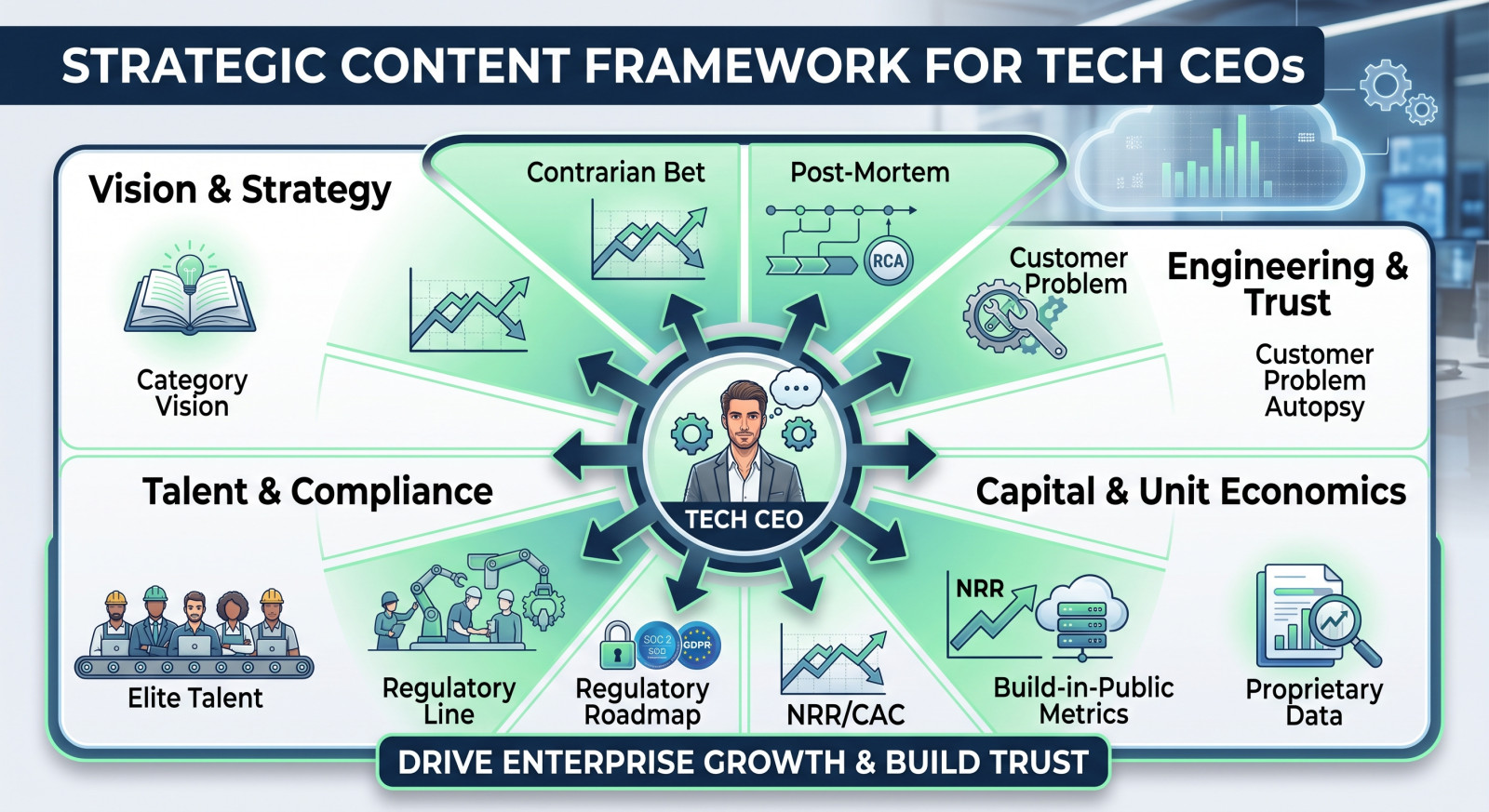
Executive Knowledge: The New Competitive Digital Asset
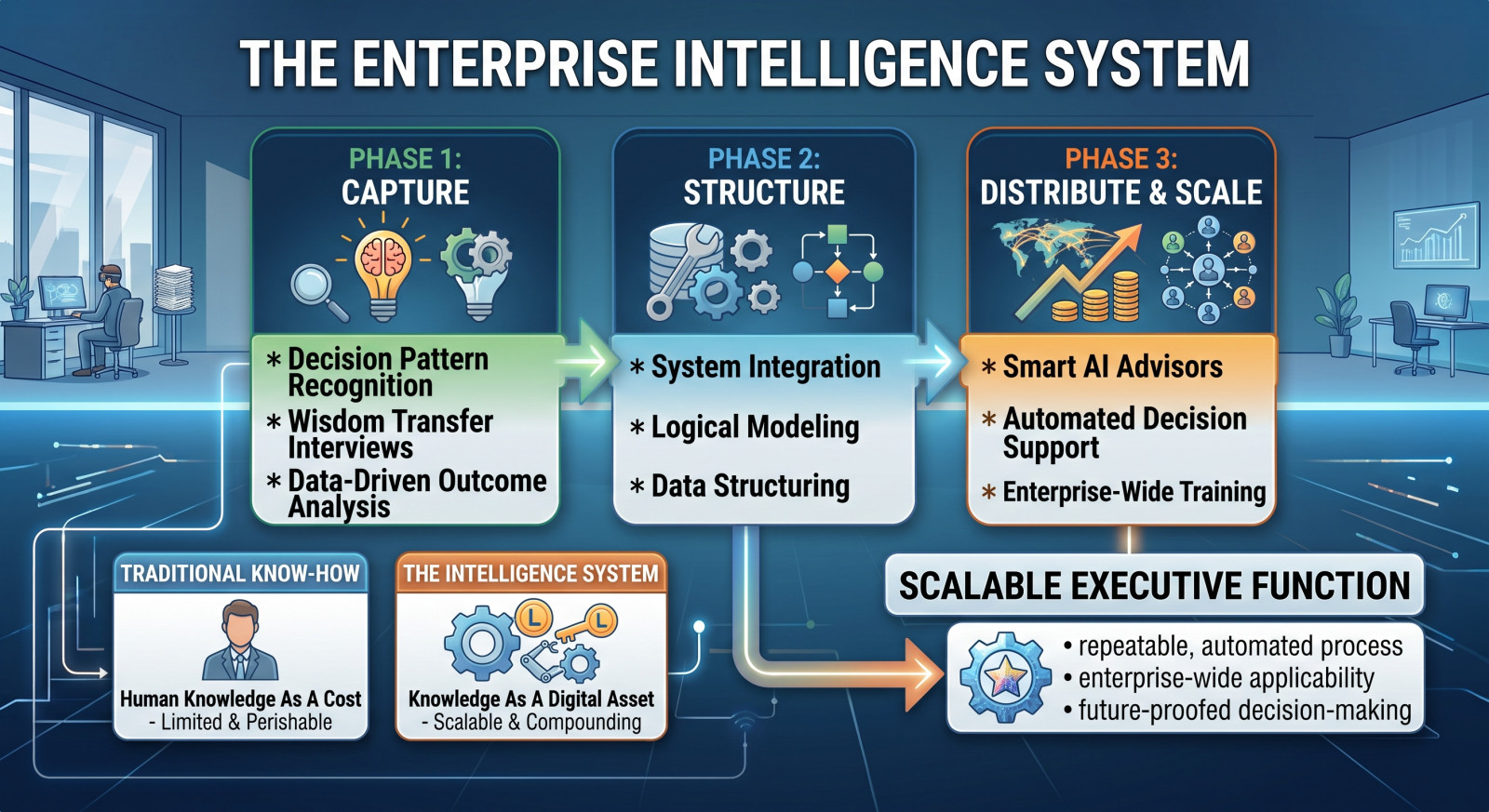
Executive Knowledge: The New Competitive Digital Asset
Generations of painstakingly accumulated experience on the executive level was traditionally limited to board meetings, internal quarterly assessments, and secret strategic planning.
Throughout many years, the accumulated intellectual property of an enterprise CEO remained solely inside the physical borders of their presence.
The perspective of an executive could not be tapped into by the company, the market, and its potential customers without the physical presence at the meeting table.
This model is being fundamentally challenged by the fast-paced digital transformation era we have entered. Every business nowadays functions in a reality of constantly shifting markets, intense implementation of technology, and huge oversupply of automated generic content.
Millions of such blog posts, white papers, and social media updates are generated weekly by the help of generative AI systems. This situation leads to a serious trust crisis of the internet.
The decision-makers are tired of generic information and do not want yet another executive summary created by the machine or junior writer. They crave the operational reality verified in the process of work.
Systematically bundled, delivered, and leveraged, executive knowledge shifts from a fleeting operational cost to a sustainable, defendable digital asset that delivers competitive advantage through customer acquisition and brand equity.
In the upcoming few paragraphs, you are going to learn why considering strategic leadership knowledge as an asset will transform the way your business grows.
You will also discover how domain authority is measured by modern search engines and AI algorithms, how niche-based talent markets allow for fractional advisory models, and how to turn leadership skills into compounded business value.
Redefining Leadership Capital: What It Means to Build a Digital Asset

In order to understand the shift in paradigms, one must think again about what an asset is in the context of the digital world.
An asset is considered an economic resource that is able to provide ongoing cash flows in the future, to maintain its value in the long run, and to compound. This applies to such things as equipment, real estate, software code, and patent portfolio.
Human knowledge was considered as the cost of doing business rather than an asset. You hire a certain executive to pay him a salary, and as a result, he gives you his working time. When the executive is not at work anymore or leaves the company, all his intellectual property goes away. This is called ephemeral capital.
Converting executive knowledge into digital assets solves the problem. The asset version of executive knowledge is organized in such a way that it becomes available to give value again and again without the need of the executive's constant presence.
The Four Dimensions of Assetized Leadership
Turning personal judgment into a sustainable company resource takes place across four different operational dimensions:
Formalized Operational Frameworks: Great leaders tend to have proprietary frameworks built into their thinking. How do you evaluate risk? What does restructuring a poorly performing engineering team look like? How do you begin an enterprise sales engagement?
By converting executive judgment into digital artifacts, like diagnostic frameworks, playbooks, and decision matrix models, you generate templates for scalable success.
Search and Algorithmic Impact: Thought leadership at the strategic level shouldn’t be restricted to internal slideshows. By publishing on indexed platforms, your views become searchable nodes of expertise.
AI-based search tools, discovery engines, and corporate buyers reference these assets when considering solutions in your space.
Fractional and Modular Advisory Expertise: The ability to assetize your insights means you’re no longer tied down by forty-hour workweeks.
Through new digital talent networks, executives can provide their expertise on-demand, serving as fractional advisors or consultants to high growth firms and business units.
Digital Brand Equity and Trust Signals: In business-to-business enterprise sales, one does not sell software or services; one sells the promise of a successful business result.
An executive who is clearly competent in the intricacies of an industry creates a halo effect that will immediately speed up the enterprise sales process and raise deal sizes.
Traditional executive capital is, of course, always finite – limited by time, constrained by siloed operations, non-indexable on the internet, and dissipating upon the departure of individuals.
Digital executive capital is always ongoing – worldwide in reach, permanently searchable on the web, and infinitely scalable.
How Modern Search Engines and LLMs Evaluate Executive Authority
If you have been following search engine trends for the last couple of years, you have seen some serious recalibrations. Search algorithms have evolved from mere keyword density and number of backlinks.
The introduction of the Search Generative Experience by Google and research engines powered by LLMs has totally changed the game.
Under such new dynamics, informational articles are no longer drawing traffic. When an article only reiterates definitions that are available in a hundred other sources, the search algorithm provides the answer itself right there in the search result page. It saves time for the user who doesn’t even click on the link of the website.
The only way to get organic visibility, branding, and engage with buyers is to offer information that the algorithm cannot synthesize by itself.
Google’s E-E-A-T and the Premium on Real-World Experience
Guidelines for Google's search quality raters place great importance on E-E-A-T: Experience, Expertise, Authoritativeness, and Trustworthiness.
Though experience and trustworthiness are quite new additions to the algorithmic criteria, the concept of expertise and authoritativeness has been around for quite some time.
The presence of executive expertise is valued by search engines since it brings novel perspectives into the indexing process.
Everybody can instruct an artificial intelligence model to generate a guide on merging companies and integrating them into one system.
But very few will be able to share their experience of how two legacy enterprise software systems collide while being merged for several millions of dollars, or how to keep salespeople motivated when a regulatory issue holds the shipment back.
Here are the specific clues in the structure which aid in the identification by the algorithm that the piece is a summary and not executive wisdom:
Heuristics Using First-Person Narratives: Ground level stories about trade-offs and edge cases rather than merely definitions.
Negative Constraints and Failures: Specific information about what to avoid which reflects operational experience.
Framework Jargon: Unique language of frameworks that creates unique entities in the knowledge graph.
Decision Reasoning: Explanation of why decisions were made for capital allocation or risk management.
AI Search and the Hunger for Primary Sources
Big language models and AI Q&A engines don’t manufacture authority out of nothing – their outputs come from high-certainty primary sources.
In the case of an enterprise buyer asking an AI engine, “What are the common failure modes of going from the licensed enterprise model to a SaaS consumption model?”, they will seek the perspectives of authorities who know firsthand what it takes to make this shift.
If your executives have captured the operational blueprints of your business processes in writing on the internet, then you become that authority in AI algorithm results.
Now your SEO is no longer just keyword-based but has become authority-based. You’re not competing with generic affiliate blogs anymore; you’ve created an intellectual barrier for AI to keep coming back to.
Monetizing Executive IP: The Economics of Fractional Advisory
Insight of executives becoming an asset is not just about a branding or SEO play but rather about a restructure of how talent makes money.
This is the emergence of a fractional and advisory economy, a business model that separates insight and clarity from conventional corporate structures.
Access to the insight of top-level executives meant making significant financial investments – executive contracts, stock awards, and lengthy recruiting processes.
The above-described business model does not work well for early-stage companies, middle market businesses looking for a digital transformation, or private equity funds trying to fast-track their portfolio.
Experienced executives themselves are growing weary of the limitations of the corporate system and are willing to seek other career options.
Modern Talent Marketplaces and Frictionless Strategic Access
It is in this area that contemporary digital talent marketplaces redefine the realm of executive capabilities. The need for instant executive expertise has led to the emergence of viable opportunities for platform development.
With solutions such as Gigmint or specific advisor networks, companies can leverage executive expertise without the hassles, cost structures, and time constraints associated with traditional recruiting practices.
Rather than undertaking a long recruitment process, the company is able to identify specific capabilities and bring on fractional executives almost immediately.
Such approach works well both for enterprises and for executives themselves:
For Enterprises: Companies get immediate, targeted access to executive expertise without the burden of long-term contracts while being assured of having needed advice to mitigate high risks of failure.
For Executives: Professionals get an opportunity to turn all their experience gained through many years of work into diversified revenue streams that have nothing to do with any hourly wage or stock performance.
The Dual Flywheel of Direct and Indirect ROI
The process of monetizing your executive experience as a portfolio allows you to create a positive feedback loop, which provides financial gain both directly and indirectly.
Monetized executive experience produces a stream of cash flow by means of advisory retainers, fractional C-level involvement, participation in boards of directors, and diagnostic programs. The payment is made according to the level of your knowledge, not hours spent.
Your digital asset portfolio serves as a business development tool for your core business:
Reduced Selling Time: When the clients see your strategic dissections, they avoid the educational stage and come directly to solution assessment.
Higher Premium Pricing: Proof of authority eliminates you from competitive pricing. Your clients will be willing to pay a premium price due to the fact of your expertise being proved.
Strategic Inflow: Media, business partners and talent will be looking for you because of the vision of your leaders.
Bridging the Talent Gap: Solving Enterprise Friction with Liquid Knowledge
Modern organizations are continually caught in an ongoing paradox of their operations. The rate of advancement in technology and customer tastes, as well as the dynamics of global markets, continues at an exponential rate. On the other hand, the traditional hiring process within any organization continues incrementally.
Every time a new problem faces the organization, like adopting generative AI in its existing software, implementing its own sovereign data security system, or reworking its global supply chain, it doesn’t have the manpower to implement its plans immediately.
Hiring a permanent VP or C-level executive takes no less than nine months. Nine months in today’s fast-paced world could be disastrous for the organization’s strategy.
The Agility Dilemma in Modern Business
This creates the need for liquid knowledge—the capability to instantly stream world-class intellectual assets into specific operational voids whenever there is a need.
Access to agile expertise provides the ability to resolve high friction problems without going through traditional recruitment processes.
Companies don’t need an executive who would be working forty hours per week to come up with a plan for transformation; what companies need is forty hours of concentrated world-class strategy within a key eight week period.
This resolves the problem of strategic inertia which is typical for scaling organizations. Teams stop considering theoretical scenarios of execution when they have an advisor who has successfully navigated through those territories many times before.
De-Risking High-Stakes Transformation Decisions
Think about the real-world implications of major organizational transitions. A digital health startup with deep knowledge in the design of clinical products may know very little about compliance certifications in various European markets.
Instead of hiring an executive for six months during a time of crisis, firms seek out executive wisdom on an agile basis. The experienced global compliance executive audits the existing processes, sets up an audit-ready process, trains the existing employees, and then leaves.
Critical corporate transitions get de-risked in many different situations, such as:
Pre-mergers & Post-mergers: Avoiding expensive culture conflicts and technology incompatibilities in advance.
Technology Acquisition & Deployment: Making sure that the firm gets actual efficiencies from the deployment of enterprise AI technology.
Capital Markets Access: Helping the founders to get through the institutional due diligence and investor presentations.
Looking at executive wisdom as a plug-and-play digital asset allows for filling the critical gaps in the organization’s capabilities instantly.
Step-by-Step Blueprint: How to Institutionalize and Assetize Leadership Wisdom

Knowing the importance of intellectual capital is easy, but doing something about it is a totally different story.
Senior executives find themselves stuck in an artisan's shop of their own when it comes to advising – they do excellent work, but every interaction involves having to start all over again.
An intellectual capital asset is one that involves a repeatable process through which intuition can be codified and integrated into operations.
Step 1: Strategic Knowledge Auditing and Extraction
The first step in taking your expertise and making it an electronic commodity is determining what unique problems you solve better than anybody else. Leaders have the tendency to try and become the all-knowing generalist, and thereby reduce their credibility.
Perform a targeted audit of your career track record by asking yourself three key questions:
What unconventional strategic wagers have you made that yielded exceptional business returns?
What operational pain points keep coming up in your industry, and what is your unique heuristic for handling them?
Where have the conventions of the industry fallen apart, and what is your innovative way of circumventing them?
Have conversations structured around these three questions. You don’t need to sit down and type up hundred page treatises; you can do this through interviews, strategic de-briefings, and client post-mortems.
Step 2: Codification into Reusable Intellectual Property
The raw perspective needs to become accessible intellectual property. Unstructured narratives are fun, but frameworks dictate the direction that organizations take in making decisions.
Use the insights you have gained to create business tools that work:
Maturity Models: Create diagnostic criteria that enable your potential customers to assess how capable their organization is compared to the industry standards.
Decision Frameworks: Document the logic trees that help make strategic choices by taking into account various strategic variables.
Teardowns and Case Studies: Share your insight on real world problems in operations, explaining the considerations, pitfalls, and the final outcomes.
When you start documenting and scaling your executive knowledge, the whole organization will benefit from a common language and potential customers will see how deep your operations knowledge is right away.
Step 3: Targeted Multi-Channel Distribution
An encoded asset holds no value whatsoever when it lies buried on your personal computer. You need to spread your IP through online channels so that decision makers in the enterprise world and machine learning can find your encoded assets.
Core Domain (The Hub): Create long-form strategic insights, proprietary white papers, and interactive calculators on your main website to build up domain authority. It is the final destination point of all inbound leads.
High Authority Professional Networks: Offer short summaries, contrarian opinions, and actionable frameworks on LinkedIn and niche-specific trade publications.
Executive Advisory Platforms: Maintain your full and validated profiles on specific executive advisory platforms like Gigmint.
Step 4: Operational Integration and Platform Deployment
Maturity comes when the asset reaches operationalization. Your documented knowledge should not be restricted to being merely some marketing collateral. It should be embedded in the way that you offer advisory services.
Upon engaging with your services as an advisor, the firm should not start off with some basic questionnaires.
You should use your diagnostic tools through technology to analyze their systems right away. Use your playbook to help implement their strategy. This will transform your advisory relationship into consulting that produces results.
Navigating the Cultural and Strategic Roadblocks
"I Don't Have the Time to Codify My Knowledge"
The most common issue reported by active executives is that of time. Being in charge of a business and dealing with staff and boards leaves executives with virtually no time to produce any kind of content.
The transition should happen at this stage – from being producers to becoming extractors. Instead of spending numerous hours on writing texts, executives have to take decisions and disseminate knowledge.
With the help of strategic writers, executive ghostwriters, and the internal product marketing teams, an executive will manage to produce multiple long-form articles, diagnostics, and thought leadership pieces in just half an hour of debriefing.
"Will Sharing Our Insights Compromise Proprietary Advantages?"
Many executives fear that talking about their leadership acumen may diminish any proprietary edge they possess or give up trade secrets of their organizations.
The reason for such apprehension is an incorrect understanding of the factors that make intellectual capital valuable. There is a fundamental distinction between telling others which models you employ to analyze situations and sharing proprietary information, such as source code or internal customer financials.
Discussing your business model is not equivalent to losing the edge – quite the opposite, it is how you become the expert in that model. Knowing how an engine operates does not mean that an amateur will be able to construct an exotic sports car.
By speaking openly about your operational strategy playbook, you teach others how difficult the execution is and get hired for it.
"Is Personal Authority a Distraction from Corporate Priorities?"
In certain corporate environments, being visible can be perceived negatively, considering that having a digital footprint of one’s own would constitute self-aggrandizement, and therefore run counter to the organizational goals.
Contemporary business data refutes this claim outright. In today’s B2B environment, consumers place much more faith in individuals as compared to companies and their logos. And when you develop a reputable, searchable online footprint, you translate that personal credibility into your company’s brand equity.
Frequently Asked Questions
What distinguishes ephemeral and assetized executive capital?
Ephemeral capital represents judgment that is embedded in the executive's experience and leaves along with them when they depart from the organization.
Assetized executive capital transforms the tacit capital into explicit digital intellectual property that can operate independent of an executive's calendar – like diagnostic matrices, governance frameworks, and strategy playbooks.
Is there a risk of losing proprietary trade secrets through publishing the operational frameworks?
Not at all. Codification decouples the methodology from the enterprise's data. Publishing the heuristics and framework for addressing complex problems (like post-merger technology integration or vendor due diligence) indicates expertise without compromising the source code, customer data, or financial information.
How does a busy C-suite executive find the time to develop his digital asset portfolio?
Executives become knowledge bases but not content creators. They take part in 30-minute structured debriefs or post-mortems of their projects, after which internal strategy teams or ghostwriters transform their raw knowledge into highly authoritative pieces of text – articles, whitepapers, playbooks.
Why are executive-created content pieces so valued by search engines and language models?
Information retrieval systems, guided by such principles as Google’s E-E-A-T rules, devalue commoditized summaries. They favor primary sources, verifiable operational data and heuristics that generative models can’t produce on their own.
How can a company get access to the executive knowledge fast enough without going through a long search executive process?
Companies use digital advisory platforms to engage fractional and on-demand executives for their projects. That allows them to have quick fixes for critical projects – e.g., international regulatory review, enterprise-level implementation of AI.
The Strategic Imperative: Own Your Authority in a Digital-First World
In the digital-first economy, plain executive know-how is no longer simply something your company should have inside the boardroom; it is the strongest intellectual property your organization can create.
With the rise of algorithmically produced content taking over the internet, turning commoditized information into garbage, the market demands more and more of tested operational wisdom, which search engines reward for, AI models link to, and enterprise leaders pay for access to.
Not harnessing your organization’s executive wisdom exposes your organization to risks from talent attrition and digital disappearance.
Through the auditing of your knowledge base, converting your intuitive decision-making abilities into usable frameworks, and dispersing the expertise in contemporary advisory platforms and indexed systems, you build a robust digital asset. that propels enterprise growth, builds brand trust, and creates sustained competitive advantage.