8 Machine Learning Challenges That Can Derail Business Projects
8 Machine Learning Challenges That Can Derail Business Projects
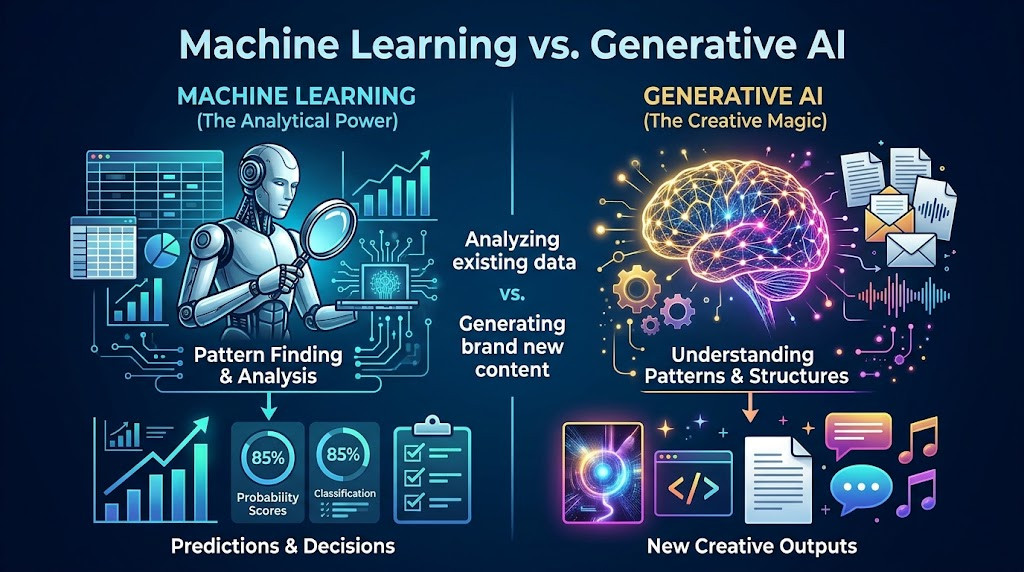
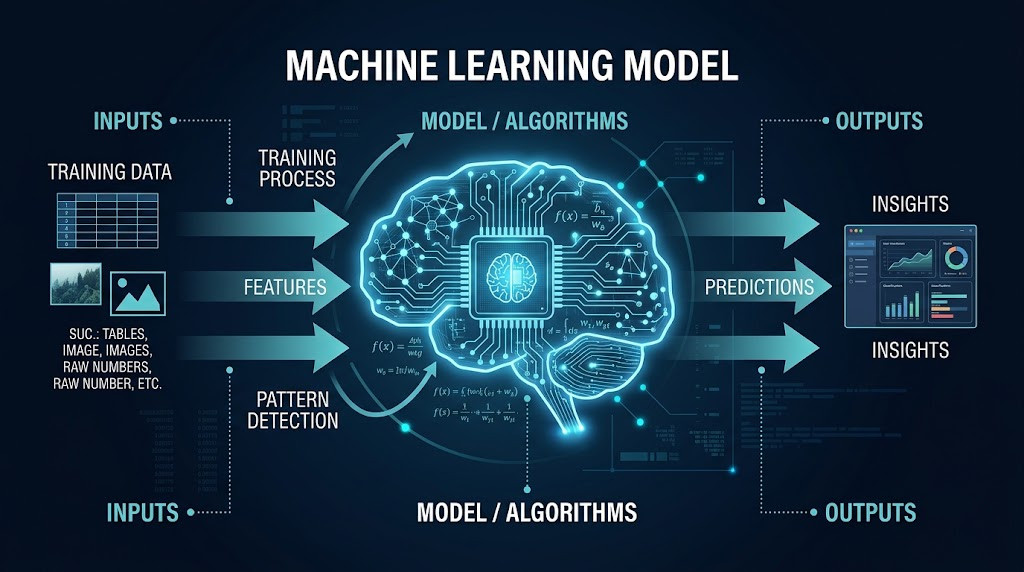
Industry reports have pointed out an important issue within enterprise technology: numerous AI and ML projects find themselves unable to transition from their experimental phases into production.
Despite the variation in the widely cited statistics about how frequently such projects fail, the issue itself stays the same: creating the model is only the first step in creating value for the business.
Even with the ever-increasing popularity of artificial intelligence, generative AI and LLMs, many companies continue struggling with delayed project schedules, budget overruns, and sophisticated machine learning models that never provide any real ROI.
How come there is so much difference between hopes and reality? Implementing machine learning is not a matter of mere technological skills: it involves changing a whole range of processes in the company.
Shifting from an algorithm created in a controlled lab environment into a real-world production system comes with many Machine Learning Challenges that can ruin the entire project irrespective of the skills of the engineers involved.
Awareness of such barriers will ensure that companies invest in the right areas and increase their likelihood of getting positive ROIs. This is because such companies will be able to create robust architecture and processes without having to deal with failure.
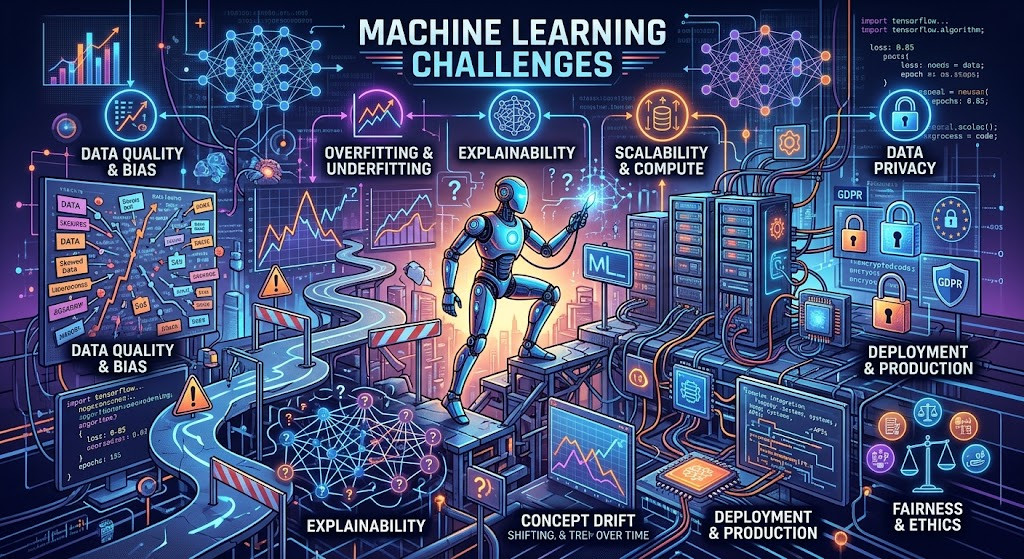
In this guide, we look at eight major Machine Learning Challenges that have the ability to sabotage business endeavors.
The Current Landscape of Machine Learning in Business
Before getting into the topic of navigating through the Machine Learning Challenges approach, it is important to take a closer look at the environment that this technology operates in.
The demands for artificial intelligence continue to increase, but the preparedness of businesses varies greatly. Businesses are beginning to see artificial intelligence as a strategy rather than an experiment.
Why Are Businesses Investing in Machine Learning?
There is plenty of application potential of machine learning for the field of health care, finance, retail, and manufacturing. Companies may implement ML algorithms in order to automate the tedious procedures and make informed decisions.
For instance, through predictive analytics, companies will be able to forecast the future demands, optimize the supply chain and analyze sales and financial trends.
Machine learning is applicable for drug discovery and personalized treatment in the field of health care, as well as fraud detection and risk evaluation in the sphere of finance.
Machine learning is also extended to the consumer side through personalized suggestions provided by streaming service providers and online shopping websites. Therefore, the firms should consider how AI can be of help to their business while getting ready for typical Machine Learning Challenges.
The Gap Between Proof of Concept (PoC) and Production
One of the major Machine Learning Challenges faced while implementing AI successfully is that of PoC vs. production deployment.
Creating a prediction model in an ideal setting like a data scientist's Jupyter notebook is entirely different than deploying it in a real business application.
While experiments are conducted using relatively clean, well-structured, and well-prepared data sets, enterprise data could be incomplete, inconsistent, delayed, or reside in many disparate systems.
Knowing the difference between these two scenarios is key to solving this critical Machine Learning Challenges scenario of deployment.
It becomes imperative to understand the difference in order to deploy ML solutions successfully.
When organizations treat ML deployment as merely extending their existing software development process, they often overlook other important factors.
The 8 Critical Machine Learning Challenges
Challenge 1: Poor Data Quality and Siloed Infrastructure
The Problem:
Good data and access to it are the keys to successful machine learning algorithms. It becomes especially true because the saying "garbage in – garbage out" applies here.
Incorrect data may include missing data, incorrect labels, duplicates, and bias in the data set. They all affect the quality of the result and may make the prediction faulty.
Most business data are stored in silos such as legacy data warehouses, cloud data warehouses, departments, and external SaaS solutions. The data is kept in various forms, starting from SQL tables up to text and IoT sensor data. This storage complexity represents one of the primary Machine Learning Challenges for modern enterprises.
Example:
Imagine an international company working on building a dynamic pricing solution. If the data about promotion campaigns is stored separately from the inventory of the supply chain department, then the algorithm may suggest reducing the price for the item that is scarce.
Impact on Business:
Bad data quality and lack of data integration create persistent Machine Learning Challenges that lead to problems of delivering accurate and relevant information to the production model.
For instance, when implementing predictive maintenance, it will be impossible to make proper predictions due to a 24-hour delay in uploading factory sensor data to the central database. By the time the model predicts a possible machinery breakdown, the machine itself may have already stopped working.
These situations may result in poor decision-making and a decrease in stakeholders’ confidence.
Solution:
Create data governance and data quality procedures prior to model development. Implement data pipelines which will deliver information safely and in an organized way from the source system to the model.
Data validation, quality checks, and monitoring can detect possible problems before compromising the model’s work.
Challenge 2: Misalignment Between ML Goals and Business Objectives
Problem:
The other major barrier among typical Machine Learning Challenges is creating an effective model that doesn’t resolve any real business problems.
Companies invest lots of time developing a predictive model which performs great from a statistical perspective, only to realize that its prediction has no business value at all.
It is possible for the model to have an excellent F1 score, low prediction error or good accuracy without making any contributions to the bottom line of the company.
This situation usually arises due to a lack of good communication between technical team members and the business representatives. Data scientists are concerned about precision, recall and effectiveness of the model, while the business people are focused on income, CLV and profit.
Example:
Telecommunications companies create a churn prediction model which helps to predict churners. At the same time, the model fails to distinguish whether it is customers that are planning to move away or unhappy with their bills.
Making discounts to such customers makes no sense since they won’t be retained anyway.
Impact on Business:
It is possible that a prediction model that does not help to retain customers, cut costs, and make profit cannot justify additional investments.
Solution:
Create cross-functional teams, which will consist of business experts, data scientists, engineers, and experts in the area. Specialists who understand the language of the business can help overcome these alignment Machine Learning Challenges.
Define measurable KPIs prior to development. Instead of questioning whether the model can be accurate up to 90%, try to find out how the predictions of the model will affect business.
Challenge 3: The Talent Shortage and Skill Gaps
Problem:
All the aforementioned fields of expertise need to be considered for the implementation of machine learning technology.
It is hard to find people that have all these abilities, and it is costly. But the technical Machine Learning Challenges surrounding talent are not limited to the recruitment of a single data scientist.
There are cases where a data engineer is needed to create a pipeline for production, an ML engineer to scale models and a person from the infrastructure team or DevOps engineer to take care of the environment.
Example:
A mid-size health care company recruits an experienced data scientist to create a model of predicting patients' readmissions. Without sufficient data and machine learning engineers, data science is mostly centered on data preparation and infrastructure instead of building the model.
Impact on Business:
It will cost money to recruit and retain an entire in-house artificial intelligence team. The project could get stuck at the research stage due to lack of expertise to convert experimental models into practical applications.
Solution:
Create a talent strategy which will involve training employees, hiring, and outside expertise wherever needed to address workforce Machine Learning Challenges.
AutoML tools can be used by analysts to create baseline models for appropriate applications, and training can allow current software engineers and analysts to be involved in data prep and infrastructure work.
Whenever there is a need for external expertise, firms may also access external expertise through means like GigMint.AI.
Challenge 4: Crossing the Deployment Chasm (MLOps Bottlenecks)
Problem:
In the case when all three mentioned components – data, people and goals of the business – align perfectly, operational bottlenecks and software Machine Learning Challenges may still lead to delays in deployment.
A good working model in a development environment may not work well in a production environment due to latency, integration problems, poor testing or insufficient infrastructure.
In addition, the lack of cooperation between data scientists and operations teams may create confusion about who is responsible for deploying and maintaining the system.
Example:
An online store implements a recommendation system which works very efficiently at the stage of testing. During the sales event the application experiences troubles dealing with the increased number of concurrent users. The response time increases, the users leave the web page and possible revenues are lost.
Impact on Business:
Without an efficient deployment process to resolve these Machine Learning Challenges, valuable models will remain confined to notebook environments or staging.
Solution:
Implement MLOps (Machine Learning Operations) that will help in developing a model from its creation to its end-of-life cycle.
This will involve:
-
Version control of code, data, and model.
-
Testing and CI/CD.
-
Containerization and appropriate orchestration.
-
Latency, error, and model monitoring.
-
Documented rollback and incident response.
Challenge 5: Model Drift and Degradation Over Time
Problem:
Model implementation does not eliminate the need for maintenance to be done. As opposed to a completely rule-based approach, a machine learning model becomes less efficient when either data or relations it learned about change, presenting dynamic Machine Learning Challenges over time.
Drift of a machine learning model is often talked about in two types:
-
Data drift: There is a shift in the distribution of input data. E.g., a certain e-commerce service acquires new types of clients.
-
Concept drift: The relation between input data and the output changes. E.g., there are changes in the patterns of fraudulent activities.
Example:
The outbreak of COVID-19 impacted the behavior of consumers in many industries, thus, affecting the purchasing patterns. The models trained on historical data could become less relevant because of the change in demand patterns.
Effect on the Business:
Not maintained models could continue producing predictions which would be less and less accurate. The outcomes include improper management of inventories, flawed risk assessment, lost revenues, etc.
Solution:
Keep an eye on the distribution of the data and the behavior of the model through continuous monitoring.
Set up correct thresholds for performance and conduct an investigation into any deviations that are important. Retrain models if new data becomes available and it becomes necessary.
In addition to that, monitoring must account for the availability of right outcome labels, which may not be known until after the prediction.
Challenge 6: Data Privacy, Security, and Compliance Risks
Problem:
For the implementation of ML algorithms in enterprises where the presence of sensitive information and multinational operations are there, it is important to address Machine Learning Challenges related to data protection and privacy.
ML algorithms create additional challenges because they use large sets of data, depend on the connection and even provide predictions via third-party APIs.
There are different types of laws and regulations that need to be considered: NIST AI Risk Management Framework, EU General Data Protection Regulation (GDPR) and the Consumer Privacy Act, amended by California Privacy Rights Act (CCPA/CPRA).
Example:
In a data poisoning attack, the hacker modifies training data to change the model's work. For example, manipulated training data can decrease the efficiency of a spam detection algorithm to recognize certain phishing emails.
The other example of a security risk is model inversion, in which the hacker uses the output of the model to reveal some information about the training data under specific circumstances.
Impact on Business:
Penalties, lawsuits, and disruptions to business operation and its reputation have been found to be some of the consequences resulting from security breaches and violations of regulatory compliance. Administrative fines under the GDPR can reach €20 million or 4% of the undertaking’s total worldwide annual turnover from the preceding financial year, whichever is higher, depending on the infringement.
Solution:
Security-by-design from the very beginning of the project should be employed. Use of access control, encryption, data minimization, secure interface for the model and security assessment regularly should be implemented.
If possible, privacy enhancing technology could be used, for example federated learning where the models can be trained on distributed datasets without collecting raw data all the time.
Challenge 7: Lack of Explainability and Black-Box Models
Problem:
There are some advanced machine learning systems which can predict important events while being opaque in their working process. Such opacity can lead to governance Machine Learning Challenges for companies because it may become difficult to understand the process behind decisions, detect any bias and prove the fairness of automated decisions.
Example:
As reported, Amazon stopped using an experimental automated recruiting tool that had learned undesirable patterns from historical resumes, e.g., it could penalize applicants for using certain terms related to women.
The example shows how historical data used to train an algorithm can introduce biases.
Impact on Business:
If there is a case when an automated system was used to make a decision to reject a person to get a loan or receive some treatment, or a job, companies would need to provide explanations of how that decision was made and prove its legal and ethical correctness.
Solution:
Include explanations and fairness checks as part of the development process of the machine learning model.
Explainable artificial intelligence (XAI) methods can assist in understanding how the model works and feature contributions to prediction. For certain cases, the use of methods like SHAP or LIME might assist in explaining individual predictions, yet they have certain limitations.
In case the interpretation of the model becomes very important for some applications, then it would be better to choose a different technique like decision trees or logistic regression.
Challenge 8: Underestimating Cloud Infrastructure and Compute Costs
Problem:
There is an actual possibility that the expenses associated with implementing machine learning might be huge and easily underestimated, adding financial Machine Learning Challenges to the operation.
It might be necessary to use costly GPUs or another specific hardware in order to train the model. There are also costs associated with inference, data storage, networking, monitoring, and ensuring services' reliability.
In generative AI use cases, the pay-as-you-go pricing model makes the cost sensitive to activity level, length of prompt, and length of responses.
The Example:
A new startup builds an AI-powered customer service chatbot. As its usage increases, the number of requests sent to the model grows greatly, thus making the cloud and inference costs grow well above the initial budget.
If there is a jump in the costs from $5,000 to $80,000 per week, then it must be a serious financial issue that needs investigation.
Impact on Business:
Unexpected infrastructure costs could spoil the business case of the project. Even though the model works successfully, it might become unprofitable because of excessive costs.
Solution:
Incorporate cloud cost optimization, otherwise known as FinOps, in the process of developing and deploying machine learning models.
The engineering and finance teams need to keep track of the cost per prediction, request, or transaction done. They need to set up budgets and alert mechanisms for monitoring their usage and comparing different infrastructures.
There are ways of saving on resource needs through quantization, pruning, caching, batching, and model distillation. The selection of the right model for a task of certain complexity in case of generating AI could help save on inference costs.
A Strategic Blueprint to Overcome Machine Learning Challenges
1. Perform an AI Readiness Assessment
Undertake a review of the quality of your organization’s data, capabilities, infrastructural requirements, security issues, and business objectives before making any significant expenditures.
Building advanced models on the foundation of inaccurate or insufficient data will only incur costs and delay results.
Consider following a “think big, start small” philosophy. Develop a vision for the future by concentrating on particular use cases that can be studied in a specified period, for instance, 90 days.
2. Establish an AI Center of Excellence (CoE)
Make a cross-functional team with data scientists, IT, law and business professionals.
An AI CoE can bring about unified standards in relation to data governance, MLOps, model evaluation, risk management, and the responsible use of AI. This will assist the CoE in addressing the Machine Learning Challenges and bringing about unified standards within the company to develop an AI adoption culture.
3. Establish a Data-Literate Company Culture
It is crucial to educate employees and their supervisors on the new issues related to AI machines.
Through data literacy, individuals will have the capacity to be more informed in making decisions on how they can use AI and reject myths with the help of data.
The design of courses must not depend on the population but on the individual taking the course.
4. Think in Terms of Products, Not Projects
Think of the above machine learning solutions as products which will need constant investment to improve and maintain.
Allocate accountability for model performance, operational stability, and business results. The above will help companies avoid typical Machine Learning Challenges and not view deployment as the end of the development process.
Accelerate Your AI Journey with GigMint.AI
The management of fragmented data pipelines, MLOps limitations, regulatory factors, and technical intricacies is not easy without the right expertise.
GigMint.AI can assist companies in exploring access to dedicated AI talent, fractional expertise included, in order to cover capability gaps and navigate various Machine Learning Challenges to implement their machine learning programs.
Depending on specific requirements for a certain project, extra expertise can assist companies in improving data engineering, deployment approach, and aligning technical implementation with business goals.
One should determine what is the major challenge for a particular company that prevents them from progressing further.
Whether it is the lack of engineering expertise, data pipeline issues, or inability to transition a proof of concept into production, GigMint.AI can help in assessing available capabilities.
Conclusion
Some of the difficulties faced in the course of executing machine learning include fragmentation of data, skills gap, model drift, regulatory compliance issues, and increasing infrastructure cost.
Early awareness of these Machine Learning Challenges helps companies better prepare themselves for execution of the project and also ensures effective adoption of MLOps, better data governance, and alignment of the technical development with the business.
It is not sufficient for a business to only have a good performing machine learning algorithm. There are other elements that play a key role in successfully implementing the technology.
Frequently Asked Questions (FAQs)
What are the reasons behind the failures of many machine learning projects?
Machine learning projects may encounter failures due to an underestimation by the companies of how difficult it is to go from experiments to production in such projects. The most common reasons include poor data quality, unclear business goals, lack of engineering capabilities, deployment problems, and lack of monitoring.
Solving these Machine Learning Challenges will increase the chances of success of the implementation.
What does it cost to implement machine learning in a business?
The cost will be determined by the complexity of the use case, level of data maturity, infrastructure needs, number of staff members, and overhead costs.
Even a relatively simple use case with the use of already existing data and models may need a budget of several tens of thousands of dollars. Creating and operating a custom large-scale model will cost even more, sometimes reaching several millions of dollars.
These are just examples and not industry-wide pricing. Each company needs to estimate costs individually.
How does one deal with the privacy risks associated with the application of AI technology by businesses?
The first step that businesses can take is to ensure that security-by-design techniques are employed, that minimal data is collected, appropriate access controls are put into place, and that security and privacy assessments are performed.
Data masking, encryption, and federated learning techniques may be used depending on the use case scenario in order to minimize risks. The second step for businesses is to figure out what regulations govern their use of privacy and AI technology while managing these Machine Learning Challenges.
Is it possible for businesses to utilize machine learning technology without having any data scientists within their organization?
Yes. Businesses can use automated machine learning tools for specific use cases and collaborate with external machine learning specialists or hire new ones who will perform data preparation and