Beyond the Hype: A CEO’s Step-by-Step Strategy for Enterprise AI Integration

Beyond the Hype: A CEO’s Step-by-Step Strategy for Enterprise AI Integration
In no industry is the board mandate clearer: adopt Artificial Intelligence or face irrelevance. But while the buzz surrounding the topic seems endless, the hard realities of actual implementations of enterprise AI integration suggest something quite different.
According to industry statistics, close to 70% of AI projects carried out by enterprises fail to progress past the pilot stage, trapping huge sums of money into what industry veterans refer to as "pilot purgatory." The executives who seek real results from enterprise AI integration can only be frustrated with such dismal performance.
The deafening roar of AI hype tends to distract from a rather obvious fact, which most decision-makers find out only when it's too late: enterprise AI integration is not just an IT project; it is a business strategy.
It is simply impossible to make your enterprise AI integration pay off if you see it as just another piece of software. On the other hand, if it is implemented as a new paradigm for business operations, it will serve as a very difficult barrier for potential competition.
The reason for this colossal gap is that often the leaders get swayed away by the technology and try to incorporate it immediately, without having fully aligned with organizational maturity level, data architecture, and readiness of the workforce to deal with this tech.
We are currently seeing the same mistakes being made during AI adoption, as we have seen in the past when companies invested in expensive cloud technologies without changing their business process underneath.
In order to succeed in this AI revolution, CEOs should ignore the fancy language and pay attention to the harsh truth of their operational base.
This extensive guide provides you with the approach to enterprise AI integration. From the brutal reality check of your data architecture to building proper governance structures and getting out of pilot purgatory, this is the ultimate guide for C-suite leaders who strive to create an AI-native enterprise.
What You Will Learn in This Strategy Guide
How to determine if your organization is really ready for AI in terms of its data and culture.
Approaches for discovering AI use cases that create actual business value through ROI rather than just hype.
The CEO’s perspective on the “Build, Buy, or Partner” conundrum in the LLMs era.
How to redesign your talent strategy and take advantage of platforms such as Gigmint.AI.
How to address the huge risks associated with enterprise AI integration regarding legal, security, and reputational issues.
How to design architecture to scale AI from a single department to a worldwide team.
Phase 1: The Reality Check – Assessing Your Enterprise AI Readiness
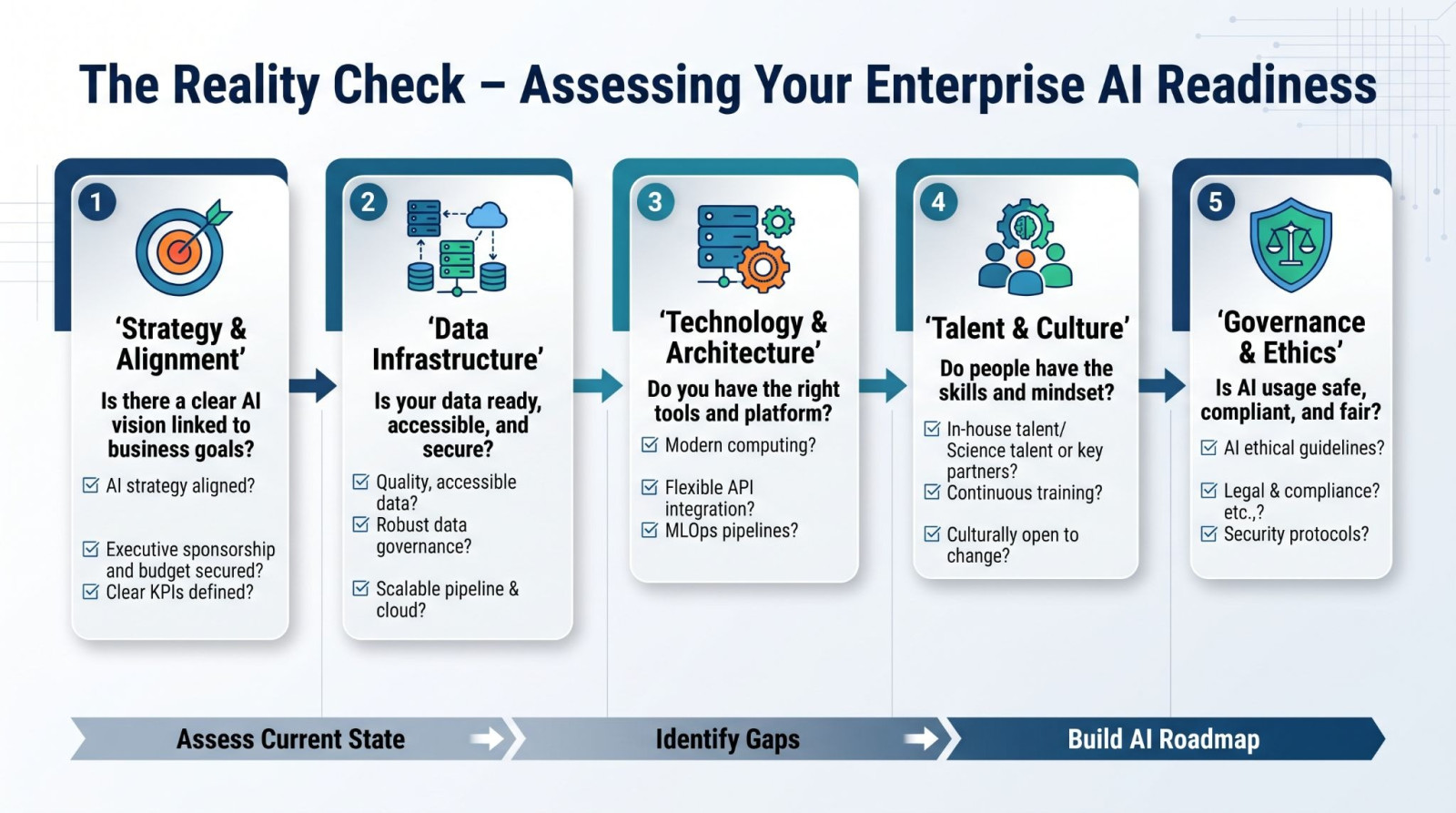
Before one writes even a line of code, before you sign any contract with your vendor, and even before you put pen to paper in that press release, leadership needs to evaluate the real situation within their company prior to launching any enterprise AI integration.
Building out sophisticated generative AI models on top of poorly structured and fragmented data would spell doom for any company in the form of costly hallucinations, frustrated employees, and major security headaches.
Data Maturity is Your Ultimate Competitive Moat
AI relies on the fuel that powers it. In today’s business environment that is highly competitive, data about your business is your unique edge. The public AI models, such as ChatGPT, Claude, and Gemini, have knowledge about whatever exists on the public internet. But, your unique customer base, your unique supply chain, your processes, and your past financial results make custom enterprise AI integration essential.
But if your data is spread across CRM, ERP systems and locally kept unorganized Excel sheets, then your enterprise AI integration project will not even be able to get off the ground. Unorganized and messy data equals incorrect data output from AI. If your AI gives out incorrect responses to your sales reps and your customers, then you will lose trust immediately and AI adoption becomes nil.
It is high time for CEOs to ask for a shift in culture and architecture in their companies from the practice of “data hoarding” to “data harmonization.” What does it mean in practice? It means performing a thorough analysis of your existing data architecture and building an infrastructure which will enable you to clean up the data and ingest it into the LLMs/ML models.
All existing enterprise-grade AI products leverage sophisticated architectures like RAG (Retrieval-Augmented Generation), vector databases, and more.
The CEO may not need to write any of this code but they definitely should be aware that it's imperative to have a well-structured data lake or data warehouse.
CEO Checklist For Data Readiness:
Data Silos: Have we centralized our customer, operational and financial data in a source of truth or is each set of data still guarded like a crown jewel by departmental fiefdoms?
Data Quality & Hygiene: Do we have processes in place that guarantee data accuracy? Is anyone dedicated to cleaning our historical data?
Real-Time Access: Can our cloud-based systems access our data in real-time safely or do we have to depend on weekly batch exportation?
Cultural Readiness and Workforce Resistance
It is not technology that becomes the primary problem during enterprise AI integration, but the resistance of people. Are your employees ready to adopt the new reality, or do they regard AI as a direct and inevitable threat to their existence?
An organization where the employees are afraid of being replaced by the machine will oppose the implementation of AI in their work processes. They will look for some weaknesses in the machine in order to prove that it does not work.
Management should assess the level of technological literacy in the company and manage the transition process. It should be emphasized that AI is a "co-pilot" or an "exoskeleton of mind," and not a robot.
The Infrastructure and Compute Audit
Are your legacy systems equipped to meet the massive compute demands of today’s AI technology? The audit process will have to include your cloud capabilities, latencies, and security parameters.
It is common knowledge that many companies realize it is vital to upgrade their underlying cloud infrastructure before proper enterprise AI integration can occur. In addition, CEOs need to know about the financial ramifications of “compute.” To use complex AI technology, either in-house or using APIs, it takes an enormous amount of compute power (GPUs).
Phase 2: Defining the AI Vision and Identifying Hard ROI
Strategic Alignment Framework
Every use case proposed during your enterprise AI integration must be mercilessly aligned to a specific business goal. If there is no demonstrable mathematical proof of how this initiative will positively impact a fundamental business metric, whether it is to reduce churn by 5%, speed up time-to-market for a product by three months, or optimize warehouse inventories to release cash, then you must kill it.
One of the mistakes that companies commit is that of "shiny object syndrome." For example, creating generative AI chatbots on your website simply because other companies are doing it, and not measuring whether it actually reduces response times and improves conversion.
The "Quick Wins" vs. "Moonshots" Matrix
1. The Quick Wins (High Probability, Moderate ROI, Low Friction) This is a highly visible project that is not only relatively safe but will help solve a very immediate and obvious problem. This would help to demonstrate that the concept works, provide an early ROI, and start the process of acclimatization of the employees to your enterprise AI integration efforts.
For instance: Automate back office data entry and invoicing; intelligent conversational bots to handle tier 1 customer service queries; or automated contract summarization in the legal department through the use of AI.Benefit: Cost saving, fewer errors, higher efficiency – and more importantly, it frees your human capital from doing menial tasks and allows them to do more strategic work.
2. The Moonshots (High Risk, Massive ROI, High Complexity) Those are the really big things that can potentially disrupt your market segment and transform your entire business model.
They involve a lot of proprietary data, large capital investment, cross-departmental coordination, and executives' patience.Example cases: Predictive supply chain models that foresee any global geopolitical events, and re-route the delivery process; drug discovery AI technology in pharmaceuticals; or an extremely personalized, on-the-spot product and pricing generation for e-commerce.Value Creation: Competitive advantage over the long term, a whole new business model being invented, and rapid income growth.
Setting the Right KPIs for AI Success
ROI calculation in the context of enterprise AI integration is not limited to any simple software metrics. An AI solution that works flawlessly and provides perfect results in the production phase is totally useless when it comes to bringing in any business benefits. CEOs should focus on implementing the following dashboard metrics:
Utilization: Is the system used by employees day to day? Or does the utilization go down after the first week?
Time-to-Value (TTV): When was the cost of implementing AI covered?
ROI Calculation Factors: Actual dollar savings through cost-of-serve, dollars per employee, and reduction in error rates.
Hidden Costs: Cost of computing, calls of APIs, and labor involved in the maintenance and updates of the model.
Phase 3: The Framework – Build, Buy, or Partner?
The classic software conundrum of "build versus buy" becomes an exponentially complex challenge in the age of artificial intelligence. Since the technology of AI itself is advancing at such an unbelievable pace that the current model becomes outdated within a matter of six months, it would make sense for you to avoid getting yourself stuck into building an extremely expensive, large-scale infrastructure for enterprise AI integration.
And yet, using only generic and readily available software could make you lose any competitive advantage and run your business the same way your competitors do.
When to Buy (Off-The-Shelf SaaS Integration)
Buying a SaaS solution is the answer whenever the process you want to improve represents a universal business function. The vendors of those solutions have invested billions into their base models and User Interface/Experience.
There is simply no point whatsoever in designing your own Large Language Model for the sole purpose of creating standard sales letters, scheduling HR interviews or monitoring website traffic. Just find the best class SaaS (e.g., Salesforce's Einstein, Microsoft Copilot or any specific HR AI solution), and integrate it quickly. Your primary goal in this case is swift enterprise AI integration and training.
When to Build (Proprietary Models & Fine-Tuning)
Only invest in developing AI algorithms yourself if this activity involves the very essence of your competitive edge and uses proprietary information that must not be exposed to third parties under any circumstances.
In case the algorithm governs proprietary algorithmic trading, highly confidential financial modeling, production of intellectual property or dynamic pricing based on the confidential supplier information, it would be a must to possess both IP and the infrastructure.
In such situations, companies typically modify open-source models (such as Meta's Llama 3 model) using on-premise servers or dedicated private cloud computing facilities.
The Power of Partnering (The Hybrid Approach and the Talent Bridge)
For the majority of Global 2000 companies, a strategic hybridization will be the best way forward. It entails harnessing powerful pre-existing foundational models through APIs and connecting them to your own company data through mechanisms like Retrieval-Augmented Generation (RAG).
Undertaking this strategic hybridization presents a huge challenge in the form of a severe talent shortage within traditional enterprises to execute successful enterprise AI integration. You will require prompt engineers, AI security experts, data architects, and MLOps engineers.
To implement this hybridization strategy, some intelligent enterprises have decided to abandon the slow and old process of hiring and opt for partnerships with specialized solutions. It is here that a comprehensive talent and solution platform like Gigmint.AI becomes a valuable strategic asset.
Finding this particular intersection of your own industry domain knowledge, highly skilled AI engineering, and strategic enterprise AI integration is highly challenging. By partnering with the solution platform like Gigmint.AI, your organization can connect to vetted AI talent, expert consultants, and integration professionals.
Your organization will be able to expand their AI capabilities by integrating skilled individuals wherever the internal teams fall short, without being part of the tech talent wars, and reducing time-to-market significantly.
Phase 4: Execution and the New Talent Strategy
Even the best enterprise AI integration strategy devised in corporate boardrooms is nothing but dead air without the people capable of implementing it. Traditional businesses are up against an unenviable task: trying to compete with the likes of Silicon Valley tech behemoths, which pay huge salaries and foster environments rich with research facilities, to recruit elite Machine Learning engineers and AI researchers.
The Future of AI Talent Strategy
It makes sense for CEOs to take a step back and reconsider the entire strategy with regard to AI talent rather than engage in futile battles with the likes of Big Tech to hire away their employees.
The key is not to hire large numbers of pricey AI PhDs internally, but to develop an extremely efficient connection between your technical AI team (recruited via strategic partnerships) and your domain expert team.
Upskilling the Current Workforce: The Rise of the "Citizen Developer"
The best enterprise AI integration is always that which happens when the employees who actually do the day-to-day work are able to optimize it. Thanks to the swift evolution of the low-code and no-code AI solutions, along with customized AI assistants (like custom GPTs), the organizations will be able to convert their current business analysts, marketers, and supply chain personnel into "citizen developers."
By pouring resources into comprehensive AI literacy programs, you will be able to empower your subject matter experts in building their customized AI solutions that can help them address their department-specific bottlenecks.
Agile AI Deployment: Killing the Waterfall
The old "waterfall" process in IT development, which has the system take 6 months to plan, 12 months to build and 6 months to deploy before a single end-user can get their hands on it, is lethal in the age of AI. By the time the 18 months-long waterfall project gets completed, the AI behind it will evolve for three cycles, making the entire software obsolete.
Companies need to embrace a hyper-agile development cycle. It requires setting up cross-disciplinary "pods" or "squads," composed of representatives from IT, Legal/Compliance, Data Security, and the corresponding Business Unit. The pod then goes through the rapid process of sprinting to come up with MVPs within a few weeks.
Advanced Change Management
Management of change becomes the unsung hero and usually the main source of failures during enterprise AI integration. The communication from the top needs to be clear, consistent, and transparent.
It’s important that you showcase the examples of successful implementation of AI internally by showing how AI helps remove the soul-destroying routine from people’s daily activities, which makes people able to perform high-level strategic activities. In addition, it’s necessary to change KPIs for your staff; otherwise, people will get twice as many tasks if they use AI.
Phase 5: Governance, Risk, and Compliance (GRC) in the AI Era
As technology grows in strength, the corporate risks grow as well, but to an unprecedented level. Uncontrolled enterprise AI integration in any business may become a serious reason for huge data breaches and losses of intellectual property, and the PR catastrophe will follow.
The Coming Problem of Shadow AI
At this very moment, people from your company are probably using AI systems designed for consumers in order to paste company data, source code, internal financial information, and even data about clients there, because they need to get things done quicker.
This phenomenon is called "Shadow AI" and it is one of the biggest security vulnerabilities in any corporate system right now. When you feed proprietary data to public models without a proper enterprise license agreement, your data becomes a training material for these vendors, thus leaking your most protected IP to everybody else.
Establishing an AI Center of Excellence (CoE)
To avoid the danger of Shadow AI and implement measures to reduce risk and standardization, the CEO must immediately establish the AI Center of Excellence (CoE) as the central body for enterprise AI integration. This governing board will be composed of senior executives from the company’s IT, Legal, HR, Cybersecurity, and core departments. The roles of the CoE include:
Approval of all AI vendors and technology used in the company.
Development of company-wide data privacy policies specific to the use of generative AI.
Creating a safe space for the employees to engage with the AI generator technology without any risks of data being leaked into the external world.
Ethical AI, Hallucinations, and Bias Mitigation
AI models are no more than as accurate as the data set they were trained on. It is important to understand that AI models are inherently biased to generate "hallucinations," which means that they will generate false information and state it as an absolute truth. If the customer service AI generates the terms of the refund policy, the company should stick to it.
If the enterprise data has any biases (for instance, a bias in HR hiring process or lending in the bank), then the AI will learn it and quickly deploy it at the speed of a computer algorithm.
The effective framework of governance will be constantly monitored for algorithmic bias, "Red Teaming" (testing the AI's limits by the security team in order to patch it), and following the company's guidelines for ethics.
Security, IP Protection, and the Regulatory Landscape
AI-based compliance is now very complicated and highly punitive. The introduction of laws, such as the European Union AI Act that set out highly stringent guidelines about the use of high-risk AI and the ongoing cases of copyright infringements all over the world, means that companies need to be extremely auditable.
You need to be able to justify your decision-making process in the AI to the auditors (Explainable AI). Furthermore, you need to mathematically demonstrate that you have protected your proprietary data from contemporary adversarial threats, such as "prompt injection."
Phase 6: Scaling from Pilot to Full Enterprise AI Integration
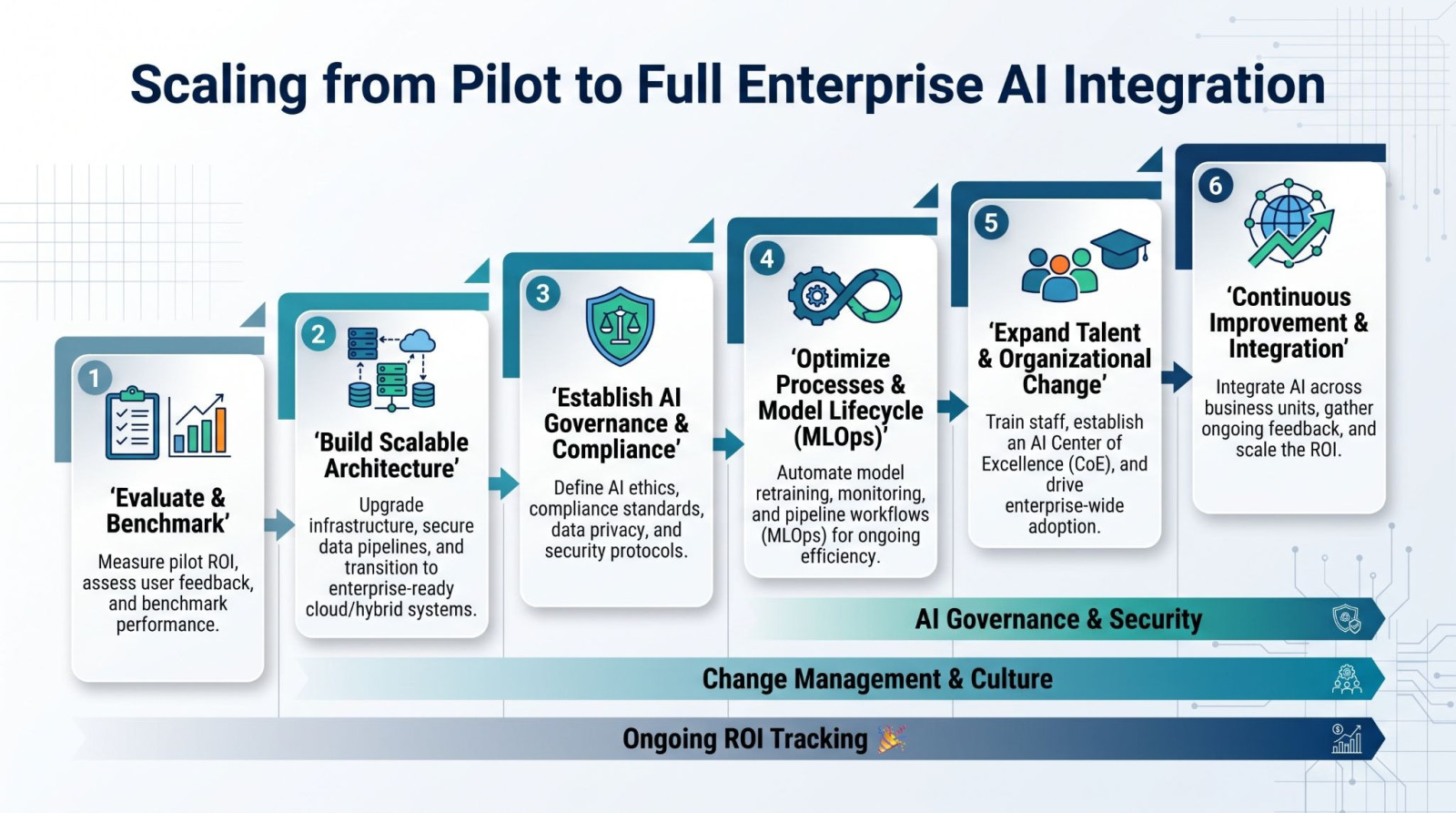
There are many companies that are able to build a highly successful and impressive AI pilot in a very controlled lab environment. There are not many who can scale their success into something larger in a more complex and global environment. This inability to scale is the very definition of what is known as Pilot Purgatory.
Exiting Pilot Purgatory Through MLOps
In order to be able to scale, the system that supports your AI must move from the experimental stage to the industrialized stage. Your pilot can work well on the computer of a data scientist; however, for global deployment, you need something called MLOps.
Machine Learning Operations (MLOps), in other words, is a set of engineering standards designed to deploy and maintain your machine learning models in a reliable, efficient, and secure manner. The implication is that when you roll out your AI application to 10,000 users at once, you don’t overload your server or API.
Continuous Feedback Loops and Combating Model Decay
Unlike static software, such as a word processor, which remains the same from deployment onwards until you manually update it, AI models are dynamic and they will actually deteriorate over time.
Since the world keeps changing—consumer behavior is shifting, there is a change in the macro environment, there may be disruption in the supply chain—the data on which the model initially relied will become outdated. This process is called "model drift" or "model decay." An AI that had been perfect at predicting the inventory in 2024 may not work for 2026 without updating.
For AI scaling, continuous feedback loops are crucial. The system should keep evaluating how accurate the output of the model is on a day-to-day basis and comparing it to the results in the business world, and then updating the model with new information.
Building Enterprise-Wide Momentum and Internal Evangelism
Scaling is not just an issue of technical considerations, but one that deals with human psychology as well. Once all the "quick wins" have been realized as identified in Phase 2, the leadership must proactively celebrate and shout from the rooftops about those achievements throughout the entire organization.
Once the global finance team hears a specific example of how AI was able to save the regional marketing team 40 hours a week by handling data reports, the need for widespread enterprise AI integration becomes self-evident.
The dynamic changes from leadership trying to force an AI "push" to becoming a compelling "pull" within the organization for departments to clamor to get access to AI through the CoE.
Leading the AI-Native Enterprise
Enterprise AI integration is not the end goal; it is an ever-evolving process of adaptation and optimization. It’s time to leave the phase of being on the side and see what happens.
But by concentrating on being data ready, connecting your AI programs only through ROI, creating a smart combination of partnerships, arming your frontline staff, and implementing an unrelenting governance policy, you can take your organization out of the hype cycle.
The most successful companies do not cope with the immense intricacies of AI implementation, MLOps, and hiring alone. They need the help of experts who can help them connect the dots between their dream and its realization. Contact us at Gigmint.AI now to reach the top global AI engineering, integration, and technical talent needed for your company's success.
Ready to accelerate your enterprise AI journey and escape pilot purgatory? Those organizations that have been able to succeed in doing so have sought the help of specialists who would fill in the gap between their idea and implementation. Learn more about how Gigmint.AI can assist you in finding world-class specialists in AI engineering, consulting and integration, and even hire technical talent for implementing the concept of AI within your company.
Frequently Asked Questions
How long does it generally take for successful enterprise AI integration?
This depends hugely on the maturity of your current data infrastructure and the extent of the project. Simple "quick win" solutions based on out-of-the-box SaaS products take 4-8 weeks to integrate and train your team. But creating, refining, and scaling custom-made proprietary ML models within a global enterprise usually requires a long-term strategic plan and roadmap of 12-24 months.
What is the biggest challenge when it comes to scaling AI for business use?
To everyone's surprise, this is not the technology in question, but rather the data fragmentation and resistance to change. Insufficient data infrastructure (data silos that are hard to get rid of) results in inaccurate work of the model, whereas no change management and training programs result in fear and non-adoption, locking your costly project in "pilot purgatory."
How should a CEO practically measure the ROI of artificial intelligence?
CEOs have to rise above technical considerations (such as model accuracy rate and speed) and think about nothing else but bottom-line results. The return on investment should be calculated using such KPIs as the number of man-hours that have been saved (and redirected), decrease in operational cost (cost-to-serve), revenue from net-new revenue attributable to AI insights, and time-to-value (TTV).
What is "Shadow AI" and what makes it so dangerous?
Shadow AI means unauthorized use of consumer-grade, publicly available AI applications (such as publicly available versions of ChatGPT or Claude) for work-related tasks. This practice is highly dangerous as people input confidential information of their employers, clients, and proprietary code into those publicly available apps, which makes the data accessible to AI vendors and the general public.
Should we develop an LLM from scratch ourselves?
Absolutely not for 99% of businesses. Creating a foundation Large Language Model from scratch will cost hundreds of millions of dollars and will take several years of research and training on GPUs. Businesses need to follow the mixed strategy, where they license either the foundation model or open-source model and then use RAG (Retrieval Augmented Generation) or fine tuning for training of that model on their corporate data.