The AI-First CEO: How Modern Executives Build Scalable Enterprise AI Strategy
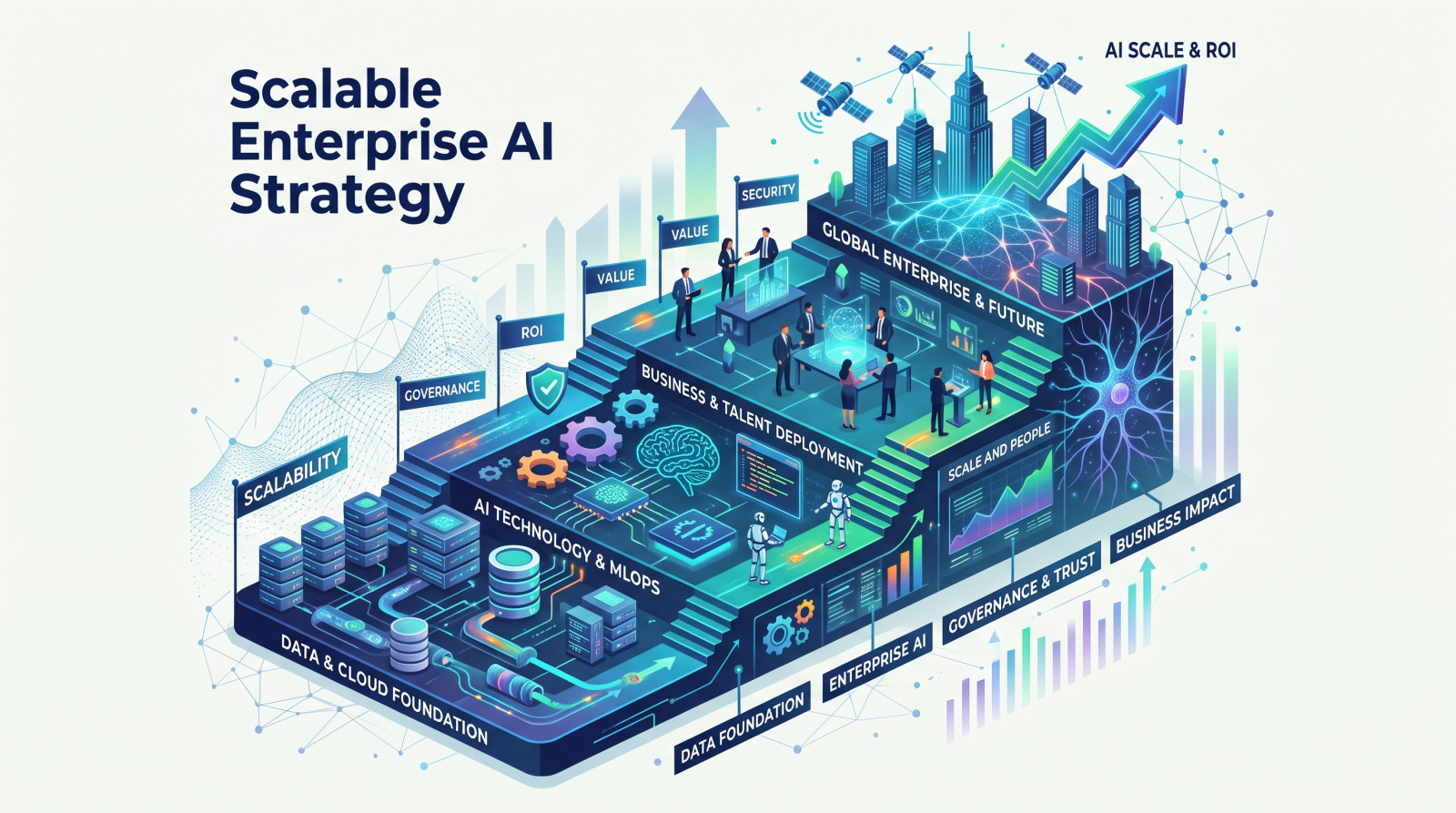
The AI-First CEO: How Modern Executives Build Scalable Enterprise AI Strategy
The Enterprise AI Gap – From Ambition to Reality
In today's world of business, no gap has ever existed between ambition and reality than that of artificial intelligence. As per the latest survey reports of leading global consultancies, although almost 90% of global businesses have initiated their AI projects or AI task force programs, less than 20% are able to scale their models to production for achieving their intended Return On Investments (ROI) via a scalable enterprise AI strategy.
It is an era which is known as the "AI FOMO" (Fear Of Missing Out). In this era, well-intentioned executives initiate disjointed AI pilots which are very impressive during board room demonstrations but end up in pilot purgatory.
This failure has never been because of technological reasons; rather almost always the failure occurs because of strategy-related factors, mainly lacking a scalable enterprise AI strategy.
The use of AI in any organization was considered as an experiment by its technology department only, as a technical work or as just another new technology which had to be implemented through the CIO or CTO office of the organization. The thought was that IT would develop the model and then it would deliver results to the business.
The successful adoption of AI technologies necessitates treating AI not simply as an upgrade of existing software tools, but rather as a strategic initiative that fundamentally transforms the business model, and should be led, backed and supported by the organization from the very top.
Introducing the AI-First CEO.
The AI-first leader recognizes that the scalable enterprise AI strategy with regards to AI technologies is not about implementing the cutting-edge LLM or Generative AI Chatbot solution for the company. The strategy involves a transformation of the enterprise DNA towards becoming truly data-driven.
Moving forward through this rapidly changing terrain requires much more than simply raising venture funding or having a sound balance sheet. Rather, what is required here is a roadmap, updated and resilient data infrastructure, and a cultural transformation at every level of the workforce.
At Gigmint.AI, we collaborate with visionary leaders and enterprise teams in order to help them cross this exact gap with a scalable enterprise AI strategy.
What It Actually Means to Be an "AI-First" CEO
Just because you are an AI-First CEO doesn’t mean that you have to become proficient at writing Python code, debugging data pipelines, and understanding the complex mathematics of neural networks and transformers.
In the same way that CEOs don’t have to be CPAs to understand corporate finance, AI-First CEOs don’t have to be data scientists to drive their companies’ AI transformations and implement a scalable enterprise AI strategy.
What this means is having great systems thinking, resource allocation skills, and the ability to instill a culture of constant transformation. What it means is seeing all of your company’s problems—in logistics, economic forecasting, customer churn, and more—as data-driven problems.
The Mindset Shift: From Cost-Cutting to Value Creation
Previously, deployments of enterprise technology (e.g., ERP systems of the 1990s and cloud migrations of the 2010s) have been seen in isolation as ways of increasing efficiency, improving margins, and reducing personnel.
The AI-First CEO approach to a scalable enterprise AI strategy makes a huge leap beyond the narrow, defensive thinking of the past. True enough, AI is very efficient in performing repetitive tasks at scale, but considering it only in these terms greatly understates the value it can bring. Its real value comes from creating net new value.
Modern CEOs use AI offensively. They rely on it to find new revenue sources among existing customers' data, to create a highly personalized experience for customers that was never before possible, and to speed up the R&D cycle.
Pharmaceutical firms are relying on AI to discover new drugs in months, not decades, and global retail firms use it to adjust pricing on millions of SKUs in real time depending on local weather patterns and social media sentiment.
In moving the leadership directive from “How can we use this technology to do the exact same things at lower cost?” to “What new capabilities, products, and services can we create that could not be created five years ago?”, the CEO positions himself to dominate and scale exponentially with a scalable enterprise AI strategy.
The Innovator’s Dilemma in the Age of AI
The AI-First CEO understands the Innovator's Dilemma introduced by Clayton Christensen. Large companies resist adopting disruptive AI technologies since they would undermine the current business model of their company, which is very profitable. A classic example would be a consulting company unwilling to introduce an AI system that replaces the current paid-by-the-hour services.
The AI-First CEO knows that, otherwise, the disruption will come from someone else, from a new venture-funded company. They are prepared to take some short-term friction and revenue losses to ensure survival in the future dominated by AI through a scalable enterprise AI strategy.
The 5 Pillars of a Scalable Enterprise AI Strategy
1. Strategic Alignment & Prioritization of Use Cases
The most prevalent pitfall in enterprise AI is developing an outstanding technical solution for the sake of solving the problem. The scalable enterprise AI strategy cannot start from the Jupyter notebook but in the board room where aggressive and ruthless prioritization takes place.
Any AI project has to be closely aligned with the strategic objectives of the business no matter what – be it an increase in CLV, reduction in logistics costs by 15% or speeding up time-to-market.
For this to happen, CEOs must introduce a rigorous Feasibility vs. Business Impact matrix to assess any AI project.
High Impact/Low Feasibility (Danger Zone): Projects such as a completely autonomous end-to-end supply chain process. The project seems amazing to the board but has extremely high technical risks and cost. Such a project will turn into a cash pit.
Low Impact/High Feasibility (Illusion of Progress): Small automation tasks such as writing a script to automatically sort an email. It provides small wins incrementally but does not make any significant financial impact on the business.
Low Impact/Low Feasibility (Distraction): These types of projects must be instantly rejected.
High Impact/High Feasibility (Sweet Spot): The major aim is to identify any use case which falls in this quadrant. For example, implementing level-1 customer service automation to handle all common queries or predictive maintenance for the costliest manufacturing machines.
Starting from the sweet spot, the AI-First CEO will create instant, unmistakable momentum that will create the necessary financial rewards to continue further innovation projects within their scalable enterprise AI strategy.
2. Data Infrastructure: The Bedrock of AI
This is one immutable and undeniable principle in machine learning: There is no way an AI strategy can exist without a data strategy. An AI system, no matter how complex it is, is as intelligent and unbiased as the data that feeds into it.
Most traditional organizations have data as a chaotic entity. Data is locked in disconnected data islands (HubSpot for marketing data, Salesforce for sales data, Oracle for finance data) filled with inconsistencies, and structured and unstructured (such as emails, PDFs, recordings of customer calls, and chat transcripts).
In order to develop an effective scalable enterprise AI strategy, you need to mercilessly revamp your data architecture.
With the arrival of Generative AI, companies need to learn Retrieval-Augmented Generation (RAG). RAG is a technology that helps the company to use a general AI model available on the shelf and anchor it into the data available within the company.
To make this happen, there are substantial investments being made by companies in vector databases – a specific technology that enables fast retrieval of unstructured data from which AI models generate the answers. The CEO who follows the principles of AI-First makes these investments way ahead of deploying any generative AI models to support a scalable enterprise AI strategy.
3. AI Governance, Ethics, and Security
As AI systems transition from being at the edges to being embedded in core business processes, the area of potential risk grows exponentially. This is not just about IT anymore; it is about risk at the board level.
The risks include Hallucinations (the system hallucinating and making up facts), data privacy breaches, and algorithmic bias. Think of the risk involved in an AI chatbot hallucinating a refund policy to a customer or the risk of an AI system absorbing hundreds of thousands of unencrypted social security numbers.
A scalable approach to AI in the enterprise needs strong, proactive AI governance, which is vital for a scalable enterprise AI strategy and includes:
Creation of an AI Center of Excellence (CoE) or Ethics Board – a cross-functional group of legal, technical, HR and business leaders whose job is to review and approve all instances of AI implementation.
Regulatory Compliance – strict compliance with all the latest developments in global privacy and AI frameworks including but not limited to EU AI Act, GDPR, CCPA, and NIST AI Risk Management Framework.
Mitigation of "Shadow AI" – enterprise employees are probably already utilizing consumer versions of AI (for example, free ChatGPT version) for composing emails, data analysis, debugging of enterprise code. This leads to massive data leakage. AI governance includes giving the workforce access to secure enterprise-grade approved AI solutions to prevent shadow IT.
Red Teaming – regular stress testing of internal AI models with the goal to break them down in order to ensure guardrails hold up in advance of the system launch.
AI governance should be viewed as a process of installing brakes and a steering wheel so that you can drive fast and innovate safely.
4. Talent, Culture, and Change Management
Technology proves to be the simplest aspect of the AI transformation of the enterprise; the most complex and unpredictable factor of a scalable enterprise AI strategy is people. The workplace of the future is, essentially, a hybrid team where human workers collaborate in real-time with AI and automation.
Instead of concentrating exclusively on the aggressive (and expensive) recruitment of scarce machine learning PhDs and AI researchers, the AI-First CEO places a great emphasis on upskilling his existing workforce.
By encouraging "AI literacy" among all departments – marketing, legal, HR, and procurement – he helps create an innovative atmosphere and psychological safety.
The employees must learn new skills such as prompt engineering and data literacy. But more importantly, the leadership must confront the issue of job security and ensure the employees that AI won't be used to replace them.
In this case, AI will serve as an extremely useful "co-pilot", freeing the worker from routine tasks and improving the nature of their work.
The change management process should be proactive, where the teams that have successfully managed to integrate AI into their process should be commended and the KPIs rethought towards AI-based efficiency.
5. Agile Execution and Continuous Deployment (MLOps & LLMOps)
The usual way in which enterprise software deployment happens is quite linear: the software is built, then tested, then deployed, and gets some updates occasionally. AI software deployment is quite different; it is cyclical, dynamic, and fragile.
This is due to the fact that the models are created in a chaotic and ever-changing world, and thus, they decay over time. Changes in consumer behavior, macroeconomics, and language mean that a model that had been working at 95% on day one will work at only 60% after six months—this is referred to as "model drift" or "data drift."
In order to scale and make the process reliable, businesses should urgently implement MLOps (Machine Learning Operations) and its relatively recent subset called LLMOps (Large Language Model Operations). It acts as an intermediary link between data science, which creates the product (makers), and IT operations, which supports it (sustainers), and is focused on the CI/CD (Continuous Integration and Continuous Deployment) of intelligent models.
MLOps methodology includes creation of feedback loops, checking of model’s performance and speed while in use, and creation of triggers for retraining the model based on new data.
Version control of data should be just as thorough as code. If there is no MLOps framework in place, the business strategy of artificial intelligence, and thereby your scalable enterprise AI strategy, is completely unsustainable; you create a fleet of racing cars but don’t hire any mechanics.
Escaping "Pilot Purgatory": Moving from Proof of Concept to Production
One of the most frustrating aspects for a modern business executive is "pilot purgatory." A business can have multiple well-performing AI PoCs in different areas of its operations. Pilots are very impressive in presentations; the organization cannot incorporate a single one into its operations without a scalable enterprise AI strategy.
Why Pilots Do Not Scale
Pilots are usually well-performing as they are developed in very controlled, sterilized environments where data scientists pick a clean and static data set. A pilot does not require interaction with an old, on-premise inventory system of a company. Nevertheless, when the time comes to bring the pilot into production, all illusions are broken.
Pilots fail to scale due to:
Integrations: The AI model is unable to exchange messages with the company’s existing ERP and CRM systems securely and in a timely manner.
Real-Life Data: Enterprise data in real life is imperfect, incomplete and arrives late, disrupting the brittle model.
Compute Expenses: An experiment using one computer or cloud server can cost a hundred dollars. Running an equivalent model on millions of transactions each day may lead to extremely high cloud compute costs that can be ruinous for the project's profitability.
No CEO Sponsorship: Often, experiments are sponsored by department budgets for innovations, while scaling up needs enterprise capital expenses, requiring CEO involvement to overcome bureaucracy.
The Blueprint for Production
Getting out of pilot purgatory necessitates a complete shift in the way that PoCs are constructed at a philosophical level right from the outset.
Don’t create pilots in isolation. Design solutions right from day one with production in mind. If the solution ultimately requires the processing of 10,000 requests per second, then test the pilot under such simulated conditions.
Ensure consistency in terms of your technology stack throughout the organization to ensure that each of the various departments isn’t developing within its own cloud infrastructure. Commit resources financially for the long haul prior to the creation of any coding at all.
Build vs. Buy vs. Partner: Navigating the Enterprise AI Ecosystem
One of the challenges that CEO/CIOs must address in the process of implementing their scalable enterprise AI strategy is a critical architectural choice: how should we get our AI? Should we develop it ourselves, purchase ready-made Software as a Service (SaaS), or configure open-source solutions?
The most successful companies have been trying to avoid extremes and using Hybrid Approach, which involves categorization of different needs into tiers according to their strategic significance and sensitivity of data involved.
Tier 1: Buy (Commoditized Functions)
In the case of non-strategic business processes, such as commodity-level customer service chatbots, basic marketing copywriting, or human resources inquiries routing, development of custom AI is just a waste of money. Purchasing SaaS solutions leveraging huge foundational models (OpenAI's GPT-4, Google's Gemini, Anthropic's Claude) is much more effective.
Tier 2: Partner & Integrate (RAG Architecture)
When a business is required to use information that it owns within its own domain but that is not necessarily highly confidential, businesses follow an equilibrium approach.
They utilize strong commercial APIs and couple it with Retrieval Augmented Generation (RAG). In essence, they “partner” with the base model by providing it with enterprise-specific documents retrieved at the exact time of querying.
Tier 3: Build & Fine-Tune (Core Intellectual Property)
In cases involving proprietary, highly sensitive, and core business capabilities, such as proprietary algorithms for predictive maintenance based on decades worth of proprietary sensor data from their factories, or algorithmic trading models, using public APIs would be a grave security and competitive mistake.
In this kind of scenario, more and more companies are choosing to adapt powerful open-source models (Meta’s Llama 3 and Mistral) by running them on secure private servers.
To navigate through this complex web of build, buy and partner is very complicated. This is when strategic partnerships prove to be of vital importance. Organizations like Gigmint.AI offer you consultancy services in order to help you make vendor-agnostic architectural decisions.
We make sure you will not get locked into any vendor's platform and select exactly the right combination of tools, open-source models, and cloud infrastructure for your scalable enterprise AI strategy.
Measuring AI Success: KPIs for the Modern Executive
How can a CEO measure the success and traction of a scalable enterprise AI strategy for their board members and shareholders? The old metrics that were used for evaluating software development are completely inadequate in the age of AI.
In order to effectively evaluate an AI strategy, a multidimensional, holistic set of Key Performance Indicators (KPIs) needs to be defined in three different buckets:
1. Financial Metrics (The Hard ROI)
This is the reality that drives the survival and finance of the AI project.
Return On Investment: Cost to develop and host the AI (compute, data storage, engineering salaries) compared to the money that gets made.
Cost Reduction Through Automation: Measurable money savings due to automation of certain processes like cost of call center overflow or reduced dependence on outsourced firms.
Increase in Net-Revenue: Measuring the financial impact of AI-generated upselling, cross-selling, conversion or even completely new products developed using the AI technology.
2. Operations Metrics (Speed & Quality)
These are the metrics used to gauge the acceleration and improvements of the operations of the business due to AI.
Time to Market: Is your time to market shorter since the deployment of AI in your research and development processes, even using code automation systems such as GitHub Copilot (6 months to 2 months)?
Efficiency: Monitoring the reduction in error rate of manual entry of important information, contract analysis, or compliance.
Model Performance: In production, is the model delivering on its promises - accuracy above 95% and response time below 500 ms to not irritate the end user?
3. Cultural & Adoption Metrics (The Scalability Indicator)
These are the real, true markers of long-term scalability. An AI tool has zero value if it is not embraced by the people.
Daily Active Usage (DAU): How many percent of the nontechnical employees log in to the company’s internal AI portal on a daily basis?
Use Case Proliferation: How many use cases have been successfully developed and implemented by the business units other than IT?
Training Completion Rates: The percent of the organization’s employees that have completed the necessary training on AI literacy, AI security, and prompt engineering.
Future-Proofing: Preparing Your Enterprise for AGI and Autonomous Agents
The world of enterprise AI as it exists today will soon become outdated and ancient in only 36 months' time. Though at present the corporate world is obsessed with copilots (generative AI that needs constant prompting and supervision by humans), we are fast approaching the age of "autonomous agents" and multi-agent systems.
An agentic workflow is that where an AI system is capable of taking a high-level goal set by a human (say, "research our three biggest competitors, analyze their Q3 profits, cross-check against our pricing strategy, and come up with a strategy to counter them"), break it down into subtasks, do them in various enterprise systems, evaluate its own performance and return the results. That distant yet quickly approaching future points to artificial general intelligence (AGI).
The only way to survive this rapid rate of change in technology is to design for flexibility rather than permanence.
The construction of a monolithic solution in association with one AI company will turn out to be a huge blunder. In case the vendor unexpectedly increases the cost of API twice, or in case another company offers a product ten times better than yours, your business has to adapt itself immediately.
The only way to make yourself future-proofed in the current scenario is to build a modular data and model framework wherein the models can be exchanged at once as Lego blocks without having to change the data flow beneath.
Your First 90 Days as an AI-First CEO
Moving an already running company to the AI-First CEO mode is a tremendous task; It cannot be postponed forever because you have to start taking decisive actions right now. This is a rough map for the first 90 days after you took responsibility for implementing a scalable enterprise AI strategy in your company.
Days 1–30: The Audit & The Guardrails
Undertake a harsh audit of all data infrastructure and shut down any AI "zombie pilots" that do not have a path to production and profitability.
Form an interdepartmental AI Governance Council for setting the ground rules, privacy considerations, and safety protocols.
Days 31–60: The Strategic Sweet Spot
Select two to three use cases with high business impact and high feasibility using the Feasibility v/s Business Impact matrix.
This step is particularly important to get funding and executive backing not only for the pilots but also for the whole production pipeline and MLOps infrastructure.
Days 61–90: The Cultural Catalyst
Organize the training and upskilling program on AI literacy for the whole company.
Move the company culture narrative from "fear of being replaced by machines" to "empowerment, co-piloting and capabilities". Establish an internal secure sandbox for experimenting.
The enterprise AI revolution isn’t waiting for those slow on the uptake, the doubters, and the analytically frozen. The choices you make now will define if your organization is a leader or a lesson in market failure over the coming decade.
Do you think it is the right time to move on from pilots and build scalable solutions to make some business out of it? It is now the right time to do something. Assess the readiness of your organization for AI and develop a comprehensive strategy roadmap using Gigmint.AI.
Frequently Asked Questions (FAQs)
What is a scalable enterprise AI strategy?
A scalable AI strategy for an enterprise is a complete strategy for the organization which guarantees the full alignment of the AI project with business goals of the company. In this regard, buying software cannot be regarded as a strategy at all.
A real scalable enterprise AI strategy covers aspects such as data infrastructure reengineering, robust governance and security policies, talent management, as well as machine learning models (MLOps) deployment to achieve continuous and tangible financial value.
What are the implementation costs of AI for an enterprise?
Depending on the selected architecture, the price of enterprise AI will fluctuate. The purchase of AI SaaS solutions aimed at a certain department may cost you several thousand dollars per month.
The implementation of a fully-fledged, safe and secure RAG (Retrieval-Augmented Generation) model, coupled with your data lakes, will set you back tens of thousands of dollars.
Developing and deploying your own custom AI models from scratch will be worth hundreds of thousands of dollars per year due to sky-high cloud compute prices, data engineering, and extremely qualified talent.
How does a CEO protect AI data privacy and security?
A CEO can protect AI data privacy and security by enforcing an effective AI governance framework and zero trust architecture from the top down. This involves employing a secure environment for training and inferring AI models (localized, private environments or single tenant cloud deployment).
It involves technically hiding or removing personally identifiable information (PII) before introducing it in the training dataset, avoiding "Shadow AI" through secure tools and leveraging open source models and contracts which specifically state that the data will never be used for training other public models in the future by third parties.
Why do the vast majority of AI projects in enterprises fail?
Although there is significant investment being done, the reason why the vast majority of enterprise AI projects fail is due to poor data quality (disjointed data silos, inconsistent formatting and unstructured data), absence of strategic alignment and integration into complex legacy IT environments and lastly, lack of addressing change management and employee resistance issues.
Do I need a Chief AI Officer (CAIO)?
Not necessarily required by every organization, but the role of a Chief AI Officer (CAIO) is becoming more popular among Fortune 500 organizations.
For an organization that relies on AI for their future business model, the CAIO will help connect the dots for implementation (CIO/CTO) and business (CEO), which is the crucial connection between both of them. The role of the CAIO involves being accountable for all aspects of scaling AI within the company.