Machine Learning Model Monitoring: Why Production Models Need Continuous Oversight
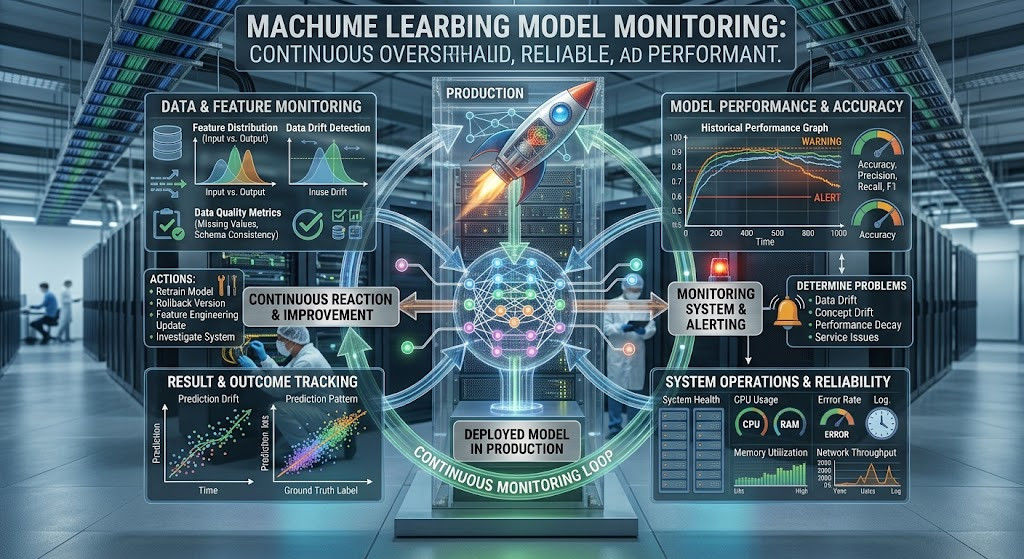
Machine Learning Model Monitoring: Why Production Models Need Continuous Oversight
Your AI Model Is Live. Is It Still Reliable?
Let’s look at the example of using the machine learning algorithm for predicting customers’ behavior, detecting frauds or predicting demand for the products. It works fantastically during development and testing stages. Your team implements it, it gets integrated into the processes of the company and you rely on its predictions.
However, after some time something changes.
Customer preferences change. Fraud techniques become new. Situations on the market become different and the data flowing into your system starts to differ from the data you trained the model on. Accurate predictions become less and less accurate.
Why does it happen? The thing is that your model keeps working but its performance is not as good as you would expect from it.
This is the moment when machine learning model monitoring comes into play. Implementing a model is not the end point of the process of machine learning but you need to monitor its behavior and performance constantly. Machine learning model monitoring helps teams maintain reliable predictions as production conditions change.
This guide will introduce you to the importance of monitoring models in production, relevant metrics, detection of model drift and possible strategies for monitoring of models.
What Is Machine Learning Model Monitoring?
Machine Learning Monitoring is defined as continuous monitoring of the deployed model on the basis of inputs, outputs, performance, and operation in order to determine the problems that might arise from them affecting the validity of the model. Effective machine learning model monitoring provides visibility into how deployed models behave over time.
Unlike traditional software which runs on the basis of instructions coded into it, ML models run according to patterns that are acquired through experience.
ML Model Monitoring involves assessing various elements of the production environment including:
Quality of the data: Is the data coming to the model as expected?
Drift of data and prediction: Is there any change in characteristics of the input or prediction pattern?
Model performance: Is there any discrepancy in the predictions when compared against the actual result?
Operational issues: Are the inference requests being served successfully, without failures and acceptable latency?
Ethical AI considerations: Are the factors such as fairness and privacy controls working fine?
There are usually multiple steps involved in the ML monitoring process which include data logging, statistics, dashboards, alerts, etc. When any metric breaches a certain threshold, your team gets an alert and can investigate the reason behind it and decide on what needs to be done. Machine learning model monitoring makes these signals easier to track and investigate.
The purpose of monitoring is not just to keep your model working. It is about making sure that your model works well in a production environment.
Why Production Machine Learning Models Need Continuous Oversight
1. Detect Model Drift Before Performance Declines
Model drift is defined as changes that may affect the performance of an operationalized model. Two types of drifts include data drift and concept drift. Machine learning model monitoring can help identify these changes before they cause significant business problems.
In case of data drift, the distribution of incoming input data gets changed. For example, an algorithm for retail forecasting that was built mainly on the basis of winter purchases may face different purchase patterns in a new season.
With the concept drift, the association between input data and the output variable changes. An example is a model of detecting fraudulent transactions where the frauds use new techniques to do transactions.
Without monitoring, these drifts might go unnoticed until the time when customers complain about it, there is more loss, or business performance gets affected.
An examination of the modifications in the distribution of input variables, the distribution of predictions, and the performance measures will help identify any problem associated with the model.
2. Protect Business Outcomes and Customer Trust
The accuracy of models is not only a technical issue. It has a direct influence on the decision-making process in your organization. Machine learning model monitoring helps connect technical performance with the outcomes that matter to the business.
Let's take an example of a financial institution that uses machine learning to detect potential cases of fraud. In case the model starts to overlook suspicious behavior, losses may rise. If the system detects too much legitimate activity, customers will be charged for payments unnecessarily.
Recommendation systems, demand forecasting systems, customer churn predictions, and document automation systems face similar challenges.
Production monitoring helps you see these challenges and link technical metrics with business impact. You don’t have to ask whether the model is running but rather whether it is serving its purpose.
3. Strengthen AI Governance and Risk Management
With the increased dependence on AI technology within an organization, there is the requirement for greater visibility of how the implemented models perform. Machine learning model monitoring supports this visibility by providing a record of model behavior and performance.
Through continuous monitoring, there is the ability to ensure accountability through record-keeping of different factors such as the version of the model used, how it performs, any anomalies noticed, and measures taken.
In some cases, this process may assist in recognizing possible problems in terms of the fairness of the decision made, data privacy issues, and other changes observed in automated decisions.
The NIST AI Risk Management Framework may assist in risk management of AI technologies.
Key Metrics to Monitor in Production Machine Learning Models
Machine learning monitoring of models is not only focused on the accuracy metric. Actually, what you need is an array of metrics that can help comprehend how your model handles data, makes predictions, and performs in practice. There are three key elements of machine learning monitoring.
1. Data Quality and Data Drift
The prediction process of your model depends on the data it is getting. Such factors as unexpected nulls, wrong data types, missing features, and other aspects affecting data quality can affect the quality of the predictions. Machine learning model monitoring helps teams identify these data issues before they affect downstream systems.
Data quality monitoring will help to identify such anomalies before they propagate across your downstream systems.
The data drift, in turn, monitors how the incoming data in your production differs from a certain reference dataset which could be your training data or some period of history.
Among useful metrics there are:
Rates of missing values.
Shifts in distributions of numerical and categorical features.
Unexpected ranges of your inputs.
Wrong data type of features.
Distributions shifts of important features.
For instance, when you observe a significant shift in distribution of incomes in your loan approval application, it can indicate either some shift in the target population, some changes in the acquisition channel or your data pipeline problems.
2. Model Performance and Prediction Quality
When actual outcomes are known, make comparisons against true labels or actual results. This will give you an idea of how good your machine learning model is performing according to what you had expected. Machine learning models can be monitored to compare the output with the expectation.
Metrics vary depending on the nature of your machine learning project.
In case you are using classification models, some of the metrics you can use are:
Accuracy: Proportion of predictions that are correct.
Precision: Proportion of correct positive predictions.
Recall: Proportion of positive cases identified by the model.
F1 Score: It’s a combination of precision and recall.
Metrics used for regression models include mean absolute error (MAE), mean squared error (MSE), and root mean squared error (RMSE).
It’s important to choose the appropriate metrics depending on the cost incurred when different errors are made. In case of fraud detection, for example, the cost incurred through a false negative error may be much higher than a false positive error.
Actual results may be available after days or even weeks of making predictions. In the meantime, the teams will be able to track input quality, drift, prediction distribution, and operation metrics, after which the teams will evaluate their predictions using actual labels.
3. Concept Drift and Prediction Drift
When the distribution of the model’s predictions changes with time, we observe prediction drift. This is likely to happen due to a change in the incoming data or in customer behavior; it doesn’t necessarily mean that the performance of the model has worsened and could lead to identifying many more customers as high-risk.
Model monitoring in machine learning assists groups in figuring out whether there are indeed changes in behavior or possible problems with the model itself.
One should never mistake the phenomenon of prediction drift with concept drift, which arises because of some changes in the correlation between the input and the output.
Prediction Drift may serve as an early warning sign of some problems, but that does not imply that the model is not functioning properly anymore. There could be actual behavioral shifts occurring with the customers.
It’s important to consider the actual behavior of the model, the distribution of its predictions, the data, and the specific business environment.
4. Operational Performance
Accuracy of prediction results does not guarantee good usability of the model if it is slow and often breaks down. Machine learning model monitoring also covers the infrastructure and service metrics that affect model availability.
Operational monitoring involves gathering metrics such as:
Latency of predictions.
Rate of request errors.
Throughput and traffic levels.
Availability of the service.
Use of compute and infrastructure resources.
This information will enable your team to tell apart the issues of model quality from infrastructure or data pipeline failures.
More information about model monitoring can be found on Google Cloud’s website and Microsoft Azure’s website.
How to Implement Effective Machine Learning Model Monitoring
Step 1: Create Baseline Metrics Prior to Model Deployment
Metrics to gauge the expected performance of the algorithm should be chosen prior to implementing the model based on a validation set of data, as well as the production data if available. ML monitoring becomes more efficient when expectations are established beforehand.
Document any accuracy metrics, distribution of inputs, patterns of predictions, latency expectations, and acceptable error rates. It becomes possible to compare the results after deployment against this base point.
Avoid basing your measurements purely on training metrics. Use a representative validation dataset and establish production baselines that reflect expected operating conditions
Step 2: Collect Production Data and Prediction Logs
Collecting production data and prediction logs provides visibility into model behavior that would otherwise be difficult to assess
Collect information which will help analyze the input factors, output factors, running time, and event factors that pertain to performance. Relate the prediction to an identifier so far as possible, so that you can link it to results in the future. Machine learning model monitoring depends on having reliable records that allow teams to investigate changes and evaluate predictions later.
The way in which the logging is going to be carried out needs to take into account issues such as data minimization, access control, retention periods, and privacy as needed. Do not log sensitive data simply because you have access to it
Step 3: Create Practical Alerting Systems
Set up alert conditions based on factors such as the presence of too many missing values, delayed predictions, and low accuracy. An alert system for a machine learning model should be such that it produces relevant alerts and not unnecessary alerts.
Alerting thresholds should take into account the nature and risks of the model. A small deviation from expected results in a recommendation engine may not be cause for concern, but the same deviation in a decision system could require investigation.
Don’t alert on every small deviation.
Step 4: Investigate Anomalies and Identify Root Causes
In case there is any alert in the monitoring system, first establish the cause of change in metrics before taking any action. Machine learning model monitoring is most useful when alerts lead to structured investigation and appropriate corrective action.
Reasons may be:
Behavior or conditions in the market have changed.
Issues with the upstream data pipeline.
Additional or missing features being fed into the model.
Production environment changes.
Disparity in training and serving data.
Actual decline in the predictive power of the model.
This helps prevent unnecessary model retraining when the underlying issue is caused by a faulty data pipeline
Step 5: Retrain, Roll Back, or Update the Model
Machine learning model monitoring assists in making decisions on whether to retrain, rollback or fix the pipeline that is in place.
Should there be changes in behavior as shown by the new data, then retraining may yield better results. If a recently released product causes a regression, reverting to a known good version may be more prudent. When the issue is from the upstream data source, addressing the pipeline may be all that’s needed.
Automate where necessary, but involve a human when there are consequences to the decision. Every improved model must go through validation and deployment steps..
Common Machine Learning Model Monitoring Challenges and How to Overcome Them
Well-conceived monitoring systems will still have certain constraints. Recognizing the issue from the beginning will help to create an efficient monitoring system. Machine learning model monitoring practices should account for these practical limitations from the beginning.
Not Having Ground-Truth Labels at the Moment of Prediction
A part of the consequences will be observed in the future. You may already have a forecast from your model about today, but you don't know if that forecast is accurate.
Solution: Combine immediate monitoring triggers, like input quality and predictions' distribution, with subsequent monitoring based on performance evaluation after having ground truth labels.
False Alarms and Fatigue Monitoring
Each distribution shift is not necessarily a problem because there might be seasonality, changes in the demography of consumers, and statistical oddities triggering the alarms despite the fact that the performance of the business is satisfactory.
Solution: Use context-based thresholds, choose proper reference periods, and pay more attention to significant and persistent changes.
Costs and Complexity of Monitoring
Monitoring many features and various models may become costly in terms of computing, storage and maintenance costs.
Solution: Allocate your monitoring efforts to focus on those features, models and metrics that are really important to your organization, and review monitoring coverage regularly.
Ownership and Alert Response Process
Alerts are pointless if you don’t know what to do with them and whom to turn to.
Solution: Define alert ownership and implement an alert response process.
Best Practices for Reliable AI in Production
For an effective monitoring system, the monitoring process must become part of the MLOps process. The monitoring of machine learning models needs to become a component of the entire model lifecycle process.
Start monitoring from day one. Turn on the right kinds of monitoring immediately upon going into production with a model, not only after problems start coming up.
Monitor using several signals. These include the data quality, data drift, model performance, and infrastructure data to get a fuller picture of what’s going on.
Choose monitoring frequency based on risk. High volume and mission-critical models need frequent monitoring, while other models might do fine with scheduled monitoring.
Track model and data versions. Track version information about the model deployments, datasets used, configurations, and performance.
Integrate monitoring with MLOps. Connect monitoring with incident management, model validation, retraining pipelines, and deployment processes as necessary.
Monitor for fairness and other risks. If you’re working on applications that affect people, monitor subgroup performance and risk factors.
Reassess threshold criteria. Change monitoring criteria as business goals, data, or modeling changes.
Business Value Identification. Align technical measurements with value factors such as savings from fraud prevention, forecast accuracy, reduction in reviews, and improvements in customer experience.
It should be a process that will be controlled, not an event. And if your team does not have enough skills to interpret the numbers presented in the dashboard, then there is no point in it at all.
Make Continuous Oversight Part of Your AI Strategy
Deploying an AI model is the beginning of its operational lifecycle, not the end of its development. Over time, due to changes in the data available, customers' behavior, business needs, and so forth, even the best trained models may become unreliable. Machine learning model monitoring helps organizations identify these changes and respond before they cause lasting problems.
Model monitoring for machine learning lets you discover new issues, analyze changes in performance, and fix these problems in order to prevent any negative consequences for your business results.
Understanding how your AI systems operate in practice can be achieved by means of data quality, data drift, model accuracy, and operations monitoring.
The best way to achieve that is with the help of adequate measurements, alerting, reaction, and evaluation. Not all metrics require immediate monitoring. Start from analyzing the risks related to your models and the corresponding indicators.
Here at Gigmint.AI, we see another, much bigger potential to assist businesses in developing a strategic perspective on their artificial intelligence – as a capability that should be developed, deployed, evaluated, and improved.
Frequently Asked Questions
1. Define machine learning model monitoring.
Model monitoring involves keeping track of a deployed model's inputs, outputs, predictions, and other metrics in order to see whether there are any alterations which might impact the stability or the business use of the model.
2. Explain the importance of model monitoring during production.
The production environment keeps changing. Model monitoring will alert you to potential data quality problems, model drift, performance decrease and infrastructure problems. It will help you address the problems before they do more harm. Machine learning model monitoring therefore supports the ongoing reliability of deployed AI systems.
3. Explain the distinction between data drift and concept drift.
When the distribution of inputs of the model is changing, it is referred to as data drift. If the relationship between the inputs and the outcome changes, it is concept drift.
4. What is the right frequency for checking a machine learning model?
The checking frequency varies with traffic, risk, business needs, and speed of change of the underlying environment. Some cases require real-time monitoring for operational metrics and regular monitoring of performance metrics. Some models will have a daily or weekly monitoring schedule.
5. What metrics should you use when monitoring your ML model?
Use the appropriate metrics for your application. They can be data input quality, data and predictions drift, classification/regression accuracy, latency, error rate, and availability metrics. In case of high impact applications also consider fairness and risk metrics.