AI-Powered Recruiting: A Complete Guide for HR Professionals
AI-Powered Recruiting: A Complete Guide for HR Professionals
1. Overview
The Modern Hiring Challenge
It has become hard for organizations to recruit the best individuals because of stiff competition among companies that require skilled talent and huge numbers of applications. The talent acquisition (TA) team receives hundreds of thousands of applications per job opening and makes it hard to screen, schedule interviews and communicate with candidates manually.
Conventional ways of hiring might lead to bottlenecks, increased time-to-hire, and the impossibility to pay attention to each candidate. Using conventional Applicant Tracking Systems (ATS) based on keywords might result in rejection of good candidates whose skills and experience differ from the description of the position.
AI-Powered Recruiting Emerges
However, with the emergence of artificial intelligence, recruiting strategy transforms. Thanks to AI-powered recruiting solutions, firms will be able to process candidate data, assess skills, perform administrative tasks, contact candidates, and recruit more efficiently.
AI-driven recruiting is not similar to conventional automation as it makes use of such technologies as Natural Language Processing (NLP), machine learning, predictive analytics, intelligent matching, among others.
What Is AI-Powered Recruiting?
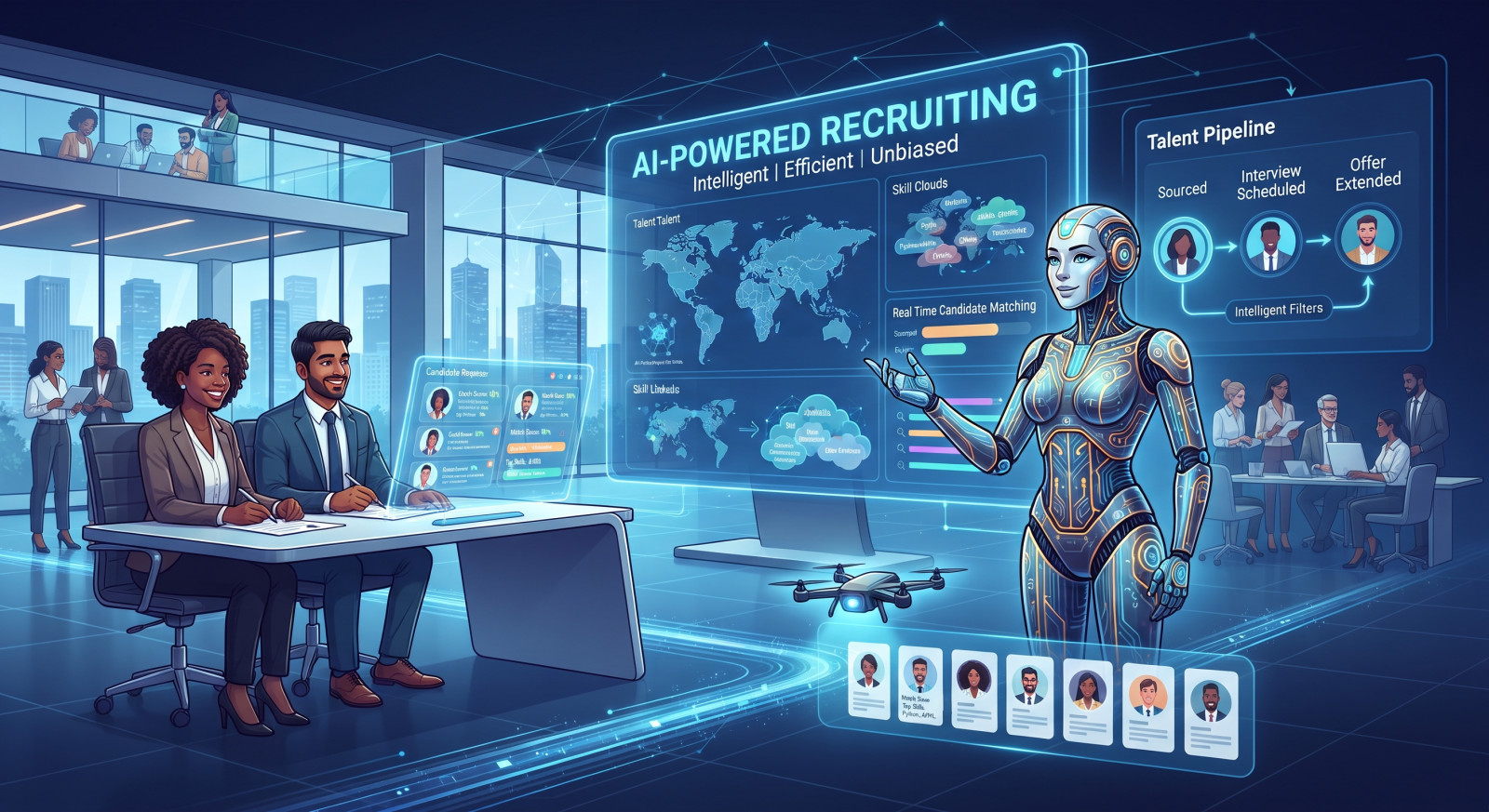
AI recruitment refers to the utilization of artificial intelligence technology for the purpose of supporting and improving different stages of the recruiting process. This technology is not intended to replace recruiters; it should act as a copilot supported by technology, making the task of administration easier and allowing recruiters to focus on areas requiring human interventions.
In this guide, we examine the impact of AI on recruiting, AI-powered recruiting technologies, their strengths and weaknesses, the ethics of AI recruiting, and an approach to responsible implementation.
2: From Paper to Pixels
There have been tremendous changes in recruitment since then, making recruitment become fast and highly dependent on technology. Getting acquainted with these eras will help us to understand why the current state of recruiting requires that we completely change our recruitment tools.
Era 1: The Manual/ Paper Resume Era
Recruiting for decades had been conducted using physical files, bulletin board postings, and lots of paper resumes. HR specialists physically received the mail, evaluated resumes manually, and were highly dependent on word-of-mouth communication or print ads for finding candidates. The process was highly personal but geographically very limited and slow.
Era 2: The Introduction of Traditional ATS
With the development of the internet, there came the Applicant Tracking System (ATS). This era introduced such innovations as keyword parsing, boolean searches, and workflow automation. While the system succeeded in centralizing data, many of such systems viewed candidates as mere entries in the database rather than actual individuals.
Era 3: The AI-Powered Recruitment Era
We have entered into the era of the Cognitive Age, where all the above features such as Machine Learning, Natural Language Processing, prediction analytics, and conversation agents form the basis. We no longer just focus on the CVs of candidates, but also analyze their behavior and performance through intelligent chatbots.
Why Traditional Tools Fall Short Today
Long time to hire: Slow decision-making process and poor user interface prevent the hiring process from moving forward.
High cost to hire: Ineffective processes and manual labor increase the recruiting expenses.
Ghost candidates: Applicants get discouraged by complicated application procedures.
Passive talent missing: Keyword-based filters block highly qualified professionals due to the inappropriate format of their resumes.
3: Core Technologies Powering Modern AI-Powered Recruiting
The evolution of recruiting from an organizational bottleneck to a strategic tool is propelled by the emergence of cutting-edge technologies of artificial intelligence. Far more advanced than any primitive tools of the past, today's recruiting tools apply advanced AI and machine learning models in order to identify, predict, and interact with potential employees in an innovative manner. The following are just some of the technologies that redefine team building.
Natural Language Processing (NLP): Beyond Word Counting
Conventional recruiting software worked on a primitive model of searching for keywords, and, in most cases, disqualified candidates who used synonyms of key terms in their resumes and cover letters.
NLP technology totally transforms the way things are done. Using advanced semantics and context knowledge, highly developed artificial intelligence scans through candidates' CVs and letters of recommendation in the same manner humans do, but faster and in greater volumes.
The system knows about the subtleties, specific terms, and real meaning of the candidate's phraseology. Rather than just checking if the candidate had used a certain buzzword in his/her CV, NLP checks how well the skill was applied by the candidate.
Machine Learning (ML) & Predictive Analytics
Whereas traditional methods of recruitment could only give information about what had already taken place, Machine Learning (ML) and prediction allow looking into the future. Analyzing the historical data related to tenure, performance evaluation, and pathways of career development in an organization, ML algorithms find out the indicators of future success.
Predictive systems can predict such indicators as flight risks, probabilities of retention, and other high-performance indicators even before the candidate receives the job offer. Recruitment departments can use such predictions for selecting those candidates that match the profiles of best performing employees in the organization.
Improving Candidate Experience
Such solutions can easily manage all high-volume and regular interactions with candidates. It does not matter whether it is replying to questions of candidates in the middle of the night, conducting pre-screening questionnaires or scheduling interviews with hiring managers.
Computer Vision & Assessment AI: Multidimensional Evaluation
The process of determining a candidate’s potential has long transcended the traditional practice of multiple-choice tests or even resume evaluations. Computer vision and assessment AI provide multidimensional assessment capabilities in the recruiting process.
Modern assessment tools employ AI technology to assess coding tests, portfolios, and skill demonstration exercises objectively.
Some sophisticated tools use video interviewing to assess verbal performance, clarity, and engagement. It is critical that such tools be implemented carefully within the ethical framework. The most professional organizations make sure that the tools are audited for fairness and compliance with regulations on a regular basis.
4: Key Benefits for HR Professionals & Talent Teams
Talent acquisition is not anymore limited to merely filling in a vacant position. Talent acquisition in the present-day world is a means to growth for any organization. Due to the pressure put on talent leaders to do more with fewer resources available.
Delegating all of the transactional work to AI technologies allows talent leaders to focus on strategic tasks. The following are the benefits of AI-powered recruiting tools to talent leaders.
1. Drastic Decrease in Time-to-Hire
In the traditional recruitment process, time spent on work includes executing repetitive tasks like scanning CVs of potential applicants, scheduling interviews via different calendars, and letting the applicants know about the status of their application process.
Through AI-enabled tools in recruitment processes, there can be considerable savings in time-to-hire due to automation of resume scanning, scheduling, and communications with applicants.
2. Quality of Hire Improvement
ATS programs using keyword matching algorithms often screen out candidates who have unique formatting or who choose to use synonyms. Matching algorithms powered by AI go beyond keyword matching and consider holistic skill sets, transferable skills, and semantic experience.
This method can assist in finding candidates whose skills and experience are more relevant to the job specifications. Both in terms of technical requirements and in terms of culture, leading to greater retention and success.
3. Enhancing the Candidate Experience
The modern candidate seeks the consumer-grade experience. Sadly, the black hole application process is still one of the main factors in losing candidates and damaging the employer brand. With AI, there is instantaneous recognition of applications, transparent portals with tracking options, and conversational bots informing candidates on their progress throughout the process.
4. Scalability Without Linear Headcount Expansion
Market uncertainties imply that there can be fluctuations in demand for talents. No matter whether it is due to seasonal surges or an unexpected expansion in businesses for an organization, expanding the traditional recruitment team in a linear way is very costly.
The use of artificial intelligence for talent sourcing allows HR teams to process larger numbers of resumes without an equivalent increase in administrative burden. This will allow the smaller HR teams to effectively conduct large-scale recruitment campaigns.
Glimpse into Gigmint.AI
For this purpose, platforms are needed which cater to the dynamics of the modern working environment in terms of speed, flexibility, and skills matching. Gigmint.AI is one such platform that stands out in this emerging field of recruitment technology.
With the help of its AI-driven matching system, Gigmint.AI bridges the gap between employers and the top-notch talent immediately regardless of whether they are freelancers needed on an urgent basis or full-time candidates hired for important positions.
5: Navigating Challenges & Ethical Considerations
While artificial intelligence has provided an unmatched speed and accuracy of talent acquisition process, its application raises numerous problems related to its functioning, legal and ethical issues.
Automated processes should not be implemented and left to work without proper consideration of potential problems like biased results or compliance issues. Talent acquisition professionals face numerous questions related to algorithmic biases, complicated legal requirements, and the necessity to retain the advantages of human nature.
Bias Dilemma: Continuous Model Auditing
One of the most problematic questions in the process of AI-powered recruiting is the issue of algorithmic biases. Machine learning algorithms depend on historical data to train, and often the information available to them contains years or even decades of human biases and inequalities.
An AI-powered recruiting tool trained on a database of resumes from a homogenous workforce would automatically learn to prioritize people of certain background, education, and professional history.
To fight such a problem, it is necessary to audit algorithms' results for disparate impact, eliminate any proxy variables and use diverse datasets. Transparency of algorithms and their results is crucial here.
Data Privacy & Compliance: Navigating AEDT and Global Regulations
Recruitment data is very private, including work experience, contact details, behavior assessment, and even biometric data obtained through video interviews. As a result, talent acquisition teams have to work in a rather strict regulatory environment.
This is why such pieces of regulation as GDPR, EEOC regulation, and the laws governing Automated Employment Decision Tools (AEDT) in New York City, Local Law 144, oblige companies to meet numerous conditions.
It is necessary to identify what legal and ethical obligations regarding privacy, consent, notice, and data processing are associated with the use of AI in recruitment depending on the jurisdiction and application, reduce data processing and ensure an opportunity to request a human review of an automated decision. Noncompliance with relevant regulations and norms poses regulatory, financial, reputational, and trust risks to the organization
The “Human in the Loop” Principle
Data processing, prediction of retention, automation of repetitive scheduling tasks are the functions of AI. The system can work with large volumes of data, but it cannot provide context and human judgment.
It is necessary to develop a "human-in-the-loop" approach in order to build an efficient recruitment approach. The recruiter must have the opportunity to make his or her independent decisions related to the evaluation of cultural fit, the conduct of the final interview, and offer negotiation. The use of AI makes the decision, but the person makes a hire.
Candidate Trust and Transparency
Candidate anxiety about the “black box” nature of automated hiring bots is a key cause of ghosting in applicants. Candidates may be less comfortable with automated assessments when organizations do not clearly explain how AI is being used or provide an appropriate channel for questions and human support.
Organizations can overcome this by exercising radical transparency and making sure that candidates are notified that they are being evaluated using artificial intelligence, what metrics are being used, and giving candidates an alternate channel of communication when necessary. This helps organizations maintain their ethical and trustworthy approach towards AI recruitment.
6: Step-by-Step Implementation Framework for HR Leaders
Incorporation of artificial intelligence in the talent acquisition process is usually not a straightforward "plug and play" process. Considering the fact that recruiting impacts individuals and has a legal perspective, a proper framework for implementation is essential for successful incorporation of artificial intelligence in the talent acquisition process. Otherwise, there could be software fatigue, lack of adoption and other challenges.
An implementation plan consisting of four stages will help HR professionals utilize all capabilities of modern recruiting technology effectively and safely.
Phase 1: Needs Assessment & Audit
Before making any kind of software assessment, a leader of talent acquisition needs to assess his or her organization first. Every company faces unique challenges related to recruiting and using AI technology without any planning will just exacerbate these problems.
Identify the Bottlenecks: Assess your talent acquisition pipeline. Do you have a bottleneck in terms of huge amounts of resume piles that you get during a busy hiring period? Or is it the problem of slow scheduling of interviews which results in candidates abandoning?
Define Your Strategy: Identify the area where AI can give you the most significant value. If you spend $60\%$ of your week manually reviewing junior level resumes, then automation should be your priority.
Assess the Technology Stack of Your Legacy Systems: Review your ATS or HRIS system. Will it integrate well with AI, or should you rethink your technology stack?
Phase 2: Vendor Selection
The recruitment space with respect to AI is highly crowded with vendors that make promises of magic solutions. The need for cutting the vendor marketing messages and getting to the nitty-gritty questions is critical.
Algorithmic Transparency: It is important to demand transparency when it comes to the functioning of the vendor’s matching algorithms. Are they proprietary models based on unbiased training data? Can the vendor prove fairness through third-party reports?
Data Security & Compliance: You need to be certain that the vendor will comply with all local and international requirements (GDPR, CCPA, etc., including evolving requirements for Automated Employment Decision Tools). Where the data is stored and how it is secured?
Ecosystem Compatibility: You need to check the capability of the vendor’s platform to integrate into your ecosystem. For example, assessing the possibility of integration of modern networking tools or specific engines with respect to your ecosystem, taking into account the presence of advanced talent matching architectures (e.g., from Gigmint.AI).
Phase 3: Change Management & Team Training
Even the most sophisticated AI solution will be useless if the recruiters you work with are unwilling to engage with the solution and have a deep-seated mistrust towards automation. Change management is essentially a people problem.
Position AI as a Co-Pilot: Don’t position the AI tool as something that replaces recruiters; sell it as an ever-present assistant that gets rid of mundane paperwork and allows recruiters to engage in more productive activities.
Upskill the Team: Educate the recruiters responsible for talent acquisition in interpreting predictive analytics and writing prompt guidelines for the conversational bots, as well as critical evaluation of AI-based candidate shortlists.
Develop Internal Advocates: Identify tech-savvy recruiters and include them in the pilot projects, debugging, and marketing of the technology to other members of their team.
Phase 4: Pilot Testing & Metrics Tracking
Do not roll out your new recruiting technology solution all at once in one big bang. Begin by piloting the technology in one part of the organization only.
Set Your Baseline Metrics: Set your KPIs prior to launching, which may include time to hire, cost per hire, recruiter satisfaction, and NPS scores of candidates.
Iterate and Improve: Keep an eye on the pilot process over the first $60-90$ days and collect ongoing feedback from both hiring managers and candidates for tweaking processes and sensitivity levels, etc.
Scale with Confidence: Once you have seen a clear return on investment and an easy adoption of the technology, then it is time to scale.
7: What's Next for AI in HR?
As artificial intelligence develops rapidly in the world of today, the HR landscape of tomorrow evolves from transactional automation into hyper-personalized strategic anticipation. Those organizations which embrace AI-powered recruiting tools have already started looking ahead to see where technology goes next.
Knowing the trends which are developing right now enables the talent acquisition specialists to anticipate changes and stay ahead of the game in today's increasingly competitive talent market.
Generative AI for Job Description Writing
No more use of boring, overused job postings with outdated language. Generative AI will change the way the companies engage their prospective employees with hyper-personalized and culturally resonant job descriptions tailored specifically for each pool of applicants and each region.
The advanced generative algorithms can identify the best job descriptions out there, clean up all the gendered language biases and generate requirements that will be suitable for the specified demographic group.
Internal Mobility Matching
The most economical and motivated group of talents can already be found within your organization. New AI engines have changed the orientation from outside to inside by creating dynamic models of employees' skills, projects and educational achievements.
Of depending on managers to assign their team members for any tasks, intelligent platforms identify talents in the existing employee base. This approach can reduce reliance on external hiring for some roles and may support employee mobility and retention when implemented effectively.
Immersive Metaverse and Virtual Reality Assessments
Spatial Computing combined with AI is enabling completely new approaches in assessing candidates. Going well beyond simple video interviews, assessments will involve immersive VR testing of the ability to solve problems, to collaborate in a challenging situation and to perform certain tasks. AI judges these judgments using the analysis of micro expressions, decision-making and involvement of the candidate.
8: Frequently Asked Questions
1. Would AI take away recruiters' jobs completely? No. The purpose of AI is to assist in automating repetitive administrative activities, such as initial resumes' screening and scheduling. Thus, recruiters would be free to concentrate more on communication with applicants and decision-making.
2. How does NLP optimize the resume screening process? Unlike traditional software which only looks for identical matches of keywords, NLP considers context and semantics of resumes in order not to exclude the qualified candidate due to different terminology used.
3. What is "candidate ghosting"? Why does AI solve this problem? "Candidate ghosting" happens when an applicant gives up due to inefficient and unclear recruitment procedures. AI solves this issue thanks to providing immediate feedback and 24/7 chatbot activity and transparency of pipeline.
4. How does technology like Gigmint.AI change the recruiting landscape? Platforms like Gigmint.AI apply advanced matching AI algorithms to connect employers with the best freelance/fulltime talent within seconds and shorten the time-to-hire process.
5. How can firms ensure there will be no bias in AI-powered recruiting algorithms? Organizational needs to perform regular algorithmic audits and ensure the diversity of datasets and compliance with all fairness principles and standards, including EEOC guidelines.
6. What are AEDT Regulations? AEDT Regulations are regulatory requirements being developed for any company using AI tools in their hiring and promotion process (examples include NYC Local Law 144).
7. How is employee retention predicted through Predictive Analytics? Machine Learning assists HR professionals to utilize the past data on HR, performance metrics, and employee engagement to predict and avoid attrition risk scenarios in the organization.
8. How should HR leaders implement AI into their HR processes? Start with an assessment of needs in the HR function and identification of bottlenecks, pilot the solution where there is a lot of friction (first touch point of candidates, initial screenings, etc.) and build up your recruitment team skills on change management.
9: Call to Action
AI-driven AI is changing how organizations approach talent acquisition by helping automate repetitive tasks, analyze candidate information, and improve the efficiency of recruitment workflows through automation of repetitive processes, analysis of candidates' information, better interaction with them, and faster identification of skills.
The transition from manual recruiting to traditional ATS platforms and then to AI-powered recruiting illustrates how technologies may assist HRs to deal with competitive labor markets.
At the same time, the implementation of artificial intelligence in hiring requires additional measures since the issue includes aspects like data privacy, algorithmic biases, transparency, compliance with regulations, and trust of candidates. It is necessary that AI assists recruiters but not take the place of their judgment in such crucial questions.
The best option is using human-in-the-loop technology when AI does certain administrative and analytical work while recruiters remain accountable for the consideration of the context, cultural fit, conducting of interviews, and the final decision.
For HRs, the following steps are needed: the identification of recruiting bottlenecks, assessment of technologies that they already have, selection of suitable AI solution, conducting of pilot projects, measuring the outcomes, and scaling when there is enough evidence of its usefulness and responsibility.
Interested in exploring the possibilities of AI-powered recruiting for your organization? Get to know about platforms like Gigmint.AI and find out how they may contribute to the improvement of talent matching and recruitment processes.