AI Talent Acquisition: The Complete Guide to Smarter Hiring
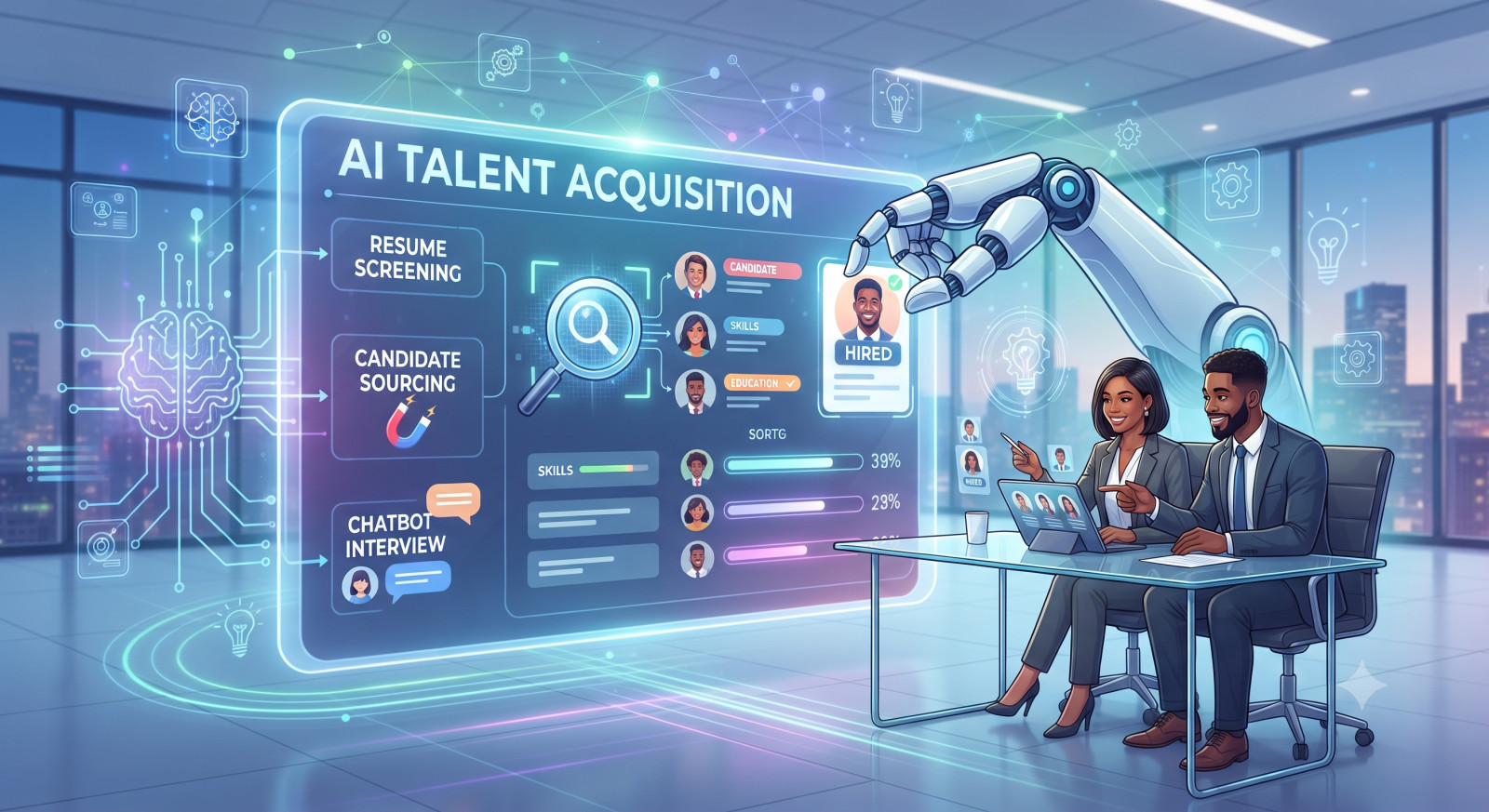
AI Talent Acquisition: The Complete Guide to Smarter Hiring
I. Introduction
But it’s now 2026, and the hiring world has never undergone a transformation more disruptive than the creation of the job board. Decades have passed in which the process of hiring has revolved around “the manual grind”—that is, recruiting passive talent, manually sifting through piles of resumes, and watching good talent fall through the cracks and get poached by competitors because of inefficiencies. All of that is changing. We are seeing a definite shift from manual-only labor to agentic labor, powered by artificial intelligence as a partner.
Hiring has always had the same core problems: it’s slow, often biased, and incredibly expensive. When the majority of a recruiter’s time goes toward scheduling, logging information, and updating the status of candidates, the strategic side of things is neglected. An error in hiring or an open position costs dearly when it comes to growth and competitiveness.
AI-powered recruiting is not just about “automation” in the traditional sense of increasing efficiency in repetitive processes – it is about an entirely new paradigm of what recruiters do.
By shifting the burden of tedious work to smart machines, companies give their teams the opportunity to transform from mere administrative filters into powerful talent strategists. In this guide, we’ll dive into the inner workings of AI recruiting, the right ways of implementing it, and why the integration of agentic AI systems is no longer optional.
II. What is AI Talent Acquisition?
If one wants to see how hiring will evolve, they should remove the buzzwords. AI Talent Acquisition is not about implementing a chatbot on the career page or automation of email follow-ups. It is an embedding of machine learning, Natural Language Processing (NLP), and predictive analytics in the basic recruiting processes. While the classic software performed only as a digital folder organizing resumes according to certain keywords and following candidates' status, AI performs like a cognitive partner.
Going Beyond Parsing
Classic recruitment solutions operated using strict parsing technology based on keywords. In case a candidate did not have the "Project Management" phrase on his resume, there was no chance to see him even if he was able to do the job. The modern approach to AI-driven talent acquisition goes beyond such simple parsing. Using NLP, these solutions interpret the semantic meaning of profiles. Machine learning models go even further and use thousands of variables, from professional path to skills adjacency, to find candidates.
From "Tooling" to "Intelligent Systems"
We are now observing the shift of generations: from fragmented "tooling" to integrated "intelligent systems". In the past, recruiters would use one tool for recruiting, another for pre-screening, and yet another one for interviewing candidates. These tools did not really talk to each other, creating a number of data silos.
Intelligent AI systems tear down these barriers. They work as one engine, in which the data gained in the course of the recruitment process feeds into the pre-screening one, and all findings during the interview stage automatically get incorporated into the candidate's profile for talent mapping.
Why Does It Matter: Data vs. Gut Feelings
The biggest effect of this change is the end of the "gut feelings" era. Whereas intuition definitely has its value in forming human relations, it is the main culprit of hiring biases and unpredictable results.
Using the power of predictive analytics, organizations can hire their employees based on historical performance data and competency modeling. By moving away from intuitive guesswork and basing our hiring on the probability of success based on data, we not only shorten the hiring process but increase the potential for the high quality of hires.
III. The Stages of AI-Powered Hiring
The evolution of Ai talent acquisition can be seen through the daily operations process. AI does not just speed up the old process but revolutionizes the quality of the experience at every stage of the process.
Sourcing: From Searching to Surfacing
Old-style recruiting is essentially a numbers game where you post your job and hope for the right candidates to come across it. The new style of recruiting reverses all of that. Advanced AI recruiting software acts like an independent agent, constantly looking into public databases, professional communities, and internal talent pools.
Instead of using boolean search methods, this system uses predictive modeling to figure out who out of those passive candidates will be a good match and more importantly, ready to accept a new challenge.
Screening: Context-Aware Evaluation
The age of “keyword traps” is long gone. Where previous automated systems merely identified resumes which included certain jargon terms, today’s context-aware resume screeners operate as sophisticated as a seasoned recruiter would.
Using Natural Language Processing, these screening tools analyze the range and depth of experience that the candidate has had. The tool knows whether the project manager was in charge of a small budget or managed a large-scale international project.
Through skill adjacencies and impact assessment, not titles, AI ensures that you are bringing to the top of your funnel high-potential candidates and not just skilled resume-writers.
Interviewing: Enhancing the Human Experience
It is here that the cognitive partnership function of AI really pays off. Firstly, the administrative hassle of scheduling can be automated using agents that coordinate themselves with the calendar and availability of the candidate.
More than that, AI assistants could provide immediate support in the form of suggestions that depend on the specifics of the candidate's resume or previous experience of the candidate.
Sentiment analysis tools would give recruiters an objective view on engagement during the first video interview allowing them to pick up all culture-add candidates who were overlooked in the heat of discussion.
Offer & Onboarding: The Predictive Edge
The last step of making sure the candidate says yes to the offer turns out to be one of the riskiest steps. Predictive analytics is used to estimate the probability of an acceptance depending on the comparison of the offered package and preferences of the candidate with historical benchmarks in the market.
Once the offer is accepted, there's no more room left for hassle. AI maps the competencies of the candidate with the company's knowledge bases helping to make the integration seamless and leading to accelerated time to productivity.
IV. The Business Impact: Why Organizations are Making the Switch
The adoption of AI talent acquisition isn’t motivated primarily by the temptation of the "latest" technology available on the market. This is an effective reaction to the growing challenges presented by today's labor market, where fastness and accuracy are the key factors of competitiveness.
Moving away from traditional recruitment systems, organizations aren't focused only on becoming more modern; they aim at activating three major business levers - efficiency, quality, and cost-efficiency.
Efficiency: End of Administrative Hassles
The most immediate and measurable effect brought about by AI is significantly decreased time-to-hire. In the traditional environment, the role of recruiters becomes that of process managers rather than talent hunters because of administrative hassles associated with scheduling interviews, screening candidates manually, and performing routine tasks.
Using AI technology for the automation of routine activities, organizations multiply their capacity for recruitment. When autonomous agents manage initial contacts with potential candidates, scheduling, and status updates, recruiters are able to screen many more candidates and increase the speed of processing of applications without affecting the candidate experience.
Quality: Data-Backed Retention
The most important impact of AI could be considered the enhancement of the "quality-of-hire." The recruitment process is notorious for its cognitive biases, which often lead to recruiting people who fit some kind of template and resemble previous hires in their look and behavior.
These AI models change all that because they consider historical data and competencies throughout the whole company. They identify those specific skills and behaviors that will guarantee the long-term success of the employee.
Recruiters move from using "gut feeling" towards using the numbers, and that increases the probability of retaining good candidates who will really match the requirements for performance.
Cost-Savings: Optimizing the Cost-Per-Hire
AI has a direct effect on the bottom line by reducing the cost-per-hire. Two ways in which this is accomplished include:
the reduction in the number of labor hours needed and the reduction in the risk of expensive hiring errors. If hiring processes are automated, then the labor cost per hire will be greatly reduced.
Quality and retention will be improved, thus reducing the "hidden costs" of hiring, such as the cost incurred when a person makes a wrong hire because of the damage that he or she can do to a company's business processes and employee morale.
V. Ethical Considerations & Overcoming Bias
With the rise of AI-based recruitment, ethics are no longer just nice to have but are becoming an absolute essential for organizations. As AI systems get to affect individuals' careers, there comes a big responsibility. In order to use AI to its fullest extent, recruiters need to address the three main ethical challenges.
Transparency Challenge: Beware of "Black Box"
Among the key concerns about using AI for recruitment is the "black box" phenomenon when the decisions are being made in a way that is hard even for AI developers to decipher. For the candidates, such lack of transparency is a deal-breaker.
If they have been declined, they should be at least partially informed about the reason why. To avoid it, employers have to focus on "explainable AI". In other words, they should use only those vendors who offer an auditing trail of all the decisions made by AI.
If a certain candidate gets to pass interviews or, vice versa, is excluded from the list of best candidates, the system should specify what exactly was the data point—skills, experience, certificates—that affected the decision.
Bias Mitigation: Auditing for Fairness
AI does not have an intrinsic neutrality; it is the manifestation of the training data that is fed into the system. In case of historical recruitment bias in terms of favoritism for hiring candidates from particular universities or gender imbalance in certain positions, the system is going to be taught how to repeat and reinforce such patterns.
It is crucial to make sure that such auditing is ongoing. The process of bias mitigation is based on "stress testing" for the existence of disparate impact on different demographics. It ensures that the AI does not systematically exclude people.
Compliance: Navigating the Global Regulatory Landscape
Regulation of AI technology is changing as fast as AI technology itself. In this light, it is necessary for organizations to consider the rights of candidate data privacy in the context of EU AI Act and GDPR.
Compliance is more than storage of data; it is about the intentionality of data processing, data storage, and the usage of AI to make automated decisions.It is necessary for HR recruiters to work together with lawyers and IT professionals to ensure that their artificial intelligence system will comply with the national and international labor law regulations.
The company needs to adhere to the principle of “human in the loop,” meaning that human professionals have to participate in important recruiting processes.
VI. Implementing AI in Your Hiring Workflow
The adoption of AI cannot simply be a software purchase decision—it will require an overhaul of your recruiting organization. In order to avoid the typical mistakes made in technology for technology’s sake approaches to software adoption, leaders need to adopt a structured implementation process.
Phase 1: Readiness Assessment: Finding the Right Processes
Before pulling out your credit card, you have to first get a sense of what your existing weaknesses are. The common error made is trying to optimize the entire funnel in one go. The first step then becomes conducting a "Process Audit."
You have to map out the processes used by your recruiting teams and then identify those parts of the process that have "Administrative Friction"—the high volume tasks that distract recruiters from giving attention to the candidate experience and recruiting strategy.
This is normally in the "High Volume/Low Complexity" process areas: sourcing outreach and preliminary screening. This gives you instant gains in terms of capacity and only when your recruiting teams adapt to this should you move towards predictive onboarding or advanced interview sentiment analysis tools.
Phase 2: The Tech Stack: "All-in-One" vs. Modular Tools
In terms of selection of technology stack, organizations typically have a choice between the “All-in-One” bundle and “Modular” integration.
All-in-One Platforms: All-in-one solutions provide you with a cohesive, “out-of-the-box” solution. They are relatively easy to implement and support, but may sometimes fall short of the depth that is needed in order to accommodate business-specific requirements.
Modular Solutions: The modular solutions allow you to "best-in-class" shop, meaning that you pick the best possible sourcing AI, the most effective screening engine, and unique scheduling solution. Although you create a more robust solution, there is a higher responsibility on your side to ensure that you have smooth API integration between all the components.
Whatever the way you go, always make sure that you go with “Open Ecosystems”. Make sure that whatever you buy can integrate into your existing ATS. The intelligence you are buying is only as good as the data it can access.
Phase 3: Change Management: The "Human-in-the-Loop" Philosophy
It is hardly ever a technological issue but rather a cultural one. Recruiters in your company might be afraid of the fact that the use of AI will be followed by layoffs in the future. It is essential to communicate that you need to think of AI as your "Co-Pilot" that will enhance their efforts but not replace their expertise.
"Human-in-the-Loop" approach plays an important role here. AI is supposed to give recommendations but it will still be up to recruiters to make decisions concerning crucial stages of the hiring process, such as choosing a candidate to hire or negotiating with them about an offer. Training "AI Literacy" is another aspect to invest in. It means learning how to create good prompts, analyze recommendations of AI and double-check them.
VII. Future Trends: What’s Next for AI Recruiting?
The AI revolution for talent acquisition is only in its infancy stage. With time, the emphasis will change from making things efficient to totally transforming the recruitment process. There are three emerging themes that are going to shape the future of the industry.
Agentic AI: Hiring by Autonomous Agents
The next step in technological development is the transition from “AI tools” to “Agentic AI.” Contrary to existing systems which need continuous human prompting, hiring agents will be autonomous.
The agents will be able to carry out a series of activities independently, from the detection of a need for sourcing and the creation of personalized messaging, to scheduling negotiations and handling all the logistics of the interviews. In this world of the future, the role of a recruiter will be transformed into "Manager of Agents."
Skills-Based Hiring: Replacing Credentials with Capabilities
Static credentials such as university degrees and job titles are increasingly becoming a thing of the past. In the future, the AI-driven recruitment system will shift towards a "skills-based" approach. The system will prioritize the skills of the candidates by taking into consideration the results of their technical test scores, simulation results, and project work as opposed to their pedigree.
Hyper-Personalization: The Candidate Journey
This candidate experience will be just as individualized as the consumer experience in e-commerce. The AI is supposed to deliver a personalized experience for the candidate which would include the delivery of personalized landing pages, interview experience, and employer brand messaging for every single candidate. The AI would factor in the interests and career goals of the candidates while individualizing their recruiting experience.
VIII. Conclusion & Final Thoughts
The incorporation of AI in talent acquisition is not just another fleeting trend; it is the new benchmark for operational efficiency.
As seen through the previous sections of this guide, the evolution of manual, administrative-heavy recruiting to intelligent, data-driven recruiting is the only path that will give you a competitive advantage in this competitive labor market environment. However, it is not the substitution of the recruiter by AI that holds real potential, but its ability to enhance the human aspect of recruitment.
By using AI to take care of the "administrative friction" (sourcing, filtering, scheduling) in your hiring process, you get the chance to use the greatest resource you have – time. By investing the extra time back into talent management, building relationships and enhancing the candidate experience, you will be able to concentrate on the aspects of human decision-making which cannot be replicated by an algorithm.
The most appropriate thing for you to do now is take a pragmatic approach. Take an assessment of your current hiring process and look out for areas that generate high volume but where you have a bottleneck.
There is no need to undertake a wholesale change all at once. You just have to start with a pilot test of some process that will save you valuable time and improve the quality of the candidates.
IX. Frequently Asked Questions
1. Will AI take away the job of recruiters? No, because AI is designed to tackle "friction," which involves administrative tasks. In the future, recruiting will involve a combination where AI handles all the data-intensive stuff and the recruiters strategize and build networks.
2. Is there any form of bias in the AI recruitment process? Yes, there would be if it is based on erroneous data. However, through proper auditing and designing, AI might help reduce human biases in the selection process.
3. What is Agentic AI? Autonomous AI able to perform multistep workflows (like sourcing, reaching out and scheduling).
4. How do I begin if my budget is small? There is no need for the whole system to change. Begin with the "Process Audit" to find out your bottleneck and develop a module-based tool to solve the problem.
5. What is the main issue in AI implementation? Cultural, not technological. "Change Management" is a main barrier.
6. How will AI enhance the quality-of-hire? Because AI uses historical performance data to determine which competency indicators predict success, not pedigree or "gut feel", AI is much better at predicting candidate success.
7. Will AI be GDPR/ AI Act compliant? Good AI tools put emphasis on "explainable AI" and data privacy. Make sure the vendor you select provides audit trail capabilities and complies with regional data sovereignty legislation.
8. What are "Skills-Based" hiring models? It's a recruiting approach that focuses on capability and project experience of candidates instead of degrees or other static credentials.
9. How do I decide on an "All-in-One" or "Modular" tool? Select "All-in-One" if you value usability and integration of processes. Select "Modular" when you need top-tier capabilities for certain aspects of the hiring process and can handle integration.
10. What should be the first step of a talent leader? Conduct the readiness assessment. Find out what repetitive and low-level tasks your team performs regularly and automate these tasks.