Cost of bad code: Why Vetted Tech Freelancers Save You Money in the Long Run
Cost of Bad Code: Why Vetted Tech Freelancers Save Money
You find a Developer on some Freelance Platform, who even compares the offer of his five competition members down to the last detail – and for the sum of half the price of it all he seems to offer you a financial surplus in the first place.
Until the Project fails to reach its deadlines promised and then starts crashing at even smallest loads. What at first sight was so clever, saving half of the money the rest of competition asked for, in the end in the worst case is just wasting so much money for an insufficient, low quality piece of software.
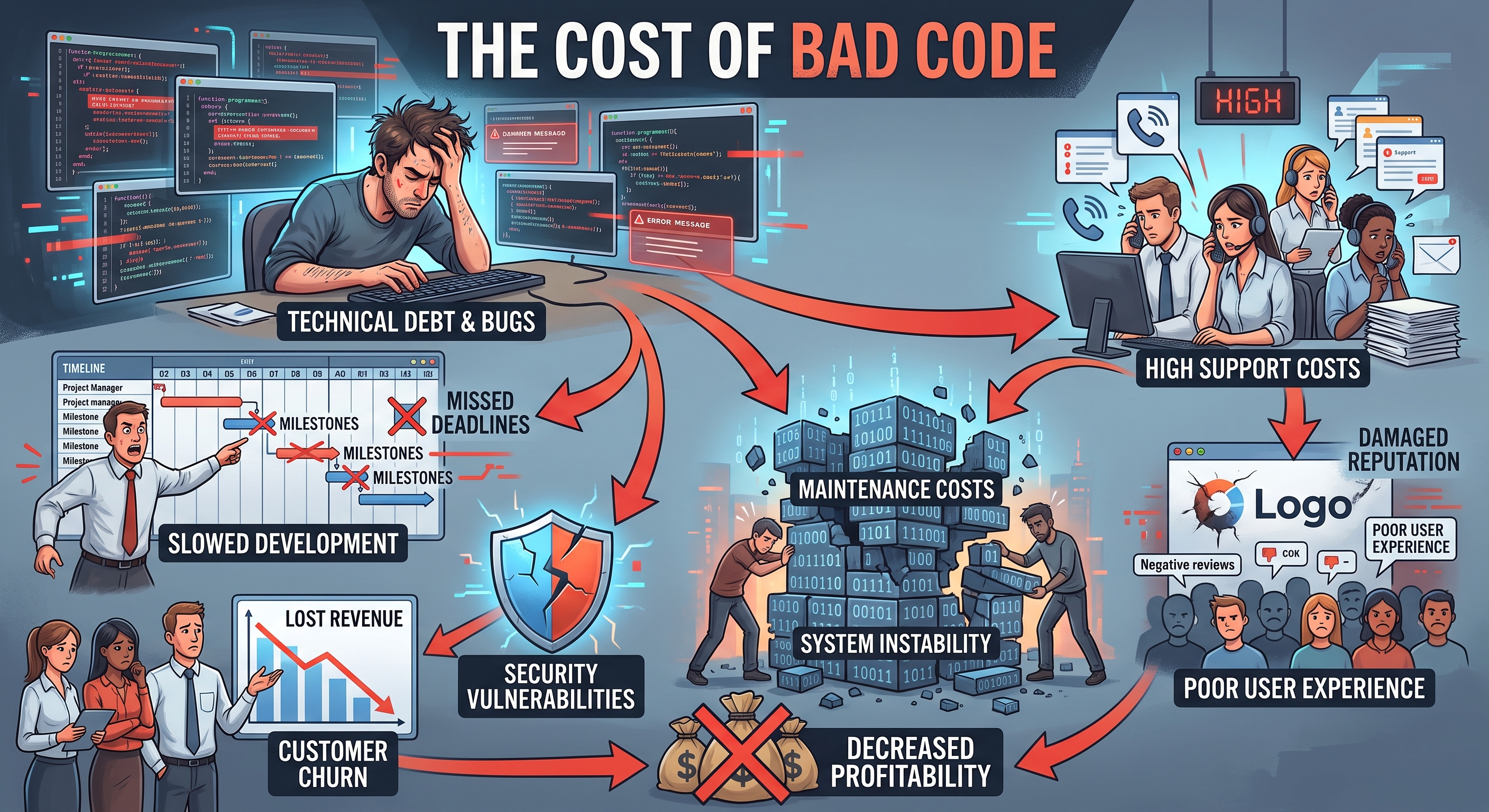
What usually first appears to be some troubles with the software released (bugging, errors etc.) in fact means so much more: this in the long run (usually unexpected for the customer) causes so much hidden technical debt, un fixed vulnerabilities for security etc., that a simple maintenance of the code (usual for most standard-software) suddenly turns into a NIGHTMARE and a huge cost factor for its owner, revealing the true cost of bad code.
Quality software development is not just better in some vague way, it is also a sound financial decision. By hiring only the best developers, businesses can avoid the costly headaches that come from bugs, poorly performing software, silent technical debt, and unpatched security holes, all of which rapidly inflate the cost of bad code. Their digital assets can continue to scale and bring value to the business, instead of quickly becoming a resource drain.
This is where GigMint makes all the difference. By being a gateway to the top 1% of global tech talent, GigMint allows you to bypass the cycle of endless rework and inefficiency typically caused by a cheap software development project and the inevitable cost of bad code.
GigMint connects you to a pool of pre-vetted experts so you can build out your digital infrastructure with the highest value talent for your company needs to succeed. With GigMint, you can secure your technical future and your budget from the very start of your next software development project.
Section 1: The Hidden Financial Drain of Bad Code.
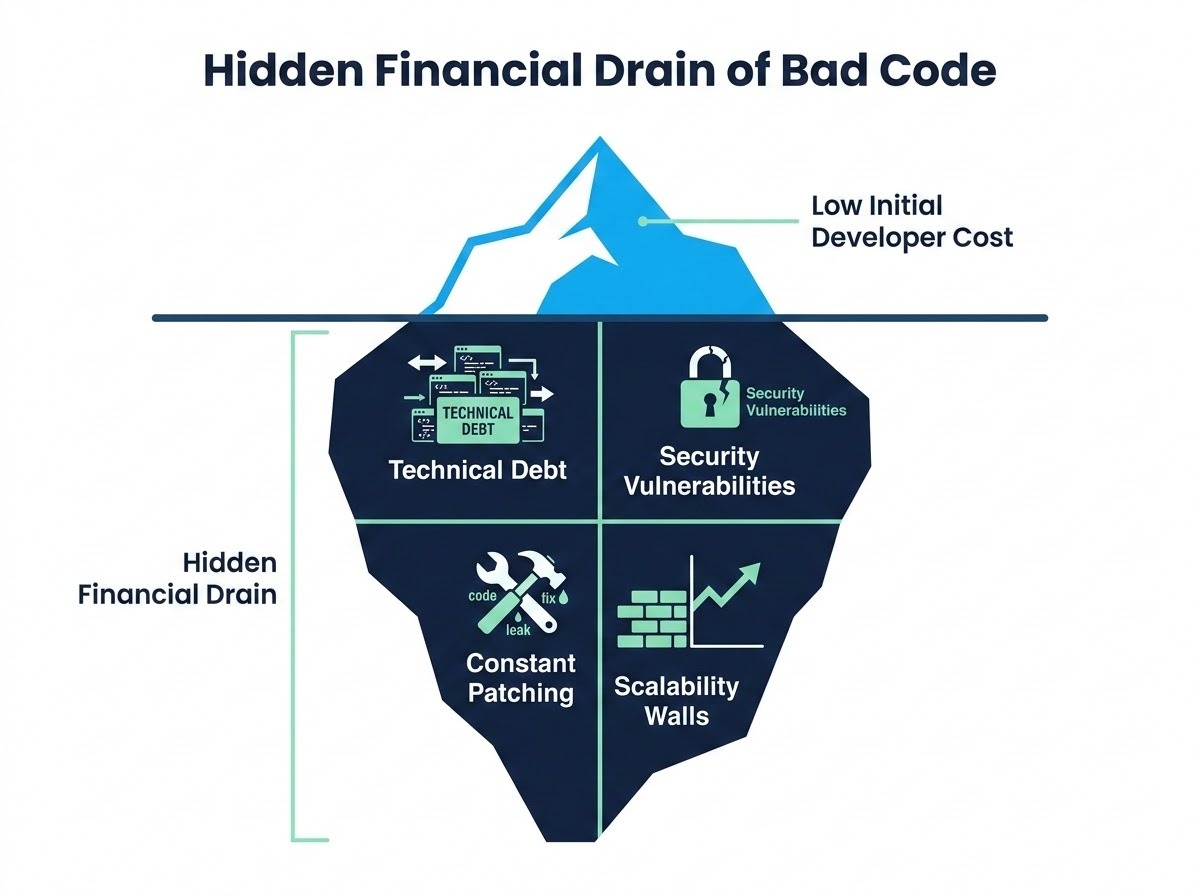
The cheap developer illusion is one that promises much in relation to cost savings but is in reality a financial minefield waiting to happen. Budget developers have their cost expressed in relation to a number of hours that are charged at a low hourly rate. Yet those that hire them are not buying hours at a low price. They are actually financing a future problem - in the form of bad code. And there are many ways in which this problem can manifest in greater severity.
Bugs-as-a-Service: When hiring developers for your software projects, the lack of proper vetting can lead to your company stuck in a Bugs-as-a-Service model. Because quality was never a priority during the development of your software, the resulting application requires a lot of patching, which in turn is very costly.
Effectively you pay for the feature once and then again for the system to work under load, all while the money could be spent on growth and new features. The cycle of build, break, patch continues to consume more and more of your budget over time.
Security Vulnerabilities: A lot of insecure applications have been built with “bad” code. The developer brought in to fix an application performance problem may not even think about security or may not know about important security-related application design considerations.
This “bad” code can introduce security vulnerabilities that can be exploited resulting in a data breach and associated catastrophic financial costs beyond that of the IT department to fix the problem. The IT department’s costs will include fixes, but also lost time due to the breach.
The rest of the company will experience compliance penalties, potential legal fees, and large losses of customer trust resulting from the breach. In the long run it will cost very little to hire a quality, security-savvy developer to write an application’s code instead of a lot to try to fix problems caused by “bad” code that was written by an unscreened/ungood developer.
The Scalability Wall: Initially, simple code in a sandbox environment can function without any problems. But when traffic increases, the Scalability Wall hits and your architecture is not able to scale. This has very expensive consequences for your business: you can’t grow anymore or you have to pay to rewrite the entire technology stack from scratch.
Opportunity Cost: It is often not realized the opportunity cost of the time of your team, or the freelancer, searching for errors in a poorly done legacy code. That time is better spent in creating higher quality work, implementing new features that will bring in money, etc.
Each hour of searching for a particular problem, and fixing it, is spent instead in implementing new functionality and thus it is spent in increasing revenue, not in fixing errors in a sub-optimal piece of work.
Paying for high-quality, experienced people to produce high-quality software is not an expense, it is an investment in your future velocity as a company against the cost of fixing errors in a legacy system.
.
Section 2: Why Vetted Freelancers Are a Financial Asset.
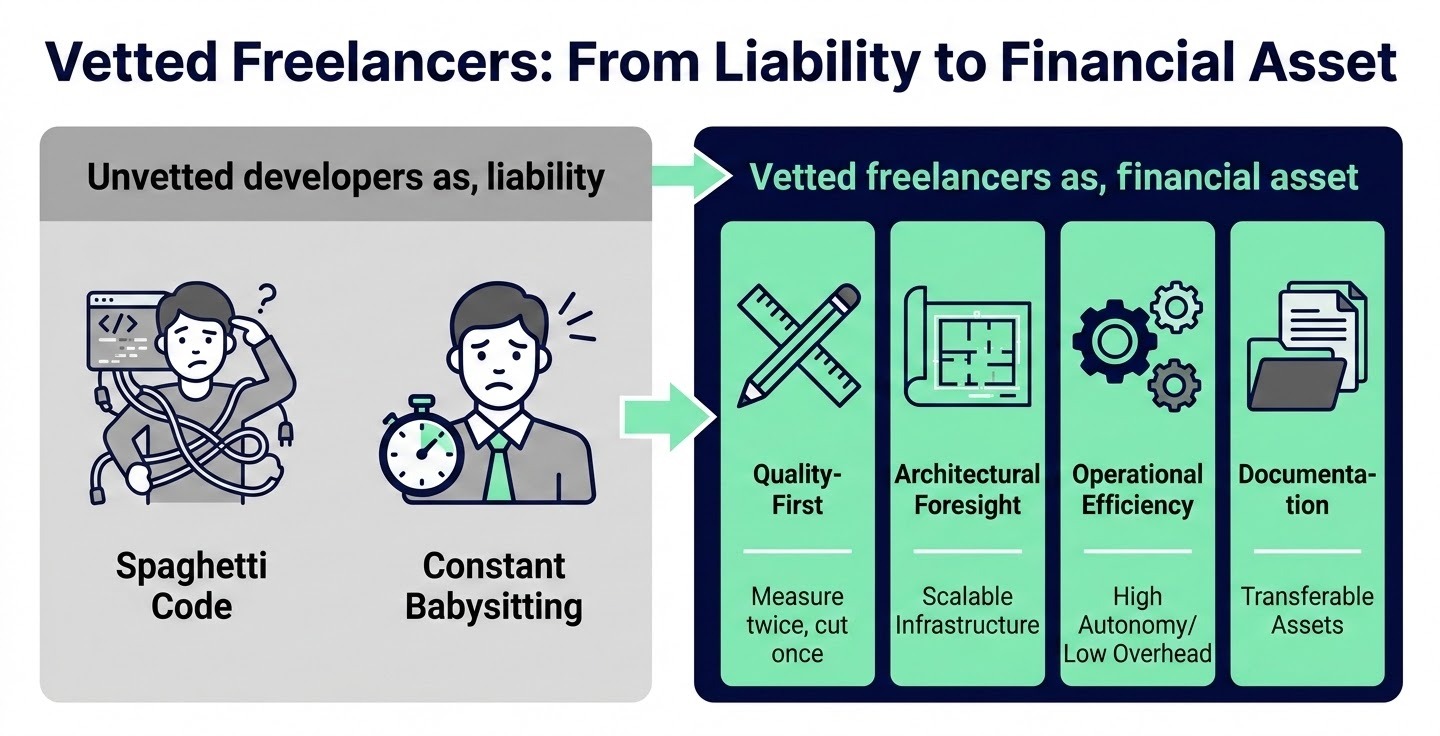
Silently, those bad code hidden costs amass. Meanwhile, you’re getting to enjoy straight away the instant and amassing benefits of hiring expert freelancers. That’s to say, you are not buying lines of code – you are acquiring an asset to protect your margin.
The Quality vs. Speed Myth: The fastest code is cheap code. No, it is the opposite – the fastest code is actually cheap code in the short term, but it causes a massive amount of regressions that require a huge amount of testing, bug reporting, and fix implementation.
By their very nature, vetted freelancers operate under a “measure twice, cut once” regime of Quality code first. This is in direct contrast to fast cheap code for first, Quality code second (which of course is never written). This approach, when practiced by someone that knows what they’re doing, increases their own delivery velocity.
Architectural Foresight: The primary difference between hiring a junior developer for low costs, and hiring a top level developer for high costs, is their ability to predict what you will need now and in the future. For example a junior developer may create a system that supports current traffic numbers but when you start to scale they will hit limits that will cause them to buckle under pressure.
Expert freelancers build for the future. They select out scalable languages, scalable frameworks and the best database structure for your application. Scalable, so that while your business is growing (exponentially), you won’t have to invest tens of thousands of $ for a lift-and-shift or a complete re-write of the code that they built for you. So, architecturally speaking, that’s the best way to invest your money for the future.
.
Efficiency and Turnover: Unvetted hires translate into management overhead – your time – spent managing out the most efficient use of their time, correcting their approach to a task, and trying to figure out why they’ve developed an unhealthy perspective on your project requirements.
Vetted freelancers typically work with a lot of autonomy, which means that they are able to do their job well with very little management and supervision. This is because of their large amount of experience as well as their knowledge of best practices.
This means that, not only will they be able to complete the work that you need done in the most efficient manner possible, they will also be able to assist you with any technical questions that you may have as well as keep you updated on the current status of the project. This allows you to focus on your business and not on babysitting a keyboard for hours on end.
Documentation and Transferability: Everyone knows that fear of the bus factor, when a project dies because one key developer leaves. But Expert Code is readable, modular, and above all: documented. So when you hire the best developers for a project, you aren’t just paying for them to write the code for that project. You are paying for code that others can read.
Hence the project doesn’t become a 3 week onboarding cost for the next hire, when the previously hired developers had to write that project in what looks like and behaves like spaghetti code for the previous hire. With Expert Code, your project is a transferable, valuable asset.
Section 3: The GigMint Advantage.
In a world where the build, break, patch cycle is standard operating procedure when hiring a freelancer as a development resource, GigMint is the industry’s ‘circuit breaker’. Rather than simply being another talent marketplace, GigMint provides a solution to the risks associated with sending work offshore.
By combining human quality vetting with best in class AI-powered project management tools, we remove the variables that create so much uncertainty for tech project owners, mitigating the cost of bad code, and turn what could be a liability into a successful outcome.
The Elite 1%: GigMint’s approach to finding freelance development work is the antithesis of the way most other platforms for freelance work operate. Rather than hosting a large number of developers competing on price—a gamble that frequently results in the cost of bad code—GigMint looks for the very best developers, assesses them through a multi-stage screening process, and then forces them to work within a strict framework that is controlled by AI-powered project management tools.
Our acceptance rate for would-be GigMinters is less than 1 in 100. That means that every person on GigMint is Elite 1% class, able to provide Elite 1% level development work, which is to say that they have a very high level of both technical skill and architectural ability, that they are very good at writing code, and that they are able to work with clients who use GigMint to deliver that work on time and with a very high level of uptime (i.e. very few bugs).
Scope creep eats away at companies in tech by slowly but surely adding to the scope of the project. The cost for scope creep typically results in increased budget and in extreme cases can result in delayed completion of the project and at worst can be canceled altogether.
GigMint’s AI-powered Task Pipeline for development projects is able to ingest a potential client’s vision and build out a clear task list to complete the development in a series of clearly defined briefs, creating a series of milestones along the way to ensure the ultimate completion of deliverables.
By creating a series of clearly defined deliverables for both the client and developer the potential for scope creep is dramatically reduced helping to prevent runaway development projects and ensure that the development is within budget from the start.
Financial Security: Traditional freelance models, such as the ‘pay-and-pray’ approach, can be catastrophic for employers. GigMint flips financial risk to the employer. By storing a client’s funds in escrow, GigMint enables clients to approve and release payments to a contractor or freelancer for completed work only. With funds released via secure Stripe payout rails, you can ensure your money is working for you while being protected from substandard work and the compounding cost of bad code. This escrow function provides you with financial security and the greatest return on investment.
Global Access, Zero Risk: Until now, employers have hesitated to engage the best global talent due to the massive administrative overhead associated with checking the background and employment history of applicants from around the world, as well as contracting, cross border payment and post delivery guarantee of work quality.
With GigMint, we handle all of these aspects, and give your organization access to a global pool of high quality talent, without the associated administrative overhead, allowing your business to scale up in terms of operational capacity with the same ease and confidence with which you would engage a local consultant.
Section 4: Cost Analysis: In-House vs. Bad Freelancers vs. Vetted Talent.
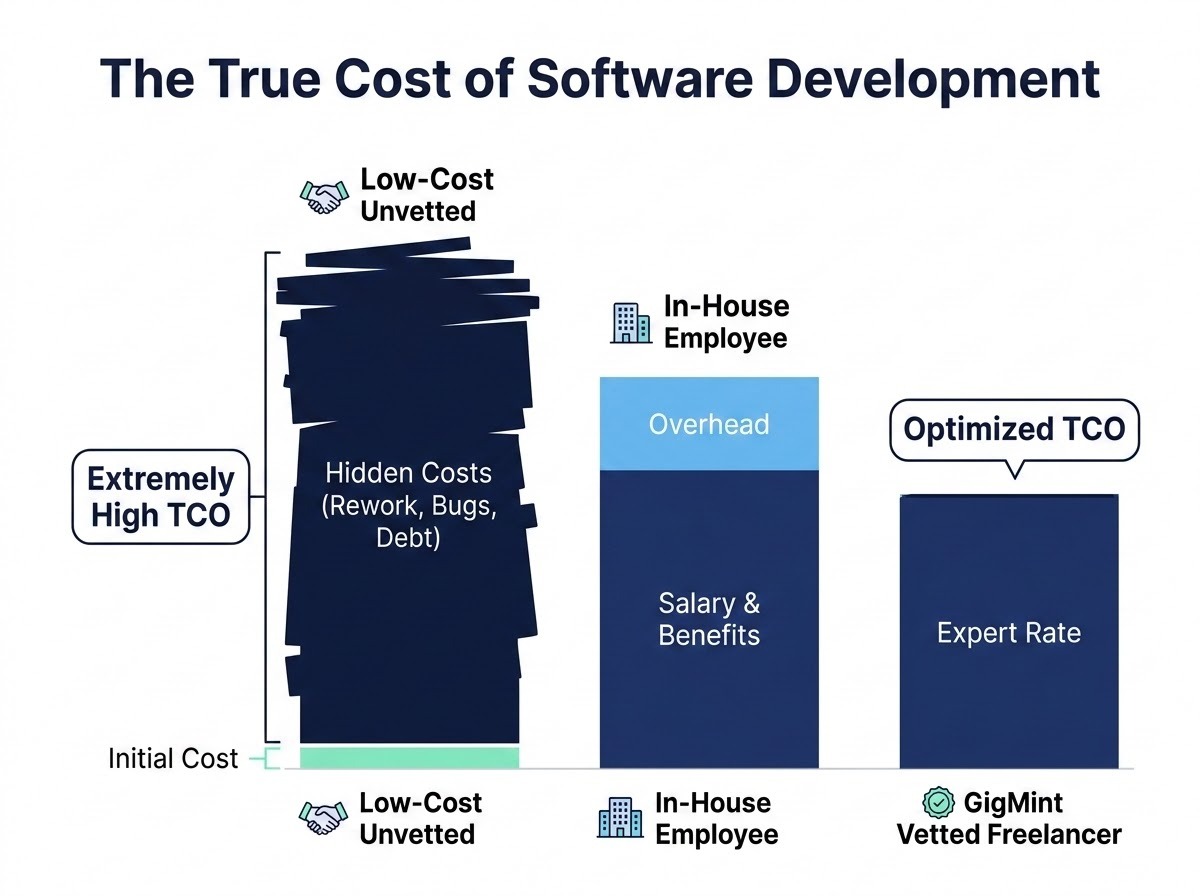
Total Cost of Ownership (TCO):
When looking at software projects, the typical first aspect businesses look at is the initial cost of the software. The cost of the software can often be abused when businesses only look at the initial invoice and not the rest of the software’s life cycle, thus establishing true financial stewardship by looking at the software’s Total Cost of Ownership (TCO).
TCO will only equal the developer’s hourly rate; however, as the code is being built TCO will also equal the build time of the initial code base, the time spent in maintaining the codebase, the cost of the cloud infrastructure and servers to host the code, and finally the huge un-recovered cost of emergency bug fixes and security patching.
Comparative Breakdown:
The Low-Cost Unvetted column looks cheap up front on your balance sheet, but the Long-Term TCO column reveals the financial pitfall of this approach: cheap code is rarely cheap, it is merely deferring debt.
|
Factor |
Low-Cost Unvetted |
In-House Employee |
GigMint Vetted Freelancer |
|---|---|---|---|
|
Initial Hourly Rate |
$ (Low) |
$$$ (High + Benefits) |
$$ (Mid-High) |
|
Rework Rate |
High (40-60%) |
Low |
Near Zero |
|
Management Overhead |
High (Constant babysitting) |
Moderate |
Low (Autonomous) |
|
Long-Term TCO |
Extremely High |
High |
Optimized |
ROI of Right First Time: Return on Investment from day one with code that works. Here’s a simple example for a large backend feature
Scenario A: The Budget Approach: You hired a developer to do a backend feature for $2,000. The work was completed rapidly. Three months later, the system failed under load. $6,000 of patches, server config changes, and many hours later the system is “stable”. The total cost for this feature is $8,000.
Scenario B: A pre-vetted GigMint expert has been hired to build this feature. They construct the feature with the appropriate architecture for scalability with clean code and corresponding test cases. It runs in production without problems and does not require a lot of maintenance.
In choosing to hire a vetted expert from GigMint instead, you not only will save $3,000 in upfront costs, but you will also instantly reap the rewards of a team that is already producing – weeks worth of time that can be spent pursuing additional revenue-generating innovative work instead of technical debt crisis management.
The most expensive code you will ever buy is the code that you must build twice. If you purchase vetted talent you are not spending additional money, you are buying insurance against the collapse of your poorly constructed digital assets in the future.
Section 5: Conclusion & CTA.
The Recap: The Cost of bad code is a deceptive financial phantom. First it looks cheap because you see a low up-front cost and a fast delivery cycle to get you to sign up for the service. But this is a debt that charges interest at an exponentially growing rate until it finally manifests itself in a form that is quite painful to you.
The growing throng of Bugs-as-a-Service that your development team has to deal with is bad enough but there is also the chance of a security breach that could destroy your business overnight.
And then of course there is the financial drain of technical debt — the growing sum of additional work required to maintain an inherently unsound system under growing strain. This will be felt most acutely at the worst possible time, as your business undergoes a period of growth.
Code Certainty: Your Technical Insurance Policy
The world of technology has become a main generator of revenue for many companies. Thus, considering the cost of bad code, there is no room for paying for technical services blindly and hopefully.
Hiring through GigMint is not mere recruitment – it is your company’s insurance policy for its future. By working with the top 1% of the world’s technical talent, you can rely on the fact that the basic architecture of any of your digital products will be developed with due consideration, that they will be secured and that they will be thoroughly documented so as to be easily transferable to other developers.
In contrast to the uncertainty lurking in every freelance market place, we offer our clients reliable access to an elite pool of developers, handpicked by us.
Quality as the Path to Growth
The digital economy of today encourages and rewards the most agile businesses, and to sustain such growth quality is the only road to long-term success.
While being able to iterate, to pivot and to scale as quickly as possible are key characteristics of such businesses, this is only made possible by the quality of their underlying codebase, which – in turn – is the result of work that has been conducted with a focus on quality.
Spaghetti code as it is often referred to and which has been developed with a view to meeting a budget in the short term, hampers business in the worst possible way, exposing the true Cost of bad code, and prevents them from concentrating on what is important: innovating and in all respects offering the best possible value to their users.
Call to Action
The most expensive code you will ever buy is the code you have to build twice. Every project you launch is a reflection of your brand and a critical component of your business’s future success. Why risk that success on the roll of the dice associated with unvetted platforms?
Stop throwing money down the drain financing technical debt and paying the ultimate Cost of bad code. Invest in digital assets that bring you growth instead. Create your project listing on GigMint today. We will connect you with the best tech talent globally. Run your project to success with the peace of mind that your solution was built the right way, from the start.