Digital Strategy Demystified Connecting Design, Data, and Growth
Digital Strategy Demystified Connecting Design, Data, and Growth
The New Unified Theory of Digital Success
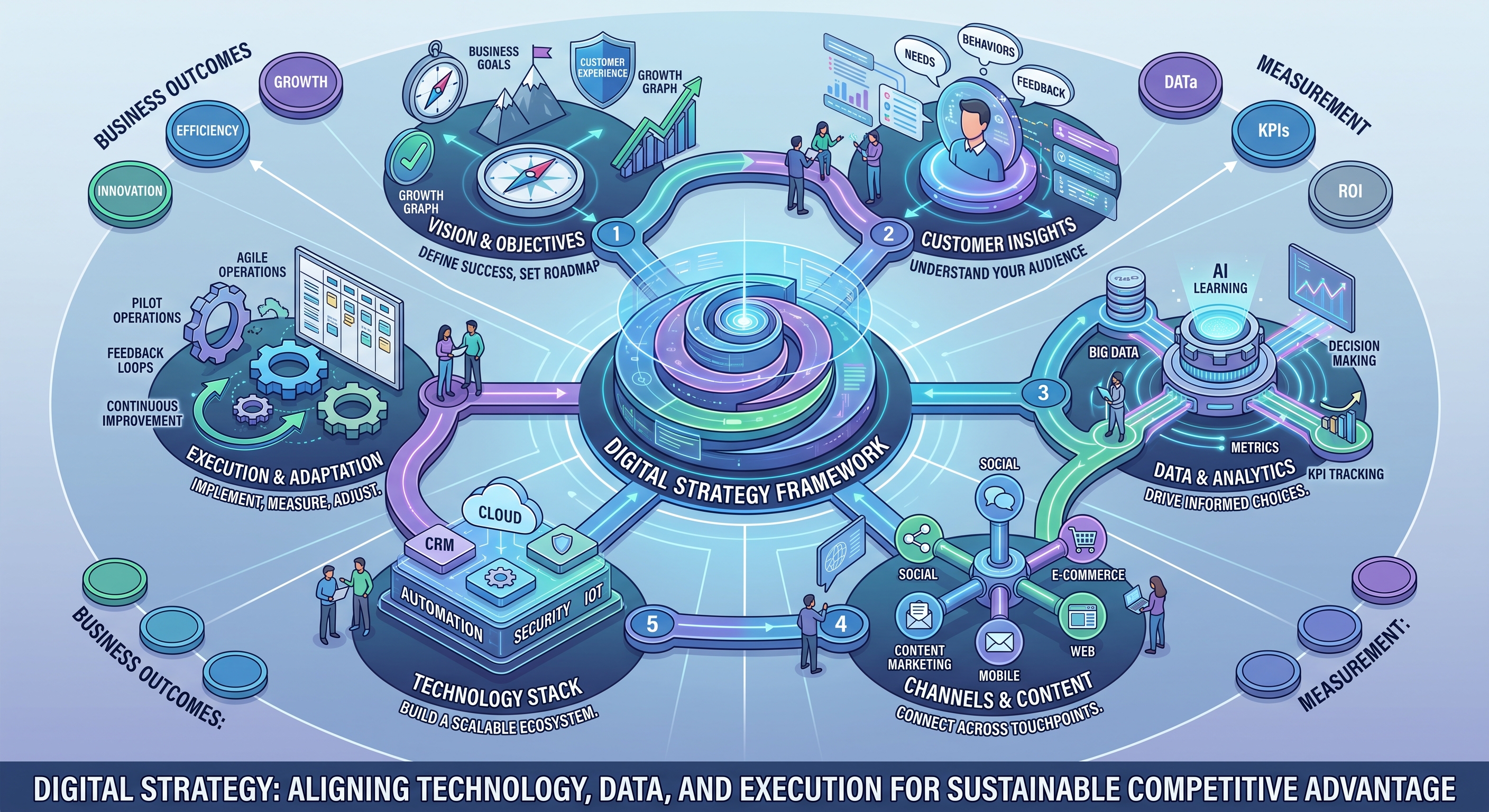
Most companies today are running in the dark, being held back by operational silos of design, data analysis and growth marketing. As separate departments, these three functions are mostly speaking in completely different languages, causing friction, leading to lots of friction, lots of inefficiency and even many opportunities being missed by companies. However, the most innovative digital companies like Netflix and Airbnb have long ago already stopped working in silos of design, data and growth marketing. They understand that all three functions are part of one ecosystem of design, data and growth marketing that should be addressed from within one unified Digital Strategy.
Creating a unified Digital Strategy for design, data and growth marketing is the challenge of the decade for business leaders. Building a team that can execute this strategy at the highest level is crucial for lasting success in digital business. The biggest competitive advantage of them all is finding, and integrating into your teams, the very best talent that can connect the dots between design, data and growth. In this article we will cut through the hype of design, data and growth and outline the key principles for building a solid foundation and create a cohesive Digital Strategy to drive sustainable success in markets.
Section 1: Design Thinking—The Human-Centric Foundation
Moving Beyond Aesthetics
So many companies treat design as the last step of the product development life cycle (after building the product, after launching it, after decorating the office to make it more beautiful). Treating design as a core strategy to solving complex business problems is a different story altogether. By approaching design in a rigorous, scientific manner designers can unlock innovation within organizations by stripping away every assumption to truly focus on the problems that matter to users. Every pixel, every interaction, and every workflow is deployed to solve a specific, and measurable objective.
Empathy as a Business Asset
Mistakenly regarded as a soft skill within the context of digital strategy, Empathy is perhaps the greatest asset that a business can have on its balance sheet. The only reliable way to build long-term market share is through understanding the user’s pain points. When a business gives Empathy priority over all else, it can move from creating products which it hopes users will want, to creating solutions to the real problems that users are facing. This in-depth alignment with the organization has with the user’s reality is sufficient to convert occasional visitors to a business’s website into life-long brand advocates.
Iterative Prototyping
The risk of failure is dramatically increased when an organization proceeds with development without first validating their ideas. Using iterative prototyping, especially low-fidelity testing, can save an organization a tremendous amount of time and resources by finding problems early in the design and user experience early on before too much time is invested in building out the full feature. In addition, it’s the primary way to fight against the dreaded “churn,” or the quick abandonment of a product. Excellent UI/UX design is not just about how something looks, it’s also about how something is put together. By identifying where users get confused or are left frustrated in the initial testing of a product or feature, designers can go back and optimize the user experience to best support their users to easily and efficiently complete their goals.
The Design for Growth Mindset
Lastly, The Design for Growth Mindset strategy integrates growth into the design of a company’s digital products in order to develop features that can create viral loops and lead to acquisition through intuitive design. These strategies often take a very linear approach to designing features that are naturally shared through their high value to end-users, leading to users referring friends and family as well as joining online communities that extend the value of that end-users experience. Designing around growth for a company can greatly reduce reliance on paid marketing and take advantage of a company’s current customer base in order to drive growth on an extremely cost efficient basis in the long run.
Section 2: Data-Driven Decision Making—The Strategic Compass

From Gut Feeling to Granular Insight
Intuition, in relation to strategy, used to play a massive role in the early days of digital. A Gut Feeling and anecdotal evidence from customer interaction would on more than one occasion swing a product in a completely different direction to how it originally started. But, that was then and this is now, a now that’s dripping in data that supports insight into customer behavior and interaction with products and services. Intuition is a liability in a world that’s now so data-driven. Only by gaining Granular Insight from signals from every single interaction a user has with your product and/or service, can Leaders transform their organizations to be proactive instead of reactive by making informed decisions based on data from every single pivot and every single launch of a feature.
The Hierarchy of Metrics
When making data-driven decisions for a Digital strategy, it is important to filter through the noise in order to uncover the real signal behind the data. A common way to organize potential metrics for a company is with The Hierarchy of Metrics.. At the bottom of the hierarchy are Vanity Metrics (e.g. likes, page views, total registered users), which typically decrease as a company scales and therefore are not a useful metric to track for healthy growth. Next are Intermediate Metrics, which can be useful for specific parts of the user journey but are not typically useful for tracking the overall health of a company. Your top metric will typically be your North Star Metric, which is meant to be a single metric to measure the core value that your company is providing to users. This can be your Retention Rate or even your Customer Lifetime Value (LTV). The North Star Metric should be the primary metric that a company tracks and should be supported by a robust data stack to understand the user journey through features.
A North Star Metric is only as good as the data stack that supports it. Real-time visibility into users’ journeys through product features is essential for measuring how users interact with product functionality. The data stack is an IT matter, but a strategic matter for your Digital strategy nonetheless. It allows one to view the business as an ecosystem in real time, to immediately see problems as they develop and friction points as they occur.
Predictive Analytics
The final frontier of data maturity is moving from descriptive analytics to predictive analytics. It allows companies to forecast and anticipate events, such as future churning of users by their behavior in different cohorts, growth in peak seasons or even optimizing of stock and of infrastructure needed for growth in advance, by analyzing all historical data with predictive accuracy.
Quantitative vs. Qualitative Data
Without the corresponding qualitative data, we’re flying blind. While quantitative data tells us what people are doing in our digital strategy (e.g. where they’re dropping off on our site), qualitative data reveals the why behind those actions (e.g. user interviews, session replay, and sentiment analysis). By blending quantitative ‘what’ data with qualitative ‘why’ data, organizations can develop the deepest possible understanding of every user and thus make every data-driven decision more human-centric.
Section 3: The Intersection—Where Data Meets Design
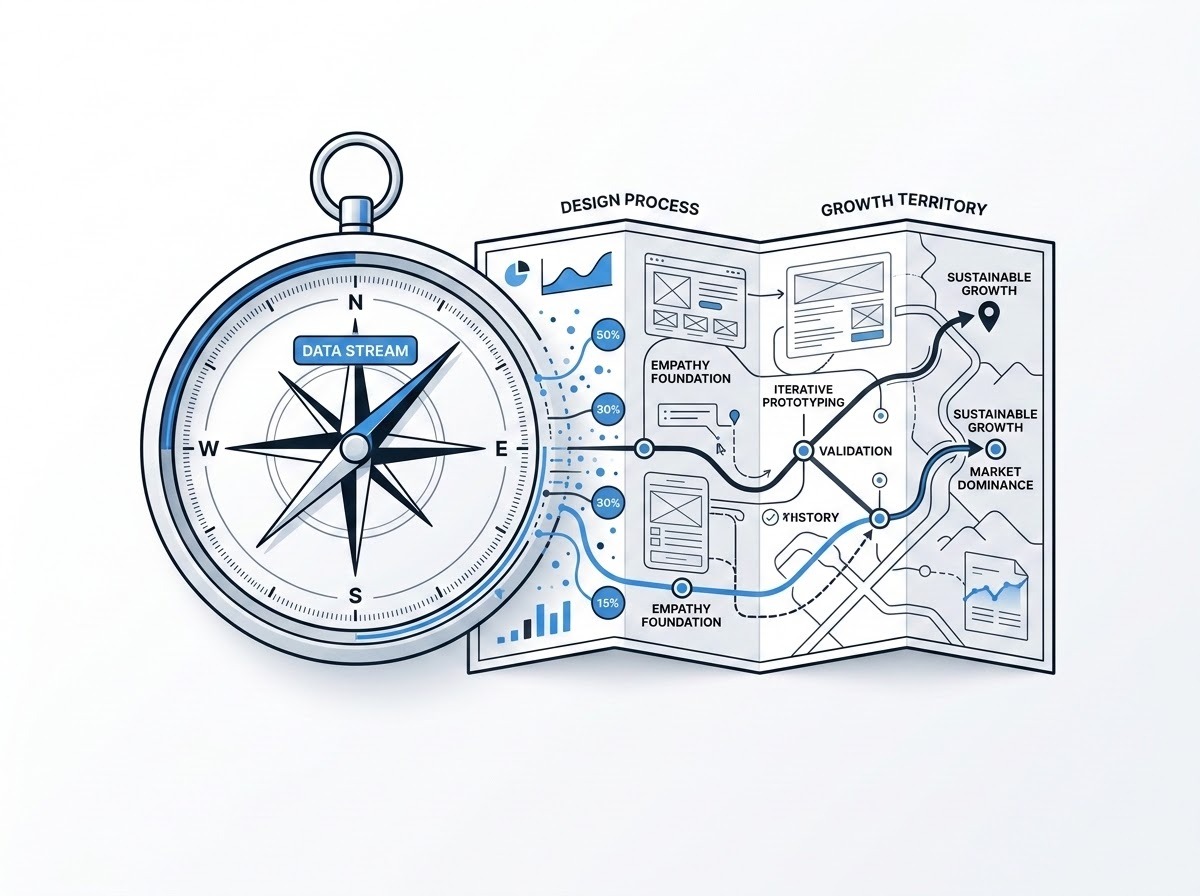
Data is the compass that guides us in the digital world and design is the map. Both components are essential and only functional in combination. A beautiful interface, which does not take into account user behavior, is mere art, whereas a very data-driven dashboard that is not of intuitive design is an absolute barrier to your customers. Digital dominance is only achieved at the intersection of qualitative design-intuition and validated quantitative data-reality.
The Feedback Loop: A truly digital strategy is a closed-loop process of observing user behavior, designing around it, testing, and adapting to new data. Product development is not just building a product and then launching it; it’s an iterative process of refining and improving a product until it reaches maximum efficacy. By watching where users drop off in a conversion funnel, for example, product managers can glean critical information about how to design a better step in the process. By analyzing data on how users use a product, companies can design a better UI, better navigation, and better calls to action. The result is a better product with each iteration.
Personalization at Scale: Data enables design that is more than just one dimensional. While qualitative designers create beautiful interfaces, quantitative data from users allows us to ‘segment’ users and create corresponding ‘experiences’ that are designed specifically to service each group's needs. A returning customer, such as an enterprise user, would see a dashboard that puts front and center their recurring projects and the management of their teams. A first time user, such as a new startup founder with a new project, would see tools and resources to help get that first project off the ground. By creating such personalized experiences designers can guarantee that their designs are not only beautiful, but are able to maximize user satisfaction in order to guarantee user retention.
A/B Testing as a Bridge: A/B testing serves as the definitive technical bridge between design variation and statistical significance. In essence, A/B testing removes the ego from the design process. No longer can designers debate which is better, a red button versus a green button, a 2-column layout versus a 3-column layout. Rather, you let data decide what is best for engagement within your product. A/B testing allows you to run controlled experiments on your site or within your product, serving different design variations to different portions of your traffic. From this, you can gain empirical proof on which design variations lead to increased engagement. This design-meets-data strategy ensures that design choices are good enough not just from internal subjective testing but also from real user interaction and resulting data.
For the marketplace GigMint, instance analysis might show that on client’s side after clicking on a freelancer’s profile only in very few cases they actually send a project inquiry. Qualitative user interviews might also indicate that the currently used skills list within the freelancer’s profile is too cluttered and therefore causes a user’s cognitive overload, as visual (skill-) tagging would.
So when the product team behind this marketplace applies design thinking to this data from user interviews, it creates a redesigned profile card that uses a visual skill-tagging approach rather than a text-heavy list approach to organize a freelancer’s skills. And then it A/B tests this against the existing version of the profile card. If it gets a 15% increase in project inquiries as a result, it has successfully applied a design-meets-data strategy to optimize the marketplace’s matching interface.
Section 4: Sustainable Growth—Scaling the Connection
The Growth Paradox
If the goal of a startup is to have “hyper-growth” then that must be the validation of a successful company. What most don’t realize is that there is a big paradox in the pursuit of that kind of growth. Many startups can scale up user acquisition quickly, but what they haven’t built up yet is a product that is designed and optimized for their users. Therefore, they’re filling up a bucket with water, but the bucket has a hole in it. They’re acquiring users at a rate that the product can’t keep up with in terms of providing a great experience for users. This kind of growth is often just translated into high churn rates. Many companies focus on growth first and then building a product for their users. In reality, however, the speed of growth should never outpace the maturity of the user experience for your users that have already joined your product. In essence, if a company is growing this quickly then they’re not scaling success, they’re scaling to lose users in a hurry.
The Sustainable Growth Flywheel
To achieve sustainable growth, you must create a Growth Flywheel, where each growth cycle phase builds off of the others:
Acquisition (Data-Targeted Marketing): Instead of blasting out broad messages to “everyone,” focus your marketing dollars on the segments where your data indicates the greatest return on investment. The result is that you are bringing in users who already need what you have to offer — leading to greater engagement with your product and experience.
Activation (Seamless Design Onboarding): Once you have gotten users to sign up to your platform for your service, your design must guide them to their aha! moment as quickly and painlessly as possible. This will transform interested users into active users of your product. A complex onboarding process for new users can have them departing the process before experiencing enough value in your product or service.
Retention (Iterative Improvement): Retaining active users is the key to long-term sustainable growth. A product that continues to improve and be refined via the data collected from its users’ behavior will continue to be relevant and interesting to them. Active and retained users are the greatest advocates for your product and as their numbers grow so does the value to the business in terms of reducing future user acquisition costs.
CAC vs. LTV: The Economics of Efficiency
Economic discipline. The last pillar needed for sustainable growth. There are so many startups spending way too much on Customer Acquisition Cost (CAC). And for what? Vanishing quick growth that in the end is never even profitable. A healthy CAC to Customer Lifetime Value (LTV) ratio is what keeps you up at night. By smartly designing your product’s stickiness (i.e. your users staying longer / spending more) within your design and data strategy, you will automatically be lowering your CAC and increasing your LTV. This is what creates sustainable, long-term growth for startups. Not short lived, ‘volcanic’ type growth of other startups. Long lasting, top of market performers.
Section 5: Building the Team—Leveraging Elite Talent
The Need for Specialized Expertise
There is a huge amount of convergence going on between design, data and Growth marketing, so in reality you need a very sophisticated team to support a high end strategy. In essence, most generalist teams aren’t able to support this level of sophistication. It takes a very specialized person or a team of specialists to bridge the gap between the very detailed, analytical work of a Data scientist, and the highly creative, detailed work of a very high end designer. Bridging the very analytical A/B testing of statistical significance to the very detailed, user-centric composition of a designer is incredibly hard, so if you rely on a generalist to lead the specialized pillars of design and data & science then your strategy will inevitably get watered down, and probably miss the mark in terms of execution and in terms of creativity.
The Modern Workforce Model
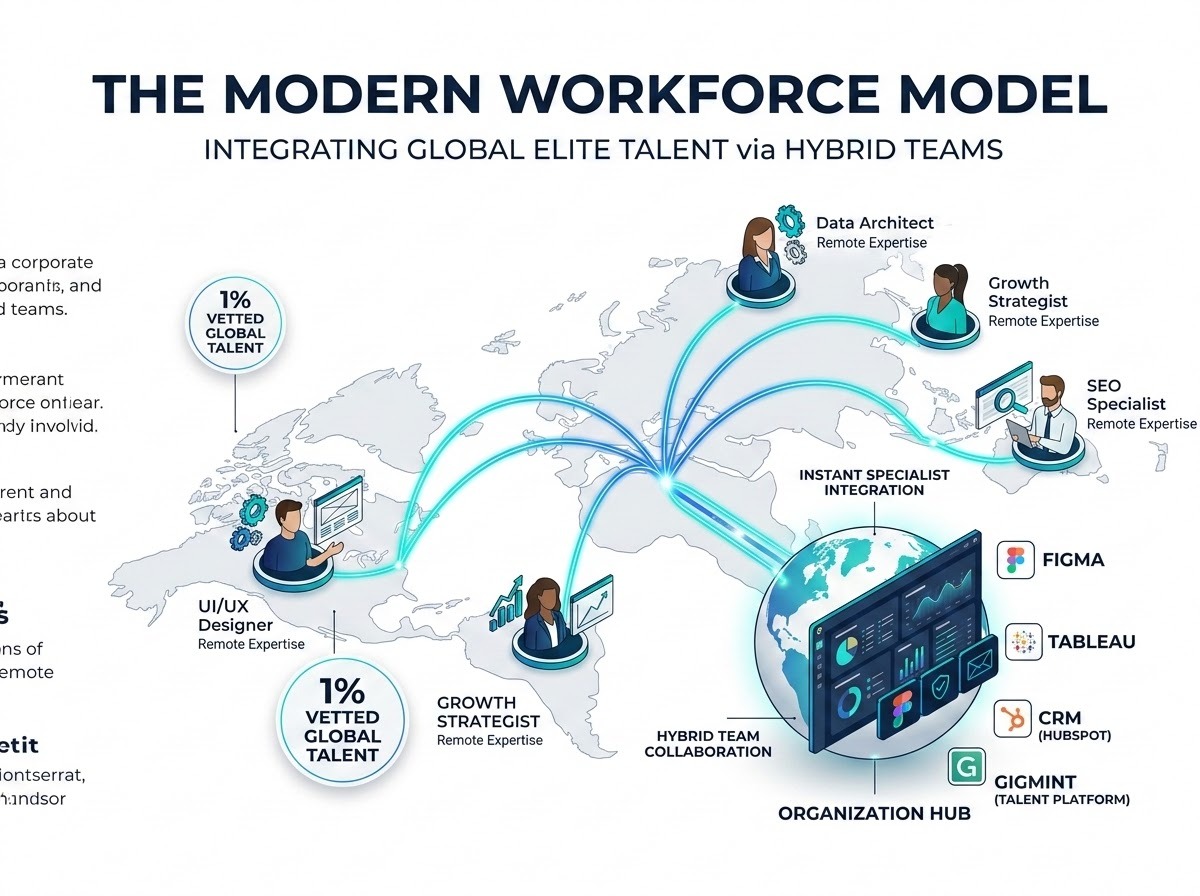
Building out specialized teams in-house can often be too expensive and time consuming for organizations. A growing number of forward thinking organizations are turning to hybrid workforce models to access the top independent talent in the world. A platform like GigMint allows businesses to access the top 1% of vetted independent talent instantly. Businesses can now bring in the senior talent they need, instantly, whether it’s a data architect to put in place the correct structure for a business's analytics, or a UI/UX lead to reinvent the conversion funnel of a website. A platform like GigMint allows businesses to reach out to a global network of the world’s best specialists instantly.
The Role of AI in Strategy
But new challenges have emerged for these elite teams of specialists in implementing their strategies. By embedding the new AI functionality into the workflows of their teams of freelancers and internal specialists, companies can now make full use of the AI-powered pipelines to create the necessary project briefs and to monitor the complex range of different milestones as they unfold. But the primary task of these specialized teams is to normalize the respective expectations of the freelancers and their clients. Thus AI functionality facilitates project scopes and objectives that are focused and that permit a corresponding communication with the respective freemarker, keeping it on track and ensuring that the work they do is of high value. Most importantly, their focus is not on administrative tasks.
Vetting for Quality
For those executing a high-stakes digital strategy, the cost of a ‘bad hire’ is too great to consider. The expense to a company of recruitment fees is dwarfed by the lost time and effort of staff and the consequent missed opportunities in the market and a ‘poor’ user experience while they get up to speed. Therefore, it is imperative that you execute a rigorous ‘vetting’ process to not only assess the technical skills of the specialist but also assess the communication skills of the freelancer to ensure that they are a good ‘mature’ communicator and reliable to deliver work on time as well as being the correct ‘cultural fit’ for your company. They must also be able to work asynchronously, be able to problem solve proactively and deliver results with minimal supervision. They must be your partner in your growth and development.
Section 6: Operationalizing the Strategy
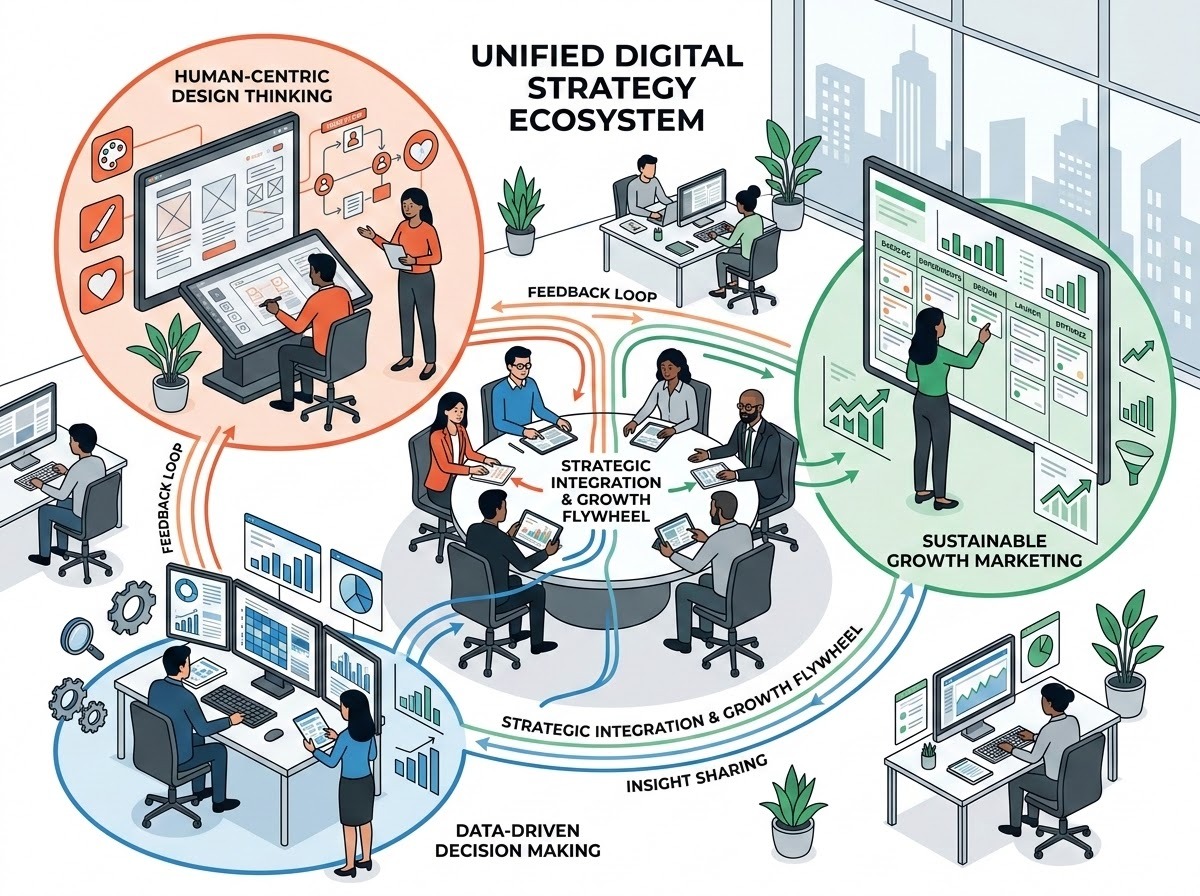
Operationalizing a single digital strategy requires more than just project management as organizations have transitioned from a waterfall approach to delivery. Traditional project management within design and data teams functioned as separate silos with hand off to other teams towards the end of the project life cycle and launch. In high-growth organizations, Agile development methodologies force cross functional work amongst teams. Operationalizing a digital strategy at an organization requires embedding data analysts and designers into the same sprint cycles. Designers then create and iterate upon designs with the most up-to-date performance metrics obtained by the analysts within each iteration of the design. The team can test, learn, and adapt based on real time user behavior as opposed to information that is typically a quarter late. The entire organization can become more responsive to changes in the market when the feedback loop is compressed to a cycle that occurs on a weekly basis.
Tools of the Trade Operationalizing a unified digital strategy involves more than simply project managing a set of projects. It requires the entire organization to function as a single unit, using a technology stack that supports and enables design, data and growth. Design teams need to function within a design platform that enables rapid prototyping and stakeholder feedback, such as Figma. Data teams require platforms that translate reams of usage data into easy-to-read visualizations that inform product decisions, including product analytics, reporting and data visualization tools like Mixpanel and Tableau. Growth teams require CRM’s such as HubSpot that support user journey design, email automation and lead nurturing. Integrate these tools with your growth dashboard to read user behavior data and remove operational friction from your workflow
Security and Infrastructure
As you bring together global talent to collaborate on work for your digital strategy, you are bringing new risks around data privacy and payment reliability. By having a robust operational infrastructure in place to support your distributed teams of work, you can build a solid foundation for your work with non-negotiable operational rigor. For work that involves data within your digital strategy, having a SOC 2 certified data handling process (or other appropriate certification for the work) gives your partners and clients assurance that you have secure, well-structured and trustworthy processes in place for handling their data. For high-value work, using secure payment systems (such as escrow accounts) to pay independent specialists for their work, ensures that clients and specialists alike are protected and work is conducted under transparent agreements that are transparent, structured and enforceable, leading to a professional environment that supports trust and growth.
The Path Forward
Design, data and growth marketing together form the DNA of companies in the digital economy. Companies that break down the silos between these areas can develop into high-performing ecosystems – essentially becoming a well-oiled machine that leaves competitors in the dust while generating sustainable value in the long term. The basis for this is design thinking, data guides the decisions and growth marketing scales the value generated.
Businesses competing in the next decade will require structures to operate across disciplines in a highly agile form. Businesses can reach their next level of growth only if they have the high-level teams to bridge current silos to a sufficient degree of data maturity. Auditing current silos, assessing data maturity, and connecting these dots is what it will take to start winning market dominance.