Freelancer Onboarding Process: Complete Workflow & Checklist for Businesses
Freelancer Onboarding Process: Complete Workflow & Checklist for Businesses
1. Overview
Finding and hiring a freelancer can be done quickly. Freelancer onboarding one effectively can take significantly more time.
Before a freelance contractor starts their job, it may be necessary to clarify project scope, determine the right classification of a worker, sign the contract, obtain all relevant tax documents, set up payment arrangements, arrange for IP protection, and grant secure access to business resources.
Doing all of that via email, Excel, instant messengers, and separate finance systems leaves room for a lot of mistakes. This can lead to scope misunderstanding, late payments, security threats, issues regarding intellectual property, and other problems.
The onboarding workflow for freelancers is designed to ensure smooth transition from the hiring stage to actual project completion with minimal administrative friction.
This article describes the way businesses can develop an onboarding process that will include legal documents, worker classification, tax documents, payment arrangements, security arrangements, project organization, milestone management, and offboarding.
Legal and tax disclaimer: this guide provides general information only and is not legal, tax, employment or accounting advice. The classification of workers, tax issues, IP ownership, restrictive covenants, privacy obligations and contractor rights depend on particular jurisdictions and circumstances. Consult qualified specialists prior to implementing your
Table of Contents
-
Freelancer vs. Employee Onboarding
-
Core Legal Agreements
-
Tax, Identity, and Payment Documentation
-
Operational and Security Onboarding
-
Freelancer Onboarding Checklist
-
How GigMint Can Streamline Freelancer Onboarding
-
Frequently Asked Questions
-
Conclusion
2. Onboarding of Employees and Freelancers: Knowing the Difference Legally
Prior to developing the Freelancer onboarding process for the contractor, organizations have to recognize that onboarding of the independent contractor is legally very different from onboarding of a W-2 employee.
The misclassification of a contractor as an employer’s employee is not only poor management; it is also a regulatory risk.
2.1 Differences in Behavioral and Financial Control
The classification of workers is based on the law and the facts surrounding the employment relationship. There is no one universal test for the classification of contractor status that applies everywhere.
In the US, the IRS uses tests relating to the issue of control, both behavioral and financial, and the type of relationship between the two parties. Other federal, state and local laws may use other tests.
Control: Behavioral - Whether the business controls how the work gets done and specifically, the details of when, where and how the work is to be done.
Control: Financial - Independent contractors normally run an independent business, have business expenses, have a chance for profit/loss and have their services available for other clients.
Relationship Between the Parties: The existence of a written contract, permanence of the relationship, the benefits, and the type of services may also be taken into account when classifying individuals or businesses.
The right classification requires the consideration of all aspects of the situation and not just one aspect alone.
International Classification: Companies that hire freelance workers from other countries cannot assume that a certain classification will work in another place. For instance, the IR35/off-payroll legislation of the UK applies in some cases, while California uses specific tests for classifying employees, such as the ABC test.
2.2 The Dangers of Contractor Misclassification
Misclassification of an employee as an independent contractor is extremely costly both financially and legally:
Back Taxes: For FICA, Medicare, and state unemployment insurance.
Benefits and Wages: Payment of back wages including health care benefits, paid time off, and retirement contributions.
Penalties & Audits: Regulatory penalties and long-term audits by labor regulating authorities.
2.3 Onboarding Philosophy: Deliverables vs Supervision
Contractor onboarding process calls for a change in mentality from supervision to delivery. Whereas conventional employee onboarding comprises things like integrating the new hire with the corporate culture and processes of the business, contractor onboarding only focuses on deliverables, boundaries, and timelines.
Comparison Chart: Onboarding of Employees Versus Independent Contractors
|
Onboarding Dimension |
W-2 Employee |
Independent Contractor |
|
Primary Focus |
Role, career growth, culture, daily hours |
Specific project, deliverables, deadlines |
|
Tax Documentation |
Form W-4, State tax withholding |
Form W-9 (US) or W-8BEN / W-8BEN-E (Non-US) |
|
Legal Contract |
Employment Offer Letter and Agreement |
Master Services Agreement (MSA) and Statement of Work (SOW) |
|
Equipment and Tools |
Provided and maintained by company |
Contractor uses their own professional tools |
|
Payment Workflow |
Bi-weekly/monthly standard payroll |
Invoice-based upon milestone or deliverable completion |
|
Intellectual Properties |
Automatic workplace IP assignment clauses |
Specific IP Assignment / Work Made for Hire Agreement |
3. Core Legal Agreements: Protecting Your Business and Freelancers
It is absolutely necessary to have a solid legal base while using contingent workforce. Using informal emails or verbal agreements increases the risk of conflicts regarding contractual issues, uncertainty about the IP, and financial responsibilities. The properFreelancer onboarding procedure makes use of five primary legal documents.
3.1 Independent Contractor Agreement (ICA)
Independent Contractor Agreement (ICA) provides a comprehensive legal regime to govern the interconnection of both enterprises. The document sets general legal conditions that do not link to any specific timeframe and deadlines.
Core Objective: To set out a legal framework for the business relationship between the two companies that would be effective for all future collaborations.
Main Components:
Scope of the Relationship: Defines that the contractor is a third-party vendor rather than an employee, agent, or partner, and must pay taxes and purchase insurance on their own.
Conditions for Payment and Invoicing: Sets the terms of payment (Net 30 or another period), preconditions for billing, acceptable payment channels, and a structure for the late fees.
Conditions for Termination: Outlines the notice periods in case of termination without cause (14/30 days), as well as immediate termination conditions in case of a material breach of the contract.
Liability Limitations & Indemnification: Shields the parties from unlimited liability and distributes the costs of legal claims due to breach of contract and/or negligence.
Governing Law & Dispute Resolution: Stipulates the jurisdiction in case of disputes and procedures of arbitration/mediation.
3.2 Statement of Work (SOW)
In contrast to the MSA, which has all the legal rules, the Statement of Work (SOW) provides practical details concerning a specific project. The SOW is implemented in accordance with the rules stipulated in the MSA and acts as the main document in the implementation of the project.
Main Purpose: To specify the deliverables, deadlines, and criteria of their performance.
Main Components:
Breakdown of Deliverables: Detailed list of concrete deliverables (for instance, “5 vector illustrations in .SVG format” instead of “graphic design services”).
Timeline and Milestones with Payment Schedule: Timeline and milestones associated with certain dates and payments.
Limitations to Revisions and Hourly Rates for Additional Scope: Maximum number of revision iterations per milestone (for instance, “two iterations per milestone”) and hourly rate for any work beyond the agreed scope.
Acceptance Criteria & Duration of the Review Process: The criteria that need to be fulfilled for acceptance along with the duration of the review process.
3.3 Non-Disclosure Agreement (NDA)
It will be imperative for the independent contractor to gain access to some proprietary systems, products, processes, and lists of customers in order to successfully accomplish the assignment. An NDA places an obligation on the independent contractor to keep the information confidential.
Unilateral and Bilateral (mutual) NDAs
Unilateral NDA: This protects the confidential information of the organization that hires the freelancer where the freelancer receives the information.
Bilateral NDA: This protects the information received from both parties and is suggested in cases where the independent contractor comes to the assignment with something proprietary.
Confidential Information Scope: In this section, the information that qualifies to be considered confidential such as trade secrets, client database, source codes, financial information and workflow processes apart from information that does not qualify to be called confidential such as publicly known information and information created independently is specified.
3.4 Intellectual Property (IP) Assignment Agreement & Work-for-Hire
The biggest mistake made in the law concerning contractor management is the belief that by paying the bill, one owns all the rights for the creation of intellectual property.
In numerous legal jurisdictions across the world, copyright laws presume the initial ownership to reside with the person who created the work rather than who paid for it.
Works Made for Hire Doctrine: Inside the United States, the “works made for hire” doctrine automatically extends to W-2 employees. In the case of independent contractors, the “works made for hire” doctrine only applies to particular statutory categories (such as contributions to a collective work, translation, or an instructional text).
Language for Intellectual Property Ownership Transfer: It is vital to have proper language in the contracts to assign all copyrights, trademarks, and patents.
Present ownership transfer language, as opposed to future, should be used in the agreement, for instance: "the contractor hereby assigns all right, title and interest in and to the deliverables".
IP Ownership Exceptions: Defends contractors from the claim that the work was made using previously owned and developed tools, code libraries, frameworks, and portfolio materials, while still granting the client irrevocable and perpetual right to use such pre-existing IP in the deliverable.
3.5 Non-Compete and Non-Solicitation Clauses
Restrictive covenants are to be taken into consideration with caution, since the enforceability of the same varies widely from one jurisdiction to another.
Competitive limitations may not be enforceable or might be restricted in some jurisdictions; non-solicitation terms might also not be legally enforceable depending on various factors.
Instead of taking for granted that a certain clause will be enforceable, businesses should seek the advice of qualified legal practitioners on whether such restrictive covenants are enforceable within the relevant jurisdictions.
In most cases involving contractors, well-crafted clauses with regard to confidentiality, intellectual property, data security, and non-solicitation will be much better protection against competition than an overbroad competitive limitation.
4. Tax, Identity, and Financial Compliance Documents
When dealing with financial taxation, there are certain rules that need to be strictly followed in order to prevent problems in the future. If a company is unable to gather the right documents before providing payments, it will incur unnecessary costs and audit liabilities.
4.1 Internal US Tax Forms
In case of non-employee domestic workers of the US, the tax documentation has to be gathered prior to performing work:
Form W-9 (Request for Taxpayer Identification Number and Certification): All domestic individual contractors, LLCs and corporations have to submit a signed W-9 form. This document provides information on the legal name, type of organization, address and Employer Identification Number (EIN) or Social Security Number (SSN).
Form 1099-NEC (Nonemployee Compensation): US companies have to provide Form 1099-NEC for any domestic contractor to whom they paid not less than $600 per calendar year.
4.2 International Contractor Tax Documents
When employing global talent, companies based in the US need to provide proof that the workers not residing in the country are not subject to payroll tax withholding and reporting:
W-8BEN (Foreign Individuals): Foreign individuals providing services outside the US need to file Form W-8BEN.
W-8BEN-E (Foreign Entities): If the international contractor is a foreign business entity like a corporation or a partnership.
Withholding & Tax Treaties: Filing the forms correctly would mean that the work is performed outside of the US and hence the organizations are protected against 30% withholding taxes due to tax treaties.
4.3 Payment & Direct Deposit Authorization Forms
In order to ensure seamless and trouble-free payments:
ACH Authorization: Gather valid routing numbers, account numbers, swift code.
Currency and Fees: State in the payment authorization form whether the currency to be used in making payments is USD or EUR and who will pay the foreign exchange cost charged by the intermediary bank.
4.4 Identity Verification (KYC/AML)
With the current work-from-home setup being prevalent, it is important that you authenticate your identity as a way of preventing:
Government ID Validation: Check the authenticity of any government identity document (passport or driver’s license) before gaining system access.
Sanctions List Filtering (AML/OFAC): Automatically check foreign vendors for sanctions lists of governments such as the United States Office of Foreign Assets Control.
5. Operational & Security Onboarding Documents
The following section explains the frameworks that have to be followed in order to ensure successful execution of the project in a smooth manner.
5.1 Project Brief & Communication Policy
In order to maintain synchronization, transparency, and smoothness in the process, all concerned parties agree to the following communications policy:
Means of Communication:
Real-time Synchronous Communication: Slack and Microsoft teams will be used for any daily communication, urgent questions, and updates on an informal level.
Formal Communication: Email would be used for any notifications related to the contract, scope changes, etc.
Tasks and Project Management: Asana/Jira/Trello will be used for any kind of tasks management and project management purposes.
Working Hours and Availability: Standard working hours are 9:00 AM – 5:00 PM [Insert Time Zone] from Monday to Friday.
Expected Response Times:
Direct Messages / Urgent Questions: within 2-4 business hours.
Emails / Other Formal Requests: within 24 business hours.
Meetings Schedule: standard meeting schedule includes weekly 30-minute status syncs, biweekly sprint planning and other asynchronous meetings at the end of week.
5.2 Security & Data Access Agreement
Data, intellectual property, and integrity of infrastructure have to be protected at all times.
Password & Credential Management: It should be forbidden to exchange shared passwords in clear text form. All users of the organization have to use enterprise level password managers (1Password, Bitwarden, LastPass) which employ Multi-Factor Authentication (MFA) on all the accounts.
Network Security & Compliance: Any connections to staging environments, private servers or databases should go via an approved Virtual Private Network (VPN). Processes have to comply with SOC 2 Type II data privacy principles and any regulatory requirements (GDPR, CCPA).
Provisioning & De-Provisioning Policy: PoLP (Principle of Least Privilege) has to be used for granting access through RBAC (Role Based Access Control). Access rights are automatically revoked after the contract expires or the developer leaves the company.
5.3 Invoicing & Time-Tracking Protocols
Proper Administrative Protocols:
Scheduling of invoices: The normal invoicing period is "Net 30" (or "Net 15" in case of milestone-based projects), after which payment is due following receipt of validated deliverables or progress report on a monthly basis.
Requirements of the Invoice: It should contain:
1. A valid Purchase Order or project ID.
2. Details of completed milestones/hours logged.
3. Routing bank/payment details.
4. Tracking of Time: In case of hourly payments, time tracking needs to be done through approved time tracking software such as Harvest and Toggl.
5.4 Offboarding Terms
Upon the end or termination of an agreement, the following offboarding tasks should be taken:
Handover Requirements: Supply of full technical documents, clean source code repositories, design assets, and transfer of third-party account ownership.
Asset and Access Removal: Immediate surrender of issued company hardware and removal of all digital access information within five working days.
Reconciliation: All final invoices should be submitted within 14 days of project termination, to be paid after handover requirements are audited.
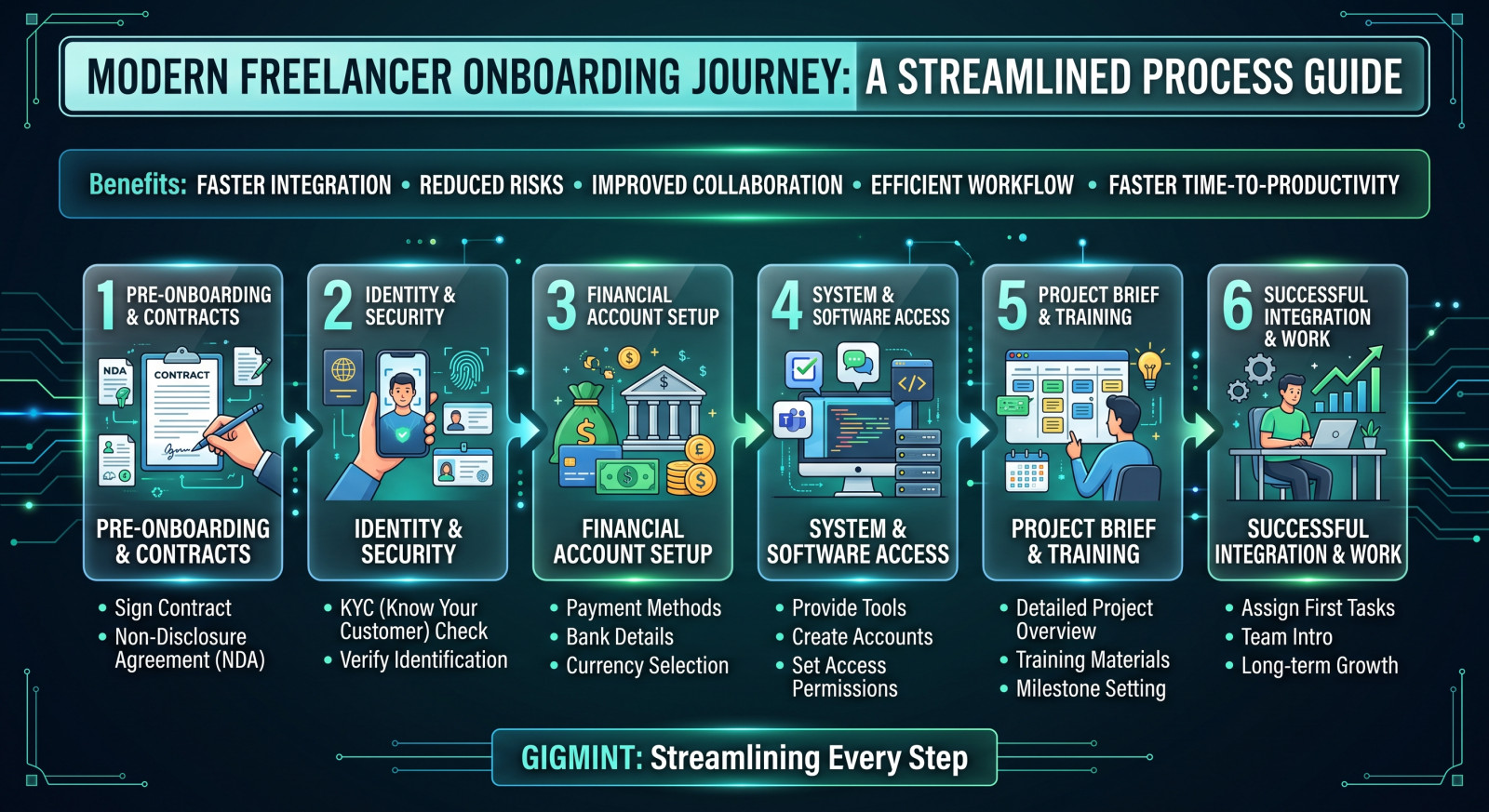
6. The Ultimate Step-by-Step Freelancer Onboarding Checklist
The standardization of a process for onboard freelancers makes bureaucracy an operational flow that is flawless and repeatable. Businesses ensure there are no legal risks, protect their intellectual property and speed up time-to-value for new talents by structuring contractor onboarding in four phases.
Phase 1: Before the Contracting (Vetting and Scope Setting)
Prior to creating the contract or providing access to the software, make sure the following steps are strictly taken.
Review the Portfolio: Check whether the candidate’s past projects and technical case studies (GitHub) meet the technical requirements of the project.
Conduct KYC and International Sanctions Screening: Conduct an identity check and international sanctions screening.
Set the Scope, Rates, and Budget Cap: Define the price terms (hourly/fixed), milestones, and the maximum budget cap for the project.
Phase 2: Legal & Tax Document Execution
Never let anyone work or share assets without having all legal and tax forms signed.
Sign Master Legal Contract: This can be an Independent Contractor Agreement (ICA) or Master Services Agreement (MSA), specifying governing laws, payments, and limitation of liability.
Attach Detailed Statement of Work (SOW): Specify detailed deliverables, time frames, number of revisions allowed, and criteria of acceptance for the project.
Sign Mutual Non-Disclosure Agreement (NDA): In order to protect your proprietary source code, trade secrets, customer data, and internal procedures of doing business.
Provide Required Tax Compliance Forms: Sign form W-9 for US-based contractors or form W-8BEN/W-8BEN-E for international contractors before project start.
Ensure Total IP Rights Assignment: Ensure you have "Work Made for Hire" and IP assignment statements giving total IP rights after final payments.
Phase 3: Operational Setup & System Kickoff
Provide freelancers with necessary tools and information along with implementing strict security protocols related to access control.
Provide Least-Privilege Access: Give accounts to collaboration software (Slack, Jira, Figma, GitHub) through centralized password managers (1Password), and allow access to relevant project channels only.
Provide Project Information: Give design systems, technical requirements, branding standards, and other documentation related to the existing codebase.
Set Working Protocols: Define working hours, communication platforms, asynchronous communication rules, and security guidelines.
Organize Kickoff Synchronization Session: Introduce key people, set out deliverables of the first week, and answer all technical questions.
Phase 4: Execution, QA Review & Automated Payouts
Provide accountable delivery and seamless payment processing in the life cycle of the agreement.
Deposit into Escrow / Milestone Payments: Securely deposit the funds in escrow or arrange for milestone payments based on deliverables’ submission.
Inspection of Deliverables (Quality Assurance Inspection Window): Conduct an inspection of deliverables according to the acceptance criteria outlined in the SOW during feedback windows.
Trigger Immediate Payment: Initiate payment instantly once deliverables have been approved to foster trust and attract high-quality freelancers.
Offboarding and Revoke Access: Once the project is complete, remove all access to the system and archive the project.
7. How GigMint Can Streamline Freelancer Onboarding
The task of coordinating freelancers on various platforms like email, spreadsheets, project management systems, and payments is just extra paperwork that could have been avoided.
GigMint allows companies to streamline important aspects of their freelancers’ engagement workflow, which include project management, milestone-based projects, secure payments, and global freelancers’ payments.
Simplify Project Engagement
By using different platforms for managing freelancer projects, companies can save time by simply organizing engagements and setting project expectations with the help of GigMint.
Setting up project scopes, milestones, and deliverables will give both the parties an idea about the project expectations.
Manage Milestone Payments
Projects based on certain deliverables can benefit from milestone-based payments.
igMint offers payment workflows that offer protection for the client and the freelancer.
Work With Global Freelancers
Companies can work with freelancers from all over the world and use the payment structure of GigMint to make payouts internationally.
Global work can still include legal requirements like tax, employment, intellectual property, privacy, and other things. Using a freelancer platform does not mean that companies do not have to meet any requirements.
Save Time On Administrative Work
What the contractor onboarding process automation tries to do is to make sure that there is less time spent transferring data between systems and more time for managing the work itself.
GigMint could enable companies to streamline the whole process from project planning through execution to payments by putting all the processes for working with freelancers under one roof.
Ready to streamline your freelancer management? Discover how with GigMint!
8. Frequently Asked Questions
What paperwork would be required to onboard a freelancer?
It all depends on the individual, location, arrangement, and nature of the work. A normal business-to-freelancer relationship can include the Independent Contractor Agreement / MSA, SOW, confidentiality clauses, IP clauses, payment information, and relevant tax forms.
Does a freelancer fill out a W-9 or W-4 form?
As far as the U.S. federal tax treatment is concerned, the U.S. independent contractor will normally submit a Form W-9. The W-4 is normally related to employee withholding and payroll processing.
This all depends on the nature of the worker and the payment transaction itself.
What is the onboarding process for an international freelancer?
Check freelancer’s nationality, legal status of the entity and requirements for the classification of workers. After that, set up the terms of the contract, obtain tax documents, arrange payment terms, secure IP and confidential information, and provide only the system access necessary for the engagement.
Is it the correct form to use W-8 for foreign contractors from the US?
The W-8 form is the appropriate one for companies from the USA when they pay for the foreign contractor. Yet the taxation is highly dependent on the situation and cannot be limited to the form.
Can an SOW create a binding contract without an MSA?
Statement of work can be a binding contract depending on the terms of SOW and laws of the jurisdiction. Still many companies have MSAs which define basic terms and conditions of cooperation while SOWs describe specifics of each project separately.
Should an NDA be signed prior to the start of the engagement?
It is preferable to have the terms of non-disclosure established before providing confidential information to the freelancer. Depending on the case confidentiality clause can be included into contractor agreement or be a separate NDA.
9. Call to Action
Finding and hiring a freelancer can be done quickly. Freelancer onboarding one effectively can take significantly more time.
Before a freelance contractor starts their job, it may be necessary to clarify project scope, determine the right classification of a worker, sign the contract, obtain all relevant tax documents, set up payment arrangements, arrange for IP protection, and grant secure access to business resources.
Doing all of that via email, Excel, instant messengers, and separate finance systems leaves room for a lot of mistakes. This can lead to scope misunderstanding, late payments, security threats, issues regarding intellectual property, and other problems.
The onboarding workflow for freelancers is designed to ensure smooth transition from the hiring stage to actual project completion with minimal administrative friction.
This article describes the way businesses can develop an Freelancer onboarding process that will include legal documents, worker classification, tax documents, payment arrangements, security arrangements, project organization, milestone management, and offboarding.
Legal and tax disclaimer: this guide provides general information only and is not legal, tax, employment or accounting advice. The classification of workers, tax issues, IP ownership, restrictive covenants, privacy obligations and contractor rights depend on particular jurisdictions and circumstances. Consult qualified specialists prior to implementing your next freelance engagement