Freelancer Onboarding Template: What to Include and How to Use It
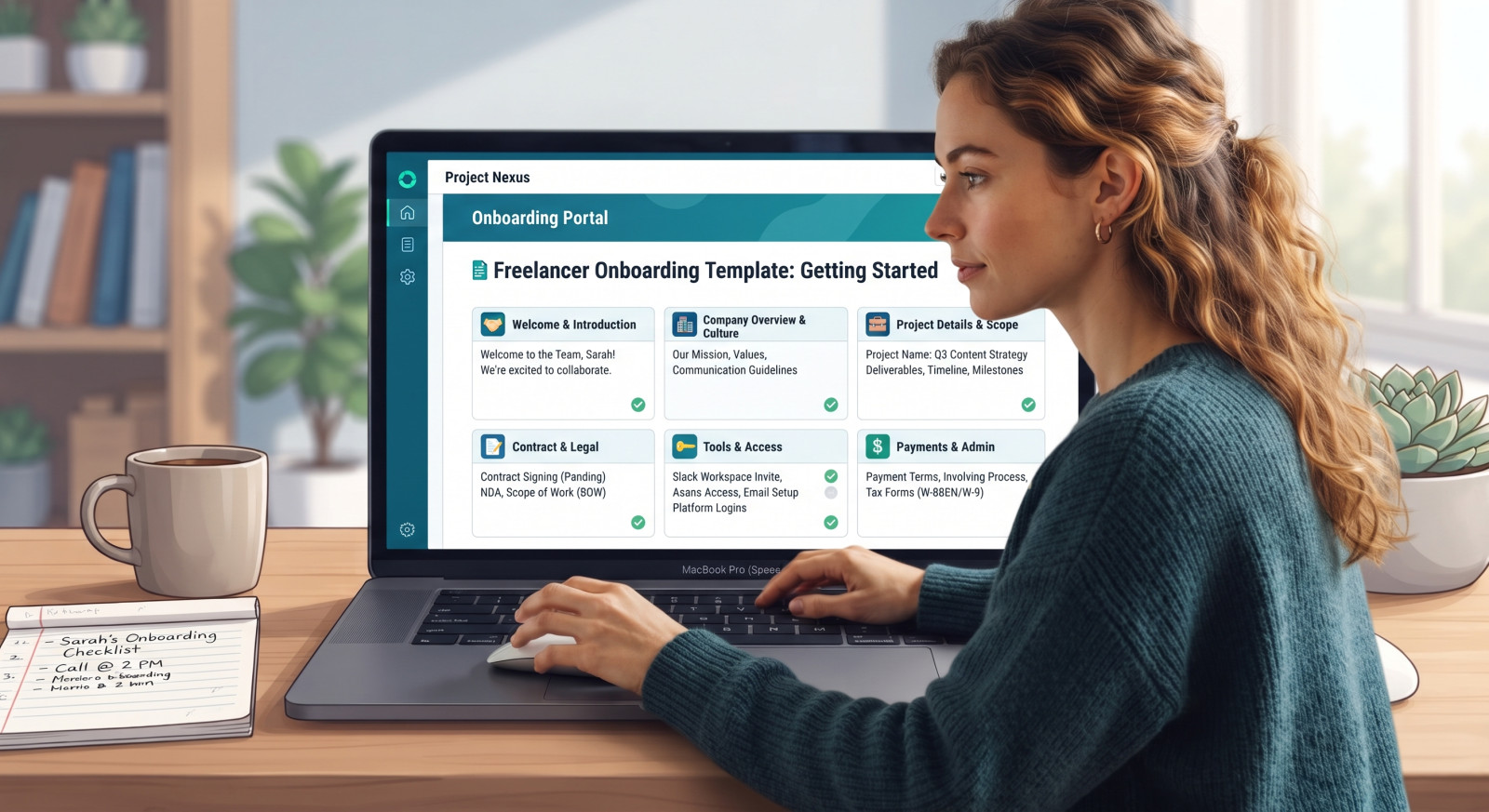
Freelancer Onboarding Template: What to Include and How to Use It
I. Overall Overview
Scaling up the organization means that you will have to deal with more freelancers and contractors. When the size of your team grows, the issue of handling all the necessary agreements, forms, accesses, and requirements becomes very difficult. Once you decide to scale the work that is being done through hiring talented freelancers, the hassle starts right away.
You are forced to track down W-9 forms, wonder if the NDA has been signed, set up secure cloud access for your new colleague, and try to recall whether you did send that necessary Slack invite. Onboarding of contractors is usually an improvised, chaotic task for many business owners and project managers.
As remote work and freelance hiring become more common, businesses need a consistent process for bringing contractors into their teams. Platforms such as Gigmint AI change the game for talent acquisition, yet without proper processes in place, your hiring and onboarding process can become difficult to manage as the number of contractors grows.
Inadequate onboarding results in wasted billable hours, introduces compliance and security risks, and leaves a poor first impression on talented individuals who could be working with any number of other clients.
What causes an unstructured contractor onboarding process, and how is this problem solved? An unstructured freelance onboarding process often occurs due to the failure to properly treat freelancers as contractors rather than permanent employees, or because the administration process is conducted informally.
You run the risk of misclassifying your employees, compromising confidential intellectual property, and losing valuable contractors because they become disappointed by the administration process.
This guide explains why a structured onboarding process matters, what a freelancer onboarding template should include, and how to implement it effectively. You will find out why structure is so important for your return on investment and compliance, discover the anatomy of an effective freelancer onboarding template, go through an implementation guide, and download a ready-to-use copy-and-paste template.
II. Why Every Business Needs a Structured Freelance Onboarding Process
In case business people are thinking about ROI, they normally take into account their marketing campaign, sales funnel, or launch of their products. In rare cases, they evaluate the ROI of an effective onboarding process. But when it comes to engaging freelancers, the efficiency and speed of onboarding play a key role in determining the ROI of the engagement.
The ROI of Speed: Maximizing Time to Productivity
Time is money, especially when you pay an experienced freelancer per hour or charge them with a costly project fee. When a contractor wastes three days looking for access to the repository, brand guidelines, and where they should submit their invoices, you simply waste your money.
At the same time, the use of the right freelancer onboarding template prevents such issues from happening since all the information will already be present in one document.
In this way, with the help of a fast onboarding procedure, contractors will waste less time figuring things out and will spend more time on working.
Onboarding provides freelancers with assurance that the project is well-organized and that they have all the necessary information for working on it.
Compliance and Risk Management
To understand all the nuances of independent contracting laws, one must be 100% accurate. Inaccurate classification of an employee as an independent contractor poses various risks for the business, including employment taxes. Requirements regarding worker classification differ between jurisdictions.
Clear Agreements: Having a systematic process of onboarding guarantees the signing of an Independent Contractor Agreement (ICA) and a Statement of Work (SOW) prior to commencing work, thereby setting the relationship up as a non-subordinate and project-based one.
Documentation: Pre-booking W-9 forms (United States based contractors) or W-8BEN forms (International based contractors) ensures your company’s protection in an audit.
Intellectual Property: With a smooth process, your company ensures its protection right at the beginning through the signing of NDAs and DPAs.
Brand Perception and Talent Retention
The best freelancers – premium software developers, elite copywriters, UI/UX designers with particular skill sets, growth marketing specialists – are always sought after. They interview prospective clients as often as the client interviews them.
The moment a contractor gets online on day one and sees your disorganized email with broken links and forgotten passwords, they question your organizational maturity.
The automated process of onboarding for professionals reflects the professionalism of companies.
An experienced freelancer will always prefer working with those companies that make collaboration comfortable. Good onboarding will become your competitive advantage because it will help you to retain the best freelancers as your partners who will be interested in your projects only.
Operational Scalability
It is easy to hire your first freelancer. Hiring twenty or thirty freelancers at once becomes a headache without proper automation and templates.
Moving from an ad-hoc approach to a standardized onboarding process allows you to manage more contractors without creating the same administrative workload each time
With the process being systematized, you can delegate onboarding coordination to junior operations personnel or automate the entire process with modern workforce management systems like Gigmint AI.
III. Anatomy of the Practical Freelancer Onboarding Template
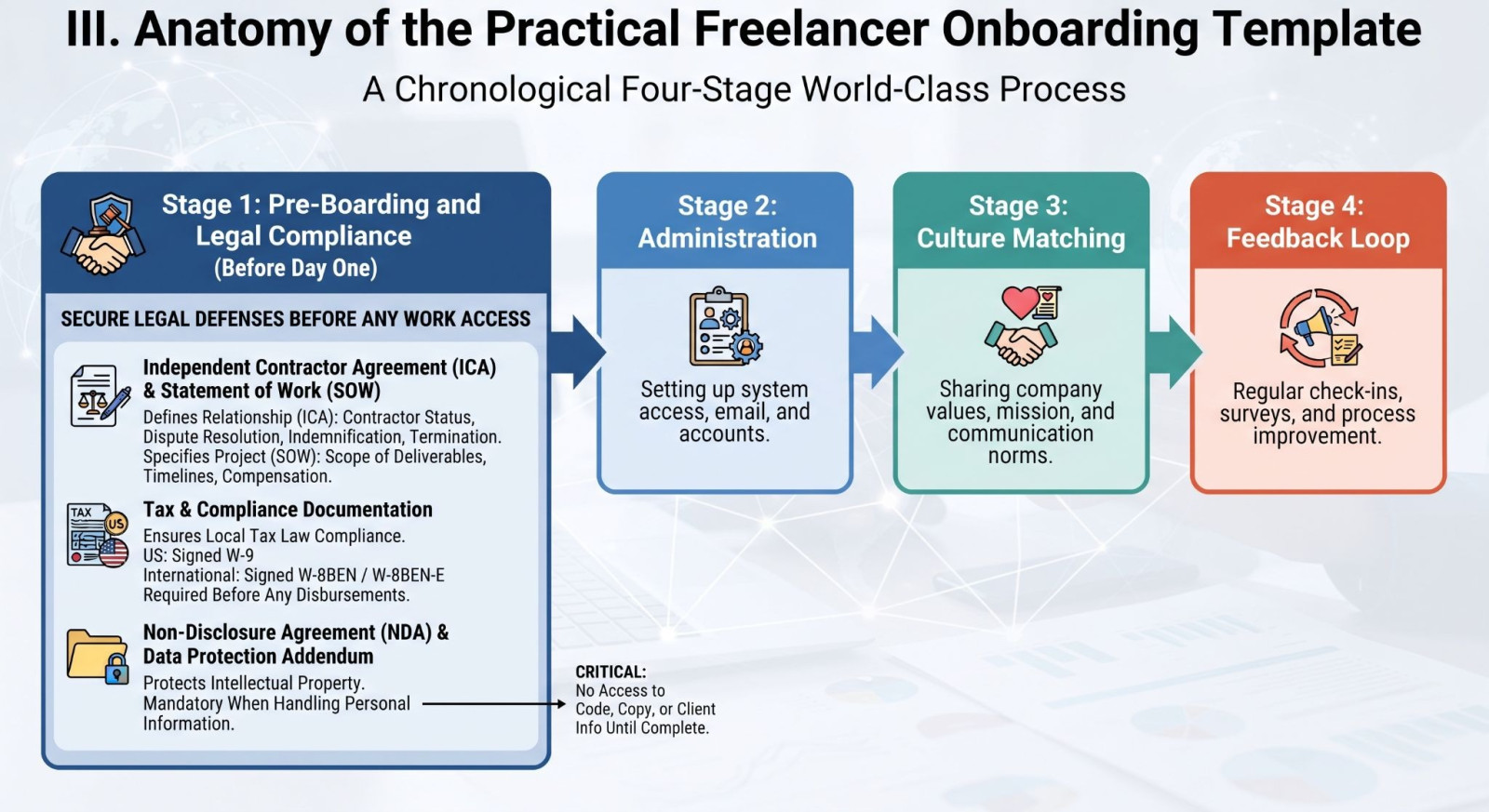
For the development of an effective onboarding program, the process needs to be divided into chronological phases. The four primary stages in the world class freelancer onboarding template are Pre-Boarding, Administration, Culture Matching and Feedback Loop.
Stage 1: Pre-Boarding and Legal Compliance (Before Day One)
Do not let your freelancer have access to code writing, copywriting or any other information related to your client till your legal defenses are complete. Pre-boarding takes place from the moment a verbal and/or written agreement is reached, which completes all the necessary legal and compliance checks prior to the start of any real work.
Independent Contractor Agreement (ICA) & Statement of Work (SOW): The ICA is the legal document that describes your relationship - being a statement regarding independent contractor status, dispute resolution, indemnification and termination clauses. While SOW describes the scope of deliverables, timelines and compensation for the current project.
Tax & Compliance Documentation: To ensure compliance with local tax law, make sure that you get a signed W-9 form (if the contractor is from US) or a W-8BEN / W-8BEN-E form (if the contractor is international) before any disbursements can be made.
Non-Disclosure Agreement (NDA) & Data Protection Addendum: Get your intellectual property protected by requiring contractors to sign the NDA and Data Protection Addendum when they will need to handle personal information.
2. Phase 2: Administrative Setup & Access Management (Day One)
Once the legal documents have been settled, Day One involves giving proper access in a highly secured digital environment. Information overload may happen, but ensure that the permissions are specific to a certain role.
Setup Communication Tools: Make an invitation for your main communication tools (Slack channels, Microsoft Teams workspaces, or Discord servers). Set up the guidelines of communication etiquette like the required time for responses and communication channel for any emergency situations.
Project Management Software Assignment: Introduce the project management software (Asana, Notion, Jira, Trello, or Monday.com) that you have been working on to your contractor. Assign your contractors some tasks in order for them to know what is a good job.
Setup Cloud Storage and Secure Credential Exchange: Make folders in cloud storage applications (Google Drive, Dropbox, OneDrive) and also encourage your contractors to use password managers for secure credentials exchange and not emailing passwords..
Payment and Invoicing Process: There is nothing worse than ambiguities when dealing with money matters. Specify your payment cycle, payment processing tools (Wise, Stripe, PayPal, or Gigmint AI), necessary information on invoices (PO number, number of hours worked, milestone descriptions) and the general terms.
3. Phase 3: Cultural Alignment & Context Setting (First Week)
A professional that has a good understanding of your brand voice, culture, and the quality standards you have will produce an output that won’t need any revisions. Phase 3 will help bridge the divide between administrative permissions and execution.
Access to Brand Guidelines, Voice, and Style Guides: Allow access to company wikis, style guides, repositories of brand assets, and tone of voice documentation. Give them some examples of previously done gold standard work to give them an idea of your quality standards.
Key Stakeholder Introduction and Role Definition: Clearly delineate their reporting lines, stakeholders responsible for reviewing their work and also someone who can assist them in case there are technical barriers. Organize a kick-off call for 15 minutes where everyone meets each other.
Understanding "Definition of Done": Set clear standards on what "done" means. Is "done" when your code has been merged with staging or copy has been approved by Grammarly and added to the CMS.
4. Phase 4: Feedback Loop & Probationary Check-in (Day 15–30)
Onboarding never stops after Day One or even Day Seven. This is the last step where both sides get aligned, and the contractor gets an opportunity to speak out and ask for more help.
2-Week Sync Call Template: Set up a mandatory 20-minute meeting at the 2-week milestone. Use it to ask some open-ended questions like these: What prevents you from going forward?
Form for Receiving Feedback: A basic form that will help the contractor to provide his feedback about the onboarding process and also assist you in developing a better form for the future.
IV. Step-by-Step Guide: How to Use the Freelancer Onboarding Template
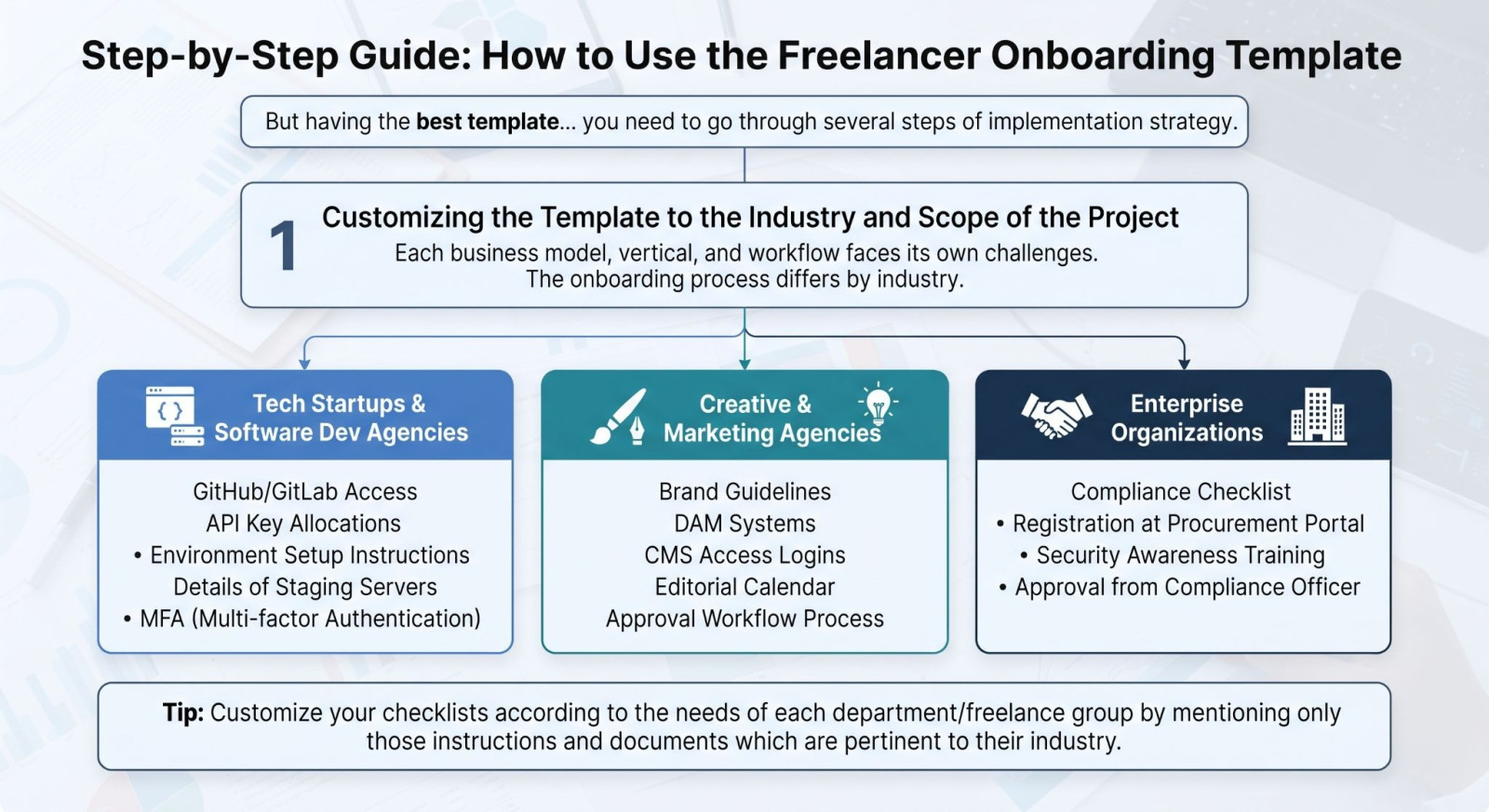
But having the best template in your file would still be of no use if you cannot implement it. In order to implement this document in the process of your work, you need to go through several steps of implementation strategy.
Step 1: Customizing the Template to the Industry and Scope of the Project
Each business model, vertical, and workflow faces its own challenges.The software development agency which is looking to hire freelance full stack developers is required to follow an entirely different on-boarding process from that of the digital marketing agency looking to hire freelance copywriters and enterprise organizations working with legal consultants.
Tech Startups and Software Development Agencies: Focus should be on the provision of access to the GitHub/GitLab repositories, API key allocations, environment set up instructions, details of staging servers, and MFA (Multi-factor Authentication).
Creative & Marketing Agencies: Make sure that you give extra attention to the brand guidelines, DAM systems, CMS access logins, editorial calendar, and the entire approval workflow process.
Enterprise Organizations: Give special focus to the compliance checklist, registration at the procurement portal, security awareness training, and approval from the compliance officer.
Tip: Customize your checklists according to the needs of each department/freelance group by mentioning only those instructions and documents which are pertinent to their industry.
Step 2: Turning Static Documents into Dynamic and Collaborative Checklist
As a PDF file or any general document type is easy to forget and ignore, an automated interactive workflow checklist can help you to ensure 100% completion of everything in your list. Embed an interactive onboarding workflow tracker within your current tools (Notion, Airtable, Trello, Asana).
Assign Task Ownership: Each individual item on your freelancer onboarding template should have its own dedicated owner, for instance, the Legal/Ops department takes care of collecting the W-9 form and executing the ICA, the IT department – of provisioning credentials and the Project Manager – of scheduling the kickoff meeting with the stakeholders.
Utilize Status Tags and Dependency Relationships: Leverage the usage of status tags (Not Started, In Progress, Blocked, and Completed) along with dependency relationships, so that the completion of tasks of phase one (legal documents) triggers the unlocking of tasks of phase two (invitation).
Step 3: Creating High-impact Automated Welcome Communications
First impressions set the psychological tone for the entire contract relationship. Your initial outreach must be a warm yet exciting and clearly defined administrative message.
The 48-Hour Rule: Send your onboarding materials and access to your portal 48 hours before the contractor's start date to give him/her enough time to do any required paper work and prepare for his first working day without being stressed out or rushed.
Set Out Clear Expectations: Tell your new contractor what to expect during the first week, who will be his primary contact person and where he can seek help in case of any technical issues.
Step 4: Using Latest Technologies and Automating the Process
Data entry, chasing signatures via different platforms, and sending calendar invites take a lot of time which you could save by using modern technology.
Centralization: Using modern workforce ecosystems and intelligent platforms such as Gigmint AI will allow you to automate your entire contractor lifecycle. Bringing together talent verification, e-contracts and signing, document vaults, and milestones into one single place removes the human element.
Scalability: Going from onboarding your contractors through manual means like using spreadsheets to using automation leads to the readiness of your contractor management software for enterprise usage.
Step 3: Communicating Expectations Clearly
Set your expectations at the outset through setting out a schedule for the first week.
Make sure to send the welcome package 48 hours prior to the actual start date so that the contractor has enough time to get acquainted with the administrative procedures without being stressed on Day One.
Step 4: Using Technology & Automation
Data entry, getting signatures across various platforms, and inviting people to calendar are administrative activities that eat up a lot of time. Modern technology is the answer.
Automate the Administrative Process: Make use of automation tools and modern workforce ecosystems such as Gigmint AI to integrate talent vetting, contracting, document gathering, and payments processing into one window. By incorporating your freelancer onboarding template into an intelligent system, you eliminate human errors and bring the contractor management to enterprise level.
V. Copy-and-Paste Freelancer Onboarding Template
Here is the fully customizable template which you can simply copy and paste into your organization.
1. Welcome Email Copy
Subject: Welcome to [Company Name]! Let’s Get You Set Up
Hi [Freelancer First Name],
We are extremely delighted that we can partner with you on our projects at [Company Name] We’ve created a simple freelancer onboarding template to help you complete everything you need before your start date. .
Before your joining date on [Start Date], make sure that you complete all the below checklist points:
[Onboarding Hub link / Notion template link]
Should you have any concerns or problems accessing the template, you can either reply to this email or contact your project coordinator, [Name], on Slack.
All the best!
Best regards,
[Your Name / Company Ops Team]
2. Comprehensive freelancer onboarding template Table
|
Phase |
Task Description |
Assigned Owner |
Status |
Due Date |
|
Phase 1 |
Sign Independent Contractor Agreement (ICA) & SOW |
Legal / Ops |
[ ] Pending |
Day -3 |
|
Phase 1 |
Collect applicable tax documentation (such as Form W-9 for U.S. persons or the appropriate W-8 series form for certain foreign payees ) |
Finance |
[ ] Pending |
Day -2 |
|
Phase 1 |
Execute NDA & Data Protection Addendum |
Legal |
[ ] Pending |
Day -2 |
|
Phase 2 |
Send Slack / Workspace Invitation |
IT / Ops |
[ ] Pending |
Day 1 |
|
Phase 2 |
Provision Project Management Tool (Asana/Notion) |
Project Manager |
[ ] Pending |
Day 1 |
|
Phase 2 |
Secure Cloud Storage & Credential Access |
IT |
[ ] Pending |
Day 1 |
|
Phase 2 |
Share Payment Guidelines & Invoicing Schedule |
Finance |
[ ] Pending |
Day 1 |
|
Phase 3 |
Share Brand Guidelines and Style Documentation |
Creative Lead |
[ ] Pending |
Day 2 |
|
Phase 3 |
Hold 15-Minute Kickoff and Stakeholder |
Project Manager |
[ ] Pending |
Day 3 |
|
Phase 4 |
Complete 2-Week Feedback & Check-in Sync |
Project Manager |
[ ] Pending |
Day 14 |
VI. Best Practices and Common Pitfalls to Avoid
Despite having the most optimal freelancer onboarding template, it might happen that mistakes may occur during implementation of the plan and this would put the relationship between you and your contractors at risk. Here are the best practices and the pitfalls to avoid as you implement your contractor onboarding process.
Pitfall 1: Over-Control of Freelancers as if They Were Your Employees
Companies often fall into the mistake of controlling their contractors in ways they shouldn't. Making them adhere to the exact schedule and attend mandatory company-wide culture meetings as well as giving them micromanagement on a daily basis.
The Solution: Pay attention only to the outputs/deliverables, but not to the hours worked or whether they spend time at the desk or not. Respect their independence as business owners.
Pitfall 2: Information Overload
Giving a contractor fifty links, three internal wikis, and ten different software logins during the first day results in cognitive exhaustion and stress.
The Solution: Drip-feed information. Provide them access to Phase 1 & 2 information on the very first day, brand and cultural guidelines on Day Two or Three, and keep technical tool tutorials for the end of the week.
Pitfall 3: No Security Offboarding
Onboarding becomes the most important thing to do because what follows it is offboarding security. It is a risk to your organization to leave the contractors with access to the API keys and GitHub repository once they have finished the project.
The Solution: Include the offboarding process in your onboarding list such that the access tokens and communication channels are revoked once the contract has expired.
Best Practices Checklist
Have Asynchronous Communication: Respect the time zones of all the participants and have decision-making documented rather than requiring instant answers.
Pay Promptly: Cash flow is the bloodline for a freelancer's business. Always respect your net terms and use automated payment platforms for the sake of simplicity.
Over-communicate the Context: Provide freelancers with a context of their projects and business goals behind them. It helps contractors to deliver better work.
VII. Next Steps
A good freelancer onboarding template is not merely a tool for tracking administrative processes but a way to secure your company’s flexibility, safety, and cooperation culture.
Replacing an ad-hoc onboarding process with a structured one can help your business reduce administrative errors, protect sensitive information, clarify expectations, and get freelancers productive faster, you will shield your business from legal issues, speed up the process of becoming productive and make sure that your company becomes a preferred client which Experienced freelancers are more likely to value clients who communicate clearly, provide the necessary resources, and maintain an organized workflow
Looking for the best ways to handle your contractors? Discover Gigmint AI right now.
VIII. Commonly Asked Questions
Q1: Do I need to have agreements when I am hiring a freelancer for a short period of time?
A written agreement would be highly advised, even when it comes to a short period of collaboration. Depending on the engagement and location, it can determine the scope of work, payments, intellectual property, non-disclosure clauses, and termination of the agreement.
Q2: How do I automate my freelancers' onboarding process?
One can use Notion and Airtable templates for checklists, DocuSign for agreements signing and workforce management, and AI-driven platforms such as Gigmint AI to manage the whole process of hiring freelancers including vetting, signing the agreement, onboarding, and global payout.
Q3: Which tools are good for managing freelance teams remotely?
The tech stack depends on the industry, but the following tools can be applied in any field – asynchronous communication hubs (Slack, Microsoft Teams), project management apps (Asana, Notion, Trello, Jira), password manager (1Password, Bitwarden) and all-in-one contractor and talent management platforms such as Gigmint AI.