Information to be Gathered During the Process of Freelancer Onboarding
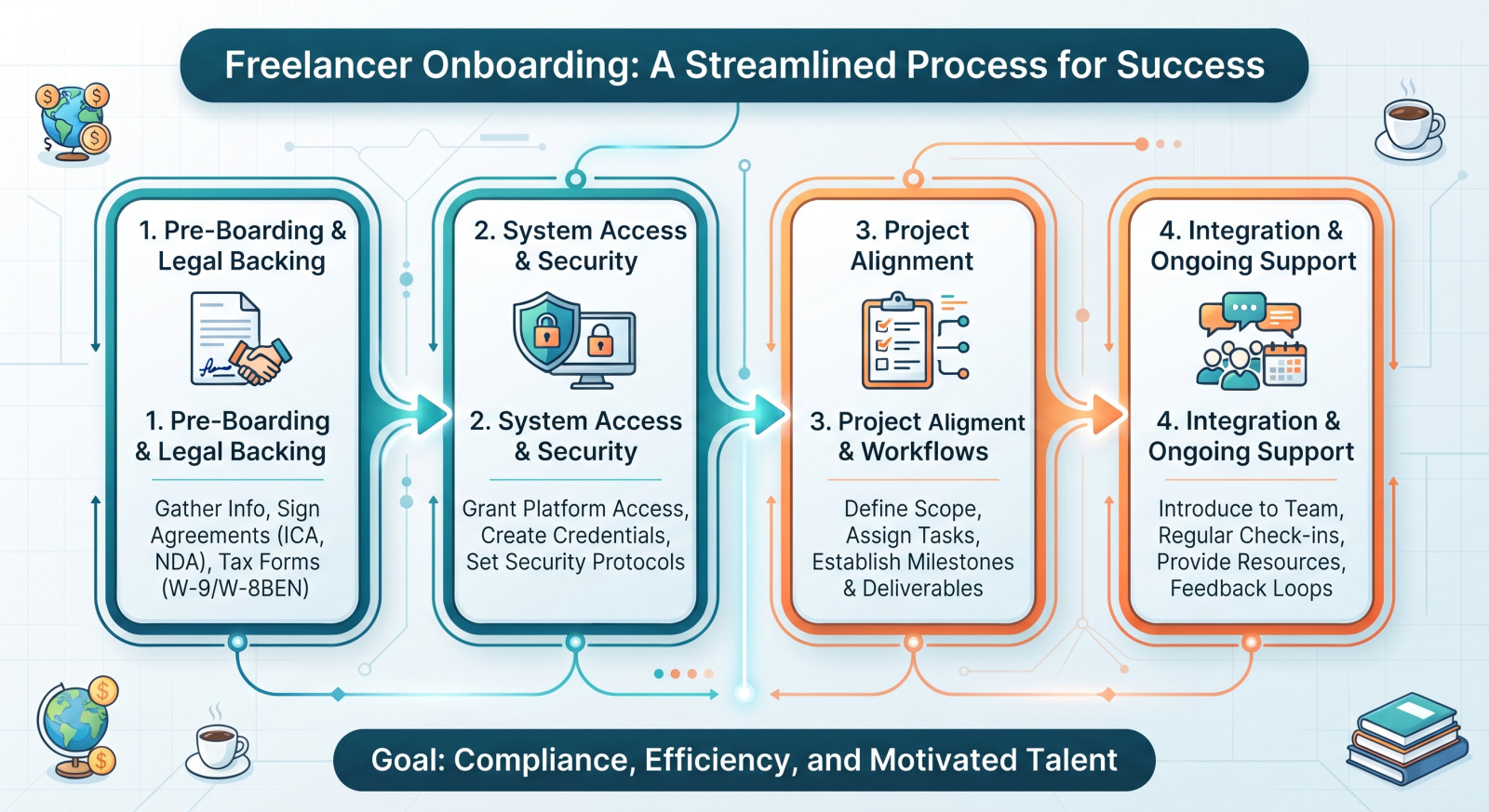
Information to be Gathered During the Process of Freelancer Onboarding
1. Managing the Transition to a Hybrid Workforce
The contemporary organization is experiencing a transformation of its underlying structure. In light of dynamic project demands and access to globally dispersed talent, companies are shifting away from the traditional rigid hiring process.
They now opt for a flexible and diverse blend of both full-time permanent employees and freelance workers. Such a model enables companies to hire the necessary level of expertise on an as-needed basis and access top-notch talent without any overhead associated with lengthy labor contracts.
The management of the contingent workforce comes with its own share of hidden administrative chaos. In absence of a standardized intake procedure, rapidly growing companies tend to end up entangled in the web of disjointed email exchanges, insecure spreadsheets, lack of compliance controls, and delayed project launches.
When different department heads hire contractors independently using fragmented tools, the organization loses cross-company visibility across the company.
The impact of an inefficient contractor onboarding process extends far beyond administrative friction. You are subject to significant liabilities due to worker misclassification, which will result in expensive audits conducted by either the IRS or the Department of Labor.
Inadequate access controls result in serious cybersecurity threats and IP leakage. Compounded by delayed payments and cumbersome document collection, top-tier talent quickly becomes disillusioned before the project starts, damaging your employer brand and project momentum.
The answer to this inefficiency is implementing a clear freelancer onboarding workflow using the capabilities provided by today's advanced platforms, such as Gigmint AI. The gathering of the necessary data at the time of onboarding contractors is not just an administrative necessity but the single most important step towards successful risk mitigation and efficient cooperation.
2. The Core Pillars of Freelancer Onboarding
The primary strategic mistake organizations make is treating freelancer onboarding like standard W-2 employee onboarding. Since W-2 onboarding revolves around benefits enrollment, orientations about the company culture, 401(k), and general integration, contractor onboarding should be highly transactional, compliance-driven, and speed-oriented.
Contractors are separate businesses, which means your intake process should account for their business operations as well as protecting the interests of your corporation.
For proper intake without stifling productivity, you need to build your intake process on three fundamental pillars that you have no choice but to implement:
Legal & Compliance: Minimizing the risks of worker misclassification, protecting your intellectual property, and obtaining necessary tax verification documents.
Financial & Tax: Creating smooth global payments routing and setting up invoicing preferences to keep your talent happy and compliant.
Operational & Technical: Provisioning exact access to systems and communicating with talent as well as integrating it with your technology stack.
Doing so manually through emails and local spreadsheets creates friction and potential for delay and security problems. With the help of automation using Gigmint AI, you will turn these three processes into an advantage that will work for you.
By doing so, you will make sure that your company verifies tax forms, legally binds its contractors with contracts, and provisions access to your resources in hours, not in days.
3. Pillar 1: Legal and Compliance Information
Legally compliant information serves as the ultimate backbone of every secure contractor relationship. Failing to properly follow through on this critical stage leaves your business open to heavy regulatory sanctions, intellectual property lawsuits, and costly legal battles.
Since your freelancer is not covered by the employment laws and is operating in the gray zone, your onboarding procedure will have to create certain limits, keep your information safe, and make sure that you are fulfilling all the tax obligations required by the law.
3.1 Independent Contractor Agreement (ICA)
Independent contractor agreement is a crucial document which needs to be signed prior to starting the coding/designing process.
Integration of Scope of Work (SOW): The onboarding pack of every contractor has to include a clear scope of work which will outline specific goals of a project and its deliverables, timelines, and boundaries. This is done in order to avoid any future misunderstandings related to scope creep and create clear lines of accountability.
Deliverables, Timelines, and Milestones: By clearly stating the deliverables and milestones, you will be able to guarantee the understanding of what the end result is supposed to look like for both sides and eliminate disagreements about the quality of the product, deadlines, and milestone approvals.
Kill Fees and Termination Clauses: In order to protect both your organization and the freelancer, you have to include termination clauses outlining procedures in the event of a project scope pivot or cancellation
Also, the ICA has to define in a very clear way that the contractor remains responsible for his/her methodology, tools, and timeline.
3.2 Intellectual Property Assignment & Confidentiality (NDA)
It is critical for safeguarding your company’s intellectual property, code, and other trade secrets while dealing with outside resources, which can work for your competitors and operate in a parallel industry vertical at the same time.
IP Assignment (IPA): The contract must clearly state that the IP belongs to the company once the payments are made in full. Failure to make any express provision for the assignment of the ownership will mean that under the default law of many jurisdictions, the copyright will vest with the developer resulting in grave implications for the company’s future funding rounds and acquisitions.
Confidentiality and NDAs: Ensure confidentiality and non-disclosure of all business-sensitive information including customer lists, financial documents, and proprietary algorithms through the inclusion of a strong NDA within the onboarding data packet.
3.3 Statutory & Regulatory Compliance Documents
Tax and regulation compliance requirements vary widely depending on where the contractor is located, as well as local labor laws. Gathering of the right tax certification documents will protect you from any costly IRS audit or international withholding penalties:
US Based Contractors: Gather Form W-9 (Request for Taxpayer Identification Number and Certification) to verify the identity of taxpayers and validate the accuracy of EIN or SSN. This will also help gather information necessary for filing year-end 1099-NEC.
International Contractors: Gather Form W-8BEN (for individuals) or Form W-8BEN-E (for businesses) to exempt from US withholding taxes by verifying the foreign tax status. Keeping these documents in your audit-ready digital records will help you stay in compliance with international tax requirements.
Regional Compliance Requirements: Be mindful of all regional labor requirements, including AB5 in California, GDPR data processing addendum in the European Union, or cross border data transfer agreements, when working with international contractors. Centralization of compliance tracking on Gigmint AI platform will ensure no compliance requirement is missed.
4. Pillar 2: Financial and Payment Details
Payment friction is widely considered by independent contractors as the primary reason for the lack of satisfaction among freelancers and their subsequent departure from the job. The best professionals get demotivated when faced with late payments, unforeseen charges for wire transfers, or any other confusion regarding invoicing.
In an international business environment where the workforce is very competitive, financial friction can ruin even the most promising working relationships before the second milestone is achieved.
It is crucial to implement an efficient process of financial freelancer onboarding. By gathering the necessary information about the contractor’s bank, tax, and billing information, you ensure smooth transactions and avoid mistakes.
4.1 Banking, Global Payouts, and Currency Handling
Gathering correct disbursement information right at the very beginning can save from payment bounces, time-wasting processing, and costly banking errors.
Direct Deposit & ACH Information: In case of domestic contractors, it is important to securely gather bank routing number, account number, and account type (checking vs. savings) to enable automated electronic transfer of funds.
Payout Infrastructure for International Workforce: Many companies of today use talents from different parts of the world. Local bank wires are too costly and time-consuming due to intermediary bank charges.
Freelancer Onboarding information needs to contain data for modern payout methods such as PayPal, Wise, Payoneer, or cryptocurrency payout services, to allow talents to choose the payment method they like best.
Preferred Currency & Exchange Rate Clarity: It is unacceptable for a freelancer to wonder about how much the currency conversion fees or exchange rate deductions would cut into his pay. Preferred currency and transparent conversion process need to be defined right in the onboarding phase to ensure talents receive the agreed-upon amount of money.
4.2 Invoicing Standards and Billing Workflows
Having a standardized way for the finance department to receive, verify, and process the invoices saves back-and-forth emails of communication and helps speed up accounts payable processes.
Metadata to Gather: The legal business name of the contractor, its billing address, Tax ID number, and billing contact email must be acquired. Most importantly, Purchase Order numbers should be required to create invoices in order to map invoices directly into budgeted funds.
Timing of Invoices & Terms: Whether invoices need to be sent weekly, bi-weekly, upon completion of milestones, or on normal Net-30 terms must be defined to avoid the bottleneck of invoices at the end of each month.
Invoicing Automation: Using services like Gigmint AI will make sure that the invoices are automated, milestone approvals are done automatically, and the payments are processed without any mistakes. This allows businesses to keep their accounting ready for audits, while also keeping contractors happy and paid on time.
5. Pillar 3: Operational, Technical, and Access Information
Once legal and financial frameworks are firmly in place, it is imperative that your company incorporates this freelancer into its internal workings seamlessly while protecting your company’s cybersecurity, intellectual property, and infrastructure from any risk of breach.
With today’s world of remote working, dispersed engineering groups, and cross-disciplinary agile teams, the recruitment of technical and creative personnel needs to be handled delicately.
On one side, you need to provide adequate access to your systems and tools in order to deliver your project objectives fast; on the other side, you need to draw stringent security parameters to avoid data breach and intellectual property theft.
5.1 Communication, Directory Provisioning, and Collaboration Workflows
Operational procedures help to eliminate communication silos, prevent any miscommunications, and enable perfect coordination among different remote departments.
Setup of Tools and Creation of Directory: Get the handles, username, and the official email id of the contractor for collaboration using tools like Slack, Microsoft Teams, Asana, Jira, and Github. Setup of the account before the first day will ensure that the contractor begins doing meaningful work instead of struggling with the setup of credentials.
Creating Operational Boundaries and Guidelines: It is necessary to record working hours, expected response time, means of communication, and the schedule for status updates. Importantly, the communication guidelines should be specified in order to keep operational transparency while not crossing the line of behavioral guidelines, which might be seen as employee misclassification.
5.2 Security, Access Management, and Lifecycle Governance
Allowing any kind of unrestricted, indefinite, or unsupervised access to your critical IT infrastructure via external contractors is nothing but a catastrophic cyber security threat which any modern-day enterprise simply cannot afford to overlook.
Role-Based Access Control (RBAC): Limit the permissions of any external contractors to only those tools, development environments, code repositories, and documentation folders which they need as part of their SOW. No universal administrative rights should ever be granted to any external contractor.
Multi-Factor Authentication (MFA): All integrated systems should implement strict multi-factor authentication to ensure that there is no possibility of credential theft, session hijacking, and unauthorized data access.
Automated Off-boarding: All systems should be designed to enforce offboarding protocols which automatically remove all credentials, access tokens, and repository permissions at the conclusion of each individual project.
5.3 Professional Metadata, Skill Tagging, and Emergency Contacts
Keep a tidy and well-organized internal talent repository of your broad talent pool for easy reengagement of resources in future projects.
Metadata and Portfolios: Ensure that portfolio URLs, preferred display names, unique skill identifiers, and time zones are collected for coordinating between different functions and capturing unique competencies of the departments.
Emergency Contact: Ensure an alternative mode of emergency contact is available in case the mission-critical deliverables or productions require immediate alignment via alternate means.
6. The Ultimate Freelancer Onboarding Checklist
The shift from chaos and unstructured intake process of contractors to an enterprise-level and structured workflow needs a detailed and systematic roadmap.
Otherwise, due to a lack of proper process, the administrative errors will result in compliance issues, payment delays, and security vulnerabilities. In order to streamline your intake process and remove the ambiguity, it is recommended to use the structured and three-day freelancer onboarding process checklist.
Day 1: Pre-flight & Legal Backing
Risk management and legal protection is the goal of Day 1. The contractor relationship needs to be made legal before the tools are provided or anything else is shared. While going through the pre-onboarding process, you will have to have your compliance department sign an Independent Contractor Agreement (ICA) along with a clearly detailed Statement of Work (SOW).
At the same time, the tax verification form (e.g., W-9 for domestic contractors and W-8BEN for foreign firms) needs to be acquired and verified in order to avoid penalties at the end of the year. Lastly, IP transfer and NDAs need to be signed to protect your IP from the first day on.
Day 2: Financial Setup & Billing Configuration
Once the legal boundaries are set, Day 2 is solely devoted to building an ecosystem for financial and administrative efficiency. Payment inefficiency is the primary reason why contractors leave. This makes it essential to have the correct financial configuration.
During this phase, accounts payable gathers information regarding direct deposit, ACH or global payout mechanisms such as Wise, Payoneer, or digital wallets. There is billing metadata, which include business names, tax ID numbers, and required PO numbers, among others.
Day 3: Technical Integration & Operational Kickoff
The last stage of the onboarding cycle marks the transition from administration to productivity. The third day focuses on technical configuration and integration of the systems securely.
RBAC permissions are set up by the IT administrator, providing the freelance worker access to particular repositories, staging areas, or collaboration tools (such as Slack, Jira, or GitHub), not compromising the entire enterprise infrastructure in any way. MFA is rigorously required at each step, and a kickoff meeting of the project is scheduled.
7. Common Pitfalls to Avoid in Freelancer Onboarding
Despite all the preparation done through having an effective checklist and proper workflow set in place, there are still various operational pitfalls that many organizations tend to encounter, leading them to ruin their contractual relationships, face serious audits from government agencies, and suffer significant security risks.
Knowledge of these mistakes enables your organization to protect itself from potential risks to its legal and financial well-being.
Pitfall 1: Confusing Independent Contractors with W-2 Employees:
This is probably one of the most damaging operational pitfalls, involving the confusion between independent contractors and permanent employees.
Forcing your contractors to work within strict working hours or attend mandatory company culture meetings or training sessions results in a harsh audit of worker classification performed by the Internal Revenue Service or Department of Labor.
In order for your organization to preserve the independent contractor status, the only things that have to be taken into account are project deliverables, milestones, and achievements.
Pitfall 2: Transmitting Confidential Information via Unsecure Channels:
Transmitting highly confidential tax information—such as social security numbers, employer identification numbers, or banking information for direct deposit—through regular email chains or unsecured local spreadsheets is a colossal data privacy problem.
Just one data breach could ruin you by exposing all of your employees and contractors to potential identity fraud, regulatory non-compliance penalties, and reputational harm. Companies today need to ensure that any sensitive documents are transferred through a secure, central, and regulatory compliant digital portal.
Pitfall 3: Lack of definition of Project Scopes of Work and Deliverables:
The failure to define the scope of work at the beginning of the freelance onboarding process results in scope creep and budget overrun.
The lack of clarity creates misalignment for everyone involved in the project and causes delays in deliverables as well as poor professional relations between everyone. Making sure that all engagements start with a defined and tight Statement of Work is key.
8. Frequently Asked Questions
Documents that are mandatory to onboard freelancers.
It is essential that you obtain an ICA, form W-9, and IP Assignment/NDA.
How do I compensate international contractors legally?
You have to gather form W-8BEN (W-8BEN-E), and use compliant payout solutions for international payments in multiple currencies.
Can I establish working hours for my independent contractors?
No, because you can face misclassification penalties from the IRS and DOL.
How can I grant access to my systems for contractors?
Role-Based Access Control (RBAC) and Multi-Factor Authentication (MFA) are your keys to success.
Why automation is a good choice for freelancer onboarding?
With the help of such tools as Gigmint AI, you can collect documents, tax verify, and transfer funds automatically.
9. Streamlining the Workflow with Gigmint AI
Freelancer Onboarding contractors manually is a process of using multiple disconnected systems, insecure email threads, and lengthy compliance checks, which creates risks and slows down your processes.
With the use of one automated system for taxpayer validation (using W-9 and W-8BEN form), international payments, and access control, the team of enterprises can get rid of unnecessary bureaucracy and avoid any costly compliance audits.
By making your contractor management process a competitive advantage, you can easily hire and engage world-class global talent.
Are you ready to optimize your contingent workforce management? [Request a demo of Gigmint AI now] or [Download our free freelancer onboarding template].