Freelancer Onboarding Process: 4-Step Checklist from Contract to First Task
Freelancer Onboarding Process: 4-Step Checklist from Contract to First Task
1. Introduction
There are several friction points that could interfere with the freelancer onboarding process. The period between the signing of a contract and the delivery of the first output by a contractor is quite risky and typically characterized by administrative lags.
There are numerous factors that can contribute to the failure of freelancer onboarding process – from the moment a freelancer picks up a pen and starts working until he/she produces his/her first lines of code or copy is a very risky period in terms of mistakes that may occur – the dreaded onboarding "black hole".
The friction is exacerbated by the scale of the current gig economy. In the era of digitalization and agility, businesses need specialized talents that will help them scale operations, bring niche expertise and stay ahead of the competition.
There is a common mistake made by many organizations in which they try to take independent professionals through an onboarding process meant for their regular workforce. Videos that never end, the old HR-ticketing system and manual verification of compliance requirements serve as the initial barriers that discourage talent from even touching a keyboard.
AI-native orchestration platforms change the game completely. By automating document verification, provisioning of access and setting right cultural expectations immediately, Gigmint AI closes both the administrative and cultural gap instantly.
The capability of creating an automated and humanized onboarding process for freelancers changes the inconvenience into an advantage. By doing so, you would be able to increase your efficiency, stay compliant, and keep the best talent.
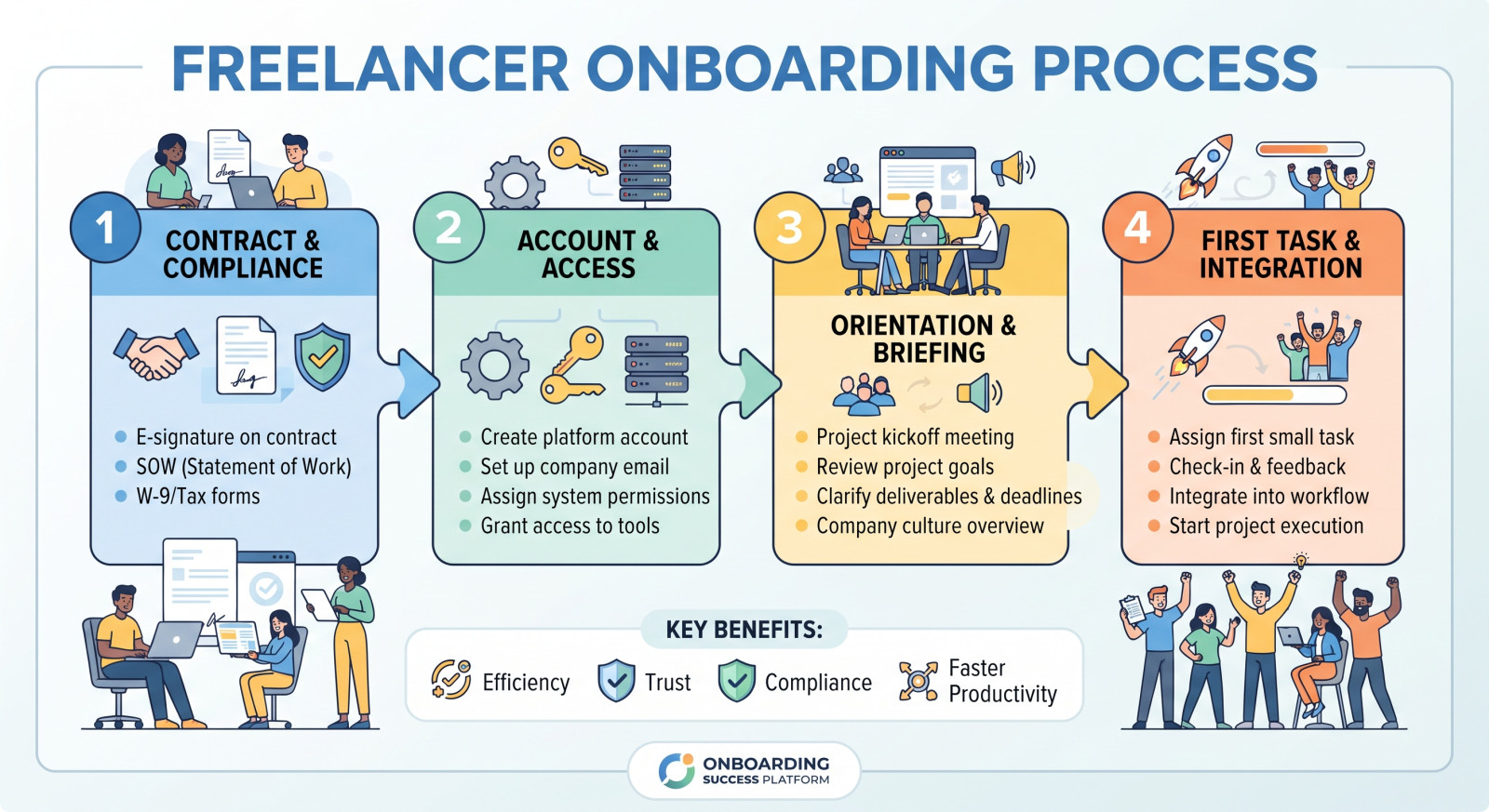
2. Phase 1: Legal Foundation & Contractor Compliance
A strong foundation for any contractor collaboration requires complete legal and financial transparency. In the process conducted manually, this stage involves the hassle of repetitive emails, prolonged document gathering, and fear of non-compliance.
Guaranteed Contract Signing and Clarified Statement of Work (SOW)
A template freelance contract represents a bomb waiting to explode. Although such contracts guarantee your company protection from common liabilities, they do not necessarily account for the subtleties of the project's agile implementation. Real security in administration starts with a granular Statement of Work (SOW). Getting past basic signatures implies establishing three important pillars first:
Scope of Work: It is crucial to set clear boundaries of the work performed, both by specifying its content and marking off-out-of-scope tasks. This ensures the absence of expensive revisions that harm your relations with contractors.
Intellectual Property (IP) and Ownership: It is necessary to include clauses which guarantee that the work product, source code, designs and their derivations become your property once the payment is made.
Milestones: Project is to be broken down into achievable and verifiable milestones rather than 100% payment at the final date.
Compliance and Tax Documentation at Scale
Having a few independent contractors locally is relatively easy, but having a global pool of workers is complicated administratively. Non-compliance such as worker classification errors or missing tax documentation can make your company liable for audits and hefty fines. The key elements for an efficient freelancer onboarding process include:
Tax Classification: If you are looking to hire US-based talent, it is important to get a Form W-9 that is verified. In case of international hires, it is necessary to get a Form W-8BEN or W-8BEN-E.
Global Regulatory Standards: In case you are operating out of or hiring from the European Union, it becomes important to comply with GDPR as well as other local labor classification laws when dealing with the contractor's data.
Worker Classification Risk: It is important to ensure that the business model accurately reflects an independent contractor by focusing on outcomes and not on how many hours the person works every day.
Automated Financial Setup and Payment Rails
One of the fastest ways to undermine confidence in a newly hired contractor is through any ambiguity about how and when the contractor will get paid. It’s a crucial mistake to wait for the first billing cycle to sort things out. Provisioning of modern funds means abandoning the outdated manual check processing in favor of flexible payment systems:
Invoicing Process Automation: Create standard invoicing procedures and formats that are easily integrated into your accounting software.
Escrows at Milestones: Secure payments for both you and the contractor through milestones escrows before the work begins.
Preferred Payout Methods: Allow the flexibility in payments by providing low-cost payouts through multiple currencies to attract international talent.
Gigmint AI – The Difference
A conventional enterprise has to organize a complicated interaction between its legal, human resources, procurement, and finance departments for Phase 1. Gigmint AI makes it possible to streamline such a cumbersome process into an instant, automated procedure.
With the help of native AI-based orchestration and smart contracts, Gigmint AI automates document verification, immediately finds gaps in compliance, and sets up custom SOW criteria into secure escrow milestones.
3. Phase 2: Cultural Alignment & Tool Provisioning
When both the legal and financial frameworks have been firmly laid, the technical and cultural integration challenge follows. The independent contractor is not really a full-fledged employee but must function like an integral part of your team.
This needs to be done by providing automated access provision and clearly defined operational guardrails that maintain their independence yet fit into your enterprise.
Tool Provisioning & Access Rights Without Friction
There’s nothing more disruptive to productivity on the first day than not being able to access the relevant systems. Legacy firms will have to go through the motions of filing IT requests for provision of access which could take several days and leave their work grinding to a halt.
To solve this problem, you’ll need automated provisioning templates that set everything up for your contractors right at the point when you sign your SOW.
Role-Based Access Control (RBAC): Grant only the permissions that the contractor requires for that particular project—whether this is access to a specific Slack channel, a limited GitHub repository, Figma project workspace, or Notion project board—without giving out any proprietary company information and any personally identifiable information of customers.
Secure Credential Management: Either use enterprise-grade password managers or automated single sign-on (SSO) guest invite solutions to on-board contractors without compromising any network security policy within the firm.
De-Provisioning Safeguards: Use automated deprovisioning of access after certain predefined dates in your SOW milestone timeline to ensure automatic closure of access to the corporate infrastructure once the project is completed.
Setting Communication Protocols and Boundaries
Independent contractors are usually dealing with several clients at once in different time zones globally. Without established rules of how responsiveness should be defined, there might be a lot of misunderstandings causing frustration from both sides. During the freelancer onboarding process, define clear operation boundaries that will help you maximize speed and freedom:
Channels for Urgency: Define in which channels urgent matters of operations should be discussed (Slack), feedback on engineering issues (Jira), or official milestone approval (email).
Response Timeframes: Establish available timeframes and respond to messages within a certain period of time taking into account the independence of a contractor.
Documentation-Driven Communication: Develop a culture that supports asynchronous communication and allows distributed talent to perform great jobs without being interrupted all the time.
Brand and Mission Orientation
Approaching a freelancer as a fungible unit destined for transaction is a guarantee for mediocrity. Seeing them as a reliable partner and a collaborator will lead you into the realms of innovation. It is worth spending half an hour acquainting your contractor with the spirit of your brand even in case of a one-time project:
Style guides and brand tone of voice: Provide them with clear guidance on the visual language, architectural decisions, and any other guidelines you have to ensure there are no questions regarding your taste.
The "why": Give an explanation of the overall vision of the company, user problems, and the impact of their particular assignment on the end result.
Psychological safety and integration: Introduce them briefly to the core team, outlining what they should expect from their collaboration.
The Gigmint AI Advantage
Phase 2 is made easy using Gigmint AI because of the automatic synchronization of access provisioning upon contract execution. Once the SOW has been signed and the escrow account is funded, Gigmint AI ensures that the workspace invites are automatically generated, access provisions are done, and contextual kits are deployed straight to the freelancer’s dashboard so that they work from day one.
4. Phase 3: The Kickoff Meeting & Briefing
Now that all the administration issues are sorted out and we have digital connectivity, it is time for the official sync-up. This first meeting is not meant to be a symbolic meeting just to report the status; it is an important tactical meeting intended to remove any confusion, build trust between us, and create an iron-clad vision for the success of the project. When conducted effectively, this will serve as the ignition point to drive everything else.
The Anatomy of a High-Impact Kickoff Sync
Poorly planned kickoff meetings result in confusion within the contractor side and worries of the internal management team. For proper value generation and motivation, make sure you structure your first sync to be effective, clear, and actionable during its timed agenda:
Ownership Clarification and Introduction (5 mins): Determine ownership of all items on both sides. Introduce project owner, technical contact person, and potential stakeholders who might impact review processes. Knowing who is behind certain roles creates instant connection.
Discussion about Deliverables, Deadlines and Success Criteria (15 minutes): Discussion of all the deliverables, deadlines and success criteria as mentioned in the statement of work. Make sure that you understand everything to 100%.
Tooling and Process Walkthrough (10 mins): Make sure that all the access rights are working well and talk about the locations of storage for all the artifacts, the location for the comments to be posted, and where the final approvals take place.
Q&A and Psychological Safety (15 mins): Ask questions explicitly and encourage the contractor to do so. Freelance talent often can provide an outside view which helps to detect potential architecture, usability, or design flaws of the internal teams.
Delivering the Comprehensive Project Brief
Inexactly defined project brief becomes the silent assassin of any freelance work. Expecting that two sentences on Slack will lead to the same result as an enterprise project becomes a long journey to frustration and endless revisions.
Your project brief should become your single source of truth that includes all needed assets, user personas, limitations, design system, and criteria of acceptance. Break down complex projects into manageable sprints or tasks to allow your contractor to see the way you go step-by-step without being scared by the scale.
Feedback Loop and Governance Setting Up
Let the contractor know how he or she will be reviewed and how much time it will take to do it. Define who makes the final decision and how the feedback will be gathered in order not to contradict several versions of reviews by several internal stakeholders. Proper governance will help to avoid possible bottlenecks and respect the contractor's time.
The Gigmint AI Value Add
Gigmint AI helps with this stage because of the embedded structured project briefs right in the workspace dashboard and intelligent milestones. All meeting summary, decisions, and action items taken as a result of the kickoff synchronization can be recorded in the platform.
5. Phase 4: Transitioning to the First Task & Early Feedback
The connection between onboarding and execution occurs on the very first day. The way in which you handle the transition from the kickoff to the first deliverable submission determines the whole course of the partnership. A bad start leads to anxiety and constant modifications, but an assisted start results in immediate momentum and trust-building.
Creating the "Day-One Win"
Do not challenge your contractor with the most complicated and mission-critical architecture redesign on the first day. Design an innovative "day-one win," which is a relatively risk-free but highly visible task. It can be a bug fix, some copy editing of the landing page or a simple wireframe drawing. It provides for immediate trust-building between the two sides before handling major enterprise workloads.
The 48-Hour Check-In Loop
Silence at the beginning stage is dangerous. Organize an automated or manual check-in after two days since the project starts. This is not a case of corporate micromanagement; it is just another step that is needed to help the contractor to answer any unexpected questions or to clear the way for them to be ready to start working. A simple question whether they have all the necessary resources will save a lot of time searching for something that doesn't exist.
Cultivation of the Culture of Constructive Feedback Iteration
As soon as the first deliverable appears, your feedback will form the tone of collaboration in the team. Don't give vague and confusing comments about what you do not like in the document. Instead, give objective, criteria-based feedback based on the statement of work and guidelines of the brand. Applaud good points and point out what should be improved.
The Gigmint AI Edge
Gigmint AI takes care of the milestone tracking and milestone verification process during this important transitional period.Once there are any drafts or code deliverables available on the platform, automatic testing is done, and you get paid through milestone escrow immediately.
6. Frequently Asked Questions (FAQ)
1. What is the 'dead zone' in onboarding? The 'dead zone' in onboarding relates to the period of time during which independent contractors sign their agreement and start working. This is the vulnerable gap of operation when traditional companies experience troubles with transfer of documentation which leads to loss of momentum, enthusiasm, and administrative bottleneck. AI-enabled platforms make it possible to automate verification and provisioning of workspace immediately after signing of agreements.
2. What are some of the issues legacy HR onboarding workflows have when it comes to onboarding freelancers? Traditional freelancer onboarding processes were designed specifically for full-time corporate hiring processes and include a series of orientation videos, multi-level approval chains, and out-of-date internal ticketing systems.
Frequent and self-sufficient freelancers find it irritating and ineffective. Applying such an approach to freelance work makes onboarding difficult from the very first steps.
3. What is the most important role of a detailed Statement of Work (SOW)? The main role of a detailed Statement of Work (SOW) is protection of interests of both company and contractor. It ensures that there is no misunderstanding regarding scope of work, ownership of IP and milestones. Thus, it helps to avoid scope creep and unnecessary work without compensation.
4. Why is milestone escrow critical in making payments to the contractor? The milestone escrow system establishes deep trust between all parties due to locking funds ahead of time with direct payments associated with the achievement of verifiable milestones.
As a result, contractors are confident about being paid for their work on completion, and businesses receive money protection and quality assurance before releasing payments.
5. How can you avoid access bottlenecks but not sacrifice security? Companies can ensure there are no IT access bottlenecks by using RBAC templates and automated guest provisioning directly connected to contract signing.
In such a way, independent experts get immediate access to the necessary tools (Slack, GitHub, Figma etc.) for performing their job, and enterprise data security and PII stay protected.
6. What is the "day one win" and what does it mean? "Day one win" is the name of a simple task with minimal risks and high visibility that is assigned to contractors right at the beginning of cooperation. Its main purpose is to establish momentum and prove collaboration and communication processes and output quality early on.
8. How does Gigmint AI make enterprise freelancer onboarding more efficient? It replaces all of the disconnected manual workflows used by legal, HR, and finance with the AI-native orchestration platform which enables compliance document verification, smart contract milestones with secure escrow, role-based instant provisioning of tools and centralized project briefs on one dashboard.
9. Why is brand and mission orientation essential for short-term projects? Even when working on short-term projects, the time spent on sharing the company's mission, user personas, and brand guidelines turns the vendor into an extremely invested partner. The understanding of the bigger picture and the target audience allows contractors to foresee the edge cases and deliver much better results.
10. How can you ensure safe cross-border tax and regulatory compliance? Working with global talent requires having compliance data collected in a standardized way using validated forms – for example, W-9 form for the US-based contractors and W-8BEN or W-8BEN-E for the international contractors while staying aligned with the labor regulation in the region, such as GDPR.
7. The Gigmint AI Advantage
The Freelancer onboarding process is no mere box-ticking exercise, but rather the very foundation on which modern agile collaboration can be built. Through the mastery of the four stages – ensuring legal and administrative compliance in Phase 1, provisioning of flawless digital access in Phase 2, kickoff briefings of high impact in Phase 3, and early execution momentum creation in Phase 4 – you remove all the friction from the old-style enterprise-contractor dynamic.
When it comes to recruiting the best of today’s global independent talent, there’s an implicit understanding that those people will want to work with an organization that appreciates their time, pays them fairly, and operates clearly.
The more frictional your freelancer onboarding process is, the more likely it is that elite talent will take its business elsewhere. But a frictionless, transparent and intelligent process is the key to incredible speed, agility and innovation.
This is the promise of Gigmint AI – by eliminating disjointed processes, disparate communications and compliance stress, and introducing an intelligent orchestration engine powered by artificial intelligence, Gigmint AI enables you to onboard elite global talent in minutes instead of days. Contracting, escrow, workspace provisioning, and milestone tracking have never been easier. Make onboarding an advantage with Gigmint AI.