The Freelancer Onboarding Process: From Contract Signing to First Task
The Freelancer Onboarding Process: From Contract Signing to First Task
I. Overview
What was once a temporary trend has evolved into the core of flexibility in the modern business environment. Agile businesses as well as Fortune 500 companies are able to expand and scale fast using independent talents to carry out crucial projects.
The challenge of scaling through freelancers is that there is an invisible choke point: friction during the onboarding process.
If there are delays, if credentials have not been verified, or if expectations between both parties do not coincide, then the project is not even initiated yet, causing inefficiencies and other problems for many companies.
In the age of technology, paper-based onboarding and handovers do not cut it anymore. Through the use of workflow automation solutions such as Gigmint.AI, businesses are able to turn the setup of their freelancer into a frictionless, seamless, and compliant process.
This guide goes over the entire onboarding process, from compliance and provisioning of digital access, to culture integration and carrying out crucial first tasks.
II. Phase 1: The Legal & Administrative Handshake (Contract Signing & Compliance)
Until the very first line of code is written, and the first design draft is created, you have to go through the most essential part of the freelancers’ onboarding procedure: the legal and administrative handshake.
In the hustle of getting down to business, companies tend to underestimate this step and view it as a formality—something to be done before moving onto more exciting tasks. This is risky. A weak legal base and a long compliance procedure will only lead to increased friction in the work process, legal risks, and even tax risks. And none of these are something you want to face before the very start of your project.
Beyond the Signature: Setting the Legal Baseline
The difference between a smooth launch of a project and a messy dispute lies in how well-prepared your starting documents are. Many businesses fall for a trap of thinking that handshake deals and informal emails will do just fine since the idea behind them is to have room for flexibility instead of precision.
Differences Between Defined Scopes of Work (SOWs) and Vague Deals
A vague deal states, "Help us develop our product and enhance our marketing efforts." The Scope of Work (SOW) provides all the information related to deliverables, deadlines for certain milestones, number of revisions you can expect from the freelancer, acceptance criteria, and compensation plans. When working with freelancers, the SOW should state what is included in the deal and what is not in.
Mitigating Misclassification Risks
Having a well-defined project scope, companies have to deal with the dangerous waters of worker classification. Regulatory agencies across the globe from the IRS of the United States to global labor ministries are putting an emphasis on punishing the misclassification of workers. Misclassifying an independent contractor as an actual employee will bring a heavy toll in the form of hefty fines, taxes, and lawsuits.
In order to avoid such pitfalls, your onboarding process needs to emphasize contractor independence. The contractor is responsible for completing the job on his/her own terms using his/her own equipment and dealing with several clients at once.
Automating Compliance and Tax Documentation
Once the engagement agreement is in place, the administrative process begins. Manually collecting the necessary documentation and the proper protections from the global talent pool becomes an administrative burden very quickly.
W-9, W-8BEN, and International Contractor Verification
The collecting of a signed W-9 Form from domestic contractors in the United States is essential for year-end reporting. Yet, with the involvement of the global talent pool, compliance becomes increasingly complicated.
It is required to gather the Form W-8BEN from foreign individuals or W-8BEN-E from foreign entities to establish foreign status and thus exclude payment from withholding tax in the USA.
The international contractors need to be verified under tax regimes and data residency rules of the respective countries. Hunting for these documents via emails can take precious time and expose confidential data to various threats.
NDA and IP Assignment Clauses Simplified
Guarding your intellectual property (IP) and confidential information is a necessity. Each onboarding process has to include an NDA (Non-Disclosure Agreement) and an Ironclad IP assignment clause.
The independent contractor has to assign the work product created and paid by you automatically as soon as it is done. Otherwise, you might lose ownership rights to core product code, brands or strategies.
The Gigmint.AI Advantage: Eliminating Administrative Friction
Finding the right tax forms, manually creating unique Statements of Work, and ensuring compliance with international laws for several freelancers is an exhaustive task for HR and legal departments. The infrastructure can make this process easier.
With the help of Gigmint.AI – an AI-powered platform – the entire legal process can be automated. Gigmint.AI provides contract templates that comply with regional labor laws and taxes, thus eliminating all the risks of misclassifying people. Compliance workflows automatically collect all the documents such as W-9s, W-8BENs, and signed NDAs before the contractor gets to the project boards.
The entire legal process that used to take several weeks will only take a few minutes with automated contract repositories and verification.
III. Phase 2: System Provisioning & Access Control (Setting Up the Digital Workspace)
After signing the contract and ensuring that compliance checks have been done, the following major challenge in the onboarding process for freelancers is system provisioning. In cases where the freelancers are being boarded by a remote team, agency or an enterprise, there are often many challenges when it comes to allowing the new external talent access to the internal systems.
Collaboration vs. enterprise security is one of the hardest challenges to solve in integrating remote workers into a company. If system provisioning takes too much time, you are essentially wasting money as your newly hired expert sits around doing nothing until he gets access to any deliverables. At the same time, giving out unrestricted access will mean huge security problems.
The Principle of Least Privilege in Freelance Security
The cornerstone of today’s access controls is something simple yet critically important—Principle of Least Privilege (PoLP). According to this security principle, each and every user—no matter whether they are a permanent employee or an independent contractor—must have the minimum required access levels that will allow completing their specific tasks.
Access Balance between Productivity and Enterprise Data Protection
It seems natural to grant the highest possible access when hiring a freelance developer, copywriter, or UI/UX designer. But excessive provision creates potential threats for company data, client information, as well as your valuable source code.
You don’t really need to give a freelance copywriter access to your production database, just like you would rarely give a contractual graphic designer access to your enterprise financial database.
Identity and Access Management (IAM) for Non-Employees
It takes a unique approach to manage the identities of external contractors compared to employees. With contractors moving in and out of organizations dynamically, depending solely on manual tracking through IT almost always leads to the creation of "orphan accounts."
Time-Bound Credentials & MFA
For proper IAM of external contractors, there are two things that need to be done without question: provide time-bound credentials and mandatory MFA.
Expiration Dates: Set automated expiration dates on all contractor accounts corresponding to either project deadlines or when the contract ends. This ensures that there won't be lingering accounts when the contract is extended or completed.
MFA Requirement: It makes no difference if the contractor works down the street or halfway around the world – mandate MFA for all enterprise applications. If there's anything you need to watch out for, a freelance credential will do just as much damage as an employee login.
Off-Boarding Triggers
Every good onboarding process anticipates its own off-boarding. The right way to set up an off-boarding trigger while you're onboarding guarantees that access will be revoked automatically and immediately. When the contract comes to its end, a single step needs to revoke the account from all communication, project management, and code repository platforms.
Streamlining Setup via Platform Automation
Provisioning individual accounts in Jira, Slack, GitHub, and emails is a huge administrative burden. Help desk tickets requesting invitations to join workspaces, permissions management, and password reset requests swamp your IT teams, delaying your time-to-productivity by several days.
Gigmint.AI to Remove Help Desk Backlogs
And here comes the power of technology, turning an administrative burden into an organizational advantage. With Gigmint.AI, the process of system provisioning can be entirely automated. Gigmint.AI is natively integrated with the leading identity providers and workspace tools, providing automatic provisioning of tools based on the roles that the project requires as per the SOW.
Once the freelancer completes Phase 1 (Legal & Compliance), Gigmint.AI automatically provisions credentials in a secure manner, provision roles-based permissions in tools like Asana and Slack, and sets up lifecycle access periods. Your help desk backlog is gone, your security policy is followed systematically, and your independent talent is ready to work within minutes after signing.
IV. Phase 3: Cultural Alignment & Workflow Synchronization
Now that a contract has been signed and the system has been set up for access, your new independent contractor has been successfully introduced to the digital environment. Providing tools and tax documents for them doesn’t guarantee that they will be able to generate impact-producing results. One of the most overlooked aspects of integrating remote workers is cultural fit and process synchronization.
Unlike full-time staff members who experience several weeks of complete immersion into the corporate culture, the expectation from independent contractors is that they come prepared. If there is no conscious effort to help them, smart people may fail simply because they don’t know how to communicate within your company and what the implicit standards of your brand are.
Bridging the Gap: Independent Contractor vs. In-House Team Member
Managing freelance talent demands a balancing act. On one hand, it is essential to make contractors feel a part of the project eco-system; on the other, you need to recognize the boundaries between them and your company's bureaucracy which makes contractors so efficient. Too much integration will ruin the effectiveness of contractors; too little communication will leave them working in a void.
"Secret Sauce": Brand voice, style guides, and technical standards
Every company has a certain rhythm to its operations – secret sauce if you will. It doesn't matter whether it is a certain tone-of-voice expected from content writers or technical standards for software developers – nothing will work if you do not clarify the rules from the very beginning.
Curated Knowledge Bases and Document Repositories
Instead of making contractors search for the necessary details in multiple folders or asking about them repetitively in messaging channels, create a centralized repository of knowledge for onboarding of each contractor. It should include:
Creative and Branding Guidelines: Tone-of-voice documentation, visuals library, design system (Figma UI Kit, for example), and formatting requirements.
Technical Guidelines: Information about codebase architecture, guidelines for pull requests, security measures, and deployment process.
With such a handy tool right from the start, you ensure contractors' works to meet enterprise standards right from the first time.
Designing a High-Impact 30-Minute Alignment Call
The last stage of cultural alignment is a kickoff meeting—an engaging 30-minute alignment meeting, meant to build relationships and make expectations clear.
Elements of a Good Onboarding Meeting
Do not use your kickoff call to go over legal contracts or other documentation, which the contractor will be able to read on their own schedule. Rather, spend those 30 minutes aligning strategically:
Introduction and Context (5 minutes): Make brief introductions of the key people involved, discuss the overall vision of the company, and share the importance of this particular project.
The First Milestone Discussion (10 minutes): Go over the deliverables and the acceptance criteria of the first milestone, and discuss what needs to be done during the first 48 to 72 hours of work.
Questions and Setting of Expectations (15 minutes): Ask the contractor for questions and concerns. Ask some proactive questions: "What potential issues do you see?", "Do you have enough information about the architecture?", "Is there anything you do not have access to?"
A good alignment call will turn a transactional vendor interaction into a collaborative relationship, preparing the ground for Phase 4 - assigning the first task.
V. Phase 4: The First Task Assignment & Milestone Mapping
You have built the proper legal basis, arranged for secure access to the working environment, and oriented your newly appointed contractor toward the corporate culture. It’s time to take action: you need to assign the contractor the first task. Your decision on how to organize this task will decide the success or failure of the project.
Many organizations that do not belong to the progressive category prefer to put the independent professionals straight into the deep waters of projects, giving them complex and critical tasks from the very beginning.
Such an approach to working with contractors is one of the key reasons for their churn and project delays. The best engineers, designers, and writers require some time to feel the new environment. In order to succeed in incorporating independent professionals, you need to create strategic momentum, starting with the quick wins approach and the immutable task brief.
The "Quick Win" Philosophy: Momentum Over Marathon
The first 48 to 72 hours of working with a contractor establish a mindset and set the stage for the whole engagement period. If you spend the first three days figuring out a vague massive task for a freelancer, the excitement level decreases, conflicts arise, and your billable hours increase with no actual output.
Why Quick Win Has to Be Low-Risk & Clear
A "quick win" assignment by definition is low-risk and easy to accomplish in the first two to three days. Examples of quick win assignments include:
For Software Engineers: Fix a bug, create UI components, or implement unit tests for an existing module.
For Content Writers: Write the outline of a blog post or edit some existing content.
For UI/UX Designers: Create one single screen design or audit an existing process with a focus on accessibility improvements.
The idea behind the quick win is not to take the biggest challenge in the project, but rather to gain some confidence, ensure the tools' permissions work, see the feedback loops functioning, and get something done. After successful accomplishment of a quick win, both sides get the same feeling of momentum.
Writing Bulletproof Task Briefs
Achieving a successful quick win and every other milestone thereafter depends entirely on the clarity of your instructions. Ambiguous instructions result in assumptions, inefficiency, and frustration. In the case of writing briefs for independent contractors, nothing should be assumed.
Elements of an Exceptional Brief
A top-notch task brief will minimize ambiguity by identifying the components of the project explicitly. These include:
Objective ($What$ and $Why$): State the primary objective of the task along with its relevance to the overall project. Knowing the "why" of the project enables contractors to make intelligent decisions along the way.
Deliverables: List the deliverables expected from the contractor including the type of format to be used, whether a link to a Figma account with auto-layout feature enabled or a pull request into the staging branch, among others.
Formatting and Technical Boundaries: Make any formatting or technical constraints clear in order to avoid rework at a later stage.
Evaluation Criteria and DoD (Definition of Done): Make it clear what qualifies as a successful deliverable and the criteria it has to meet, whether in terms of passing automated linting tests or attaining a particular readability score.
Having a standard task brief template helps you achieve a well-articulated instruction for every task.
Milestone Mapping & Feedback Loops
After securing the low-risk quick win, it's time to get your contractor integrated into the project cycle properly by setting up milestones in a well-planned way. Monolithic large projects are very hard to manage for anyone outside the team, as distant deadlines will lead nowhere.
Turning Large Projects into Manageable Milestones
Dissect your project into manageable milestones which should be completed within one to two weeks. The milestones should contain a complete functional piece of work that can be checked, tested, and approved. Such an approach allows creating good natural checkpoints for payments and strategic adjustments.
Making Sure You Are On the Same Page from Day One
The worst-case scenario in remote work is a silent disagreement between you and the contractor, when after two weeks you discover that he did not understand the task correctly. In order to avoid it:
Organize an Early Check-in: Arrange an obligatory meeting when you will assess the performance of the contractor after 48 hours of receiving the assignment.
VI. Phase 5: Tracking Success & Continuous Optimization
The handshake is complete; you’ve managed to navigate through it, provided secure access to the workspace, synchronized cultural workflow, and managed to lead the contractor to the completion of their first deliverable successfully.
In most cases, at this point, the onboarding process is officially completed, and everyone gets back into project delivery mode. But considering the onboarding process as a static event that can’t grow is something that makes the company miss out on opportunities to develop further.
In order to scale a freelance program, continuous improvement is essential. To turn an independent contractor integration process into a strategic advantage for your company, you need to evaluate its efficiency and improve friction points in your workflows.
Measuring Onboarding Effectiveness
What can be measured can be managed. Without hard data, evaluating whether your onboarding process works well or not is purely guessing. In order to measure whether your independent contractor onboarding process is effective or not, track the following three basic Key Performance Indicators (KPIs):
1. Time to First Task
How many business days pass from signing the agreement to successfully completing the first task? The poor onboarding pipeline with slow legal approvals or delays in tools provisioning will result in time-to-first-task being two or more weeks. The efficient and automatic onboarding process will get this number down to 48-72 hours, increasing your value and billable productivity.
2. Contract Turnaround Time
This KPI is about the time that you need to create, review, negotiate and complete compliance documents (W-9/W-8BEN), and NDAs. If it takes weeks for your contractor to sign the paperwork, then it's time to improve your administrative intake process, which could involve manual data entry, outdated templates or lack of clear localized instructions.
3. Satisfaction Score (CSAT) for Both the Client and the Freelancer
To measure satisfaction of each party, set up feedback loop after 30 days:
For the Hiring Manager/Team Lead: was the contractor prepared and properly provisioned, was he or she aligned with your technical requirements?
For the Independent Contractor: did the transition go well? Were they welcomed and ready to work?
Iterating the Process Through Continuous Feedback
Metrics give you the area where there is friction, but qualitative feedback gives you the reason behind it. Without action on metrics, it is just stagnancy.
Have an established process for a quarterly review of your onboarding list and repository. Insights gathered from your surveys for existing or onboarding contractors can help you discover gaps that may exist; for example, do engineers have trouble finding any documentation in your code repository? Are copywriters confused about the tone of your brand?
The Role of Gigmint.AI in Scaling Freelance Operations
Expanding an internal freelance network from five freelancers to fifty—or five hundred—cannot be managed manually via spreadsheets, scattered emails, and improvised help desk tickets. The operational complexity increases exponentially, putting administration under threat of overload and non-compliance.
This is how centralized talent pools change the game. Through the power of Gigmint.AI, companies integrate every step of the process, from automated contract signing and rapid provisioning to milestones management and performance analytics, into one single glass pane. Onboarding changes from a labor-intensive and stressful task into a powerful and secure engine of development.
Frequently Asked Questions
1. What is the most critical security risk in onboarding of freelancers? Over-provisioning of credentials stays the key risk. Giving too wide access rights or permanent access to the sensitive repositories to an external contractor means putting at stake the data silos of yours.
The application of the principle of least privilege (PoLP), automatic expiration of credentials and multi-factor authentication will help you mitigate the risk.
2. How can I secure my intellectual property (IP) while hiring international freelancers? In order to manage the risks related to the protection of IP, the use of jurisdictionally compliant templates of work-for-hire and IP assignment contract is essential prior to starting the project. This standardization of legal documents will ensure that the result belongs to your company.
3. What is the concept of “Quick Win” for freelancer onboarding? Quick win means starting with a low-risk yet very well-structured project that can be completed within the first 48 to 72 hours of onboarding.
This is when both parties will be able to test their communication methods, establish technical skills and understand the expectations related to quality without putting too much on the line.
4. How is Gigmint.AI automating the onboarding process? Gigmint.AI unifies the whole lifecycle through automation of contract management, tax and compliance verification, role-based tool provisioning integrations, and milestones tracking.
VII. Next Steps
Moving from an unorganized onboarding process to one that propels your team forward is no longer a luxury—it is a necessary condition for any successful organization.
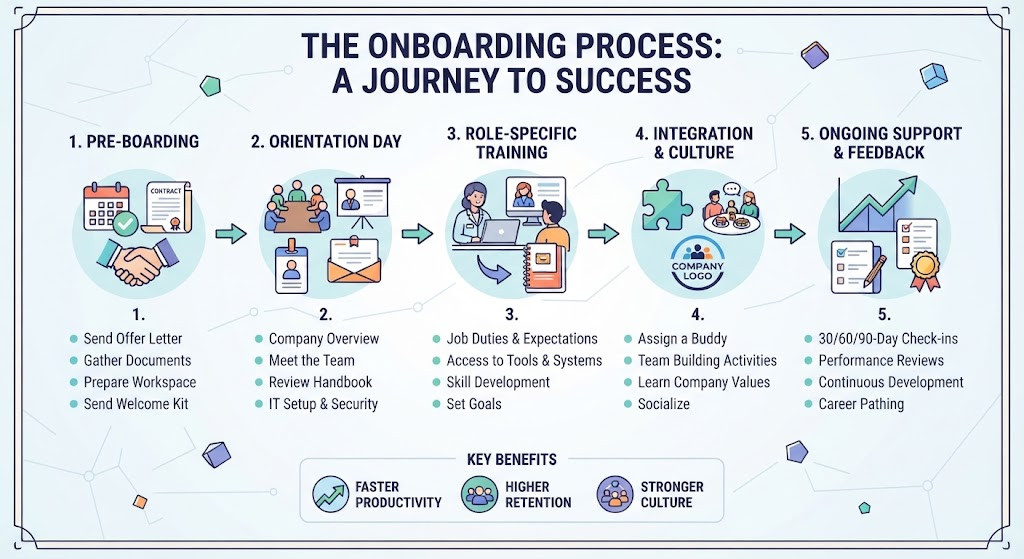
With an organized 5-stage process, you will be able to:
Remove Compliance Risk: Automated W-9/W-8BEN submission, tax validations, and NDA management.
Enable Zero Trust Security: Role-based provisioning of access means that freelancers have access to only what is needed for their particular work.
Improve Time to Productivity: Project briefs and low-risk "Quick Wins" mean that contractors start adding value in less than 48-72 hours.
Automate Your Freelancer Operations Now
Stop IT backlogs and reduce administration costs while preparing your remote talent for success.
[Streamline Your Contractor Onboarding with Gigmint.AI →] (Insert CTA Link/Button)