Freelancer Onboarding: A Complete Guide for Modern Teams
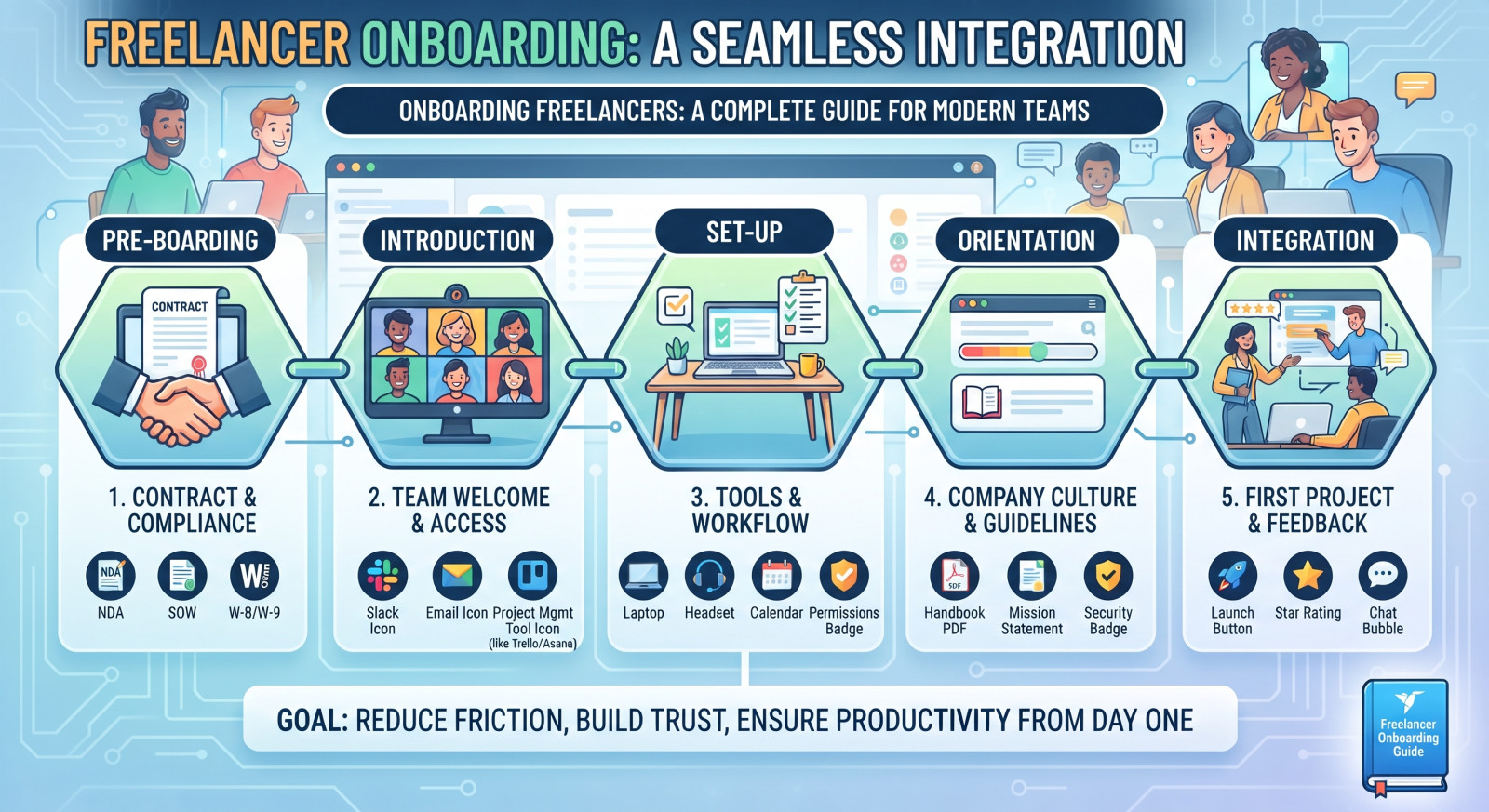
Freelancer Onboarding: A Complete Guide for Modern Teams
I.Turn Freelance Complexity into a Competitive Advantage
The world of work is changing rapidly. As companies depend on flexible and diverse teams to grow fast, execution becomes difficult without an organized onboarding process.
Recruiters have no difficulty in finding the best people through today’s job markets. Nonetheless, integrating a newly hired contractor into existing processes without established access mechanisms or context is bound to cause immediate complications.
The main reason for such conflicts usually does not lie in the quality of the talent itself but in the lack of a systematic approach. Freelancer onboarding is an important mechanism for moving from a recruited contractor to a well-performing and independent outside contributor. It helps turn a simple transaction into an extension of your core team.
In this detailed guide, you will learn about the principles of efficient remote contractor management by analyzing frameworks used by successful companies for proper talent integration.
You will also learn how to handle compliance, technical and cultural challenges while retaining speed and security of the process. You will be introduced to how modern tools like Gigmint.AI can improve freelance onboarding to make it not just another routine task but a true competitive advantage.
II. The Strategic Importance of Freelancer Onboarding
The moment an organization decides to leverage external talent, the immediate thought revolves around the process of sourcing them - hiring the best developers, copywriters, or designers. But finding the right person isn't enough.
Everything that follows determines whether you will receive the benefit of having transformed the found talent into an asset or just incurred the cost of a distracting investment. Here we see why the process of freelancer onboarding is strategically important.
Freelancer Onboarding: The Definition Beyond HR Form-Filling
Where corporate onboarding is associated with filling out tax forms and watching compliance videos, freelancer onboarding means much more than just that in the traditional context.
Freelancer onboarding is a multi-faceted and comprehensive process designed for successful operational, technical, and cultural integration of an external expert. Onboarding an independent contractor is a strategic effort to ensure that the freelancer has everything required to act autonomously as a part of your team.
Why Traditional Employee Onboarding Fails for Freelancers
Many organizations seek to integrate external contractors within their existing internal HR processes of onboarding. This is an essential blunder on the part of many organizations. The employee onboarding process is designed for extended institutional immersion. Applying employee onboarding model to freelancers involves three unique forms of friction:
Legal Boundaries and Regulatory Implications: Employees are bound by the stringent governance, behavioral controls, and HR policies of the organization. Freelancers, being freelance business owners, are not.
The process of onboarding them like regular employees could unknowingly put the organizations at significant risk of serious legal implications and costs due to freelancer classification and co-employment risks.
Time-to-Execution Requirements: Whereas full-time recruits might be offered time to acclimatize to the organization, freelancers are hired for immediate execution. The requirement is that they start producing results in a short span of time against the project timeline with absolutely no scope of extended orientation process.
Different Needs for Immersion: Employees need to immerse themselves in organizational culture and politics over their careers. Freelancers require immersion in specific project requirements rather than organizational context.
The ROI of Exceptional Onboarding
Such firms can create a unique competitive advantage by understanding these facts and developing an optimized onboarding process. In terms of ROI, there are three key areas where such advantages will be revealed:
Time-to-First-Deliverable: If contractors have all the needed information from day one – a detailed description of the project, credentials and communication policy, then they will not spend any additional time to adapt to the company’s environment.
Improved Deliverables and Less Revisions: Lack of clarity always leads to poor-quality work. With an organized onboarding process, all the requirements and guidelines will be understood, which means that the contractor will produce better outputs and will need less revisions.
Talent Retention: The best contractors are usually busy and have many offers, but they prefer those who make the working process more comfortable. Such an onboarding process will show contractors that their time is valuable and appreciated, which means that contractors will continue to work on the same projects again and again.
III. Phase 1: Pre-Boarding & Administrative Foundation
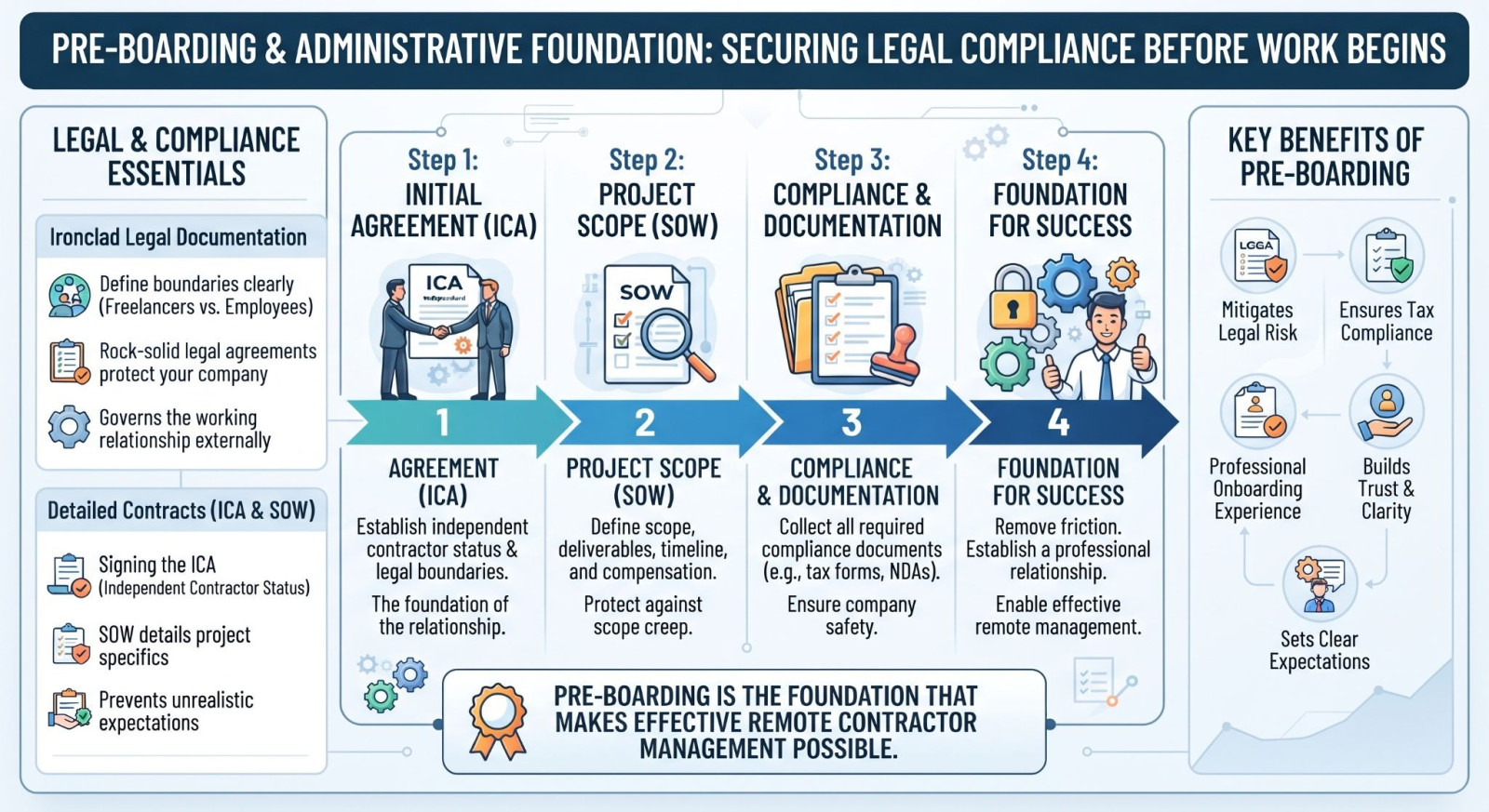
Secure all legal agreements and compliance documentation before project work begins. Pre-boarding is the foundation that makes effective remote contractor management possible. By taking care of everything from the terms and conditions to the finances, you remove all potential friction ahead of time, keeping your company safe while establishing a relationship with your new people.
Legal and Compliance Essentials
Ironclad Legal Documentation: The basis of a strong freelancer contract is rock-solid legal agreements. As opposed to regular employees who have an internal corporate handbook to govern them, freelancers stand alone and independent outside. It serves to clearly define the boundaries between you.
Detailed Contracts, Statement of Work (SOW) and Independent Contractor Agreement (ICA): Every freelance agreement starts from signing of ICA that clearly establishes the independent contractor status.
It is crucial to have a statement of work which details the scope of works, deliverables, timeline and compensation for the project in order to protect yourself from scope creep and unrealistic expectations.
Intellectual Property (IP) Assignment Clause and Non-Disclosure Agreement (NDA): Your enterprise data and creations are essential to you. Your onboarding must consist of a clause that legally assigns all the IP created for hire to your company once you pay the bill. You should also make sure that the freelancer signs a standard NDA for the sake of protecting your proprietary information.
How to Avoid Co-Employment: The most prominent legal risk in managing remote contractors lies in worker misclassification. In order to avoid co-employment issues, you need to be very careful while onboarding your contractors. You cannot control how and when your work is being completed but only when it will be completed.
Financial Setup and Invoicing Alignment
Payment friction is the fastest way to ruin a new business partnership. Pre-boarding can solve the problem and allow administrative harmony and timely deliverables.
Payments Based on Milestones vs. Payments by Hour: Determine the way to pay based on the scope of the project. When there is a specific deliverable, milestone payments are the best way to motivate the person. In other cases, when there is advice or consultation involved, it is better to agree on hourly payments.
Taxes and Payment Channels: Provide your client with necessary tax documentation. It might be Form W-9 for US-based contractors or Form W-8BEN for international contractors. At the same time, agree on how you will be paid.
Automating Administrative Workflows
Manual management of contracts, taxes, and local agreements results in delays in the administration. Automation allows for compliance without stopping the project.
Incorporating features such as automated contracting, digital signature processes, and compliance management right into their ecosystem, Gigmint.AI takes away all the potential hassle you might face from the very start. In this way, managers get a chance to concentrate on implementation and not get lost in paperwork.
IV. Phase 2: Technical Integration & Access Control
After the signing of the Independent Contractor Agreement and the financial parameters have been established, the focus turns from the paperwork to the platforms. The technical integration is where most remote onboarding projects fall flat. The companies either open the floodgates of the digital world wide open and become extremely vulnerable to cybersecurity threats or impose such strict limitations that the contractor cannot do anything.
The Principle of Least Privilege: Security Without Friction
In onboarding third party professionals, the key cyber security guideline becomes the Principle of Least Privilege (PoLP). The contractors should be provided with access to those particular systems, databases, and files that will be needed for completing the particular assignment — no less and no more.
Giving a copywriter full root access to your whole GitHub repository and a UI/UX freelance designer access to your finance spreadsheets creates unnecessary openings. Through splitting up the digital space, one ensures the protection of enterprise confidential information as well as the fast movement of the contractor through his own sphere.
Creating the Digital Workspace Kit
As a physical office equips the individual with desk, chair, and computer, so should a remote onboarding process provide the contractor with the proper Digital Workspace Kit. Tool access prepackaged minimizes back-and-forth communication through emails which take up valuable time on day one. The typical workspace kit includes three tiers:
Communication Channels: Set the communication channels for daily interactions. This could be a Slack channel, a Microsoft Teams page, or even a Discord server, to which they are immediately invited, as well as rules regarding channels versus direct messaging.
Project Management Board: Instant access to the project management board of your team members - whether it’s Jira, Asana, Trello or Notion, to name a few. Link them to their respective project management boards, sprint backlogs, or task pipelines so that they get an idea of the deliverables at once.
Cloud Storage & Assets: Access to the cloud storage (GitHub, Figma, Google Drive) which has everything necessary in terms of assets - be it branding or technical docs.
Identity and Credential Management
There must be no sharing of logins and passwords through email while allowing access to external contractors. Identity management is very important in order to establish audit logs and safeguard intellectual property.
External Account Security: Provide legitimate external contractor accounts (such as name@contractor.yourcompany.com or guest accounts) instead of unknown personal email accounts if the need for enterprise security exists.
Multi-Factor Authentication (MFA): Strict policies must be established regarding the use of multi-factor authentication in all collaborative platforms. Contractors must utilize enterprise-approved password managers to manage credentials so that their access may be quickly denied once the job is done.
Hardware and Software Provisions
Equipment ambiguity is another potential hidden issue that may cause conflict. Get your requirements clear right at the start of the process:
The Equipment They Bring: The independent contractor typically brings their own equipment (their laptops and specialized design equipment) and licenses for professional software required for their work.
The Equipment You Provide: If your project needs proprietary internal software or other tools which the contractor cannot reasonably own, your IT department should prepare the relevant licenses in advance.
In doing so, you will create a workable environment right from the start.
V. Phase 3: Cultural Alignment & Context Setting
When administrative barriers are overcome and secure technical access has been achieved, you reach the most often forgotten part of managing contractors from a distance, that of cultural alignment and situational awareness.
Freelancers, because of the fact that they work beyond your physical and organizational fence, are easy targets of being seen only as faceless code creators or task performers. But elite external partners deliver at their peak level of performance when they know not only what they are building but also why and for whom.
Integrating the "Outsider" into the Team Dynamic
This psychological divide will rapidly lead to feelings of isolation, miscommunication, and conflict. Freelancer Onboarding is intended to tear down this barrier without crossing any legal lines.
Introduction of Stakeholders & Collaborators: Begin the collaboration on the right foot with an introduction video call. Introduce the contractor to collaborators in other departments, product managers, or designers within the organization. Make it clear what the contractor's position and influence entails so that everyone works together effectively.
Mission and Brand Voice: An outsourcing service that understands your company’s mission and brand voice will produce a lot better output for you. Send your style guide and brand manifesto along with your latest accomplishments as a company. Once your freelancing writer/developer understands your brand voice, it will not appear as outsourced work anymore.
Project Briefing and Expectation Setting
The more you have ambiguity in your agreement, the slower your momentum will be. The most experienced freelancers must know everything about expectations with crystal-clear clarity to start working.
Statement of Work (SOW), Deliverables & KPIs: Go into details for all points mentioned in SOW. Set KPIs, qualitative milestones & definition of done criteria.Describe what success means for the first milestone and the whole project cycle.
Establishing Communication Guidelines: In order to prevent any possible burnout as well as lack of alignment in advance, establish communication guidelines for yourself. Determine what your expectations are for synchronous communications versus asynchronous communications as well as window periods for responses during the working hours.
The Welcome Kit / Contractor Portal
Rather than having the onboarding assets scattered in disorganized emails and messages, have all of them centralized in one asset.
Centralized Wiki or Notion Page: Create a customized "Welcome to the Team" portal which is specifically designed for the external parties. This portal should include your company’s assets, guidelines on how you communicate, project management links, key people to contact, and FAQ section.
The fact is that not only can you save lots of time by using the portal because of not having to repeat yourself when answering the same questions, but you will also show the world your professionalism.
VI. Phase 4: Ongoing Management, Feedback, and Offboarding
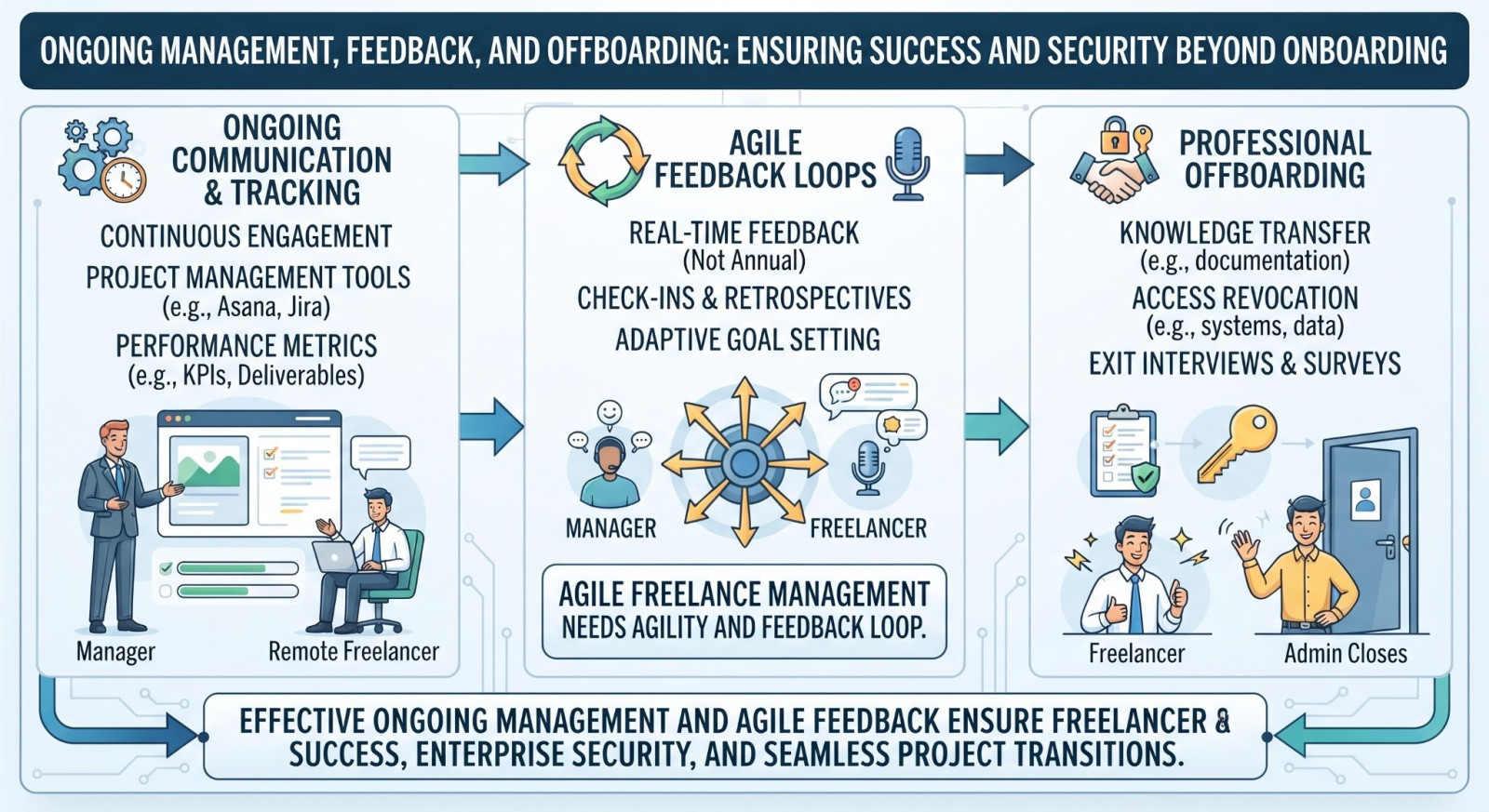
The freelancer onboarding process will not cease when the freelancer makes his or her first commit or draft. This stage will be effortlessly moved to the management. In order to make sure that the freelancers will be successful and enterprise security is ensured, there must be further communication, performance tracking, and offboarding.
Feedback Loops
Since the partners work from outside the regular osmosis of an office environment, feedback must not be left until annual performance reviews. Agile Freelance Management Needs Agility and Feedback Loop.
Mini-Retrospectives of Milestone: After completion of the milestone of the project by the contractor, arrange a mini session of about 15 minutes. This should include appreciating the positives, finding out the problems, and identifying the things that were done right along with things to be improved for future.
Transparency and Constructive Feedback: Make sure that you give constructive feedback. In case of any changes that need to be made, use brand guidelines or SOW deliverables instead of making vague comments. Treat your contractors the same way as your own employees.
Measuring Freelancer Success
TObjective evaluation of the performance of the contractors is necessary to make sure that you get maximum returns from your investments and also discover top performers who can be hired in the future for other assignments. Some of the KPIs are:
On-time completion rate: Is there consistency in completing each milestone on time without having to stretch out your schedule indefinitely?
Revision numbers: Is there high correlation between expectation and deliverables in the first attempt, or are projects often stuck in revision cycles?
Communication: Is there transparency in the communication process within stipulated time frames?
Graceful Offboarding and Knowledge Transfer
All engagements of a freelancer will come to an end – whether after sprint completion, the end of a quarter-long campaign, or even years down the road. Offboarding can be just as important as onboarding itself.
Account Archival and Access Deletion: Safeguard company cyber security by immediately deleting access to the digital workspace, deactivating any external guest account access, and deleting the contractor’s credential from project management and code management boards. Ensure that all deliverables, documents, and code are uploaded to the internal cloud storage service of your organization.
Exit Interviews and Process Improvements: It will be worthwhile conducting an exit interview/review with your contractor. Ask for feedback about their freelancer onboarding process, operational issues, and technology issues. Leverage their fresh external insight to continue refining your onboarding process to be used on your next wave of candidates.
Constructing a "Preferred Freelancer List": Quality freelancers are rare and precious. Rather than each engagement being a one-time affair, gather all your best freelancers on a list to be reused again and again. Gigmint.ai makes it easy to reuse, roster, and scale your agile team through trusted freelance partners.
VII. Next Steps with Gigmint.AI
In a world where expertise moves all the time, depending on fixed and full-time employee hiring will not work anymore. Successful companies and agile teams need to capitalize on the flexibility of freelance talent. As we discussed throughout this guide, finding the best independent talent is just the first step.
Without the necessary operational structure, even the best freelancers will get bogged down by various logistical issues.
Summary of Core Takeaways
Taking freelancer management from an ongoing logistics pain point and making it a competitive advantage means taking a broad, phase-by-phase approach:
Pre-Boarding & Administrative Framework: Secure your organization against co-employment threats and costly fines through bulletproof ICAs, Statements of Work (SOWs), and financial railroads.
Technical Connection & Access Control: Strike a balance between security and speed with a robust principle of least privilege, standardized Digital Workspace Kits, and identity management via authenticated channels.
Cultural Alignment & Contextualization: Knock down the wall of the "outsider" through introduction to key internal people, branding your company culture, setting expectations for communication, and providing access to all resources in an freelancer onboarding portal.
Management & Offboarding: Ensure high performance by maintaining ongoing feedback, objective KPI measurement, and safe, smooth offboarding of your top-performing freelancers who can then be put on your "preferred talent" list.
Onboarding gives you more than just skilled labor but trusted strategic partners in your freelancers.
Scale Your Workforce with Gigmint.AI
Dealing with compliance in multiple jurisdictions, manually drafting contracts, and utilizing diverse contractor management solutions may consume a great deal of organizational resources. You do not have to figure out all the intricacies associated with freelance employment on your own.
Gigmint.AI is the one-stop solution powered by artificial intelligence that will help your company hire top freelance professionals without wasting any time. No matter if you are growing an agile startup or running enterprise-level freelancer pools, Gigmint.AI takes away all the hassle and allows your team to focus on building amazing products and developing them further.
Ready to change the way your company works with freelance professionals? Try out Gigmint.AI today or schedule a demo with us!
VIII. Frequently Asked Questions
1. How do the onboarding processes of a freelancer vary from that of an employee?
While the onboarding of employees involves a focus on institutional immersion, payroll, and the company’s own policies, freelancer onboarding is more task-based and flexible. The aim is to connect the contract between the outside individual and collaboration, emphasizing technical onboarding, compliance, and milestone attainment without entering into territory of worker misclassification.
2. How can companies secure proprietary data during onboarding of contractors?
Proprietary data of companies can be protected through strict enforcement of the Principle of Least Privilege (PoLP) – allowing the contractor to access only the tools and repositories needed to do the job.
Other measures could include creating secure external access, implementing Multi-factor authentication (MFA), using enterprise password managers, and revocation of digital access immediately after the end of the project.
3. How does Gigmint.AI streamline the contractor onboarding workflow?
The Gigmint.AI platform serves as an ecosystem for the management of the entire freelance life cycle. The discovery and vetting process, automatic contracting, and onboarding workflows are all integrated in one place to remove any administrative hurdles. This ensures that hiring managers have an effortless experience while managing talent rosters.