The Complete Guide to Onboarding Process of Freelancers Successfully
The Complete Guide to Onboarding Process of Freelancers Successfully
1. Overview
Organizations across industries are capitalizing on their ability to leverage agile talent pools and reach out to the best independent contractors, remote experts, and subject matter specialists. There remains one key operational hurdle: why do the existing onboarding process for employees not work at all with independent contractors?
For many years, human resources departments have used strict, linear onboarding programs designed for permanent workers—with obligatory HR orientation sessions, company culture briefings, and even equipment allocation.
Such a process may be too bureaucratic and cumbersome for the experienced freelance developer or specialized fractional marketer. What is worse, the use of such an employee-oriented onboarding may create serious legal classification problems, which can result in statutory liabilities, taxation, and compliance audits for the organization.
The true cost of onboarding failure goes far deeper than mere administrative difficulties. Companies suffer from increased time to productivity, greater security risks, large fines associated with worker misclassification, and an immediate culture clash that repels high-quality talent.
Freelancers who go through a poorly organized onboarding process become much less engaged in their tasks and are much more likely to leave even before finishing their deliverables.
In turn, top-tier freelancers choose potential clients depending on how operationally mature they are; a smooth onboarding experience is a strong indication of respect for their skills and time.
At the end of this guide, you will be able to implement all necessary steps in order to optimize your contractors’ onboarding process.
From understanding complicated legal processes to providing bulletproof technical infrastructure for them, from choosing how to onboard remote employees most efficiently to using cutting-edge GigMint AI for automation of workflows — you will know everything there is about turning a burden into your competitive advantage.
2. What is Freelancer Onboarding & Why It Matters
In order to create a top-notch external workforce, you need to first recognize the basic differences between regular employee onboarding and independent contractor onboarding.
Employee onboarding is meant for introducing an individual into an established organizational hierarchy of the firm, wherein there will be supervision, benefits administration, and continuous employment.
Independent contractor onboarding, is all about independence, project-based delivery, and business relationship. Independent contractors can be defined as either business organizations or people working individually, who do not necessarily need any training regarding health care insurance and corporate hierarchy but need clear understanding of project requirements.
The ROI of smooth and systematic onboarding process is huge and has direct impact on your bottom line:
Time-to-Productivity Improvement: Onboarded contractors can be productive right away in just a couple of days, instead of spending days or even weeks on dealing with access requests and finding missing documentation.
Retaining Freelancers and Building Trust: The best freelancers have many offers from different clients, and they love working with well-organized and professional clients. The smooth experience in the beginning creates trust and loyalty, which means that they will come back to you in other phases.
Operational Efficiency: Your organization saves many hours by standardizing the process because there is no need for unnecessary communication with project managers, lawyers, and operators.
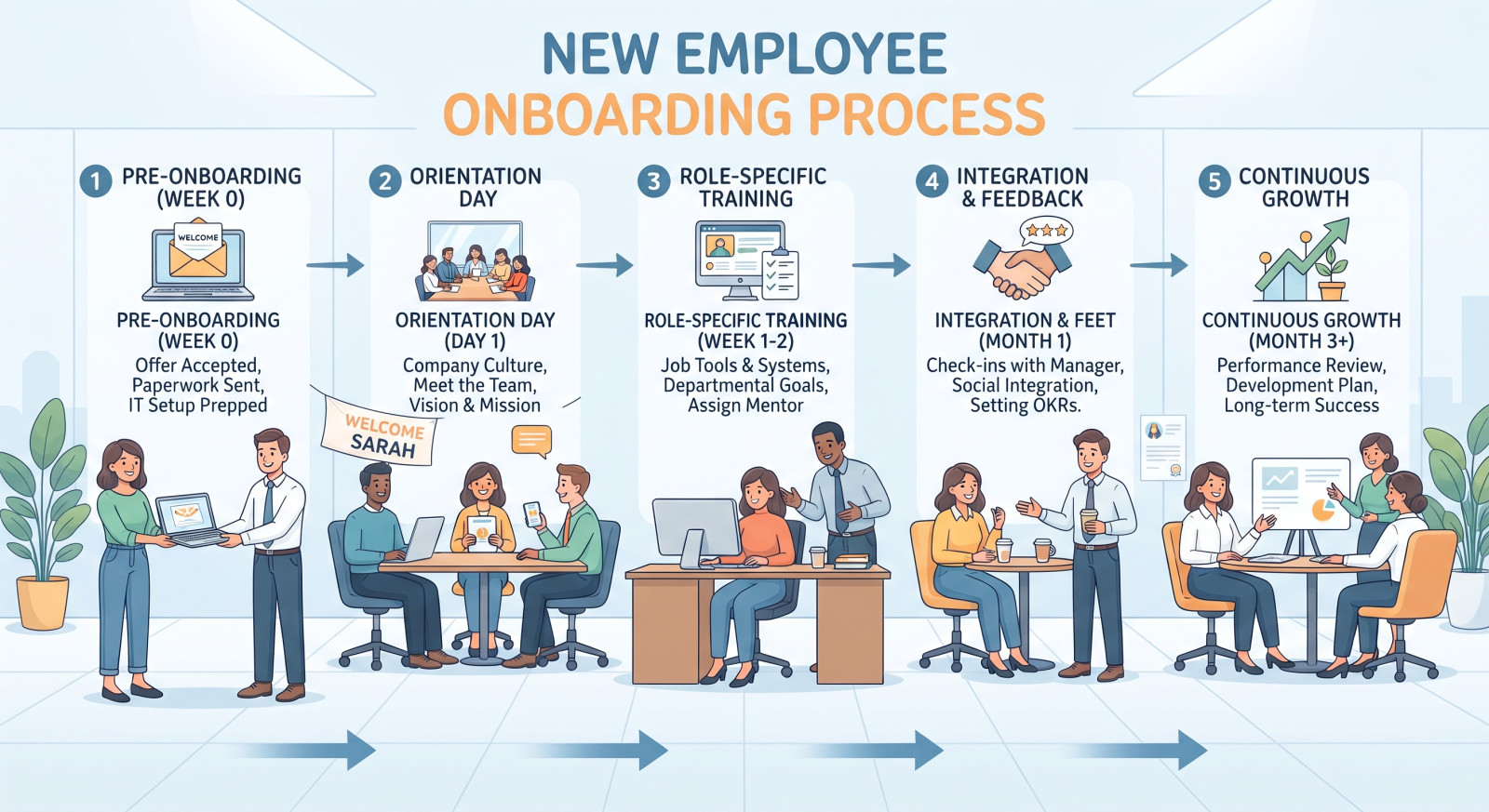
It is vital to understand how to master the process by seeing it as the Anatomy of the Modern Freelance Lifecycle:
Each step is contingent upon the success of the previous step. The important point is that an effective onboarding process leads to the link between evaluating the candidate and working together in a profitable manner.
3. Pre-Onboarding & Legal Compliance (The Foundation)
Navigating Worker Classification
Before you write a line of code or sign a single document, you have to know how to thread the needle through the laws of worker classification.
There are many different laws like IR35 in the UK, AB5 in California, as well as others around the world, that have stringent guidelines regarding the testing that must take place to classify whether the workers are employees or independent contractors. Misclassification of the workers can end up costing you a lot of money because of penalties and payroll taxes.
In order to avoid certain mistakes, here are some major elements to be considered while classifying the workers as independent contractors:
Control over behavior – Does the employer determine the method, schedule, and even the location where the work is done?
Financial control – Does the contractor provide for themselves in terms of business expenses, financial risks, and deal with many clients at once?
Relationship – Do you have any employee-like benefits or do you expect permanent working arrangement?
Essential Paperwork and Documentation
In order to safeguard your enterprise, all contractor onboarding process will need the following legal documents:
Independent Contractor Agreement (ICA): Making the difference between the engagement and a normal employment agreement, defining the project scope and payments, along with termination details.
Intellectual Property (IP) Assignment and Work for Hire Provisions: Confirming that any code developed, any creativity created, documentation written, and any inventions created as part of the project belong to the enterprise without question.
Non-disclosure Agreement (NDA) and Data Processing Addendum (DPA): Keeping confidential all the enterprise’s data and safeguarding the privacy of the customers while remaining compliant with GDPR and CCPA.
Tax Forms: Collecting W-9 or W-8BEN in the US and equivalent tax forms around the world.
Compliance Automation
Errors from manually keeping track of tax forms, expiration dates, and global compliance issues are highly prevalent. Intelligent solutions allow modern companies to collect documents, authenticate identities, deal with global tax compliance issues, and create digital signatures, all without any difficulty.
4. Phase 2: Technical Provisioning & System Access
The Principle of Least Privilege
Giving access to contractors to your digital environment is a challenge of maintaining productivity without compromising cybersecurity standards. Contractors usually work in completely different external network environments, which makes the security of the system a top priority for the information security team at enterprise level.
The best practice in this area is Principle of Least Privilege (PoLP), meaning that contractors should be given access only to those tools, repos, documents, and code bases necessary to accomplish their task, protecting the core enterprise networks, customer data and other intellectual property from any unnecessary exposure.
In order to apply for PoLP, you have to do a proper provisioning audit before starting the process of onboarding. Instead of giving the contractor a broad set of credentials in your organization, engineers and IT specialists have to create user roles, temporary access tokens, and scoped directories. If contractors switch to another phase of the project or end their cooperation, their permissions can be changed or revoked immediately.
Communication & Collaboration Stack Setup
Create a standardized toolkit for each incoming contractor to ensure they fit well within their respective teams without compromising any security concerns:
Messaging Channels with Scope: Create messaging channels through Slack or Microsoft Teams that give guest access and not access to the entire organization's messaging platform, which can lead to leaks of sensitive company data and HR conversations.
Project Management Boards: Create project management boards on platforms such as Jira, Asana, or Notion where projects have limited permissions that allow contractors to view and modify their tasks and epics only.
Collaboration Handles: Create handles for contractors that indicate their presence and status as external contractors who are collaborating on a project for a company.
Security Protocols for Remote Contractors
The independent contractor is one who works within varied networks around the globe, thus requiring secure endpoints. It is crucial for your onboarding process to have security standards enforced prior to accessing any enterprise system as follows:
Multi-Factor Authentication (MFA): MFA will be required on all the tools and version control repositories and cloud, where hardware keys and authenticator apps should be used as opposed to the insecure SMS.
Secure Password Manager: Ensuring that secure enterprise credentials management is required and discouraging the use of personal passwords.
Expectations on Endpoint Security: Information on secure devices, OS updates requirement, secure hard drives, safe WiFi use, both at work from home and from co-working spaces.
Hardware and Software Procurement
Define explicitly who will supply the tools at the beginning of the onboarding process. Although most independent freelancers use their own custom hardware such as high-end developer computers, designer computers, or custom audio-video editing tools, the organization needs to make clear about the software license arrangements and any proprietary software license keys that are needed.
5. Phase 3: Cultural Integration & Alignment
Bridging the Gap
The respect of the freelancers, their recognition as useful external partners rather than mere temporary employees, makes an immense difference to their performance. Valued and appreciated freelancers are motivated to put extra effort to do a great job, which is not possible with temporary generic employees.
Highly skilled external talents may have profound corporate knowledge due to their experience with top industry players; by respecting such talent, you will benefit from their innovative approach to your operations.
The Welcome Packet & Blueprint
Every hired contractor has to be provided with a professionally compiled Welcome Packet once he or she signs an Independent Contractor Agreement. The Welcome Packet will work as an onboarding blueprint and it must contain:
An engaging overview of the company's background, its values and strategic initiatives currently implemented.
Clear communication guidelines regarding the time frame, platforms used, and procedures in case of any blockages.
Internal point of contact for the contractor (contractor’s manager or technical mentor).
Important links to the company glossary/acronym dictionary and other sources containing important information.
Setting Clear Expectations
The single biggest impediment to freelance productivity is ambiguity. As independent professionals are judged on their results and not time spent at the desk, the need for having clear expectations at the outset becomes paramount.
Make sure there is a clear set of Key Performance Indicators (KPIs), deadlines and quality criteria agreed upon before even a single deliverable is delivered. Make sure you have established communication protocols early – whether you are working in an asynchronous fashion with daily written standups or if some synchronicity is required.
6. Phase 4: Workflow Integration and Knowledge Transfer
Context Over Control
Independent contractors do not require micro-management; they require depth of understanding. The micromanagement of independent contractors will stifle their creativity, slow them down, and cause conflict.
What independent contractors require is a thorough background on your branding, buyer personas, business objectives, technological architecture, and past limitations associated with projects.
Once a contractor knows what a project entails and whom it will serve, they are able to make decisions which are completely aligned with your vision of the company without the constant input of management.
Access to Resources & Brand Assets
Make the information and material assets readily available in central hubs, where contractors will not face any hurdles when trying to access vital resources. The resources include complete style guides, design asset repositories, UI component libraries, technical documentation wikis, brand voice guidelines, and approved template repositories.
By centralizing such assets, you prevent repetitive questions from being asked, while maintaining brand consistency in all deliverables – whether done by your core team members or any external professional.
The First Milestone / "Quick Win"
Create a milestone that is designed and developed as a "quick win" milestone. Do not start with assigning a huge, risky, and complicated project to the freshly hired contractor right at the very beginning of their employment; instead, set up a simple project that will give you a quick win.
With the help of this approach, you and your core team, as well as the new contractor, can assess the workflow and communication aspects and get momentum right away.
7. Leveraging AI & Automation in Modern Freelancer Onboarding
The Role of AI in Scaling Operations
The sheer scale of managing an international freelancer network makes spreadsheets, email chaos, and fragmented HR systems absolutely obsolete. Today's businesses that are scaling their agile talent pool resort to the use of cutting-edge infrastructure powered by AI to automate, secure, and streamline their contractor management processes.
By incorporating intelligent automation in the onboarding process, businesses are able to eliminate any potential administrative hitches while at the same time ensuring absolute compliance in different legal jurisdictions.
Automated Document Chasing
Spending countless man-hours trying to get your contractors to sign documents such as the contract, tax forms, non-disclosure agreements, and banking details is a thing of the past now.
Through the use of intelligent automation, companies are now able to keep track of the lifecycle of each document being shared, automatically send smart reminders for document chasing, check whether the document is complete, and notify businesses about any expiring compliance certifications automatically.
Smart Matching & Skill Verification
Thanks to AI algorithms, vetting and onboarding of external talent has been revolutionized. The use of historical data such as the projects worked on, output from the portfolio, skills verification, and even past metrics is what powers the verification of talent capabilities.
8. Actionable Next Steps
The move from an unorganized and disorganized management of contractors to an organized process is necessary for scaling the modern enterprise in the gig economy. The adoption of legal, technical security, culture, and automation by AI will ensure that your organization is not exposed to legal challenges and helps independent contractors operate in the best way possible.
Want to minimize administration headaches, secure your technical platform, and scale your contingent workforce without a hitch? Learn more about GigMint AI's automation of compliance, payment processing, and contractor onboarding process. Find out more about GigMint AI now.
FAQ
1. What is the difference between employee onboarding and freelancer onboarding?
Whereas employee onboarding encompasses the entire procedure of cultural assimilation, the distribution of benefits, continuous supervision internally, and the presence of a career in perpetuity within the organization, freelancer onboarding consists of fast availability of resources, legal issues (correctly classifying employees and completing documentation) and deliverables per project.
2. How do I avoid worker misclassification during onboarding?
To be safe from misclassification issues, make sure that your contracts with independent contractors stress autonomy of behavior and finances. Do not set up any working schedules or provide benefits. Use compliance software such as GigMint AI to ensure correct paperwork internationally.
3. What documents should I have from my freelancer prior to their commencement?
The basic documents that need to be in place include an executed Independent Contractor Agreement (ICA), an Intellectual Property (IP) assignment and work for hire agreement, a Non-disclosure Agreement (NDA), a Data Processing Addendum (DPA), and proper tax documents like the W-9 (US) or its equivalent across different regions.
4. How can I give the necessary system access to my remote contractors?
Stick to the Principle of Least Privilege (PoLP) and limit the system access to the particular software/tools/repos/documents that the contractor needs for the project, enforce multi-factor authentication, use secure password management systems and guest channels on communication apps such as Slack and Microsoft Teams.
5. Why do you need a Welcome Packet for freelance workers?
The Welcome Packet builds professional relationships, defines communication parameters, highlights key contacts, and ensures that the freelancer is aligned with your company culture and objectives, thus saving time significantly.
6. How can AI help you onboard freelancers more efficiently?
AI takes away the manual burden of sending out documents and forms, doing compliance checks, collecting tax forms, and signing contracts. It helps in intelligent matching of talents and skill verification of the freelancers.