How to Create an Effective Freelancer Onboarding Process
How to Create an Effective Freelancer Onboarding Process
More companies today depend on freelancers and independent contractors in order to fill skill gaps and complete specific projects without increasing headcount.
Inviting freelancers to join one's business is not limited to signing contracts and sending emails. In order for freelancers to be effective, they should be informed about project requirements, have all the necessary documentation, receive access to necessary software and have a process in place of how to communicate.
Failure to have a well-defined onboarding process for freelance workers can cause project delays, lack of proper documentation, security threats, ambiguity and other problems.
Proper freelancer onboarding process will help a company onboard its contractors quickly and effectively while keeping everything appropriate and compliant.
In this article, you will discover a simple step freelancer onboarding process.
What Is a Freelancer Onboarding Process & Why It Matters
An effective workflow of bringing in external talents requires the understanding of the basic mechanics of the difference between independent contractors and permanent employees.
A contractor onboarding process is the onboarding workflow where an organization onboards external talent, ensures compliance from a legal and taxation perspective, gives technical access and sets project expectations, without turning this into a regular employment.
Contractor Onboarding versus Employee Onboarding – The Key Difference
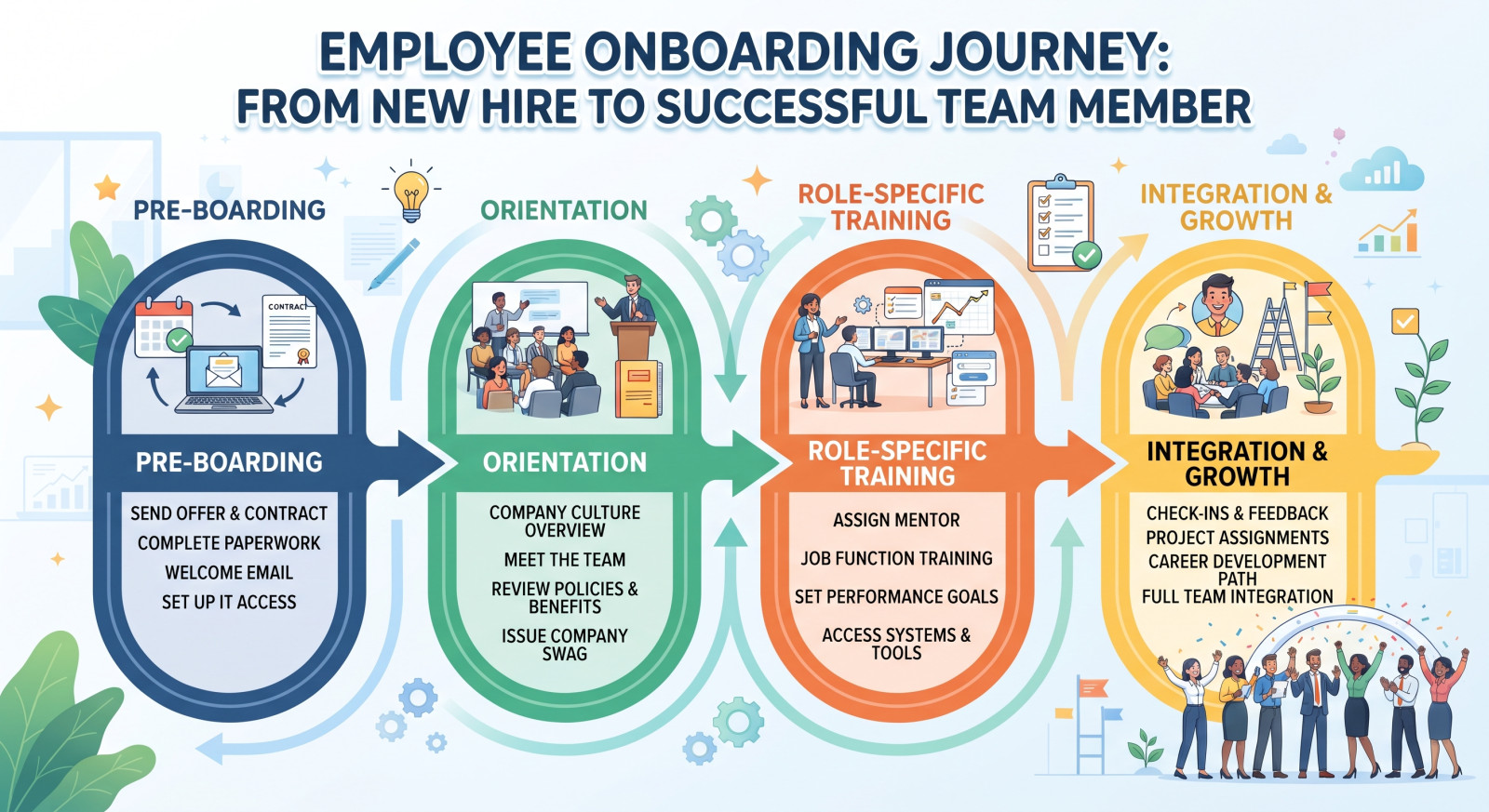
Unlike employee onboarding which revolves around cultural integration, benefits enrollment and permanent career development, contractor onboarding is centered around autonomy, project specifics and non-employment.
Whereas an employee onboarding process involves becoming an integral part of the organizational hierarchy, being under direct supervision with respect to the way tasks should be performed and having indefinite employment, contractor onboarding means that a person or a company will deliver particular results.
Any attempt to on-board a contractor like a regular employee by making decisions about the working hours, or forcing a contractor to attend organizational culture meetings poses compliance risks.
The Business Impact of Structured Onboarding
By building out an onboarding system that can be repeated consistently, the ROI will become apparent through the following three key pillars:
Decreasing Time-to-Productivity: In the fast-moving market today, having a two-week delay to get a contract signed or get software access creates a major issue. With an efficient onboarding engine, the lag associated with administration is minimized, enabling the very best talent to focus on valuable work immediately.
Compliance Risks Management: Regulators throughout the globe are watching worker classifications very closely. By documenting the onboarding process, the Independent Contractor Agreement (ICA), Statement of Work (SOW), and tax documents are all captured, keeping the business protected against any misclassification lawsuits and audits.
Improving the Freelancer Experience: The best talent in the world is highly sought after. They talk and know when the organization is well-run versus the ones with chaotic emails flying around. When the onboarding is smooth, the freelancer knows their time is being valued, creating loyalty.
The Price of Poor Onboarding
Poor onboarding may cause mismatches in expectations, delays in projects, and considerable contractor turnover. Security blind spots such as orphaned credentials and file access create vulnerabilities within the corporation’s infrastructure. Moving from improvisation to a systematic process solves the problem.
Pre-Boarding & Administrative Foundation
In the absence of any coding done or sketches made, your administrative base has to be airtight. Pre-boarding is the shield against litigation for your external labor force model. The lack of an airtight administrative base exposes organizations to serious legal and financial risks.
The First Step
It all needs to start with a clearly written Statement of Work (SOW), embedded in a master Independent Contractor Agreement (ICA). SOWs have to include deliverables, milestones, payment terms, and schedules.
Inadequately defined scopes are the basis of scope creep, delays, and problems between the company and contractors. Make sure that your ICA includes governing law and dispute resolution processes.
Mitigating Misclassification Risk
Taxing authorities throughout the world (e.g., IRS or international labor unions) examine worker classifications. To avoid costly worker classification litigation, the paperwork you prepare during onboarding needs to stress behavioral and economic independence.
The contractor needs the freedom to control time and means to get the job done, while also retaining the ability to work for another client. Constraining the contractor in terms of hours worked or having him participate in culture events within your company results in heavy fines.
Tax Form Documentation & Identification
A compliance management system implies obtaining proper tax forms prior to making any payments. If you have an American-based contractor, get his signed W-9 form. In the case of foreign-based contractor, make sure to obtain appropriate W-8BEN (or its international equivalent).
Getting those forms verified beforehand will prevent any problems related to tax withholding and allow your accounts payable department to make payments hassle-free.
NDA & IP Assignment
Make sure your confidential code, your customers' information and your valuable intellectual property remain protected. Get your ICA to include the IP assignment clause that would clearly state that all the work that will be performed under the contract belongs exclusively to you, once paid. Sign a mutual NDA before diving into project discussion details.
Access, Security, and Provisioning
Enabling easy access to your digital environment for external talent involves striking a balance between efficiency and stringent security protocols. Companies often fail here either by blocking access of the contractor to the necessary tools because of some administrative hurdles or by providing unlimited and unmonitored access to critical infrastructure.
The Principle of Least Privilege
Do not allow full access to your corporate infrastructure ever. Adopt the least privilege principle and give access only to the tools that are necessary to reach the designated milestone.
Tech Stack Integration
Outline your technical stack needs before hiring begins, so that accounts are set up prior to day one. Based on the nature of the position, your provisioning checklist would include:
Tools For Project Management - Use Jira, Asana, Monday.com, or Notion boards to track milestones and sprint velocity.
Communication Channels – Use guest channels on Slack or Microsoft Teams for working together without company directory access.
Code Repositories and Design Applications – GitHub/GitLab or Figma/Adobe Creative Cloud licenses specific to engineering and design talent.
Security Best Practices
It is mandatory that all company accounts used by third parties are MFA compliant. Enforce the use of enterprise password managers and provide non-negotiable guidelines around best file-sharing practices so that no sensitive data is inadvertently leaked.
Any outside contractors should not keep company's source code, financials or PII of customers on unencrypted local hard drives or personal cloud storage services.
Automation of Provisioning
IT tickets are cumbersome to process and add administrative overhead to hiring managers. By using an integrated Freelance Management System (FMS), you can automate provisioning and de-provisioning of software automatically at the end of contract period.
Context Setting & Cultural Integration
After the establishment of the administrative and security frameworks is complete, the next vital step involves alignment. Many organizations fail to realize that it is wrong to view freelancers as vending machines where they are just put into the pipeline without any context and expected to produce results immediately.
A professional freelance onboarding process bridges the gap between administrative approval and operational agility through contextual awareness, clarity of expectations, and cultural integration.
The "Why" and the "Who": Alignment with Mission and Stakeholders
Despite the fact that external contractors retain their operational autonomy, integrating them into your organization necessitates giving them a sense of the overall organizational mission.
Explain your company's mission, your primary users and why their particular engagement matters for your overall business goals. Once the "why" of a project is known to the freelancers, their approach to problem solving evolves from completing tasks to anticipating business needs.
Yet another equally crucial step would be to make them understand the various internal stakeholders. Clarify that they will have to report to such-and-such people, get the nod from them for their work to proceed further and who their cross-functional contacts will be. If there is any ambiguity regarding decision-making stakeholders, conflicting instructions will follow.
The Project Brief Deep Dive
Kick-off Process Begins With Review of Project Brief
Never give any ambiguous instructions or assumptions regarding what the project needs to deliver. Instead, go through a live walkthrough or review of the main objectives of the project, main KPIs, and all details of deliverables along with timelines. It is essential to define the definition of done for each deliverable to avoid scope creep.
Defining Explicit Communication Protocols
Poor communication is one of the main factors behind the contractor turnover. Specify the communication protocols and requirements before work begins. Agree on channels you are going to use (Slack for asynchronous communication, Jira for task management, emails for formal documents), specify the way how people will interact and provide response time SLAs. Having a clear understanding of the required communication cadence, remote work will become seamless.
Creating a Centralized "Freelancer Wiki"
In order to ensure the autonomous work of external talent, create a centralized knowledge base or "Freelancer Wiki". It should include such information as brand guidelines, style sheets, technical documentation, architecture, templates, and FAQs. This will allow you to have this "Freelancer Wiki," which will help your outside contractors not interrupt your internal team for simple assets.
Setting Clear Workflows, Milestones, and Feedback Loops
The first and foremost trigger for the collapse of external projects is uncertainty. After completing all the admin tasks, accessing security and establishing cultural context, the world-class talent acquisition process creates an understanding of how the work will move from conception to execution without any guesswork involved.
Milestone Mapping: Dissecting the Scope
Large, monolithic scopes are demotivating for individual contractors and make the process of checking progress difficult. Rather than giving one big task for several weeks with one deadline at the end of the period, a massive project should be split into smaller reviewable milestones.
This provides you and the contractor with a natural way of evaluating quality, fixing potential issues and celebrating intermediate achievements. If you are developing software, it will be the milestones related to sprints. And in case of marketing or design, it can be the milestones related to wireframes, mockups and production files.
Establishing Robust Feedback Mechanisms
Open-ended feedback leads to continuous rounds of revision, overblown scope, and increased frustration for both sides. The exact process of iteration requests, evaluations, and approvals needs to be outlined in the onboarding stage.
The approval authorities among internal stakeholders need to be defined to avoid conflicting feedback from multiple managers. Besides, the process of determining what falls under normal rounds of revisions versus changes that go beyond the scope of work and require an amended SOW needs to be spelled out.
Transparent Invoicing and Payment Terms
Nothing discourages a contractor more than uncertainty and delay in payments. Trust is one thing that is going to ensure that you retain the services of your external hires in the long term.
On hiring them, educate your employees about your process of payment, submission deadlines for invoices, and modes of payment (Stripe, Wise, or global payroll systems). Provide your best freelance talent with the invoice form to submit their invoices through FMS and get prompt payments without any back-and-forth.
Leveraging AI and Automation to Scale Freelancer Management
As a company grows its external workforce, manual processes can quickly become difficult to manage . A system of spreadsheets, email, and local files that works effectively with five independent contributors becomes a bottleneck when the number of active contractors exceeds ten or twenty. To scale efficiently and reduce administrative work, companies can use automation and AI
The Problem of Manual Freelance Onboarding Process
Manual onboarding can create delays, repetitive work, and compliance risks. The process of keeping track of expiration of contracts, searching for W-9 and W-8BEN tax forms, provisioning of software logins on different platforms, and checking invoices takes hundreds of working hours. It leads to delays in starting projects and to the increased risk of errors in compliance issues. It is also extremely frustrating for hiring managers and top talent.
Enter the Freelance Management System (FMS)
Automated contractor management starts with the development of an integrated Freelance Management System (FMS). FMS functions as a centralised view for your whole ecosystem of external talent.
Centralizing all information on contractors, master services agreements, active statement of works, compliance data, and performance history in one single dashboard makes it easy to get instant visibility and control. You don’t need to switch between different systems to manage the complete life cycle of contractor relationships.
The Role of AI in Onboarding
The introduction of artificial intelligence upgrades the classic FMS platform from a mere data storage system to an operational engine. The contemporary integration of AI adds value to the freelance onboarding process in the following ways:
Automatic Drafting and Compliance Checks of the ICA/SOW: Using AI-based systems, contracts are automatically drafted depending on the regulations of regional labor laws and highlight worker misclassification red flags before contract signing.
Skill Matching and Briefing Automation: Algorithms use historical success stories for matching briefs with suitable independent professionals, populating the onboarding kit automatically.
AI Onboarding Chatbots: These chatbots give immediate answers to any queries that the independent talent may have about invoicing rules, security procedures, and even internal tool usage.
Highlights of Gigmint AI
As firms struggle with the challenges of managing the distributed freelance workforce, platforms such as Gigmint AI take the lead in providing end-to-end automation of discovery, vetting, contracting, and freelance onboarding processes through a single unified workflow. The platform is able to automate compliance verification, provisioning, and milestone tracking processes.
Common Pitfalls to Avoid in Contractor Onboarding
Even the best HR team and hiring manager may fail in their attempt to build an external workforce program. Making a shift from regular employment to a flexible contractor model involves unlearning old ways.
Staying away from these four mistakes guarantees that your onboarding process for freelancers will be both legally sound, financially enticing, safe, and culturally compatible.
1: Thinking of Freelancers as Employees
Worker misclassification is one of the most serious legal and financial risks in freelance management. By imposing rigid time frames, forcing attendances at daily company meetings, providing organizational equipment, or monitoring the way in which the job is done, companies step over the edge of the traditional employment sphere. Your onboarding process should guarantee maximum freedom to contractors. It should involve no other aspects but results and deliverables.
2: Delayed Payment or Unclear Invoicing Rules
The easiest and quickest way to lose great independent professionals is financial friction. When a freelancer has to go through endless back-and-forth for approval or deal with confusing invoicing requirements or has to wait two months to get paid, then chances are their motivation is going to be very low from the very beginning of your collaboration. Be clear about payment cycles and use automatic payment processing to show respect for your talent's time and financial well-being.
3: Inattention to Safety and Security
Keeping contractors' access alive after they've completed the project is a big mistake and huge risk. Access left to be unused, but not deleted from your code repository, cloud drives, and communication tools is a serious breach in the safety of your company.
It's important to automate the process of onboarding and offboarding – to make sure all the credentials get deactivated the moment the contract expires.
4: Not Providing Any Context
It is another mistake to include an external contractor to the project without acquainting him/her with all the stakeholders and providing context to business objectives.They are solo workers, but they need to know something about the team they become a part of.
Frequent Questions
1. What is the difference between onboarding freelancers and onboarding employees
Employee onboarding emphasizes long-term integration, benefits, and supervision. Onboarding of freelancers needs to emphasize the legality of the process (independent contractor agreement, tax forms), secure access provisioning, project scope conformity, and respect of the worker’s independence to avoid misclassification.
2. How can I protect intellectual property while onboarding the contractor?
Each and every onboarding process of freelancers requires signing a Non-Disclosure Agreement (NDA) and an IP assignment clause prior to starting the work. It will guarantee that any code, design or data produced by the freelancer under the agreement will belong solely to your company.
3. What kind of tax documents do I need for independent contractors?
For independent contractors in the domestic United States, it is necessary to obtain a valid Form W-9. For independent contractors located overseas, it is necessary to have a Form W-8BEN or its equivalent statutory form before paying the money.
4. How can I reduce the risks associated with worker misclassification?
In order to protect yourself from being penalized by law enforcement in the area of worker classification, your onboarding process needs to be purely based on outcomes and deliverables and not on monitoring the behavior of workers. The contractor has the right to have total independence over his schedule, processes, equipment, and work for other companies.
5. What software do I need in my contractor tech stack?
The contractor tech stack is composed of a Freelance Management System (FMS) which helps with compliance and documentation, such as project management tools like Jira or Asana, communication software like Slack or Teams, and MFA procedures.
6. How does an FMS help me manage freelancers more efficiently?
The Freelance Management System (FMS) provides you with a centralization of your contractor data, master service agreements, active statement of work, and invoicing processes all within one single platform.
Conclusion & Actionable Takeaways
An efficient onboarding process must facilitate contractors to get to work while streamlining management of documentation, security, compliance, and project expectations for the organizations.
The most practical way would be maintaining simplicity throughout without complicating things. Verify the correct classification of workers, establish scope of work, complete the documentation, safeguard company data, grant access to relevant projects, and set out expectations at the very outset.
For organizations that are working with several freelance contractors, automation of mundane tasks associated with both onboarding and offboarding processes will help save time.
In case your organization requires external talent for its operation, using a Freelance Management System like Gigmint AI would be a wise move. It will bring your contractor management and onboarding processes in order.