Onboarding Freelancers: A Complete Step-by-Step Guide
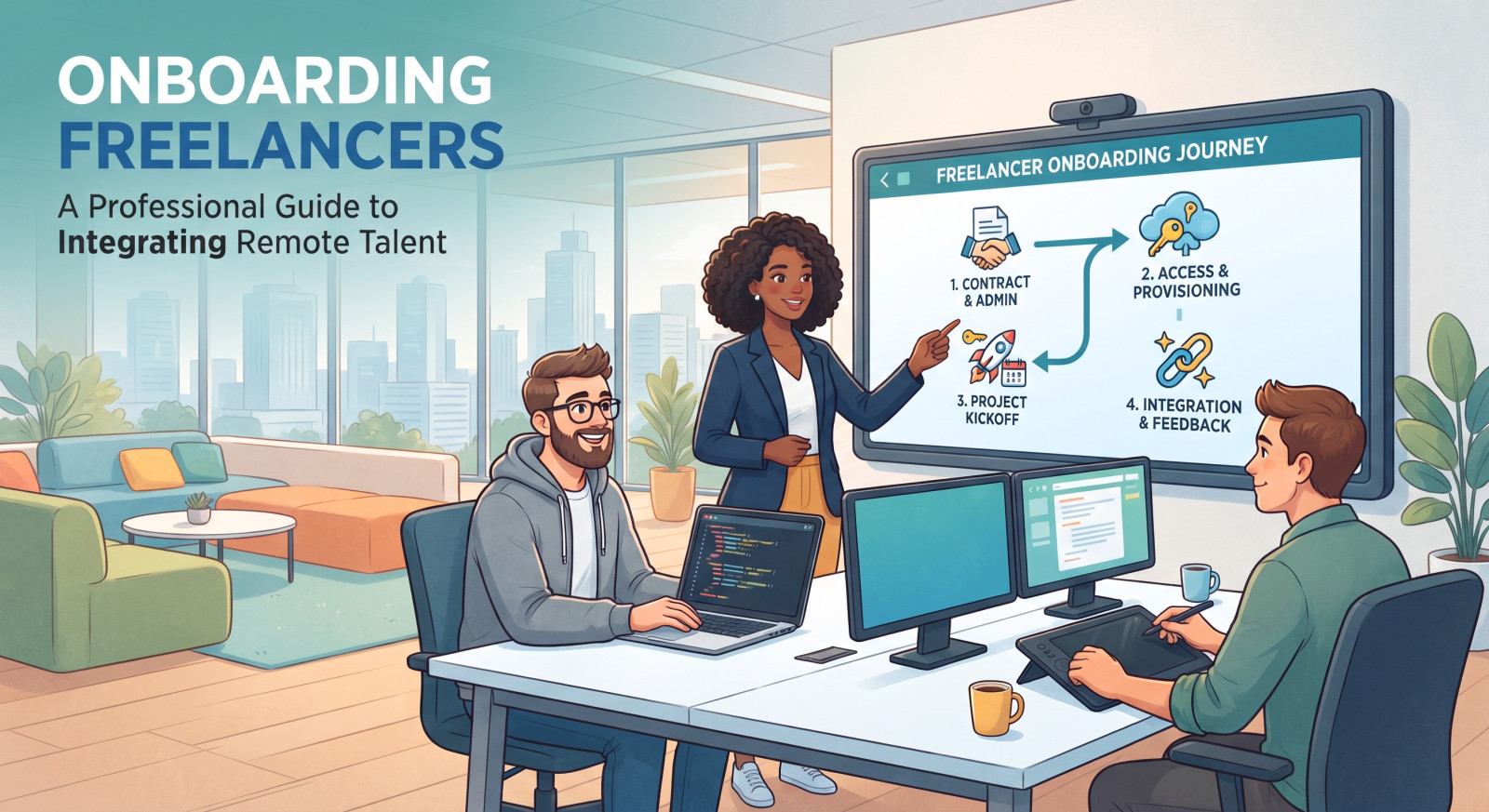
Onboarding Freelancers: A Complete Step-by-Step Guide
1. Overview
Companies are increasingly utilizing freelancers and independent contractors in order to acquire special skills required for particular projects.Recruitment alone is far from sufficient; without a proper onboarding freelancers process, independent contractors might start working without necessary documents, permission to access company data and information about the project and its specifications.
Freelancer onboarding process is a way for companies to determine their responsibilities toward a person they hire prior to the start of work. The onboarding process can include the following elements: contractor agreement, tax and payment documents, access to company systems and processes, communication, project description, deadlines and expectations from the project.
The purpose of this onboarding is not to turn freelancers into employees. Businesses should provide contractors with everything they will require to do their job, but maintain necessary boundaries of access and control over the process.
In the following guide, we discuss all the steps of the onboarding freelancers process for freelancers including pre-boarding and administrative preparations, technical access, communication, project expectations and first project kick-off. There are platforms such as GigMint.AI that can help with some of the onboarding steps.
2. Phase 1: Pre-Boarding & Administrative Setup
Before the freelancer starts working, the organization needs to set up the right legal framework for him/her. It is necessary to decide whether the individual should be contracted as an independent contractor, prepare the contract and obtain all the necessary paperwork.
The contract between the independent contractor and the organization should contain a description of the services provided, payment conditions, scope of work, confidentiality requirements, intellectual property issues, and termination rules. The contract should correspond to the real nature of the working relationship because contractor status depends on the law and the nature of the relationship.
When preparing agreements, you have to differentiate between an Independent Contractor Agreement (ICA) and employment contract. The regulatory framework (Department of Labor rules or California AB5 or federal independent contractor test) looks into worker classification with particular scrutiny.
The ICA has to include a clause stating that the contractor retains control over behavior and finances of his activity, uses personal equipment and works independently. Misclassifying workers in such a way can cost you a lot in terms of audits, back taxes, statutory benefit liabilities, and fines.
Apart from the ICA, there are a few key things you need to consider in advance for the legal preparation for freelancers:
Intellectual Property (IP) Assignment: It is necessary for you to assign IP rights from the very beginning regarding the code, design, copy, or strategy developed during your teamwork.
Non-Disclosure Agreement (NDA): It is necessary to prevent the disclosure of confidential information of business nature, which may include such things as algorithms, customer list, or product development plans.
Financial & Tax Infrastructure
The requirements in payment and taxation should be set up prior to when the freelancer sends the first invoice. The required documents depend on where the contractor is located, where the business is located, and the nature of the job.
If the engagement is related to the United States, the business might need documents such as W-9 form if the U.S. contractor or relevant W-8 form for certain foreign payees. Businesses should consult an expert on which forms are needed in particular circumstances.
Payment terms should be agreed upon beforehand. For example, the agreement should state whether the payment will be per project, per milestone, per deliverable, or according to some other pre-agreed terms. Payment platforms make it easier for both sides to keep track of all of this.
Invoices, milestones, contractor's documents, and international payments are all managed by the platforms.
The "Pre-Boarding" Welcome Package
The time span between signing of the contract and the contractor starting work should be used to prepare the contractor for the project. A quick pre-boarding package would be helpful to eliminate unnecessary questions and let the contractor know what to expect before work starts.
Send the package in advance of the start date, and include in it the information that the contractor is likely to require, including the following:
A greeting from the lead of the project
Methods of communication and expected response times
Information on brand/style/product guides
Links to relevant documentation and resources
An overview of the priorities for the first week
Guidance for logging into their tools and systems
3. Phase 2: Technical Provisioning & Access Control
The Principle of Least Privilege (PoLP)
After the contractor agreement and necessary documentation have been prepared, the next task is granting the freelancer access to the systems and data that he/she will need to complete the project.
Least privilege means granting only those permissions that the contractor needs to perform his/her tasks. A freelance programmer will need access to some particular repository but not the company’s financial reports and internal HR data.
If it is possible, use individual user accounts for contractors, permission settings based on a particular project and role, and review permissions from time to time to delete unnecessary access after the completion of the project.
Tech Stack Integration Checklist
The disorderly start of their interaction with your software system will inevitably cause some operational friction. To ease technical onboarding for these contractors, create a tech stack integration checklist for external contributors:
Communication Tools: Include them in the corresponding Slack or Microsoft Teams channels and set visibility guidelines so that they are not flooded with unnecessary company communication.
Project Management System: Give access to particular boards or epics on Asana, Jira, Notion, Trello, etc., where they are supposed to work on the assigned tasks.
Access to Repository and Source Code Management: Give them permission to access the necessary repositories on GitHub, GitLab, design systems on Figma, and documentation systems on Google Workspace, Confluence, etc.
As a result, by organizing the digital environment properly, you will give your freelancers an opportunity to dive into work right away without searching for links and permissions. The inclusion of pre-flight documentation within these systems will help shorten the transition period as well.
Password Management & Security Protocols
Any external access is bound to increase the attack surface of your business. No compromises can be made regarding security hygiene whether the task is for a long term or not. No passwords should be exchanged through emails or chat applications.
Instruct the use of enterprise password management services (like 1Password, Dashlane, Bitwarden etc.) to transfer credentials of shared apps.
Impose multi-factor authentication for all platforms and software utilized by the freelancer. This way, the need for an authenticator app or security key would render the vast majority of credential stuffing and unauthorized access attempts useless.
When the protocols for security are streamlined and hassle-free to implement, you have nothing to worry about while the contractor operates at full velocity. Make sure to remind them of these protocols during kickoff meetings.
4. Phase 3: Cultural Integration & Contextual Onboarding
Sharing the "Why" (Mission, Vision, and Brand Voice)
When there is no connection to the soul of the corporation in independent contractors, the results will lack context and will not have that certain nuance that makes something truly great.
They will view it as a job rather than a mission that must be undertaken. The process of cultural integration may begin with an attempt at answering an extremely important question: Why does your company exist, and what is its set of values?
Share your brand deck, style guide, and product vision document with your independent contractors.
When a freelance copywriter understands not only what product features you offer but also what problems and psychological drivers motivate your target audience, then the messages that they create will be more effective.
The same goes for developers; when they know the product roadmap of the company, they will create more scalable code.Provide contractors with pertinent information on your company objectives, product, target audience, and communication style.
For instance, a copywriting contractor will be in a better position to create pertinent content when he knows who his target audience is and what the campaign entails.
Developers and designers may also require information regarding the roadmap of the product, and how their involvement affects the whole project. It is important to give enough information to enable contractors to make wise decisions, without burdening them with unnecessary information.
The "Do’s and Don’ts"
Remote contractors might operate across different time zones, and they can even have other customers or professional engagements. Establishing good lines of communication will avoid many conflicts.
Establish how your team is supposed to communicate, how much time your contractors are supposed to spend with you, and what communication channel should be used in case of emergency. Concentrate on deadlines rather than forcing freelance workers to keep up with the company schedule.
Create clear boundaries in order to protect yourself and your contractors:
“First, Asynchronous”: Point out that productivity is more valuable than responding promptly to the chat. A period within which the freelancer should respond (for instance, within 24 hours) should be set so that the freelancer can have some leeway with regard to his/her schedule. Meetings: Indicate whether a meeting is compulsory or entirely optional.
Freelance contractors usually get paid per deliverable, not just for taking seats at the meetings – show respect for their time and keep syncs tightly structured, focused, and limited.
Escalation Mechanisms: Outline who they need to talk to in case they come across any obstacles – technical or project-related – in order to avoid wasting any time on waiting for someone else for help.
"Buddy System" for Freelancers
Even seasoned and highly qualified contractors have their own learning curve as they join a new company's digital ecosystem and political structure. Reduce this transition friction by putting in place a "Buddy System" for the first week.
Appoint a point-of-contact (POC) within the organization—a product manager, a lead designer, or an operations specialist—who will be the go-to person for cultural and operations-related advice during week one.
The function of the POC is not to control the assignments and outputs of the contractor but to provide immediate answers, explain the company slang or abbreviations and make nice phone calls to see how the contractor is doing during these crucial first 48 hours.
The personal element is what makes an otherwise solitary process of working remotely feel like being part of the team, thus minimizing any potential transition problems and earning the contractor’s loyalty in the process.
In order to integrate culture effectively, it needs to be acknowledged that contemporary contractors come from all over the world and are used to multiple time zones and different corporate cultures.
A safe psychological environment promotes the participation of outsiders who can pose questions about conventional thinking and provide fresh perspectives based on their wide experience in the industry.
If the contractors feel valued and accepted culturally, then the participation of the contractors will flow smoothly from being purely contractual to a business partnership.
5. Phase 4: Setting Expectations & Defining Success
Writing Bulletproof Statements of Work (SOWs)
Project scope ambiguity may cause misunderstandings in terms of deliverables, deadlines, revisions, and payments. An effective Statement of Work (SOW) ensures that both parties have a common understanding of the project.
An SOW should outline the deliverables, milestones, deadlines, responsibilities, conditions of acceptance, and revision process. If the revisions are not extensive, specify the amount of revisions that are included in the work and discuss how any extra work will be addressed.
The better the scope of the work is described prior to starting the project, the simpler it becomes to set expectations.
A well-prepared statement of work must not leave anything to chance at all. The SOW must outline what the deliverables, milestones, deadlines, and others are. It should even define the number of revisions that an asset can undergo before it passes as completed, say two revisions max. Through this, the internal team and the contractor will have a shared understanding of success.
Establishing KPIs and Success Metrics
Managing freelancers properly means moving away from tracking time spent to assessing value of the work done. Since you hire a freelancer for a particular result, the way you measure their work must be focused on the actual result achieved.
Create specific KPIs that suit your particular project. If you are hiring a software developer, you can track such parameters as speed of code reviews and bug-free pull requests.In case you are seeking a growth marketer, you might be required to monitor their conversion rates, cost-per-acquisition goals, or campaign deliveries on time.
The Kickoff Meeting Agenda
The final step to move from planning to implementation occurs in the kick-off meeting. This is more than a casual conversation but a structured 30-minute synchronous meeting using the following template to clarify expectations and to start answering some questions:
Introduction & Context (5 minutes): Reinstate the key stakeholders along with the rationale behind choosing a particular freelancer for this project.
SOW Review (10 minutes): Line by line review of deliverables and key milestones.
Process and Tools (5 minutes): Make sure that permissions are in place and go through the communication process (Slack, asynchronous updates).
6. Phase 5: Offboarding & Retention
Secure Offboarding & Access Revocation
As thorough preparation is essential at the beginning of a collaboration, structured offboarding should be implemented at its end. Having your contractor credentials open forever means having tremendous security gaps which are not controlled.
You need to have a structured and comprehensive offboarding procedure:
Access Revocation: Disable guest access, revoke permissions in GitHub or Figma and remove contractors from your internal workspace tools.
Credentials Rotations: Change administrative keys and other passwords used by freelancers in project lifecycle.
Project Archiving: Make sure that all deliverables, working files and code branches are moved into your internal repositories and backups made.
Feedback Collection (Offboarding Survey)
The most professional companies see offboarding as a way of continual improvement. Freelancers give you an independent view of your internal processes, briefing clarity and technical infrastructure.
Prior to offboarding process send a short survey which takes only 5 minutes and includes some important questions:
Was the initial project brief and SOW clear enough?
Were there any technical obstacles and administrative bottlenecks during the first week of work?
What about the effectiveness of your internal point-of-contact supporting your workflow?
Building a Talent Pool
The biggest oversight companies have is regarding freelance workers as single-shot hires. Hiring, evaluating, and training top performers in order to become an employer of choice takes considerable time and effort. Once you have found top external performers, it makes complete sense to keep them available on the “bench” for further use.
Having ongoing connections with those who already passed through rigorous evaluation saves a ton of onboarding freelancers hassle. When the time comes for another project next quarter, the team doesn’t need to go through legal, taxation, and technical procedures from scratch since you already have all of your contractors onboarded. Gigmint.AI is one of those modern solutions that can do just that.
Frequently Asked Questions
1. How much time would a proper onboarding freelancers process take?
A proper onboarding freelancers process should take 24-48 hours from signing the contract to being ready for work on day one. The preboarding paperwork (tax forms, contracts) should be done before day one, but technical setup and kickoff meeting should happen on day one.
2. Which is the most important documentation before onboarding freelancers?
The Independent Contractor Agreement (ICA), which includes IP assignment and NDA, is a must. Along with that, having a verified set of tax forms (W-9 or W-8BEN) is obligatory for legal and financial compliance.
3. How will I ensure there won’t be any security problems when giving freelancers access to our internal tools?
Ensure the PoLP is followed diligently. Issue only guest user accounts and require MFA for all the entry points.
4. What is the difference in the onboarding freelancers process of a full-time employee and that of a freelancer?
The onboarding process of a full-time employee consists of many elements, such as cultural immersion, benefits registration, and career path planning. Onboarding freelancers is mostly concerned with legal considerations (proper classification), scope of work (SOW), and technical least privilege access.
5. How will I avoid scope creep in my relationship with an external contractor?
Scope creep will be avoided through proper drafting of a solid SOW which should include well-defined deliverables, deadline and very strict revision policy (maximum two revisions). Milestone payments will be tied to deliverables.
6. How does Gigmint.AI facilitate the onboarding freelancers process?
Gigmint.AI streamlines the whole contractor lifecycle process using smart contracts, automated tax and compliance documents archiving, role-based technical provisioning, and fast multi-currency payout process in one place.
7. Next Steps with Gigmint.AI
The onboarding freelancers properly executed ensures that the contractor gets all the necessary information and instructions that they require to start working efficiently. The process must cover the essential aspects that are necessary before the contractor starts the first task. These include appropriate documentation, payment methods, access and means of communication, the scope of the project, and success measures.
Businesses may want to check access permissions and documentation during the course of the project and revoke them when it becomes unnecessary.
In case businesses work with numerous contractors at once, it can be convenient for them to use a centralized platform in order to minimize redundancy. GigMint.AI platform can help companies with part of the contractor’s life cycle such as matching talent, project workflow, documentation, and payments.
The best solution here would be to combine proper processes and tools to help to run these processes.