How to Onboard Freelancers Successfully: The Ultimate Guide
How to Onboard Freelancers Successfully: The Ultimate Guide
Freelancing is no longer just a trend, it's reshaping how modern businesses scale. As companies increasingly rely on ai-powered talent platforms and global freelance marketplaces, hiring independent professionals has become a long-term strategy rather than a temporary solution for filling skill gaps
But despite the ability to access world-class freelancers, many companies fail already at the beginning. In the process of integrating gig workers, the manager is prone to making one of two mistakes that can be made: either to drown them in the same bureaucratic training designed for regular W-2 employees, or simply drop them into the water with no preparation at all. In both cases, you will get nothing but high turnover rates, wasted money and missed deadlines.
Finding the right freelancer is only half the battle. A structured onboarding freelancers process is what turns great talent into successful project outcomesWhat you need now is a proper onboarding process to connect this hiring stage and the perfect execution of the project.
For you to realize the highest return on investment from your flexible workers, you require an organized process. In this definitive guide, we are going to show you the best ways of getting onboard freelancers. We will discuss the important pre-onboarding preparations, the important legal considerations in classifying your contractors, the foolproof on-boarding checklist and the major mistakes in managing which you should avoid.
Why a Dedicated Freelancer Onboarding Process Matters
But the temptation to treat them like any other W-2 hire and provide them with the same employee manual and training courses that you would give to any employee in your HR portfolio is understandable yet a highly inefficient and potentially dangerous way to go about things.
Onboard freelancers Workflow is tailored to the specificities of freelance work. It aims to make everything quick, clear and legally sound rather than to immerse the new employee in your corporate culture. And here are three reasons why a dedicated and tailor-made process is absolutely critical for every business.
Speedier Time-to-Value (TTV)
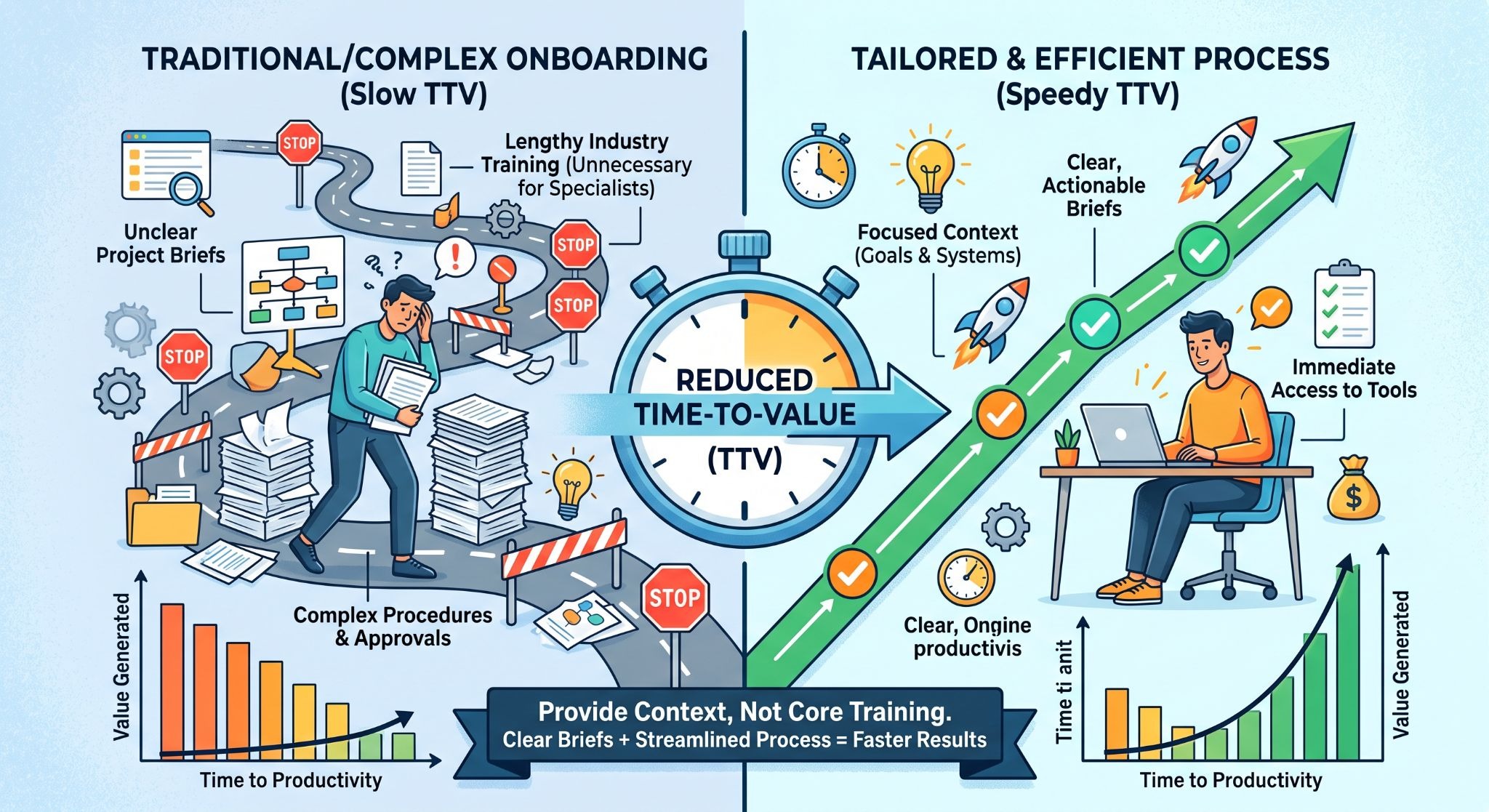
Your reason to onboard freelancers is to solve certain immediate issues, fill skill gaps or speed up a project’s completion. Since it is done to get access to specialized skills, the new worker does not have to be trained in the industry but only needs context. The more time your contractor spends trying to find his/her way through complex procedures and unclear project briefs, the less value he/she creates. So, having a tailored process helps to reduce TTV.
Mitigating Worker Misclassification Risks
From the standpoint of administration and legislation, this might be the most crucial factor for which to separate the onboarding process. The IRS and other global labor boards make an unambiguous distinction between an employee and an independent contractor.
Forcing a freelance worker to participate in mandatory training courses of the company’s behaviors, setting strict requirements regarding working schedule and strictly controlling how tasks are being performed by the worker can easily make you liable for worker misclassification. The special onboarding process for freelancers guarantees compliance with legislation, because it focuses solely on projects’ scopes, deliverables, and brand guidelines.
Long-Term Talent Pool Building
The upper level of the independent workforce is in great demand. Top freelance workers can afford to select their clients, and they leave organizations in case of any disorganization and difficulties. Your onboarding process will serve as a signal about your organization’s professionalism for the freelancer. Making it convenient for onboard freelancers to work with you guarantees that they will continue working with you in the future. Combined with advanced AI-based matching systems such as Gigging.ai, this ensures not only filling of a certain vacancy, but building of a long-term and on-demand talent pool.
Setting the Stage Before Day One
Onboarding can only be considered successful when it starts even before your freelancer records his first billable hours. This is because by prioritizing the pre-onboarding process, you avoid misunderstandings and guarantee that the first day at work is productive instead of just being another day of administrative hurdles.
This is the list of things you need to check before you start.
Defining the Scope of Work (SOW)
The Scope of Work (SOW) will be your guiding star throughout the process. The best SOWs not only define all the necessary deliverables and deadlines but also list what is considered out of scope. This way you protect your budget from the notorious scope creep and give the freelancer enough information to function independently.
Tying Loose Ends with Paperwork
You must first define the legal grounds of your collaboration before any proprietary data is exchanged. It is important for you to set the legal framework of your collaboration to preserve both your IP and the company’s liability. Make sure you have an Independent Contractor Agreement (ICA) signed by the freelancer, which defines the freelance nature of the collaboration, the payment and the ownership of the work. Not to mention, you need a Non-Disclosure Agreement (NDA) if you collaborate with someone who is going to work with your company’s sensitive data. (Disclaimer: Consult your internal legal department or a professional employment lawyer.)
The "Least Privilege" Access Principle
The integration of any external contractors must involve cybersecurity at the forefront. During the provisioning of software, communications, and file sharing privileges, make sure that you strictly follow the least privilege access principle. In other words, give your freelancer access to all the software and directories that are necessary to perform his/her task – and no more than that. Set up a temporary account for your Slack or Microsoft Teams environment and assign a particular Google Drive or Notion directory just for him/her.
Creating a Freelancer Welcome Packet
The freelance welcome guide is totally different from the regular employee handbook. The guide should contain only one to two pages (or even a Notion page) that is meant to serve as a guide. Provide an overview of your branding voice and style, your brand assets including logo hex colors and fonts, and your list of contacts, namely those individuals that the onboard freelancers have to report to and other technical and billing contacts. Last but not least, include your process of payments and what the invoice should look like and how to submit it.
How to Onboard Freelancers Successfully
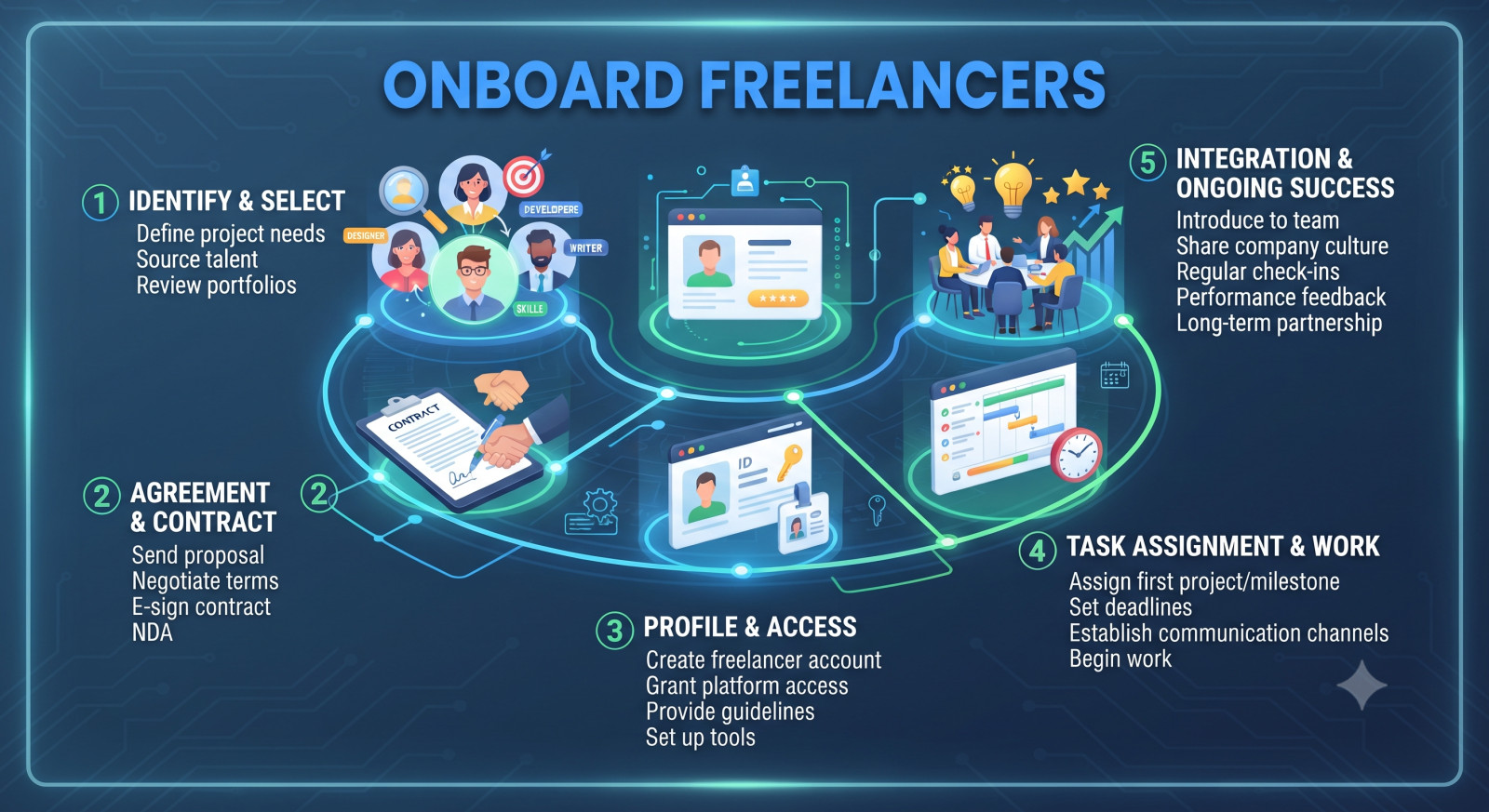
Having completed all the preparations for onboarding before onboarding itself, having signed the contracts and set up access, now it’s time for your first day. This is when you move from preparation to execution. Go through this five step onboarding process and make sure that your new freelancer starts with crystal clear understanding and confidence.
Step 1: The Kickoff Call (Aligning on Vision)
Each and every successful freelancing gig should kick off with a concise kickoff call that lasts about 30 or 45 minutes. Just keep in mind that you are paying the freelancer’s time and you don’t need to spend too much money in this way.
The purpose of this kickoff call isn’t to tell all the details about your organization or politics. Instead, concentrate only on the vision of the project. Talk about its goals, the target audience and what does ultimate success mean for this particular deliverable. Go through Scope of Work (SOW).
Step 2: Establishing Communication Protocols
Onboard freelancers usually have more than one client to serve at a time, having good communication rules becomes an imperative. While onboarding your freelancer, clearly explain your communication standards to avoid any holdups.
-
Single Point of Contact (POC): One thing that kills any freelance work immediately is contradictory feedback from different people. Assign a single person in your team who would act as the ultimate decider and point of contact for your freelancer.
-
Sync and Async Communication: Clearly define the tools for urgent communication and those for asynchronous collaboration so that your freelancer understands how it works.
-
Response Time Expectations: Set realistic response time standards for your messages and feedback to avoid delays.
Step 3: Sharing Brand Context and Guidelines
It was an expert whom you chose to perform a particular job for you, but no matter how good that expert is, it will be impossible for him/her to do his/her work successfully without knowing the nuances of your brand. You have to equip the expert to make independent decisions within the bounds of your brand.
Make sure to provide all information about your brand right at the beginning, including your brand's guidelines, which not only mean the colors and logo of your brand but also the voice, tone, buyer persona, and even previous successful examples from your brand.
Step 4: Setting Milestones and Feedback Loops
If it is an important or a big assignment, then giving the brief to the designer and expecting the finished product after a few weeks from now can be very risky. It should be approached using a milestone-based approach.
It can be divided into smaller stages (for example, a 25% check-in, then a first draft of 50%, and a final edit at 90%). It should be discussed how exactly the feedback process will take place. Is it going to be done through leaving comments on a Google document? Or will a brief Loom video be recorded explaining the necessary changes?
Step 5: Finalizing Payment Schedules
High-end gig workers are entrepreneurs, and they demand to be treated like one. There is nothing worse than a misunderstanding regarding payment. As part of the last phase of onboarding, restate the payment terms agreed in the contract.
Clarify all of the administrative requirements:
Where should the invoices be sent?: through the website portal, by email to accounting)
Which data has to be provided in the invoice?: purchase order numbers)
What is the net payment term?: net 15 days, net 30 days)
Are all of the required tax forms available (W-9 for US workers, W-8BEN for international contractors)?
When freelancers are assured to receive timely and proper payments, they will be greatly motivated to do their job right.
Freelancer Onboarding vs. Employee Onboarding
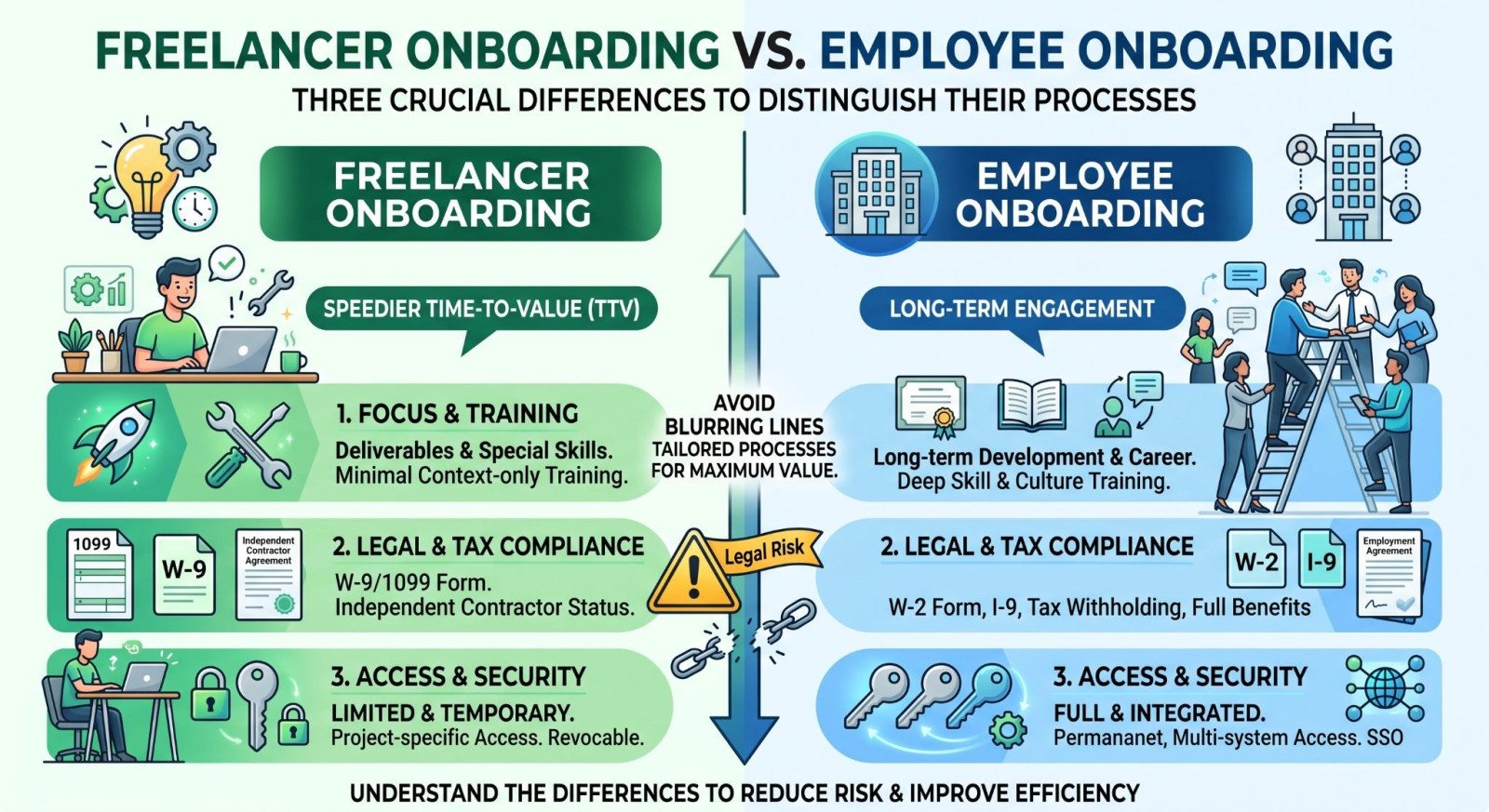
It is unbelievably frequent that companies blur the lines between their regular employees and onboard freelancers. But managing those two groups of people is quite different. Trying to use the W-2 onboarding experience with a freelancer is inefficient; even more so, it can get you into serious legal troubles.
There are three crucial differences that will help you distinguish between freelancer onboarding and regular employee onboarding.
Focus on the Project vs. Focus on the Company Culture
When you onboard an employee, a considerable part of the first week is taken up by immersion into the company culture. You want him/her to know what the company stands for, join some team activities, get used to the way the company is operating long-term.
Freelancers do not have to be immersed into company culture because they are hired just to accomplish one particular goal. The process of onboarding a freelancer has to be focused entirely on project details, brand, and deliverables. Any activity which does not have anything to do with the project has to be cut from the process.
Orientation vs. Training
This makes all the difference legally and operationally. You train your employees, but you orient your freelancers.
Since you hire freelance workers based on their prior skills, you should not be teaching them how to do what they know how to do already. When hiring a graphic designer to work freelance, for example, you do not need to teach him how to use Adobe Illustrator. You orient him within your company’s system. You tell him where to find your company’s logo, how to log in to your project management software, and whom to send the final files to. The need for training may mean employment.
Behavioral Control
Onboarding of employees creates the norms of conduct that must be adhered to, such as working hours and mandatory internal meetings as well as stringent performance reviews. By law, you are entitled to tell the employees how to do their jobs.
For onboard freelancers, you preserve your independence through giving up on control over their behaviors. The onboarding process must honor their independence. While you set the deadlines, the outputs to be delivered, and the quality of output to be attained, the freelancers will have the right to determine their schedule, techniques, and environment in order to meet those objectives.
The Best Tools and Tech Stack for Managing Freelancers
Despite the best onboarding program, your technology must not make things difficult for you. In managing a highly agile and remote workforce, you need a tech stack that facilitates cooperation and transparency. The following are the tools required to properly manage independent contractors.
Project Management Platforms
There's no way to organize the work of external talent through chaotic emails. It should be some place where both your team and the freelancer would see the progress of the project at one glance. Platforms such as Asana, Trello, or Monday.com will do the job. There, you can delegate certain tasks to your freelancer, put deadlines on them and control them via visual representation (via Kanban or Gantt charts) without controlling your freelancer's work day by day.
Communication & File Sharing
It goes without saying that proper, asynchronous communication is the oxygen for freelance management. I strongly suggest Slack Connect. It enables you to add the freelancer into one particular channel without granting him access to the rest of your company workspace.
As for file hosting and management tools, Google Drive or Notion will help. You may upload their "Freelancer Welcome Packet" and brand guidelines following the rule of "least privilege" we've just covered.
AI-Driven Talent Matching (Highlighting Gigming.ai)
There is nothing better that can be done to reduce the onboarding hassle than hiring the right freelancer. If there is any kind of basic misalignment with respect to skills, approach, or expectations, no amount of onboarding process would be able to rectify the situation.
This is where your tech stack has to begin from the very start: Gigging.ai.
Unlike the conventional job board websites which have you wasting hours upon hours searching for misaligned portfolios, Gigging.ai makes use of state-of-the-art artificial intelligence technology to align the freelance talent according to your exact project needs. In other words, with Gigging.ai, your basic onboarding is already taken care of since it ensures complete skill alignment even before signing the deal.
3 Common Freelancer Onboarding Mistakes to Avoid
In spite of having noble intentions, companies tend to destroy the very chances of successful cooperation by screwing up the onboarding process. Thus, it becomes crucial to learn not only how to do something but also what not to do. Below are three mistakes in onboarding freelancers that need to be avoided.
1. "Ghost Employer" Syndrome
In case a manager hires a freelancer, gives him/her the brief, and then vanishes into thin air not answering any questions, conducting check-in meetings, or replying to requests for feedback within weeks, then he/she falls victim to the syndrome known as "ghost employer". A freelancer needs some interaction with a client and support. To get the best possible results, the manager should be accessible, responsive, especially during the first week of a project.
2. Micromanagement
On the contrary to the first type of mistake, in case a manager is controlling every single step of his/her hire, conducting daily status update meetings, and contradicting the expert at each point, then he/she is micromanaging. A freelancer was hired for the reason that he/she is a professional in the field. It is necessary to state what needs to be done, and the deadline.
3. Vague Briefs and Moving Goalposts
One very typical cause for the demise of the working relationship between a freelancer and the client is the so-called scope creep. In this scenario, the client provides an initially unclear brief and starts adding more requests, requirements, and tasks midway through the assignment without changing anything about the pay and deadlines. The end result is mutual dissatisfaction that will make sure the freelancer will never be willing to work with you again.
Maximizing ROI on Your Gig Workforce
Effective onboarding of your freelancers is the difference between an unpleasant experience where things don’t quite line up and a streamlined process that delivers high ROI.
With your gig workers’ workflow segregated from your normal employee hiring processes, respecting legal limits and completely centered on project clarity, you give your independent talents the freedom to perform at their very best.
The best possible onboarding will always depend on making the best possible hiring decisions. Don’t waste precious time searching for ill-aligned candidates on traditional job boards anymore. Learn about the future of talent matching today!
Visit Gigming.ai to source, hire and onboard your next top-tier freelance talent.
Frequently Asked Questions (FAQs)
1.How fast should onboarding for a freelancer be done?
In contrast to conventional employee onboarding, which may take several weeks, onboarding for a freelancer should be incredibly fast. An efficiently designed onboarding procedure usually takes from 1 to 3 days and is mostly an asynchronous one. The major thing about it is to provide them with all necessary context and software access to be able to start working right away.
2.Does a freelancer need a company email address?
Giving a company email address to an independent contractor would be putting their employment status in question and causing worker misclassification. The only exception in case when a freelancer will have to use the company's email is the situation when they will have a very client-oriented job that demands brand white-labeling.
3.What should be included in a freelancer NDA?
It is important that an NDA contract between a freelancer and a company should be detailed about what the confidential company information consists of, how long will the confidentiality period last (i.e., two years or indefinitely if the information concerns a trade secret), and what are the limits of using the information by a freelancer. Seek professional advice when preparing such an agreement.
4. Should I pay a freelancer for their onboarding time?
Of course, in the case when onboarding involves participation and needs some time for it—45-minute kickoff call, studying a lot of proprietary brand guidelines, etc.—they deserve to be paid. It may be done by simply paying them according to their hourly rate or taking into account their time investment in the project's flat-rate.
5. Difference between a 1099 contractor and a W-2 employee?
A 1099 contractor in the US is an individual running their own independent business; he/she pays his/her own taxes, provides all necessary equipment himself/herself and works independently. A W-2 employee is a member of your company's payroll; you deduct the taxes from their salary and have the right to control their behavior and ways of working.
6. How do I track a freelancer's progress without micromanaging?
Only consider the output and not the number of hours that have been put into the work. The most effective way of doing this is to create milestones and deliverable check points within a project management software such as Asana or Trello.
7. Can I invite freelancers to general company meetings?
It is highly discouraged. The freelancers must only participate in those meetings which are going to affect their unique Scope of Work (SOW). Making them come to all-hands meetings, culture-related sessions or department-wide coordination meetings indicates that they are under behavioral control; therefore, there are more chances of them being incorrectly classified as employees.
8. How do I include a freelancer into my internal team?
Inclusion must be practical rather than cultural. The freelancer needs to be introduced to the internal team as an expert hired for the sole purpose of achieving a specific objective. Clearly demarcate their role and give them one internal point of contact within your organization.
9. What happens if a freelancer delivers poor quality work?
Refer to the SOW each time you assess whether the deliverables objectively passed the set standards. In case the work is not up to par, let the independent contractor know about the problems and refer to your contract's revision requirements. If there is a continual problem, consider utilizing the termination provisions in your Independent Contractor Agreement.
10. How does Gigming.ai make the onboarding easier?
The onboarding process becomes much smoother through the use of Gigging.ai because it ensures that you have the perfect match right from the start. You won't have to spend days trying to teach fundamental things to someone who is not qualified enough to understand those things. With the help of Gigging.ai's advanced AI, the perfect match is made for you right away.